What Working Product Team Structure Looks Like in 2026


Product team structure conversations go wrong because teams start by copying operating models instead of asking what kind of decisions the organization needs to make quickly.
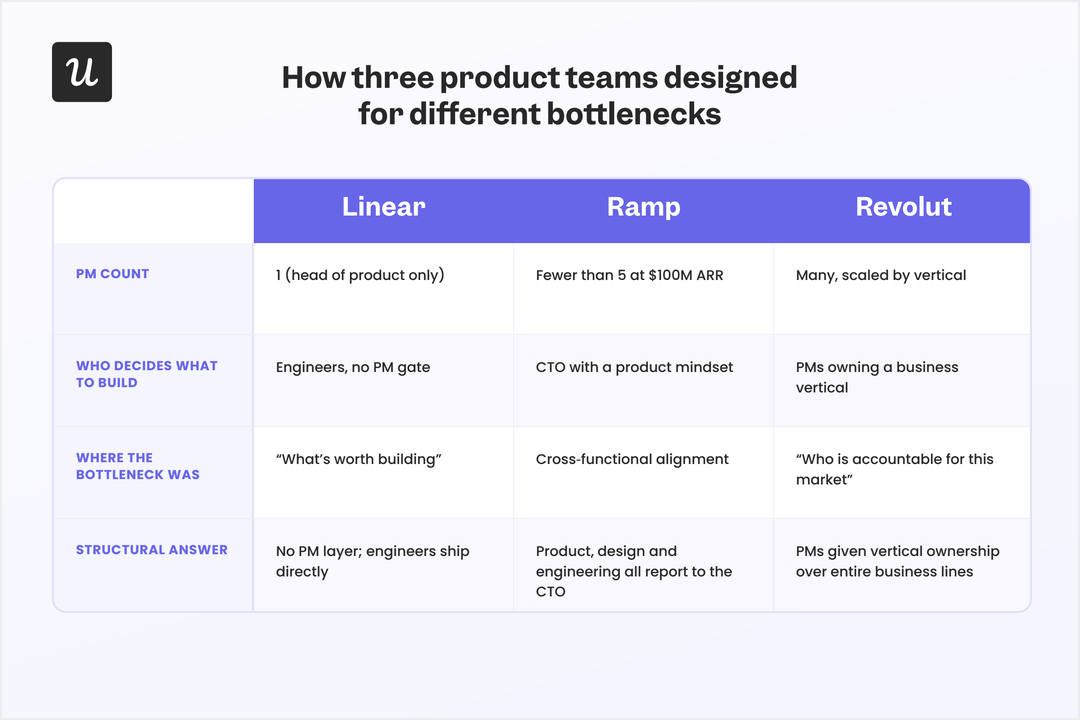
Companies with very different structures perform equally well because what they share is clearer ownership and faster decision-making. Linear runs with almost no traditional PM layer, Ramp scaled to $100M ARR with fewer than five PMs, and Revolut gives PMs ownership over entire business verticals. Their structures barely resemble each other, but as Lenny Rachitsky has documented in his How X builds product series, each one is designed around a specific decision the team needed to make faster.
The same gap shows in the data, too. Productboard’s 2024 State of Product Excellence report found that 70% of large enterprises take one to two months to make strategic product management decisions, and 29% say their product initiatives rarely or never meet the timelines they set. At that point, the structure is part of the product problem.
So in this article, I’ll break down the product team models SaaS companies are using in 2026 and the structural decisions for building efficient product teams.

What’s wrong with the product team structure debate?
The problem with the product team structure debate is that people keep treating structure like a best practice instead of a tradeoff.
You see this all the time when teams argue about whether PMs and POs should be separate roles, whether product should report into engineering, etc. But in fact, most of the frustration is coming from unclear ownership and decision-making.
I think that’s why so many product structure conversations go in circles. Teams copy the visible part, like squads, reporting lines, and titles, without copying the operational reasoning.
I’ll eventually get to the solutions, but let’s first talk about what’s wrong.
Teams optimize for coverage and accidentally destroy ownership
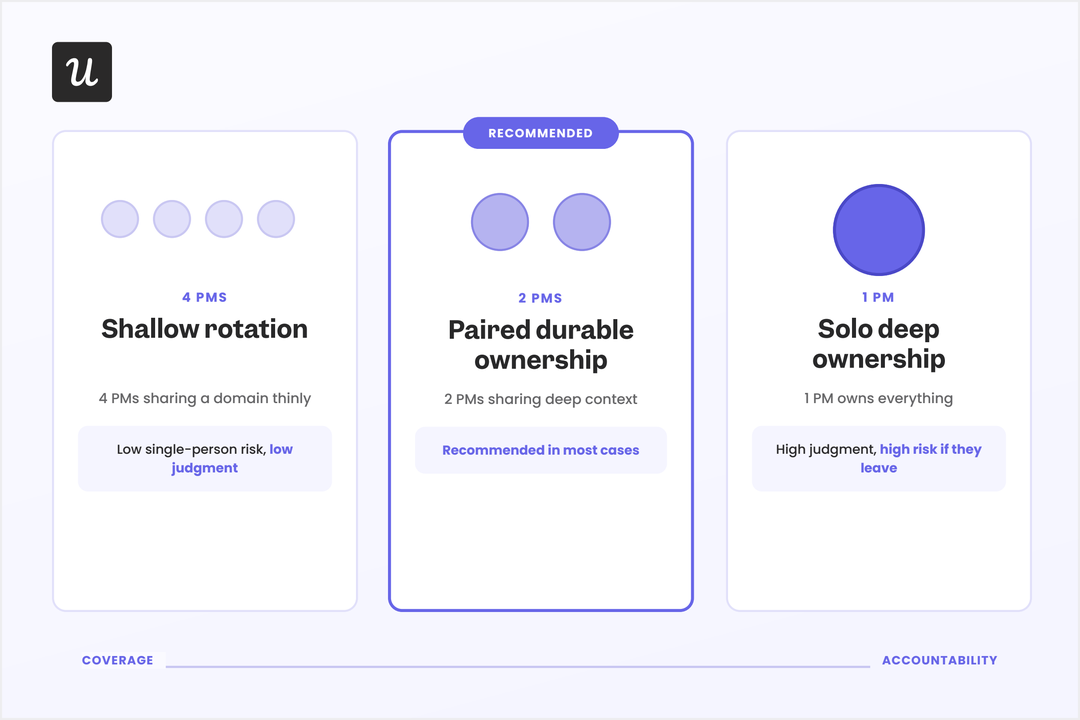
A lot of product orgs are structured around the fear of dependency on one person. So instead of giving PMs ownership over a product area, teams rotate people across projects, split ownership across layers, or spread knowledge as widely as they can. I get the intention behind it, because nobody wants a product to collapse if one PM leaves.
But the tradeoff is shallow context and weak accountability. You end up with PMs who can coordinate work across the org, but don’t really own the long-term quality, direction, or customer understanding of any specific product area.
Product structures become proxies for company politics
What gets me every time is people debating structure like it’s a workflow question when it’s a power question in disguise.
Should product report to engineering, or should PMs own delivery, or should engineering have final say on product roadmap tradeoffs? Each of those is a proxy for who actually gets to shape the product, not a workflow question.
If product and engineering already trust each other, separate reporting lines barely matter, and when they don’t, no amount of org chart rework will compensate for it.
Teams copy structures from companies solving completely different problems
This is the part of the debate that feels the most misleading to me. People look at Spotify, Linear, or Revolut and try to reverse-engineer the org chart as if that’s the source of performance.
Those companies operate at different scales, with different product complexity, different hiring bars, and very different expectations around autonomy. A small B2B SaaS team with one designer and five engineers does not have the same coordination problem as a multi-product enterprise org with platform dependencies across teams.
So when people ask “what’s the best product structure?” the question doesn’t really make sense. They’re comparing organizations solving fundamentally different operational problems.
Should you work in a product trio?
I’d say yes, as long as all three people in it have ownership over their domain.
It’s one of the few structural patterns I’ve seen survive contact with different company sizes, industries, and operating models. Teresa Torres made the case for it in continuous discovery, and Marty Cagan has built outcome-driven product teams around it for years.
That said, there are two ways teams get this wrong.
The first is leaning on the IDEO viability, desirability, and feasibility map, with PM on viability, UX on desirability, and engineering on feasibility. In practice, the lines overlap so much that the question stops being “who owns desirability” and becomes “who is in the room when we decide what problem we’re solving.” If the engineering lead joins after someone has written the brief, you’ve built a relay race and labeled it a trio.
This is also where titles get in the way. Some “PMs” are project managers running tickets, and some “UX designers” are UI designers handed mockups to skin. A trio between a project manager, a UI designer, and an engineer rotating on tasks is not the same operating model as a PM, a product designer, and an engineering lead framing problems together, even when both show up on the same org chart under the same label.
So if you’re deciding whether to work in a trio, stop asking “do we have three roles?” The question should be whether those three people are shaping the problem together before anyone commits to a solution. If they are, the title under each box matters a lot less than this debate suggests, and if they aren’t, you’re running handoffs and calling it a trio.
How else should you structure your product team?
My answer is that you should structure your product team as a response to how your team makes decisions. Among various product management frameworks, there are four moves I think matter most.
Design around the decisions
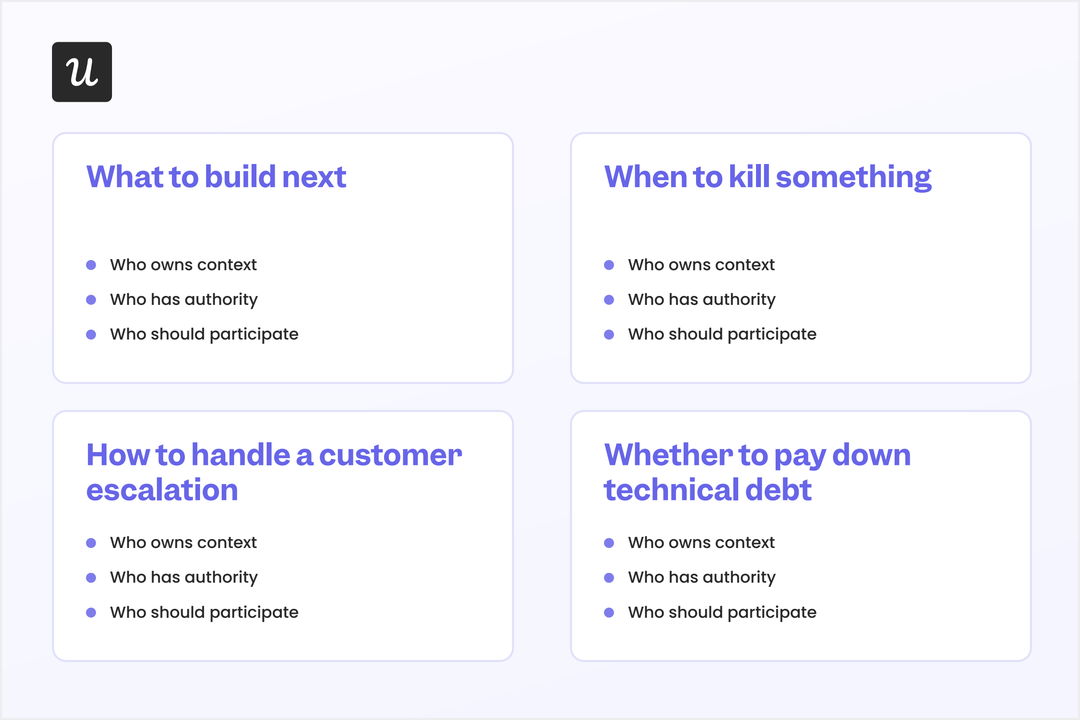
Before you draw a single reporting line, write down the three to five decisions your team needs to make faster. Common ones include what to build next, when to kill something, how to handle a customer escalation, and whether to pay down technical debt.
Then design the structure backward from there by determining who has the context, who has the authority, and who needs to be part of the product conversation.
This is the part Linear, Ramp, and Revolut have in common. Linear gave engineers the authority to ship without a PM gate because their bottleneck was “what’s worth building,” while Revolut gave PMs vertical ownership because theirs was “who is accountable for this market.” They ran the same exercise and ended up with completely different answers.
Most reorgs I’ve seen tend to skip this step. Teams move from squads to matrix to outcome-based and back, without writing down what slowed them down in the previous setup. That’s why the next structure looks different on the org chart and behaves identically in practice.
Give each PM ownership of a domain
This is my answer to the “what happens when the one person who understands a product leaves” problem. The fix isn’t to spread ownership so thin that nobody has any, but to pair PMs within a domain so that two people share the context, rather than four people sharing it superficially.
That can mean two PMs jointly owning a product area, or a senior PM overseeing a broader domain while another PM owns a specific workflow, user persona, or use case underneath it. The important part is that someone develops a durable context for the customer, the product behavior, and the long-term direction of that area, instead of rotating between disconnected initiatives every quarter.
On my own team, this is what made the difference. When we launched the email feature at Userpilot, I owned that part of the product end-to-end. While monitoring our conversion funnel analysis, we noticed a sharp drop at the domain verification step.
Because I’d been close to the data for months, I could see within a few hours that the issue was in-product friction, not engineering. I deployed in-app guidance using a targeting tooltip and a checklist directly inside Userpilot to walk users through the right steps. Drop-off rate closed within days, with no engineering ticket required.
I don’t think I’d have moved that fast if I’d been rotating across three product areas at the time. That’s the thing about durable context. You don’t catch the small operational fixes that close 20% drops if you’re only in a product surface for a quarter.
I also think this changes PM behavior for the better. As AI absorbs operational work, applying strong product thinking and strategic judgment becomes the ultimate differentiator is increasingly judgment, market understanding, and decision quality. You don’t build that kind of judgment by spreading PMs across five unrelated product surfaces at once.
Be careful about splitting PM and PO unless you have a clear reason
I’ve seen a lot of companies introduce separate PM and PO roles because it sounds cleaner organizationally. Strategy stays with the PM, delivery stays with the PO, engineering gets a more dedicated counterpart, and everyone becomes “specialized.”
But in practice, this is where a lot of product orgs accidentally create handoff culture again.
Without clear product communication, a lot of PM/PO setups end up creating too many hands on the steering wheell. Prioritization slows down because strategy, delivery, and technical tradeoffs are split across different people who all partially own the outcome.
That doesn’t mean the split never works.
In larger orgs with multiple product lines, regulated environments, or heavy operational complexity, separating strategic ownership from delivery coordination can make sense. Especially when the delivery layer itself becomes a full-time operational job.
But I think teams should treat the PM/PO split as a response to a specific scaling problem, not as a default “mature” product structure.
Because once product strategy, customer context, and delivery execution get separated too aggressively, the organization usually starts compensating with more meetings, more documentation, and more alignment overhead just to reconnect the context that used to live in one person.
Use feature teams or divisional structures only when your product areas are genuinely separable
Feature teams make sense when the product has stable, separable areas that rarely require coordination across team boundaries. The risk is that customer journeys span features, and when they do, ownership falls between teams with no clear resolution mechanism and no one accountable for the end-to-end experience.
Divisional structures make sense when your market segments or business units have genuinely divergent needs, and the organization can sustain separate product lines without creating dependency conflicts. Most companies that default to either of these models do so because the structure is familiar, either mirroring a previous company or reflecting how the product was built technically.
Product depth, the organization’s growth stage, and reporting structure are better selection criteria than familiarity. The gap between picking by familiarity versus picking by criteria compounds over time, and it shows up as coordination problems at the seams between teams, rather than as a visible structural failure.
What are the deciding factors for picking the right product team structure?
Regardless of the model you use, you should be questioning these three questions before going after any model or structuring advice.
How close the product sits to the CEO in the reporting chain
The first thing to look at is how many people sit between the head of product and the CEO. In my experience, the closer, the better.
When a product team gets buried under IT or Operations, the work turns into project management, and you lose the standing to push back on engineering or sales when priorities conflict.
Take the product team at Ramp. Product, design, and engineering all report to the CTO, and somehow it works, because their CTO thinks like a product person and is making product management decisions.
But that doesn’t copy. Swap him for a CTO whose job is uptime and velocity, and the same structure becomes a trap where the product stops driving decisions and starts scheduling engineering’s work.
That’s why the CPO title and the combined CTPO keep showing up in bigger companies. Product gets its own seat at the executive table without depending on whoever happens to be running tech.
The catch with the CTPO is that the person doing the job usually came up through one side or the other. Whichever side they came from is the side that wins when there’s a conflict.
So before you build the org around a CTPO, ask which way they lean. That’s the direction your company will lean too.
Whether Product Ops functions as an enablement team or a compliance layer
Most Product Ops setups I’ve seen start with a good mandate and slowly become the process police. You get Jira fields nobody fills in, GTM checklists nobody reads, and weekly reporting templates that eat half a PM’s day. It’s bullshit work, and the kind of “fAgile” that adds ceremony without changing how the product actually gets made.
Good Product Ops is the opposite, because it’s there to make PMs faster, not to enforce process on them. That means coaching on discovery, fixing the feedback loops between product and customers, and clearing the operational mess around launches.
If you’re not sure which side yours is on, ask whether it unblocks things or whether it makes you write a doc to do something that didn’t need one. You can skip the function entirely until you’ve got three or more product squads, because below that, the work it would do still fits inside a PM’s job.
Giving PMs the data to decide faster!
You can debate org charts forever, but if your PMs don’t have visibility into what’s being used, abandoned, or stuck in the product, the structure conversation is mostly academic. Most of the structural friction I’ve seen, like handoff culture, slow prioritization, and weak ownership, gets worse when the people supposed to own a domain can’t see what’s happening in it.
The PMs I know who own their domains well don’t wait for a quarterly data pull to know what’s happening. They have feature usage, product health, and user feedback in front of them every week, and that’s why the structure they happen to be in starts to feel less limiting.
That’s the part Userpilot is built to fix. Userpilot user analytics gives PMs the funnel data, feature adoption signals, and feedback they need to own a domain, instead of just organizing it. If your team structure conversation is really a decision-speed conversation in disguise, that’s a better place to start.

Book a Userpilot demo to see what your PMs would have on their domain in the first week.
About the author