How Liv-ex Transformed Product Decision-Making with Data-Driven Insights and No-Code Tools



Liv-ex is the exchange for fine wine, market data, and insights. The platform grants wine professionals the ability to price, buy, sell, and transact through one point of contact.
| ⚙️Challenges | Lack of data clarity and ways to quickly act on insights often force product teams to rely on guesswork or delay decision-making. And when users’ needs go unanswered, customer relationships end up at risk. Liv-ex needed a solution for more data-driven product roadmapping. |
| 🏆 Solutions | ✅ Liv-ex product team refined product roadmapping by combining Userpilot’s quantitative analytics with targeted qualitative feedback, turning data into action points. They reduced developer dependencies, labeling around 95% of events alone. ✅ With paths and funnels, they uncovered inefficiencies in user navigation that have driven UX improvements across the whole application and boosted its ease of use. ✅ Switching from generic surveys to behavior-triggered feedback improved feedback quality and resulted in an over 70% response rate. ✅ The product marketing team can set up onboarding and feature walkthrough without writing a single line of code. |
Challenges: Limited data visibility, insufficient feedback, and high developer dependency
Liv-ex’s product team wanted to ensure that their trading exchange meets current standards and that members can easily navigate across the platform. This drove them to search for a user analytics and engagement tool that can help with the following challenges:
- Limited visibility into user behavior: Before Userpilot, the Liv-ex team struggled to understand how users navigated their complex platform. While they had basic click logging and Power BI dashboards for reporting, they lacked the tools to easily analyze user behavior and use the insights to guide their work.
- Lack of efficient product marketing toolset: The product marketing team needed a no-code solution to deliver onboarding tours and feature announcements without relying on developers.
- Hard-to-action user feedback: Liv-ex has been running surveys within their product, but their previous provider lacked advanced segmentation and targeting. They could only show the surveys to all users or a random subset. This blanket approach resulted in lower-quality feedback since not all users were equally engaged with the measured features.
Solutions: Easy product analytics, targeted engagement, and behavior-triggered feedback
When evaluating the providers, Fred Haselton, Product Manager at Liv-ex, prioritized two jobs:
“We were looking for a way to deliver customer enablement material seamlessly using no-code solutions, as well as being able to analyze usage patterns and flows. Our goal has been to improve product adoption and user engagement, and to get actionable data to improve the product.”
Userpilot turned out to be the only platform excelling in both aspects without breaking the bank.
Fred was also impressed by Userpilot’s ease of setup. “The ability to set up a suite without months of planning and setting up” was a decisive factor. The clean analytics interface and no-code event tracking meant the product team could move quickly and independently.
Analytics for understanding user workflows with no-code event tracking
Liv-ex implemented Userpilot’s analytics suite to track how users move through the app. The paths and funnels features (correlated on custom dashboards) became essential tools for understanding user journeys and identifying friction points.
“Being able to set up dashboards quickly to track new feature adoption is incredibly helpful. After a minimal amount of setup, I can get in there, understand what’s being underutilized, and where we’re seeing great engagement. Thanks to trends and funnels, I can also get immediate insight into whether we need to improve a feature or increase adoption via member enablement and product marketing.”
The platform’s no-code event tracking allowed Fred to label most events himself using the visual labeler, with minimal developer involvement.
“90 to 95% of event labeling was done by me in a pretty short time for a pretty large website.”
In-app engagement for better user onboarding and new feature announcements
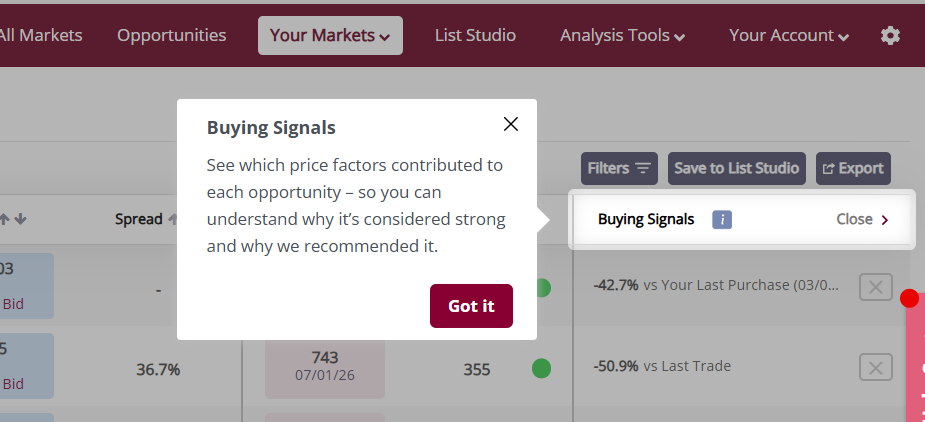
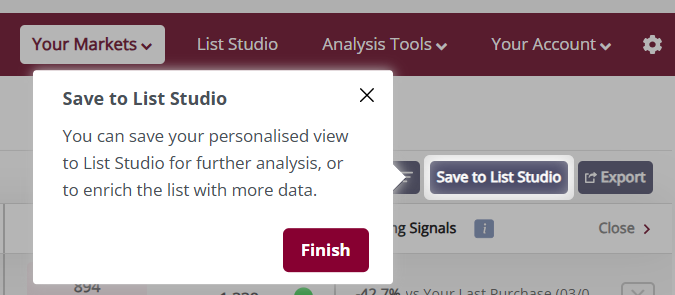
The product marketing team now uses Userpilot to create onboarding flows, banners, and spotlights that reduce reliance on email communication and account management resources.
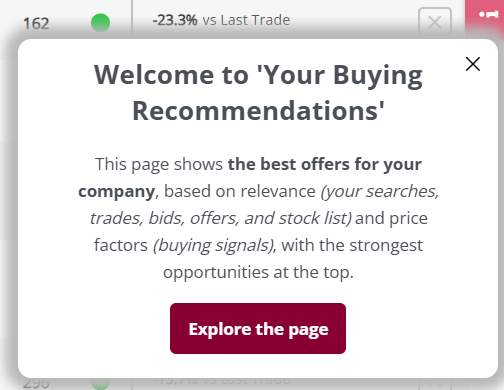
“We’re able to create tools and journeys to help people at the start of their journey, and reduce the need for our account management team to spend a huge amount of time onboarding.”
For new feature releases, contextual banners and spotlights allow the team to highlight updates directly within the product, reducing the amount of sent emails and saving development time.
Behavior-triggered surveys to collect the right feedback from the right users
The shift from blanket surveys to behavior-triggered feedback transformed the quality of insights Liv-ex receives. Fred’s team now sends surveys prompted by specific user actions after new releases. This ensures responses come from users actively engaging with relevant features.
Session replays for decision validation
When launching new features, the team uses session replays to observe real user behavior and validate feedback:
“We can watch individual sessions of people who left their feedback to understand how they were using the feature, how we could improve, or potentially how we could improve our training to ensure user success.”
Results: Faster iterations, UX redesign backed by data, and increased feature adoption
Thanks to Userpilot, Liv-ex can now easily track both qualitative and quantitative data in one platform. Product and marketing teams independently act on all the collected data by setting up relevant user flows and making data-driven roadmap decisions.
This would have been impossible with a fragmented toolset: moving various data points between different solutions would require developers’ help, and that equals increased time and budget and, ultimately, delayed time-to-value for the whole userbase.
Data-driven UX redesign
Userpilot’s paths feature revealed that many users would go from the search bar to search results to individual wine pages every single time, even when their search was specific enough to bypass the middle step.
This insight led to a fast UX improvement:
“When those users in the search bar actually were specific enough in their search, we just take them immediately into that page rather than having to go through steps.”
More significantly, the insights from user path analysis have provided the foundation to start a complete redesign of the exchange feature:
“Understanding how users move around has led to us ripping up the current designs and creating something brand new.”
Higher-quality user feedback
The shift to targeted, action-triggered surveys dramatically improved both the quantity and quality of feedback. Liv-ex surveys now reach 70% completion rates.
“When we moved to that targeted serving of these pulse surveys, we found particularly the qualitative responses a lot more in-depth and a lot more thought about, as it’s completely fresh in their mind.”
Faster feature iteration
By combining product analytics with user feedback and session replays, the product team can now validate hypotheses quickly and iterate with confidence. As Fred told us, “Just having that insight of exactly who’s using it, then having the actual data to back it via the survey, and then being able to go back to validate and iterate is really helpful.”
Reduced development dependencies
The no-code approach to both analytics setup and in-app engagement reduced the need for engineering resources. The product and marketing teams can move faster and more independently, whether it’s about setting up a tour for a newly added feature, measuring the feature’s performance right after it’s implemented, or reacting to users’ feedback.
Combining quantitative and qualitative data for confident product decisions with Userpilot
Liv-ex’s success with Userpilot showcases how you can combine quantitative and qualitative data and set up a workflow that improves product decisions and user adoption:
- No-code implementation enables teams to move quickly without heavy developer involvement.
- Onboarding tours, new feature announcements, and walkthroughs improve user experience and product adoption.
- Paths and funnels reveal how users navigate the product and where they experience friction.
- Behavior-triggered surveys capture feedback from the right users at the right time.
- Session replays validate and contextualize both quantitative data and user feedback.
As Fred summarizes:
“If you want to understand your customers’ workflows, identify opportunities for improvements in UX, and find ways to advance your products through the use of data, go for Userpilot. And if you want to serve customer enablement materials in dynamic ways and get actionable feedback to best answer to your customers’ wants and needs? Userpilot will help you there, too.”
About the author