Mobile App Engagement: 12 Strategies to Engage Users

Mobile app engagement is the most important metric product managers should focus on when designing their apps.
If you look at the data, only 26% of users return to an app after the first day, and just 7% are still active after 30 days.
That’s what you’re up against when you launch a mobile product. And in most cases, it’s not because the product is broken. It’s because users don’t get to value quickly enough or don’t build a habit around it.
Engagement has to be designed into the product from day one, starting with onboarding and continuing through every feature a user touches.
In this guide, I’ll walk through eight strategies we’ve used at Userpilot to increase mobile app engagement and foster customer loyalty across mobile products.
What is mobile app engagement?
Mobile app engagement refers to how users interact with your app interface over time. It includes behaviors like opening the app frequently, completing actions, exploring features, and responding to in-app messaging or push notifications.
Engagement is multi-dimensional. It covers how often customers use the app, the length of each session, and the features they use. In this way, high mobile app engagement is often linked to better user retention and product adoption.
Why is mobile app engagement important?
I use engagement data to spot real patterns: what users care about, where they’re dropping off, and which features quietly succeed without fanfare. It’s the difference between guessing and knowing what to build next.
- Improves user retention: The more users engage with your app, the more likely they are to stick around. And retaining users is far more cost-effective than trying to grow your monthly active users from scratch.
- Generates richer behavioral data: When users interact consistently, you collect meaningful behavioral insights. These signals, along with direct user feedback, help identify friction points, prioritize product improvements, and personalize experiences.
- Enables smarter product decisions: Strong mobile app engagement fuels mobile analytics. With reliable data, you can measure mobile app engagement, evaluate feature performance, optimize funnels, and increase feature engagement with confidence.
- Boosts feature discovery and usage: Engaged users explore more of your app’s functionality. This improves adoption rates for new features and helps existing users realize more value from your product.
- Supports organic growth loops: Active users are more likely to share your app, invite teammates, and leave positive app store reviews. They become product champions who drive growth without added cost.
12 Strategies to increase user engagement on mobile apps
With over 5 million apps across Android and iOS in the app market, users have plenty of options, but few reasons to return. The average 30-day retention rate is just 5.7%, meaning 94.3% of users churn within a month.
Mobile app engagement may not be just a design problem. It can be a psychological one. You’re shaping habits, nudging behavior, and competing for attention in a crowded market.
So, how do you do that?
My team and I pulled together 12 strategies that have worked across real mobile products, so you can drive mobile app engagement and build stronger user engagement metrics.
#1 Optimize user onboarding
Your onboarding flow determines whether new users reach activation or abandon your app before they see its value. Make it as quick and painless as possible.
Optimizing mobile user onboarding means showing only the absolute minimum actions users need for setup. Showcase the absolute must-use features first.
For longer app onboarding flows, clarify what should be done in what order. Let users know which steps are obligatory and which are optional. If there are multiple steps, break them down so users can follow them easily.
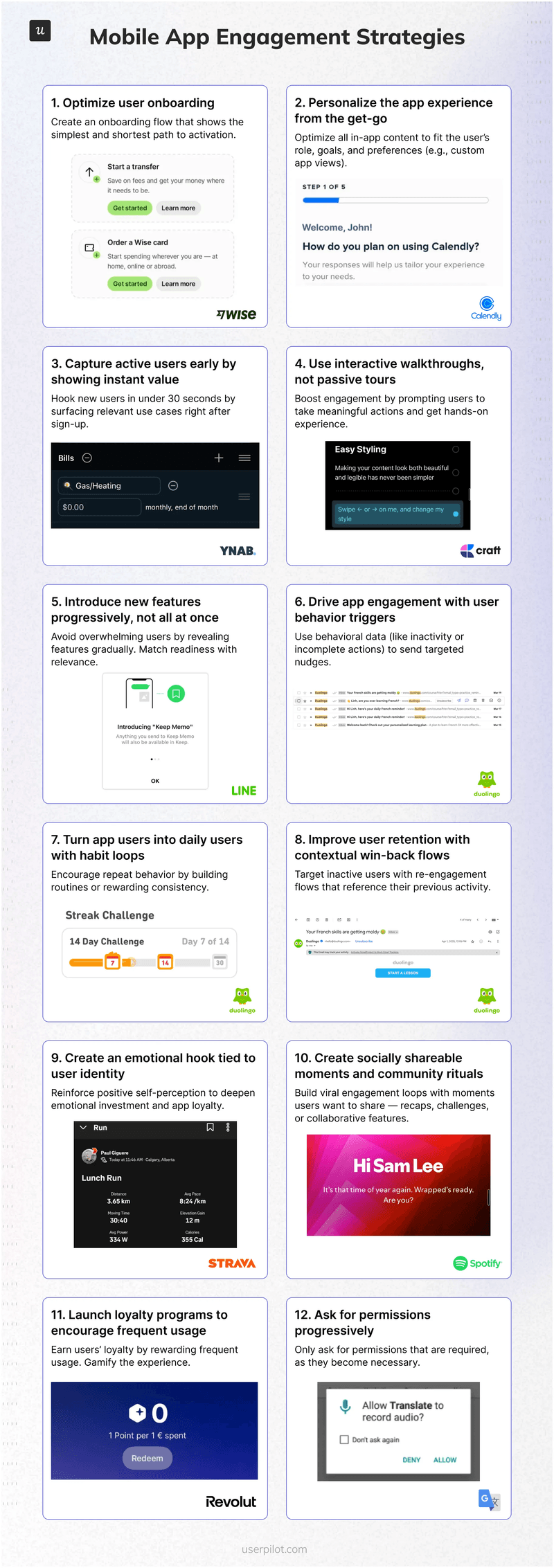
Wise is an excellent example here. On the home screen, new users see a clear list of onboarding tasks, each presented as a separate card. You can tackle them one by one, in any order you prefer. Each task includes a brief explanation of why it matters and two clear CTAs: “Get started” for immediate action or “Learn more” for context.

#2 Personalize the app experience from the get-go
Users expect your app to answer their needs immediately and show only what’s relevant to them. Therefore, tailor your UI setup and content to their role, goals, and use cases.
You can implement this approach by collecting the relevant information during onboarding. Ask a few targeted questions in a welcome survey, then use those answers to build custom views. You can also personalize in-app messaging using metadata like the user preferences, name, or role.
Take Calendy, for example. During their onboarding flow, they ask users how they plan to use the app (on their own or with a team). This single question allows them to customize the entire app experience. Solo users may see features like personal booking links, while teams see features like workspace setup or team scheduling.

#3 Capture active users early by showing instant value
The first session is your best opportunity to demonstrate your app’s value.
If users have to figure things out on their own, they’re likely to drop off. That’s why the most effective apps can deliver results within the first 30 seconds.
YNAB does this well. As soon as you open the app, it asks you to set a few basic spending targets. You don’t need to enter detailed amounts, just estimates. Within seconds, you’re already personalizing your budget and moving toward a meaningful first outcome.

Fitness apps follow a similar approach. After asking for your top goals, they generate a custom routine immediately. This shortens time-to-value and helps users feel like they’re already making progress.
You can apply the same principle using mobile carousels in Userpilot. These full-screen, swipeable screens let you guide new app users through setup steps, ask a few key questions, and tailor the experience based on their goals or preferences. It’s one of the simplest ways to create a personalized customer experience right from the start, no developer work required.
#4 Use interactive walkthroughs, not passive tours
Instead of walking users through static tooltips or swiping through generic intro screens, use interactive walkthroughs to help them complete real actions inside the app. When users engage with your product, they invest. And when they invest, they’re more likely to stay.
Examples of meaningful interactions:
- Tapping to customize a dashboard layout.
- Dragging items to reorder a playlist.
- Typing a quick note to save progress.
Craft’s onboarding flow on iOS shows how to do this well. The walkthrough invites users to experiment with styling and interact with formatting tools in real-time, rather than just explaining what’s possible.

This kind of hands-on guidance improves product understanding and increases app engagement metrics like activation and average session length.
At Userpilot, we help teams build code-free interactive walkthroughs that guide users step-by-step through your mobile app’s core features. It’s one of the most effective ways to drive early feature adoption and reduce friction without overwhelming new users.
#5 Introduce new features progressively, not all at once
One of the most common mistakes in mobile onboarding is trying to show everything at once.
When users are flooded with too many options, they often disengage entirely, a behavior known as choice overload. Instead of feeling empowered, users feel overwhelmed and unsure of what to do next.
That’s why it’s better to reveal new features gradually, based on behavior and context. For example:
- Show collaboration tools only after a user has created two or more documents.
- Unlock advanced filters after someone completes a few basic searches.
- Introduce premium dashboards once users have explored the default one.
LINE demonstrates this well. It introduces its “Keep Memo” feature right when users are interacting with the Keep section, when the feature is most relevant.

You can build the same experience using behavior-triggered slideouts in Userpilot, which app developers can implement with minimal effort. These allow you to launch in-app messages when a specific condition is met, like reaching a goal, performing an action, or visiting a particular screen.

This kind of in-app messaging improves feature discovery and supports user satisfaction by reducing cognitive load. And because you’re aligning messaging with behavior, you can track the impact through key metrics like click-through rates, usage frequency, and retention curves.
#6 Drive mobile app engagement with user behavior triggers
One of the most effective engagement strategies to increase mobile engagement is to use behavioral triggers for your push notifications. These can be delivered through email, in-app messages, or on-screen notifications.
They’re most effective when timed to key points in the user journey, like post-onboarding drop-offs or skipped features.
Behavioral triggers let you engage users based on what they do, or don’t do.
- If a user views a feature but doesn’t activate it, you can follow up with a tooltip or targeted in-app prompt.
- Also, if someone hasn’t opened the mobile app within three days of signing up, trigger a reminder via in-app notification or email.
- If they complete onboarding but skip a core workflow, send a contextual message tied to that drop-off.
One of the best examples came from Duolingo. After I reinstalled the app, I received a series of behavior-based emails over two weeks. Each message landed in the afternoon, tailored to my timezone, and referenced my inactive French lessons. The tone evolved from light nudges (“Your French skills are getting moldy”) to more reflective prompts (“Am I coming on too strong?”), before eventually stopping.

The final email admitted defeat: ‘These reminders don’t seem to be working.’ They knew I was a lost cause.

With Userpilot, you can build these flows using real-time user behavior data and launch them across mobile and web apps without writing any code.
#7 Turn app users into daily users with habit loops
Habit loops help you build mobile app engagement by reinforcing small, repeatable actions. The pattern is simple: a clear trigger, a low-friction action, and a quick reward. Do it right, and your product becomes part of the user’s routine.
Apps like Duolingo use this well. A five-minute streak is easy to commit to, but hard to break when missing a day resets your progress.

The key is frequency. Notion nudges you to review your daily task list, and Calm reminds you each evening to reflect or unwind. These also encourage users to form a daily rhythm with your app.
You can create similar flows using time-based push notifications. With Userpilot, you can trigger reminders based on behavior or schedule, and link them directly to key actions using deep links.

It’s a simple way to guide your app users back into your mobile app at the right moment, and keep them coming back.
#8 Encourage repeated app usage with contextual win-back flows
A generic “We miss you!” email won’t bring disengaged users back.
To improve mobile app retention, the messaging has to feel relevant to where the user left off. This is especially important when re-engaging inactive users who haven’t interacted with the app in days or weeks. Contextual win-back flows use behavior data to make that happen.
For example:
- If someone dropped off after using a specific app feature, show them what’s new or improved in that area.
- Highlight fresh and personalized content that aligns with what they last viewed.
- Offer something new, like a template, challenge, or exclusive update tied to their previous usage.
In my case, I had been learning French in Duolingo before uninstalling the app. When they tried to win me back, every email was focused on French content, reinforcing what I had previously shown interest in.

That level of personalization in the user interface makes a difference. It feels like a continuation of my journey, not a generic retention play. To improve win-back flows, you can also collect user feedback at the point of re-entry, either through a short in-app survey or a feedback prompt.
With Userpilot, you can build flows like this using real user behavior. Set conditions based on drop-off points and trigger personalized messages that reflect what users cared about last.
#9 Create an emotional hook tied to user identity to boost customer loyalty
Apps with long-term engagement often reinforce who users want to become, not just what they want to do.
Strava doesn’t just track workouts. It assigns goals, displays badges, and highlights achievements across user feeds. These elements turn regular running into a shared identity. You’re not just tracking a run. You’re part of a community of athletes working toward visible milestones.

Headspace nudges users to reflect daily, framing the routine as part of being mindful and grounded. Duolingo builds language streaks into the UI and uses gentle gamification to encourage consistency. Missing a session feels like breaking a promise to yourself.
These apps are designed for identity. They use behavior, content, and recognition to make progress feel personal.
What does your app help users become? And how can you reflect that through the interface, achievements, or personalized nudges?
#10 Create socially shareable moments and community rituals
Some of the most effective mobile app engagement strategies I have seen include shared experiences and fostering an in-app community.
When you give users something worth talking about, you create momentum that extends beyond the app. These app experiences feel like personal wins, but they’re designed to be visible.
Spotify does this exceptionally well. Every December, millions of users look forward to their Spotify Wrapped summary. It’s personalized, visual, and made to be shared.

Smaller interactions matter too. Features like Music Blend, pop quizzes, or listening stats give users more ways to connect with friends around content they already enjoy.
Strava taps into this dynamic with its community challenges. From 5K badges to pro-athlete collabs, the app gives runners reasons to stay engaged and reasons to share that progress publicly.
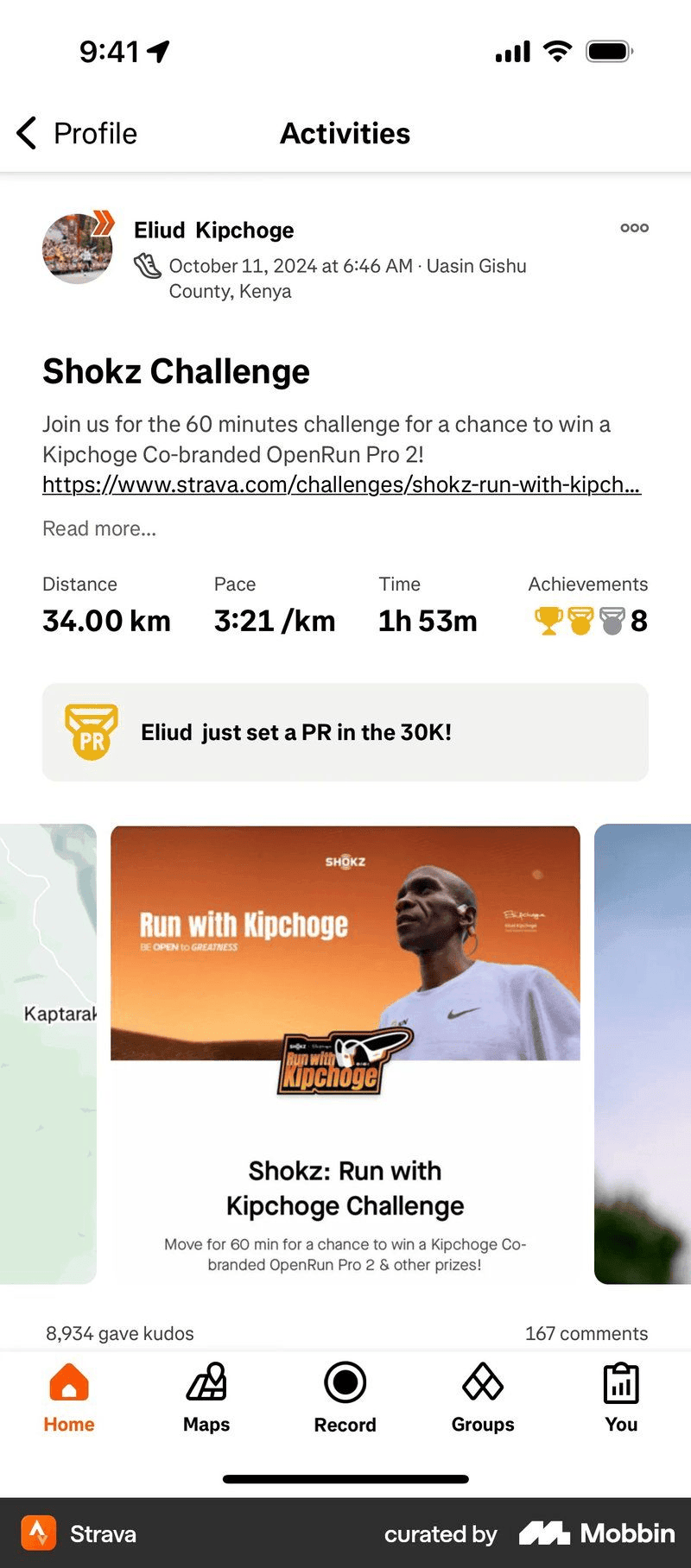
These rituals don’t just enhance user engagement; they build identity and belonging. Whether it’s a yearly summary or a weekly goal, the key is to give users something that feels personal but invites others in.
If your app has moments worth celebrating, don’t hide them in a dashboard. Celebrate those wins, make them visible, meaningful, and worth sharing.
#11 Launch loyalty programs to encourage frequent usage
Loyalty programs reward users for actions taken in your app.
These programs gamify user experience through point-based systems that make app usage feel more rewarding. Once users accumulate points, perks, or status, they’re far less likely to abandon your app and lose everything they’ve earned.
The key is rewarding the behaviors users perform naturally while offering benefits they actually want.
Revolut’s RevPoints program is a good example of this approach. Users earn points for actions like exchanging currency, making card payments, or referring friends. The rewards are practical and aligned with the user base’s needs: discounts on travel bookings, cashback on purchases, and access to premium features.

#12 Ask for permissions progressively
It’s necessary to request permission, but timing matters. Overwhelming users with multiple permission prompts during onboarding creates friction and signals that your app might be invasive.
Only ask for what you need, exactly when you need it. Avoid preemptive requests for features users haven’t tried yet, or “just in case” permissions that serve no immediate purpose. When a permission request appears in context, users understand why it’s needed and are far more likely to grant access.
Google Translate demonstrates this perfectly. The app doesn’t ask for microphone access during onboarding or when you first open it. Instead, it waits until you tap the audio icon. Only then does the permission prompt appear, with a clear explanation.

How to monitor mobile app engagement? 10 Essential metrics to track
These metrics give you a clear picture of how users interact with your app, where engagement is strong, and where you’re losing customers. Track them to ensure the strategies we’ve mentioned above work and your app is performing well.
Daily and monthly active users (DAU & MAU)
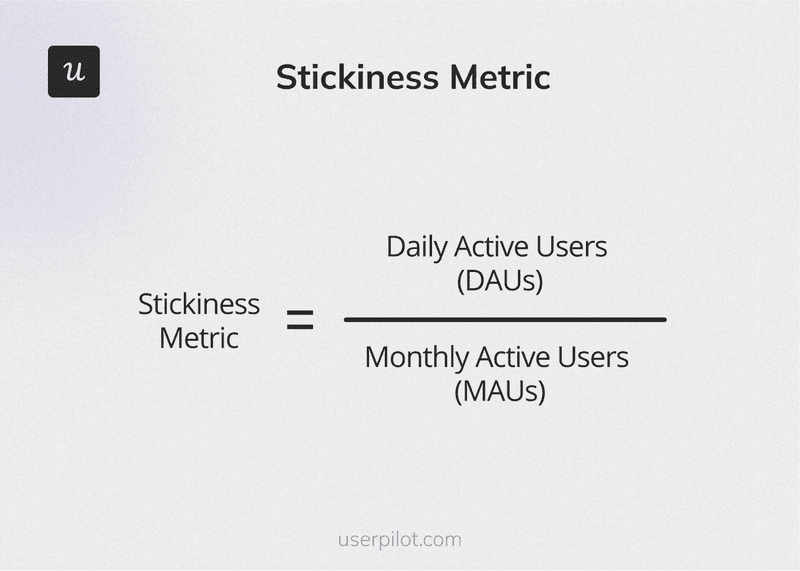
This is the starting point. It’s the most basic measure of your app’s audience size. But just looking at the raw numbers isn’t enough. The real insight lies in their relationship.
What it is: DAU is the number of unique users who open your app in a 24-hour period. MAU is the same, but over a 30-day period.
How to calculate it: Most analytics tools give you these numbers directly. The magic happens when you combine them into the user stickiness metric. Stickiness Metric = DAU / MAU
Why it matters: The stickiness ratio shows the percentage of your monthly users who engage with your app daily. It’s a powerful indicator of habit formation. A 20% ratio is considered good for many apps, while top-tier social media apps can exceed 50%. A low ratio suggests customers might find my app useful occasionally, but it’s not part of their routine. That’s a signal for me to investigate how we can increase active users and become more integrated into their lives.
User retention rate
If stickiness is about daily habits, retention is about long-term value. It costs far more to acquire a new user than to keep an existing one. This metric shows if you’re succeeding at keeping users.
What it is: The percentage of users who return to your app after a specific period. This is typically measured in cohorts (e.g., users who signed up in the first week of January).
How to calculate it: (Number of paying users at the end of the time period – Number of users acquired) / Total Number of users at the beginning of the period x 100.
Why it matters: I look at Day 1, Day 7, and Day 30 retention. Low Day 1 retention is a major red flag, as it indicates our first-time user onboarding experience is failing. If users drop off after Day 7, they might not have discovered the app’s core value. Poor retention is often a symptom of a poor onboarding process that fails to guide users to their Aha moment. Improving how you onboard new users is one of the most direct ways to boost this number.

User churn rate
This is the rate at which users are leaving your app for good. It’s a metric you want to keep as low as possible.
What it is: The percentage of users who stop using your app during a specific period.
How to calculate it: (Number of users who left during period / Total users at the start of period) x 100.
Why it matters: Churn is a smoke signal. A rising churn rate tells me something is wrong. It could be bugs, a confusing UI, a competitor’s new feature, or a change we made that users hate. It’s my job to play detective and find the root cause. Often, user friction comes from small annoyances that build up until the user gives up. Keeping a friction log can help you pinpoint exactly what’s driving people away.

Average session length
This metric tells you how long, on average, a user spends in your app each time they open it. But be careful; longer isn’t always better.
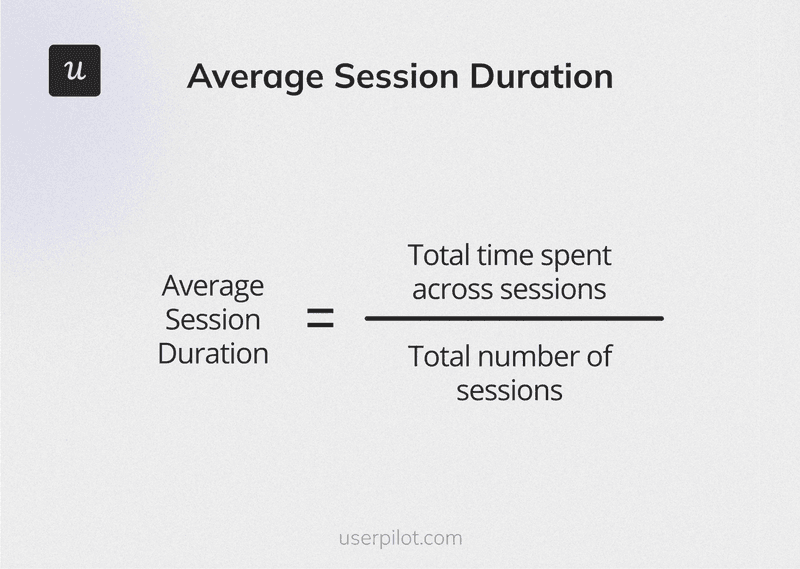
What it is: The total time users spend in your app across all sessions, divided by the total number of sessions.
How to calculate it: Total duration of all sessions / Total number of sessions.
Why it matters: Context is everything here. For a gaming or content app, long sessions are great. It means users are engaged. But for a utility or productivity app, extending session length might mean the user is confused, can’t find what they need, or the UI is inefficient. I always analyze this metric alongside task completion rates. If session length is high but users aren’t achieving their goals, we have a problem.
Session frequency and interval
These two metrics measure how often users come back. They’re another way to look at habit formation and the role your app plays in a user’s life.
What it is: Session frequency is the average number of sessions per user in a given time frame. Session interval is the average time between a user’s consecutive sessions.
How to calculate it: Frequency = Total number of sessions / Total number of unique users. Interval is the average time between each user’s sessions.
Why it matters: A short session interval means users are returning frequently. If I see the interval lengthening, it might mean the app is becoming less relevant. This is a cue to re-engage users with personalized notifications or highlight new features that can provide more value-based growth.

Feature adoption rate
As product managers, we spend weeks or months building new features. This metric tells us if anyone actually cares.
What it is: The percentage of active users who engage with a specific feature.
How to calculate it: (Number of users who used the feature / Total number of active users) x 100.
Why it matters: Low adoption doesn’t always mean the feature is bad. It often means users don’t know it exists or don’t understand its value. You can use in-app marketing strategies, like tooltips or hotspots, to guide users toward new functionality. Monitoring feature adoption helps us decide whether to improve a feature, market it better, or remove it.

Conversion rate
Conversion rate measures how effectively you’re guiding users toward a desired outcome. While often tied to revenue, a conversion can be any key action.
What it is: The percentage of users who complete a specific goal within the app.
How to calculate it: (Number of users who completed the goal / Total users) x 100.
Why it matters: The goal can be anything: upgrading to a paid plan, completing the onboarding tutorial, inviting a friend, or creating their first project. A low conversion rate on a key action tells me there’s a barrier. Maybe the call-to-action is unclear, there are too many steps, or the value proposition isn’t strong enough. A goal-oriented onboarding flow is critical for driving those initial, crucial conversions.

Customer lifetime value (LTV)
This metric predicts the total revenue a single user will generate throughout their time using your app. It can help you make smart decisions about spending.
What it is: The total predicted net profit from a single customer over the entire duration of their relationship with your app.
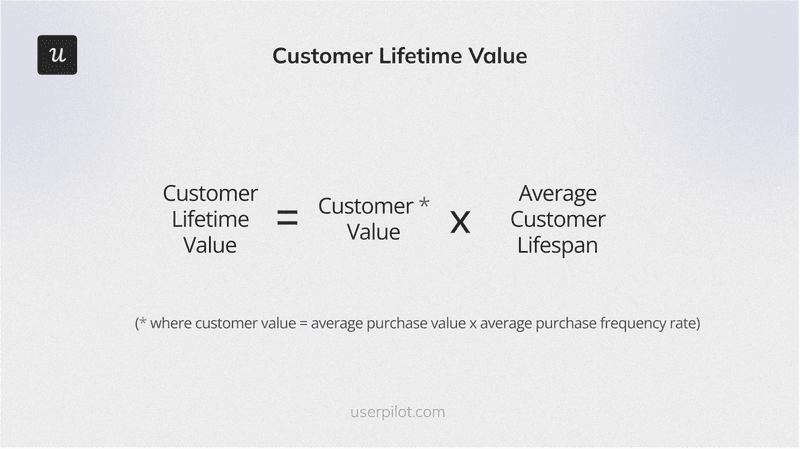
How to calculate it: Customer Value (Average Purchase Value x Average Purchase Frequency Rate) x Average Customer Lifespan.
Why it matters: While LTV tells me what a customer is worth, it’s more meaningful to compare it to our Customer Acquisition Cost (CAC). As long as LTV is significantly higher than CAC (a common rule of thumb is 3:1), the business model is sustainable. If our CAC payback period is too long, we need to either reduce acquisition costs or find ways to increase LTV through upselling, cross-selling, or improving retention.
Average revenue per user (ARPU)
ARPU shows how much revenue each user generates on average. It’s especially useful when paired with LTV and churn metrics to understand monetization performance.
What it is: The average revenue generated per user over a specific time period.
How to calculate it: Total revenue / Total users.
Why it matters: This helps me identify which user segments are most valuable and whether monetization strategies are working. A rising ARPU means we’re successfully moving users toward paid features, upgrades, or in-app purchases. A declining ARPU signals that we need to revisit our pricing, improve feature value, or better communicate what users get for their money. You can segment ARPU by cohort, acquisition channel, or user behavior to spot patterns. For instance, users who complete onboarding might have an ARPU 3x higher than those who don’t.
Average Revenue Per User (ARPU) formula.
In-app message conversion rate
This metric shows how often users act after seeing an in-app message. It’s a direct measure of whether your messaging drives behavior.
What it is: The percentage of in-app messages that result in a desired action, like clicking a link, completing a task, or making a purchase.
How to calculate it: (Number of conversions / Total number of in-app messages sent) x 100.
Why it matters: A low in-app message conversion rate means your messaging isn’t resonating with users. The problem could be timing, relevance, copy, or placement. Use behavioral triggers to display in-app messages when they’re most contextual(like showing a feature tip right after someone completes a related action). Also test different message formats, CTAs, and placements to see what drives clicks.

Enhance your mobile app engagement strategy with Userpilot!
Mobile engagement isn’t just about features. It’s about how, when, and why users interact with your product, and understanding the common app engagement metrics that keep them coming back.
If you want to build flows that adapt to behavior, personalize onboarding, and re-engage users at the right time, you need more than templates. You need a mobile app engagement platform built for cross-platform product growth.
That’s where Userpilot fits in.
With support for mobile-specific UI patterns, behavioral triggers, push notifications, surveys, and in-app guidance, Userpilot helps product teams build mobile engagement into every part of the user journey, without relying on engineering.
It’s not just what we say. It’s what our customers experience.

Ready to design better mobile journeys? Book a free demo with Userpilot and explore how to drive mobile app engagement without writing a single line of code.
FAQ
How to increase engagement in an app?
To increase engagement in an app, focus on personalized onboarding, behavior-based triggers, timely push notifications, and in-app messaging that reminds users. Use mobile app analytics tools to track user behavior, then build engagement strategies around key actions like daily use, feature adoption, and content interaction.
Do mobile apps increase customer engagement?
Yes, mobile apps can significantly increase customer engagement when designed around user needs. Features like personalized push notifications, in-app guidance, and behavior-triggered content help keep users active. Mobile-first apps also allow brands to stay connected with users in real time.
What is the engagement rate of an app?
An app’s engagement rate measures how often users interact with it over a set period. Common mobile app engagement metrics include daily active users (DAU), average session length, and feature usage. A high engagement rate suggests users find ongoing value in the app experience.
About the author
![What are Release Notes? Definition, Best Practices & Examples [+ Release Note Template] cover](https://blog-static.userpilot.com/blog/wp-content/uploads/2026/02/what-are-release-notes-definition-best-practices-examples-release-note-template_1b727da8d60969c39acdb09f617eb616_2000-1024x670.png)