Message Testing in 2026: How to Test Copy That Beats AI-Generated Noise


Message testing is the practice of putting your marketing copy, landing pages, and in-app messages in front of real people before you commit to them at scale. Advancements in technology have also given it a new job: making sure messaging sounds like it was written by humans rather than generated by an LLM. 65% of US adults are uncomfortable with brands using AI-generated content in advertising, which creates a market opportunity for anyone willing to put the work into testing their messaging until it sounds human (whether or not it was actually written by one).
Message testing gives you a way to know whether your value proposition, clarity, and CTA are landing before you find out the hard way from a disappointing conversion report without any context. This guide will cover the LIFT model framework for deciding what to test, a step-by-step process for running message testing on a SaaS product, which questions to ask participants, and where AI actually earns its place in the process instead of just publishing the first draft it spits out.

The LIFT model: The framework that tells you what to test
In 2009, Chris Goward, Founder of CRO agency Conversion, introduced the LIFT model to explain why some pages convert and others don’t.
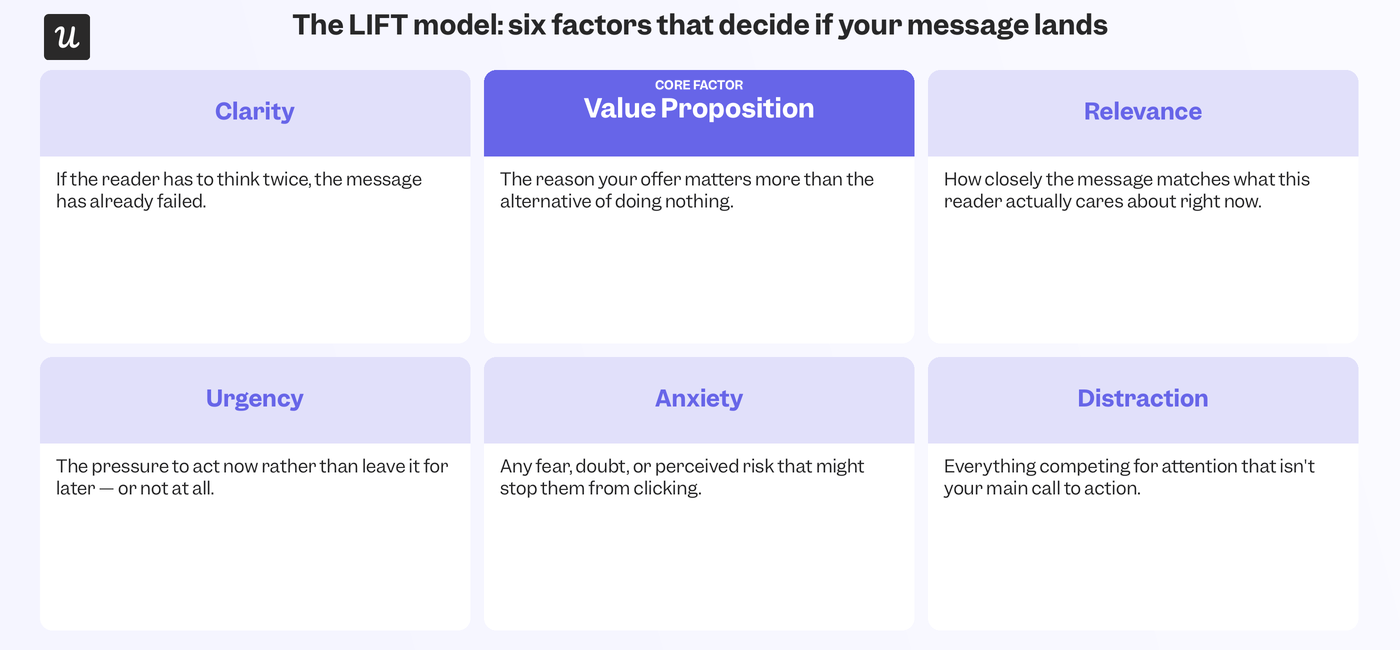
The LIFT model breaks a message down into six factors:
- Value proposition
- Clarity
- Relevance
- Urgency
- Anxiety
- Distraction
Value proposition sits at the center because it determines your ceiling on everything else. Clarity asks whether a visitor can tell what you do within seconds. Relevance asks whether your message matches what they expected to find when they clicked through. Urgency, anxiety, and distraction round out the model by asking whether your copy pushes someone to act now, whether it addresses their hesitations, and whether anything on the page is pulling attention away from the point. LIFT turns a vague “Does this copy feel right?” into a set of testable questions.
Step 1: Define your objective before you write a single variant
The most common message testing mistake is testing everything at once and failing to measure anything substantive as a result. Before launching a test, write down the primary question you’re trying to answer (e.g., whether a new headline clarifies your value proposition or if a different CTA can drive more upgrade clicks).
Once you have your question, pick the metric that will serve as the answer. That could be click-through rate, average conversion rate, feature adoption, or a qualitative sentiment score from a follow-up survey. Product experimentation only produces reliable data when the objective is fixed before the test starts.
Step 2: Segment your audience before you test anything
Message testing can only provide actionable insights if you’re targeting the right cohort. The message that converts a brand-new trial user into an activated customer will likely be the wrong message for convincing a three-year power user to upgrade to a higher tier, so testing both groups together will bury the insight you need under a sea of averages.
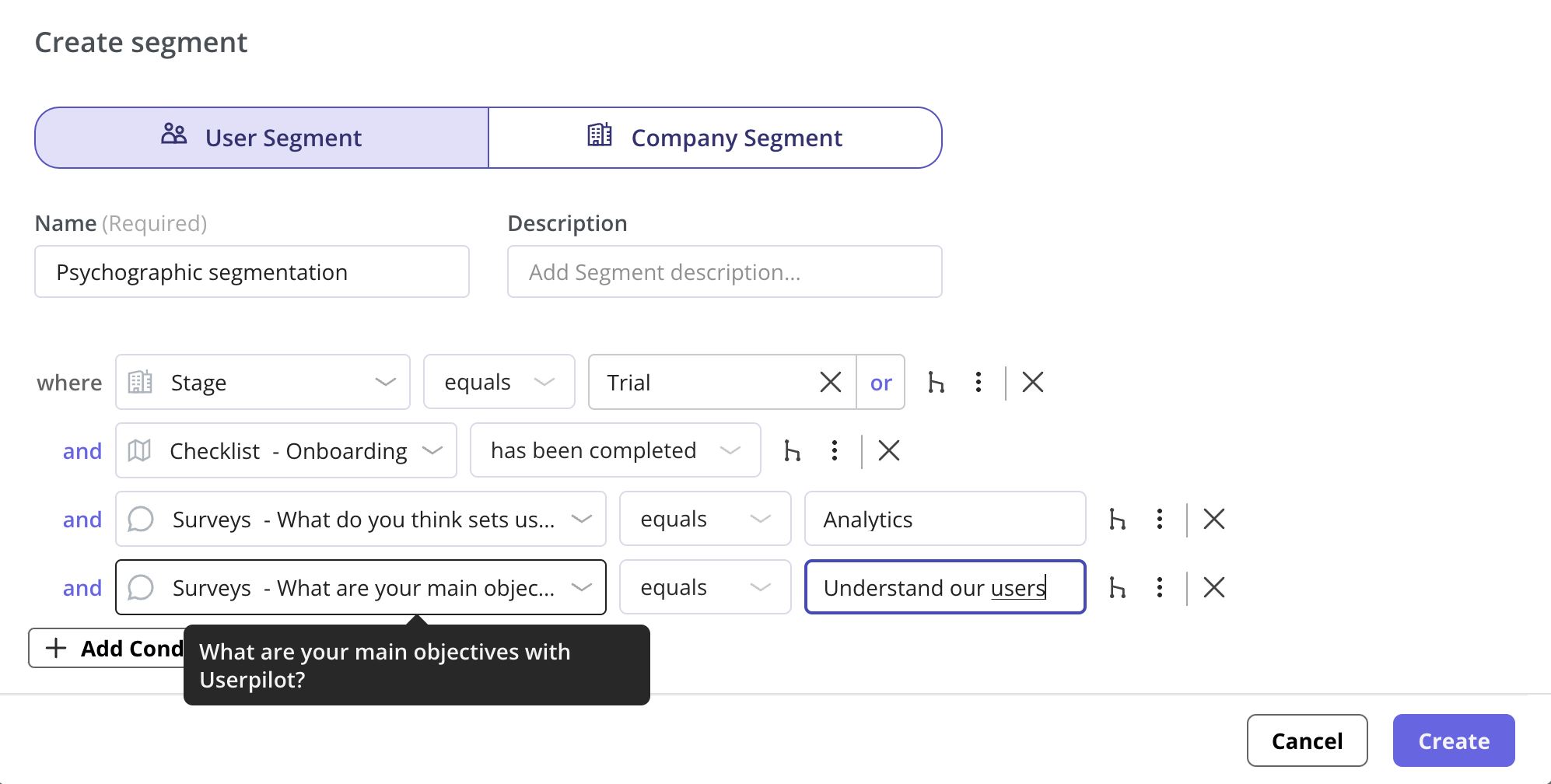
Segmenting test cohorts by role, lifecycle stage, or behavioral pattern before you deploy a single message variant prevents common pitfalls, like discovering a message works for one user segment and incorrectly treating that as a universal result.
Step 3: Build variants that isolate one LIFT factor at a time
Once you know your objective and audience, use the LIFT model to structure what you’re actually iterating on. Rather than making arbitrary copy changes, build one variant that sharpens the value proposition, another that adds urgency, and lastly one that addresses the most common objection you hear from that segment. Testing across LIFT dimensions (instead of random rewrites) gives you interpretable results. You’ll know not just which message won, but which dimension of your messaging actually moved the needle most. This can matter more than the win itself if you want insights you can apply to your next campaign.
When you’re ready to collect customer feedback, ask questions that map directly to the LIFT factors instead of open-ended “what do you think” prompts. Kate Meyers Emery, Senior Digital Communications Manager at Candid, had this to say about how she approaches message tests:
“Pick one thing to test or one question to answer. Determine what success looks like. Once you’re done, assess the results. Even if it fails, there are lessons to be learned.”
Five questions cover most of the LIFT model in a single round of interviews:
- Value Proposition: Is there demand for what you’re proposing?
- Relevance: Does the messaging match what the visitor expected to find?
- Clarity: Does the page clearly communicate the value proposition and the call to action?
- Urgency: Does the messaging convey that action needs to be taken right now?
- Anxiety/Distraction: What hesitations might a visitor have about converting?
Keep the list to five so that participants give you genuine answers instead of speeding through a long survey just to be polite.
Step 4: Collect signal with surveys, A/B tests, and behavioral data
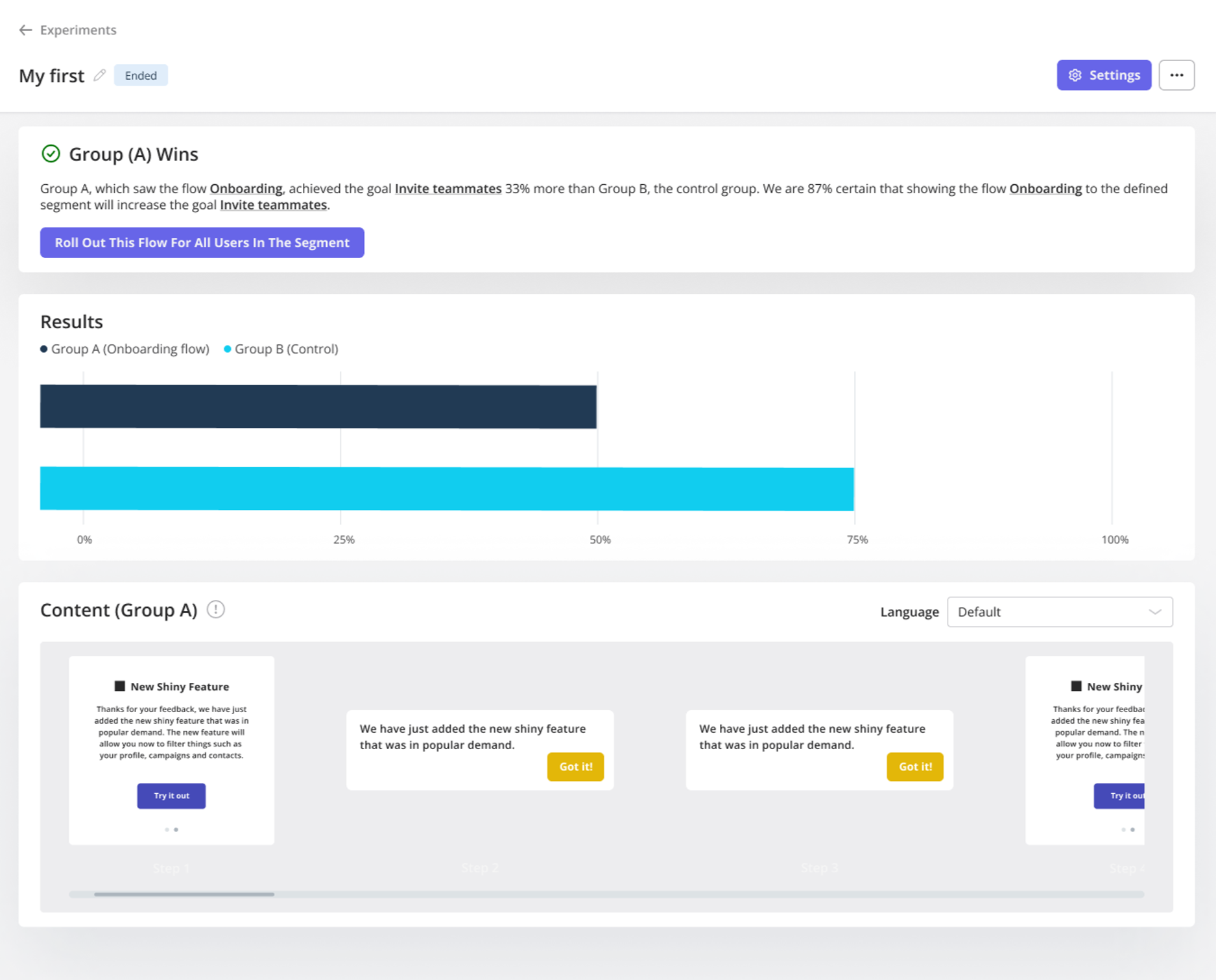
Triggering a microsurvey right after a user encounters the message you’re testing captures that reaction while it’s still fresh, instead of days later when the experience has faded. Meanwhile, A/B testing gives you statistically reliable data on which variant actually drove the behavior pattern you defined as your objective.
Marianne Kaiser, CEO of Contrary Collective, framed her testing philosophy as a process of continuous learning:
“It’s not about getting the words perfect the first time. It’s about watching the reaction and figuring out what actually connects with your audience. You’re testing what lands, what sticks, what makes people feel something, what they remember enough to retell. Not every version will be a hit, but every version teaches you something.”
Behavioral data closes the loop by telling you what users actually did, not just what they said or clicked on. Compare downstream behavior between message variants to see if users who saw variant B activated at a higher rate, reached their first value moment faster, or churned less. If a message sounds generic or AI-flattened, it usually shows up in the form of lower activation and adoption rates (even if the A/B testing metrics showed a marginal lift in open rates).
Why testing beats guessing in the AI content flood
Two-thirds of US adults being uncomfortable with AI-generated ads means most of your addressable market is telling you they can see the difference between messaging written for them versus messaging written at them. The antidote isn’t renouncing AI tools entirely but refusing to ship a draft without testing it against real people first, whether it was written by a human or generated by a model. Teams that build message testing into their process aren’t just optimizing app conversion but picking up the market share their competitors are surrendering by publishing messaging that sounds like everyone else’s ChatGPT outputs.
At Userpilot, we empower SaaS teams with segmentation to test with the right cohort, in-app messaging to deploy variants without an engineering ticket, survey tools to collect qualitative feedback at the moment it matters, and behavioral analytics to measure what users do after they see your message. If your messaging hasn’t been thoroughly tested in the AI era, get a demo and we’ll show you where to start closing that gap!
About the author