Knowledge Bases Are an Activation Tool, Not a Cost Center

Users of product-led companies try to self-solve whenever they hit friction long before talking to a human. As such, the knowledge base is the first resource that’s checked before they resort to contacting your support representatives. I run Customer Success at Userpilot, and I’ve watched our own resource center catch that exact moment, mid-task, before anyone’s typed a support ticket. That’s what makes a knowledge base a primary activation tool, not a line item on the support budget.
Most PLG companies still write their knowledge base like a legacy enterprise support archive built for a call center, not for a trial user trying to hit value in the next five minutes. That gap shows up in the numbers, with Gartner finding that 73% of customers attempt self-service before contacting anyone yet only 14% actually resolve their issue. A knowledge base in a product-led company is a user activation tool, not a cost center, and most teams are still building it like one.
That mismatch gets worse the faster you ship. A PLG product changes weekly, sometimes daily, and a knowledge base built like a static archive can’t track a UI that’s still moving. Every unshipped documentation update is a moment when the fastest path to activation just quietly closes. This guide will highlight the impact of gaps in your knowledge base, show you why in-app resource centers outperform external help articles, and provide three real knowledge base examples to study.
Why knowledge base gaps affect product-led growth
The 14% resolution rate I mentioned in the introduction isn’t caused by technological limitations but rather by a pure lack of content. Gartner found that the most common reason for self-service failure was that customers couldn’t find content relevant to their issue.
Eric Keller, Senior Director in Gartner’s Customer Service Practice, put the disconnect plainly while discussing their findings:
“While 73% of customers use self-service at some point in their customer service journey, it’s concerning to see that so few fully resolve there. It’s imperative that customer service and support leaders work to resolve the issues customers face in order to fully realize the value of their self-service investments.”
Even with these low resolution rates, the return on investment is still clear, with the median cost per contact being $1.84 for self-service and $13.50 for assisted channels. However, those cost-saving benefits can quickly be offset by revenue churn if your users face so much friction while attempting to self-serve that they abandon the product entirely.
Why in-app resource centers outperform external knowledge bases
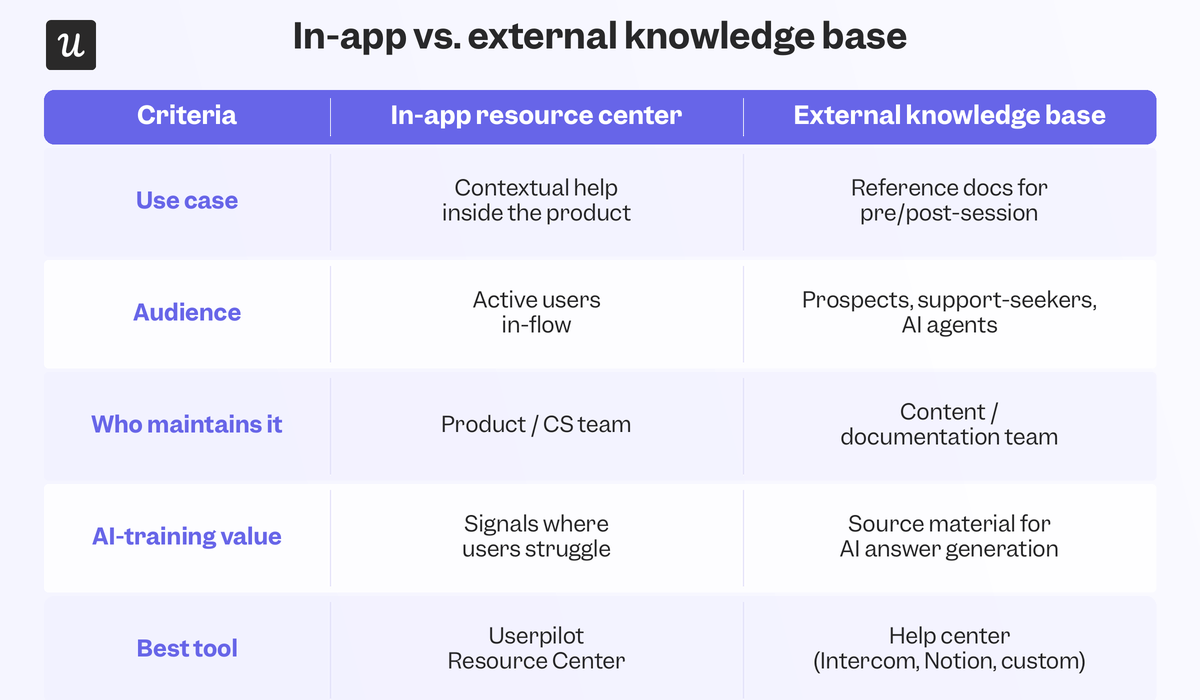
External knowledge bases and in-app resource centers solve different problems. The external site covers pre-purchase research so prospects can learn about the product before signing up, while resources inside the product need to cater to active users who are stuck on a task and urgently need a solution. For product-led growth teams, the in-app moment carries higher stakes, especially during free trials, because users who haven’t made any monetary investment yet might not return after leaving to find answers.
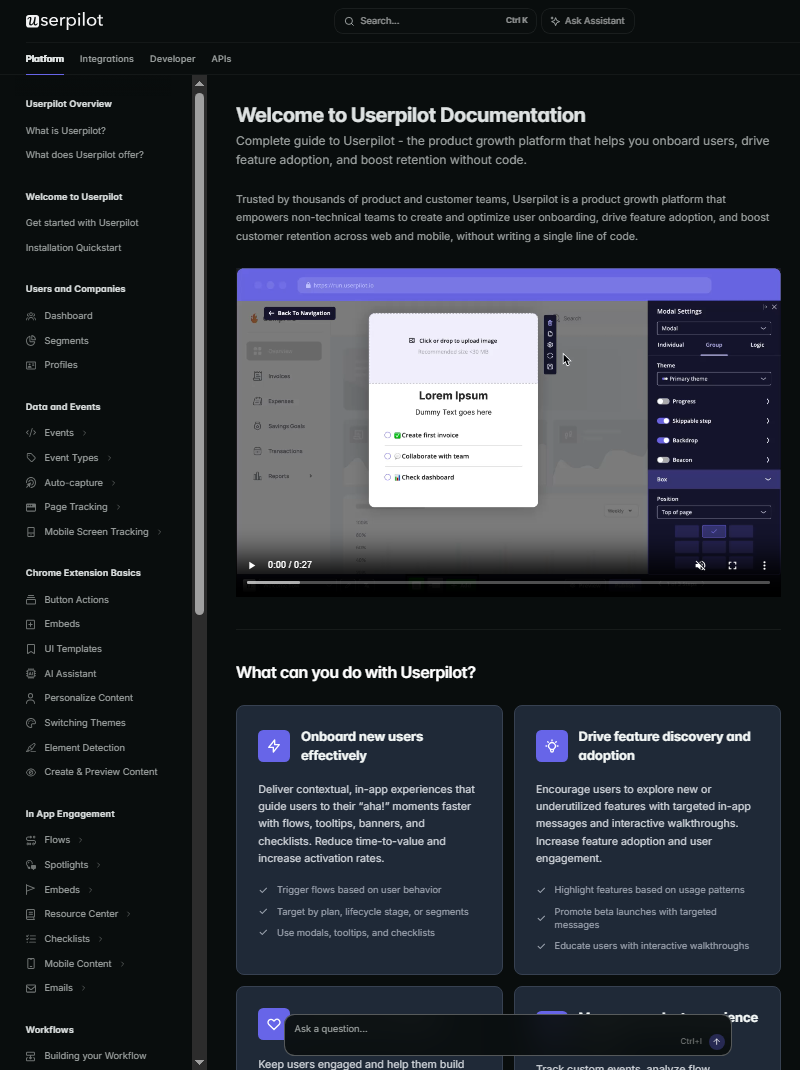
I’ve measured this directly against our own resource center. Whenever we add tooltips and documentation for complex features, we see a massive reduction in support ticket volume. Our resource center also comes equipped with an “Ask Assistant” button at the top, right next to the search bar, so users can phrase their questions in natural language if they’re not sure what keywords or topics to look up.
How to counter knowledge base decay
Knowledge base articles decay quietly as features change, interfaces are redesigned, and terminology is redefined. Rarely does anyone schedule a specific day to go back and fix the paragraph describing a button that no longer exists.
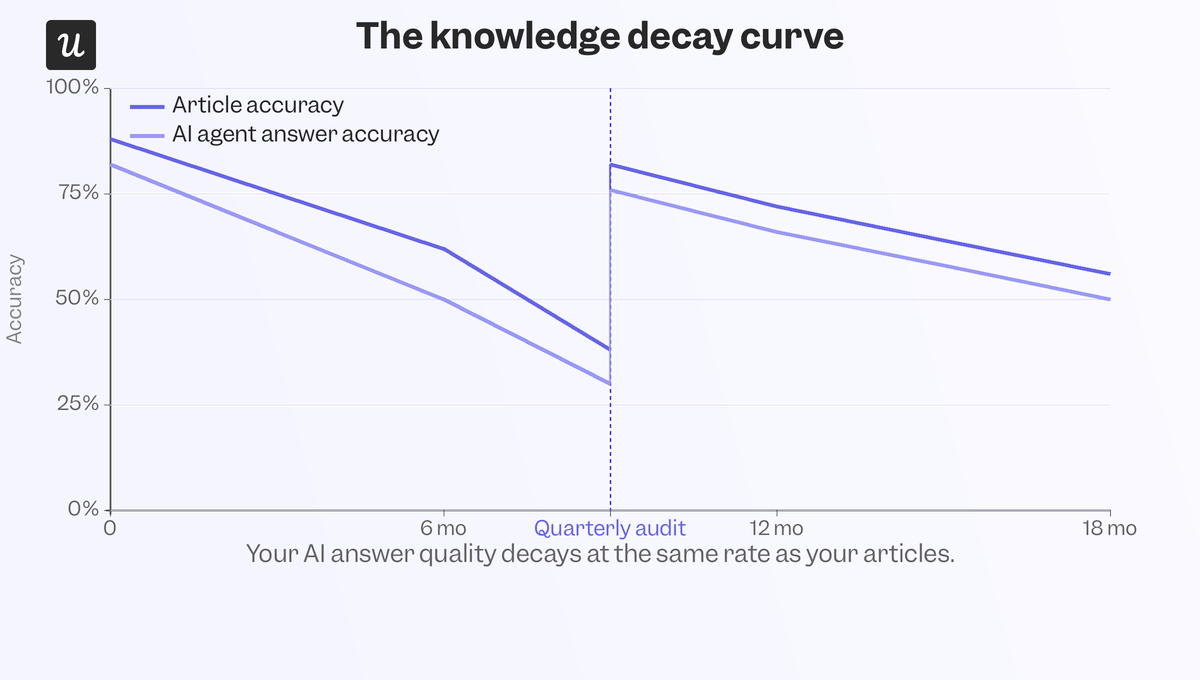
The fixing isn’t hiring more writers but putting alarms in place to catch decay before it compounds. Track which article categories generate the most follow-up tickets after a user has already read the article. That’s the clearest signal that an article is no longer capable of answering the questions it’s supposed to. Monitor searches that don’t return results to spot high-demand content gaps that need to be filled. Audit every article quarterly so nothing slips through the cracks, especially for products that are constantly changing.
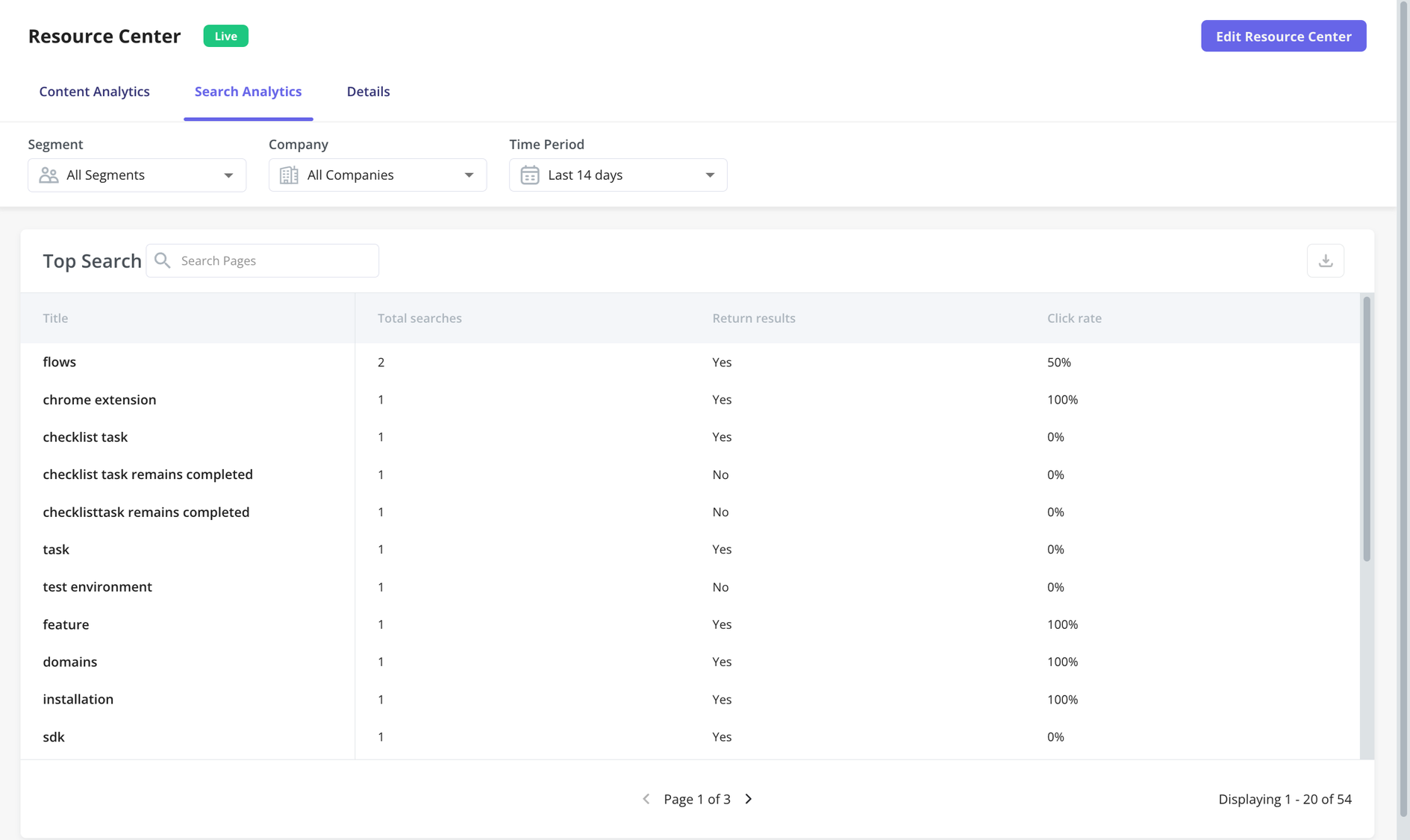
Userpilot’s resource center analytics tell you what users are searching for and which resources get clicks, so you know where updates are needed.
Knowledge base examples for SaaS products
Three examples worth studying are Heap, Mailchimp, and Amplitude which employ different best practices to serve readers with their respective knowledge bases. Read our knowledge base examples resource for a more extensive roundup with additional examples.
Heap
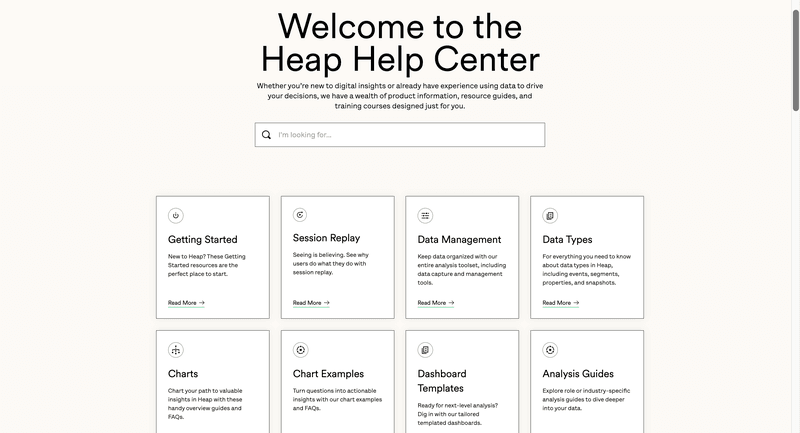
Heap organizes its knowledge base by how long someone has been using the app, with a section of articles built specifically for new users. At the bottom of the page sits Heap University, a set of courses and sessions for users who want to learn more than any single article can teach them. In other words, Heap’s knowledge base is doing double duty as a user onboarding track.
Mailchimp
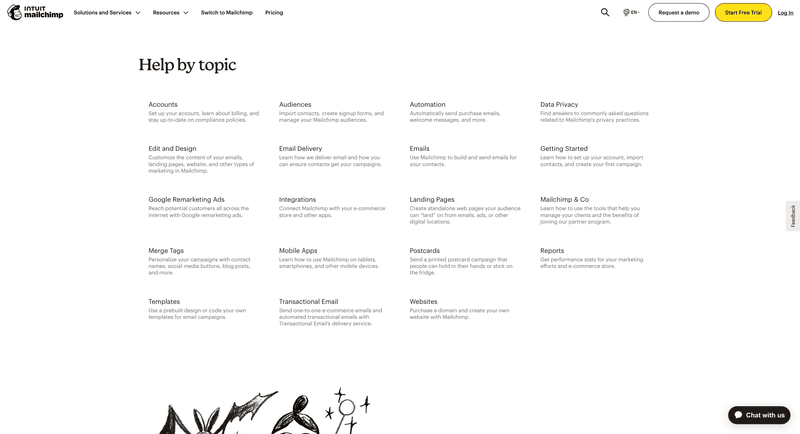
Mailchimp surfaces its most-clicked articles at the top so that the questions most people actually have get answered without a search even happening. Tutorial videos and a chat button provide multiple alternatives when the popular guides don’t align with what a user is looking for.

Mailchimp’s knowledge base also offers a comprehensive set of articles organized by topic to help users find the resources they need by skimming semantically.
Amplitude
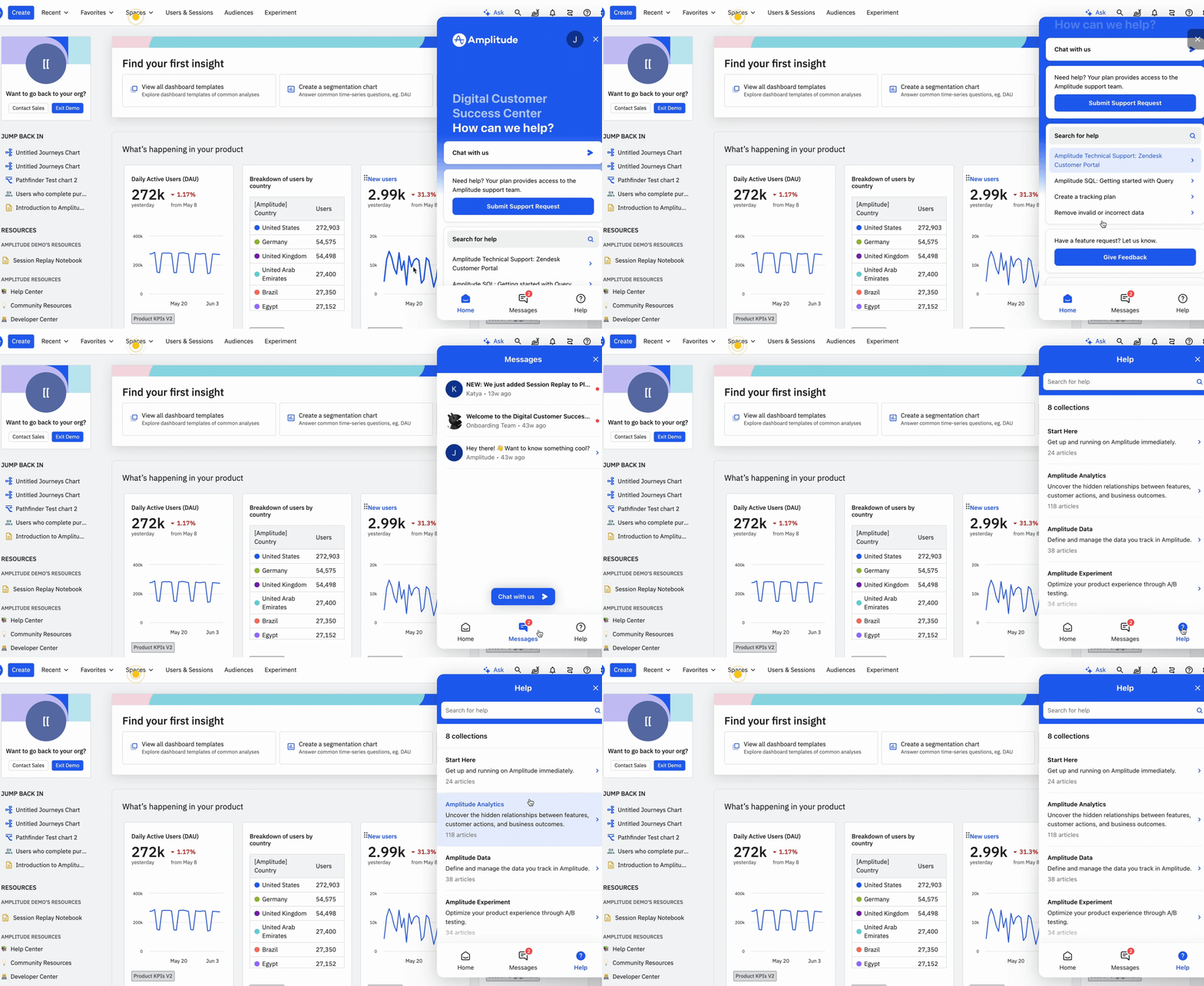
Amplitude leads with a contact widget and organizes help categories by underlying functionality. That’s a reasonable design for highly technical products like Amplitude. However, leading with the human representative path can also pull users toward that option before they’ve even tried to solve the problem themselves, harming deflection rates.
Turn your knowledge base into an activation tool, not a cost center
A knowledge base was never meant to be a cost center. It was meant to be the moment a stuck trial user turns into an activated customer. Fix that framing and everything else starts making sense as one connected funnel taking users from confusion to product adoption. If you want a knowledge base that works as an in-app resource center instead of a static library, get a demo to see how Userpilot’s resource center, AI answers, and content analytics come together to optimize your self-serve infrastructure!
About the author