Heap Integrations Explained: Does It Fit Your Tech Stack?



Heap integrations can talk to your CRM, marketing platforms, and product adoption software to turn behavioral data into action.
However, Heap gates these integrations behind their highest tiered plan. Is it worth upgrading your Heap account instead of switching to an all-in-one platform?
To see if it fits your stack, I’ll break down all integrations in Heap, including how they work and which platforms are supported.
Explaining Heap integrations
To better understand Heap’s environment for integrations, I’ll break it down into 12 different types of software:
1. Customer data platforms (CDP)
CDPs that connect with Heap: Segment, Evergage (requires custom development), and Tealium.
Heap provides integrations for customer data platforms (CDPs) to import or export data via server-side APIs. It ensures Heap’s data doesn’t live in a silo and “User 123” in your analytics is the same person as “User 123” in your help desk.
This integration makes it possible to, for example, use Heap to analyze product usage based on demographic data (e.g., job titles, salaries, etc.) by pulling it from the CDP.

2. Data warehouses
Warehouses that connect with Heap: Snowflake, BigQuery, Redshift, Amazon S3, and Databricks.
Heap’s warehouse integrations use ETL (Extract, Transform, Load) to sync raw event data from Heap into a structured SQL database.
This way, if the built-in analytics in Heap aren’t enough, your team can run complex SQL queries to find answers. For example, you can join your product usage data with your Stripe revenue data to correlate LTV/CAC ratio with in-app behaviors (activity, feature usage, etc).
3. Product adoption and onboarding
DAPs that connect with Heap: Chameleon, Appcues, Userflow, CommandBar, Product Fruits, Candu, and Userpilot.
With the product adoption tools integrations, you can use UI elements (modals, tooltips, checklists) to reduce friction in the product experience (e.g., drop-offs, inactivity, etc). It submits the engagement data from the adoption tool (e.g., “Flow Completed”) back to Heap for analysis. Plus, it also sends behavioral data (e.g., feature activation) to target personalized in-app guidance based on Heap segments.
This makes it possible to, for instance, see if users who complete your interactive walkthroughs have higher retention than those who dismiss them.
Note: Userpilot’s integration is not two-directional. You can only send data from Userpilot to Heap, but not backwards.
4. Session replay
Heap only integrates with Fullstory for session replays. This integration passes a session ID from Fullstory into Heap as an event property, allowing you to click a link in Heap and watch the exact session where an event occurred.
So if a funnel step in Heap shows high drop-off, it’s possible to use the integration to watch directly how users are dropping off.
Note: Heap has its own session replay feature, which might turn this integration redundant.
5. Net Promoter Score (NPS)
For analyzing customer sentiment, Heap only offers integration with Delighted. It sends customers’ NPS rates so you can use Heap for deeper analysis.
This means that, besides segmenting users into promoters, passives, and detractors, it’s also possible to correlate NPS ratings with key events in Heap (e.g., activation, upsells, etc.).
Note: This integration only sends NPS ratings. It doesn’t include any form of qualitative feedback.
5. A/B testing
A/B testing platforms that connect with Heap: Optimizely, VWO, Kameleoon, AB Tasty, Spit, Qubit, Flagsmith, Statsig, and Oracle Maxymiser.
Heap’s integration with A/B testing tools sends the “Experiment ID” and “Variation Name” (e.g., Control vs. Variant B) to Heap as event properties. Allowing you to perform deeper analyses of your experiments
For instance, you can segment your Heap data by “Experiment Variant”. And thus, see if Variant B brought in users who actually stayed active for 6 months (rather than just generating short-term signups).
6. CRM software
CRMs that connect with Heap: Salesforce and HubSpot.
This integration pushes aggregated behavioral data (e.g., “Last Login Date,” “Total Key Actions Performed”) from Heap into custom fields in your CRM. It allows sales reps to approach leads based on their in-app activity, as well as correlate product adoption based on CRM values.
For instance, you can set a Product Qualified Lead (PQL) condition in Heap based on high-intent actions (e.g., inviting teammates, viewing the pricing page, hitting usage limits). This way, when a user meets the condition, the integration syncs this status in the CRM to automatically promote it to a PQL.
7. Customer success and support
Helpdesks that connect with Heap: Intercom and Zendesk (requires custom development).
These integrations embed a “user timeline” into the support agent’s view. So when a ticket is opened, the integration queries Heap to display the user’s recent actions.
This helps the agent understand the context of the issue. So if a user asks, “How do I invite teammates?”, the agent can see they failed three times in the last ten minutes. Also, it’s possible to trigger automated retention campaigns via Intercom if key accounts stop logging in, preventing churn before it happens.
8. Marketing automation
Marketing platforms that connect with Heap: Marketo, Klaviyo, Braze, Iterable, Autopilot, and Sendgrid.
Heap can serve as a trigger source for marketing automations. So whenever a user performs (or fails to perform) a specific set of actions, Heap pushes that event into a marketing platform to trigger a campaign.
For example, if a user signs up but fails to activate a core feature, Heap detects this and triggers a “Need Help?” email sequence. This improves open rates and feature adoption compared to time-based drip campaigns.
9. Attribution
The Heap-Attribution integration tracks the source of a conversion or visit to calculate the ROI of advertising campaigns.
With Heap, it can tie that acquisition source to product behavior. For example, you may find Facebook Ads bring cheap leads who rarely become “Power Users,” while LinkedIn leads cost more but have 3x higher LTV.
10. E-commerce tools
E-commerce platforms that connect with Heap: Shopify, Stripe.
For D2C brands, Heap can integrate with Shopify and Stripe to analyze users based on purchase behaviors. These integrations ingest order data (SKU, quantity, cart price) into Heap, allowing you to identify users by “Total Spend” or “Average Order Value.”
For example, you can:
- Map specific SKU purchases to browsing behavior.
- Analyze the path to purchase high-ticket items versus accessories.
- Use behavioral data to create complex customer segmentation, distinguishing between high spenders and “Window Shoppers”.
11. Email marketing
Email platforms that connect with Heap: Mailchimp, Salesforce Marketing Cloud, and Mandrill (custom development required).
Heap’s email marketing integrations rely heavily on syncing “Cohorts” (segments of users). This lets your email platform send campaign events (e.g., opens, reads, bounces, etc) to Heap, as well as trigger contextual campaigns based on in-app behavior.
Let’s say you want to email every user who signed up 14 days ago, but hasn’t upgraded yet. To do it, you just need to create that segment in Heap and sync it, then create a campaign targeting that segment as an audience.
12. Zapier automation (iPaaS)
Additionally, you can integrate Heap with Zapier. This connection uses webhooks to listen for events in Heap and trigger actions in thousands of other apps.
With this, you can create custom workflows that trigger a specific Heap event (e.g., “User hit credit limit”) to update a field in a Finance Google Sheet. It might also create a Trello card for the account manager to upsell a higher-tier plan.
The issue with Heap’s integrations
Heap offers a robust platform for retroactive analysis. This makes its integrations highly valuable for sales, marketing, or support to leverage behavioral data.
However, this doesn’t come without its caveats. Here are some factors you should consider first:
- Gated pricing: Heap pricing gates all integrations behind their most expensive plan or as an add-on.
- Cognitive load behind context switching: So many integrations force your team to context-switch continuously and get more cognitive drain from it (in fact, data shows that employees switch between applications an average of 1,200 times per day).
- It’s more prone to error: Most of these integrations rely on a common identifier, usually a user ID. You need to ensure that the ID in Heap is the same string you use in other tools. Otherwise, the integration will break, and you’ll end up with fragmented profiles.
In short, I only recommend Heap if you possess a dedicated data engineering team, require complex SQL access for retroactive analysis, and have a high budget to support the higher-tier plans.
Userpilot for analyzing user behavior
Userpilot lets me combine the insights from product analytics with the engagement tools required to take action.
So instead of buying Heap for analytics, Appcues for onboarding, and Fullstory for session replays. Userpilot let me handle all three!
Here is how it creates a better ecosystem for growth:
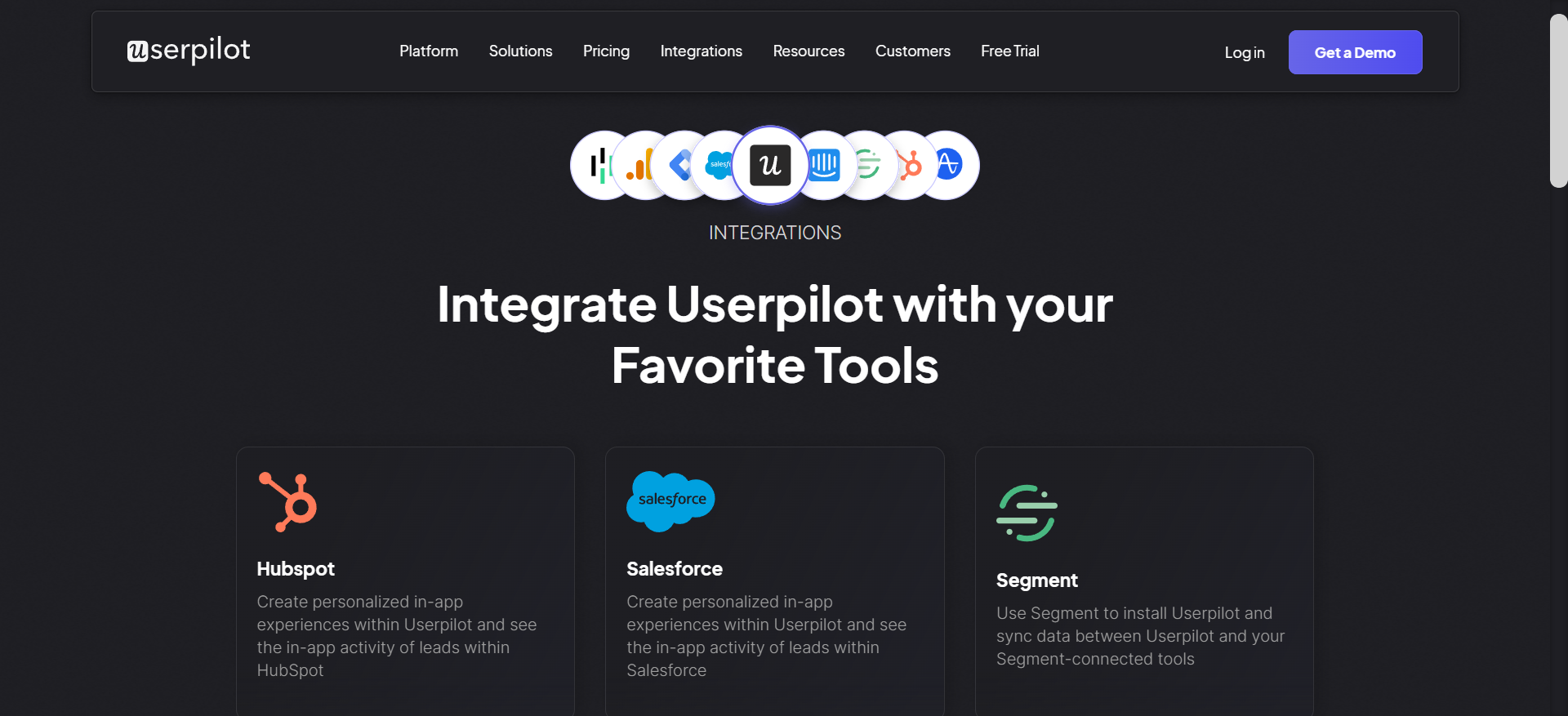
- Two-way integrations: It offers similar two-way integrations with popular platforms like HubSpot, Salesforce, Segment, and most data warehouses. It also syncs qualitative feedback such as NPS scores, form submissions, and survey responses. It also supports webhooks.
- Actionable analytics: You can use a visual labeler to tag historical data without code. You can then build a custom dashboard with key product metrics, generate funnel reports, analyze user paths, perform cohort analysis, etc.

- The engagement layer: The biggest flaw in the Heap ecosystem is that it relies on other tools for product adoption. Userpilot builds this directly into the platform. You can create interactive walkthroughs, onboarding checklists, banners, in-app resource centers, and more. Plus, all these UI patterns can be personalized, customized to look native, and created without code.

- Analyzing user sentiment: You can trigger a microsurvey immediately after a user interacts with a feature to spot friction points. And then, segment users based on their answers to target proactive support.

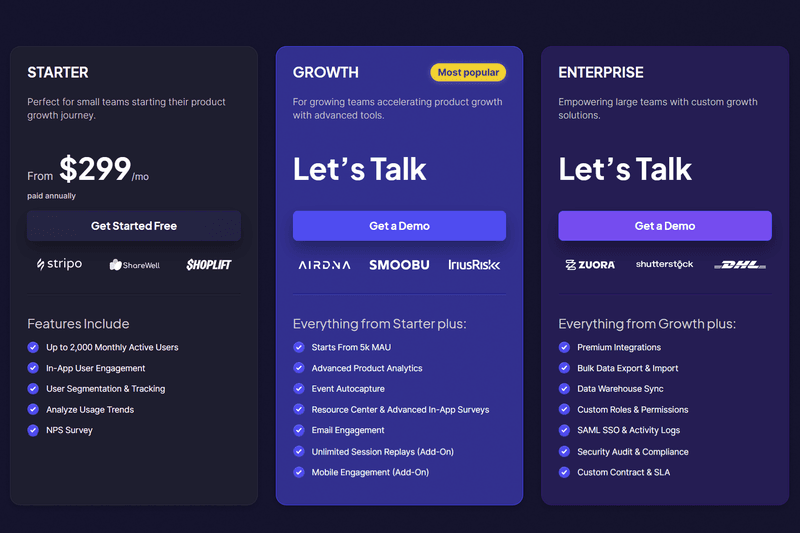
- MAU-based pricing: Heap calculates prices based on session volumes. Meaning if your product is sticky and users log in every day, you get punished with a higher bill. Whereas Userpilot pricing is based on Monthly Active Users (MAU). It doesn’t matter if a user logs in once or one hundred times.
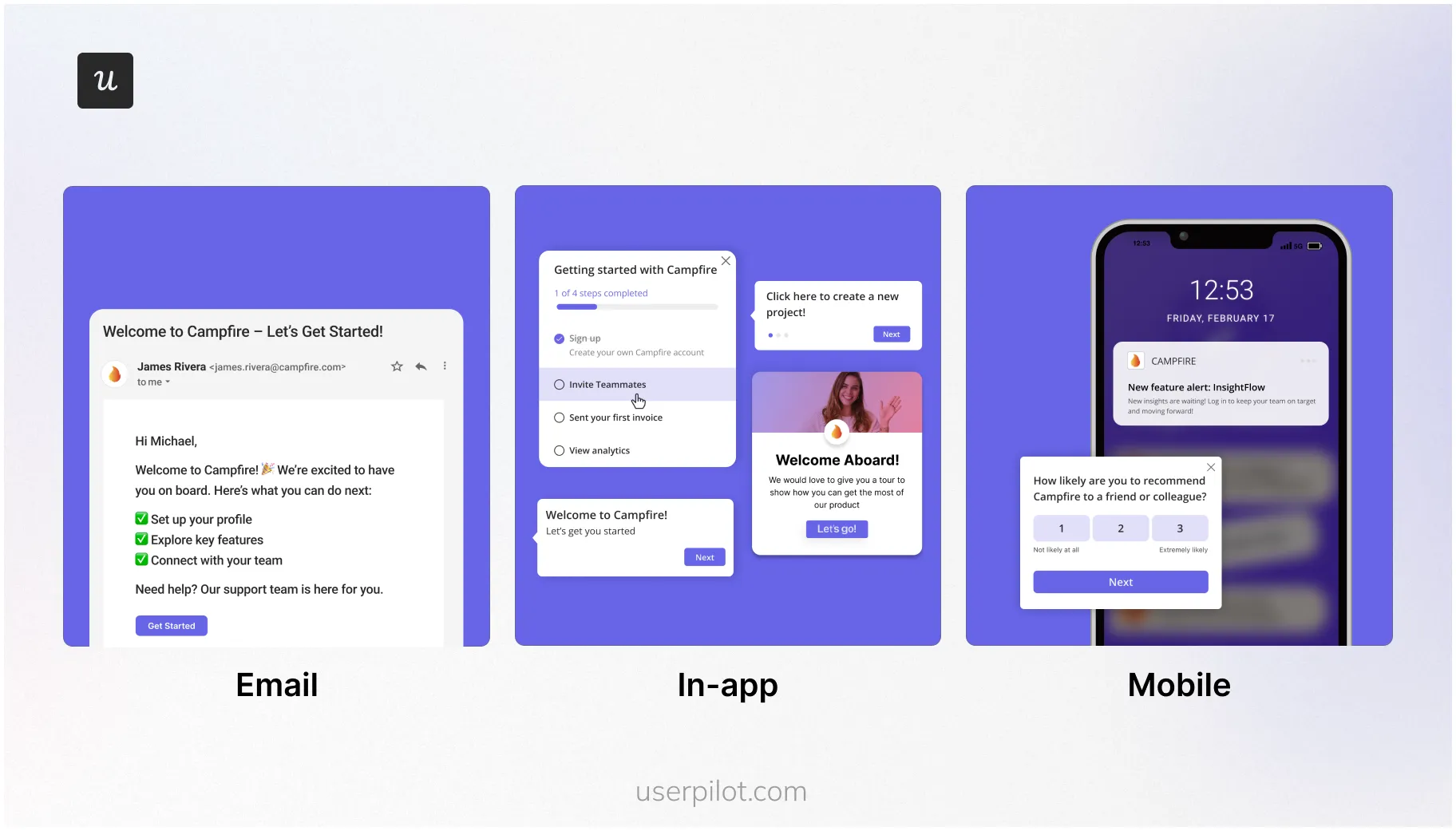
- Omnichannel engagement: You can engage users on mobile apps and email. You can trigger native mobile patterns like carousels and push notifications, as well as trigger email campaigns based on in-app behavior. And since everything is integrated in the same platform, you can see if an individual user signed up on the web but activated on mobile, then target specific messages based on their device.
- Product AI agent: The upcoming AI assistant (Lia) will automatically analyze user behavior, flag recurrent themes in survey responses, and even craft personalized in-app campaigns. The AI can also parse survey responses and generate insights or appropriate next steps. Join the beta here for early access.

Looking to reduce the number of integrations?
With its wide integrations, Heap is more than just a product analytics tool. It gets the power to drive growth if used correctly.
However, Userpilot’s all-in-one platform is more effective. It requires a smaller budget and removes the mental effort of switching between multiple tools.
Userpilot strives to provide accurate information to help businesses determine the best solution for their particular needs. Due to the dynamic nature of the industry, the features offered by Userpilot and others often change over time. The statements made in this article are accurate to the best of Userpilot’s knowledge as of its publication/most recent update on December 2, 2025.
FAQ
What is Heap?
Heap is a product analytics platform that provides in-depth insights into customer behavior. It can track user interactions within your product automatically, helping you identify friction via retroactive analysis.
Do Heap accounts support webhooks?
Yes, but it’s currently in beta with limited support. You must reach out to their support team to try it out.
About the author