I’ve spent enough time running account-based marketing programs to realize most of what you read about ABM only sounds good in theory. That’s exactly why I wanted to write this article and share the ten working account-based marketing tactics I’ve been using from time to time.
While many examples come from LinkedIn, the principles apply regardless of the platform. I’ll show what worked, what didn’t, and how to apply these ideas to your own ABM strategy without unnecessary complexity.
1. Start lean with an account-based marketing strategy before buying any expensive ABM platforms
One thing I’ve learned when we first started running ABM campaigns is not to invest in any tool before you have a proper strategy for both your marketing and sales activities.
I’ll tell you why.
I kept seeing the same pattern where companies buy an expensive tool first, implement it without a real strategy, watch it fail, then blame the vendor and churn to the next platform on the list.
This cycle repeats until they’ve burned through every tool in the market without ever fixing the fundamental problem of not having a strategy.
Not to mention, when we started researching ABM tools, the quotes came back at $60,000 minimum, with the “best deal” at $30K for a multi-year commitment, and none offering trials.
Therefore, you should start by building a strategy first, then assembling tools that fit.
Our entire ABM infrastructure costs us ~$2,500 per month using HubSpot Marketing, Clay, BuiltWith, and ZenABM for LinkedIn data integration.
At this stage, Userpilot plays a supporting but important role. While most ABM campaigns focus on pre-pipeline signals, we use Userpilot to validate interest later in the funnel once accounts sign up.
Welcome survey responses and in-app behavior, like which features users spend the most time on, give us account data we can feed back into our broader account-based approach.
| HubSpot Marketing | CRM, workflows, ad management, reporting | Already owned |
| Clay | List building & data enrichment | ~$350 |
| BuiltWith | Technographic data (via Clay) | Included in Clay |
| ZenABM | LinkedIn engagement data → HubSpot | ~$59 |
| Userpilot | Collecting product signals from trial signups | Already owned |
| Total | ~$2,500/month |
The one thing we didn’t cheap out on was people, because you absolutely need a marketing ops manager for this. The RevOps work is brutal, and our MOps manager, Bilal, spent over 100 hours just on initial setup, building custom integrations, workflow automations, and reporting dashboards from scratch.
After our first campaign, we generated $440K in pipeline from $52K total spend. Once you’ve run 2-3 campaigns, documented your playbooks, and proven ROI like this, then decide if you need the enterprise platform.
We still don’t since we’ve decided to continue running the ABM playbook just on LinkedIn.
2. Reverse-engineer your TAM and budget from revenue goals
Instead of picking random account counts or budget caps, I recommend working backward from your revenue target, so your invested account-based marketing efforts don’t go to waste.
That’s what I did.
Using Kyle Poyar’s ABX benchmarks, here’s how I calculated our budget:
For example, let’s say our revenue goal is of $1M ARR and $50K ACV. To reach that, we’ll need at least 20 deals.
Then, work backwards through your funnel:
- 20 deals ÷ 25% close rate = 80 opportunities
- 80 opportunities ÷ 75% qualification rate = 107 demos needed
- Apply ABX benchmarks (18% considering, 32% interested, 55% aware)
The result is 3,367 accounts to target
For budget calculation:
- 107 demos needed ÷ 1% landing page conversion = 10,700 clicks
- 10,700 clicks ÷ 0.4% CTR = 2.7M impressions
- 2.7M impressions × $55 CPM = ~$147K ad budget
- Add a 15-20% buffer for testing

3. Simplify target account scoring to what you can reliably measure
You should use only engagement signals you can consistently track, rather than complex models with multiple weighted factors that may be unreliable.
I’m going to save you from that mistake we made in our first month of running ABM campaigns.
We built an elaborate account scoring model with page visits, intent signals, and weighted behaviors. On paper, it looked sophisticated. In practice, it collapsed. We even set up a no-index domain just for account-specific landing pages tied to our based marketing efforts. After 90 days and ~300 visitors, website deanonymization identified exactly one company: us testing our own landing pages.
So we stripped the model back to what we could measure.
- For pre-demo stages, we scored target accounts based solely on quantitative LinkedIn engagement we could trust. Through ZenABM, this account engagement data flowed into HubSpot and powered our ABM strategy: Aware = 50+ impressions; Interested = 5+ clicks or 10+ engagements.
- Once an account signs up or books a demo, we leverage our own product, Userpilot. At that point, accounts are identifiable, and we could use Userpilot to track in-app behavior during the trial. Think of factors like feature usage, activation progress, and friction points, and sync those events back to HubSpot as scoring signals for high-value accounts.

We also pulled existing HubSpot properties into Userpilot to personalize the trial experience based on account context.
Thanks to Userpilot’s bidirectional HubSpot integration and webhooks, activity from specific accounts flows both ways. That data then supports smarter sales and marketing team efforts after the trial, especially for prospects who don’t convert immediately.

Basically, Userpilot Hubspot integration helps us deliver better offers.
Here’s a concrete account-based marketing example. When a PM persona from an “Interested” stage account signs up for a trial, Userpilot knows their intent (from ZenABM via HubSpot sync) because this account engaged with the”Session Replay + Analytics” campaign content.
The PM immediately sees a personalized onboarding checklist highlighting analytics features and use cases relevant to their role.

4. Launch single-channel to learn, then expand
One of the few things we got right early on was resisting the urge to launch account-based initiatives everywhere at once.
We started with only one channel: LinkedIn Ads. No display ads, no retargeting networks, and no email orchestration across multiple tools.
This focus made both marketing teams and sales teams learn what actually worked. We spent time understanding which personas engaged, which messaging moved target accounts through stages, and where drop-off occurred across key accounts.
Only once we had clear benchmarks and a working scoring model did it make sense to expand the ABM strategy.
Only then should you think about retargeting.
For example, account-based retargeting platforms like Demandbase can extend reach beyond LinkedIn. They identify target accounts using IP-based signals and serve ads across a broader network of sites.
When someone from one of your strategic accounts visits a Demandbase-enabled property, they’ll see your ads.
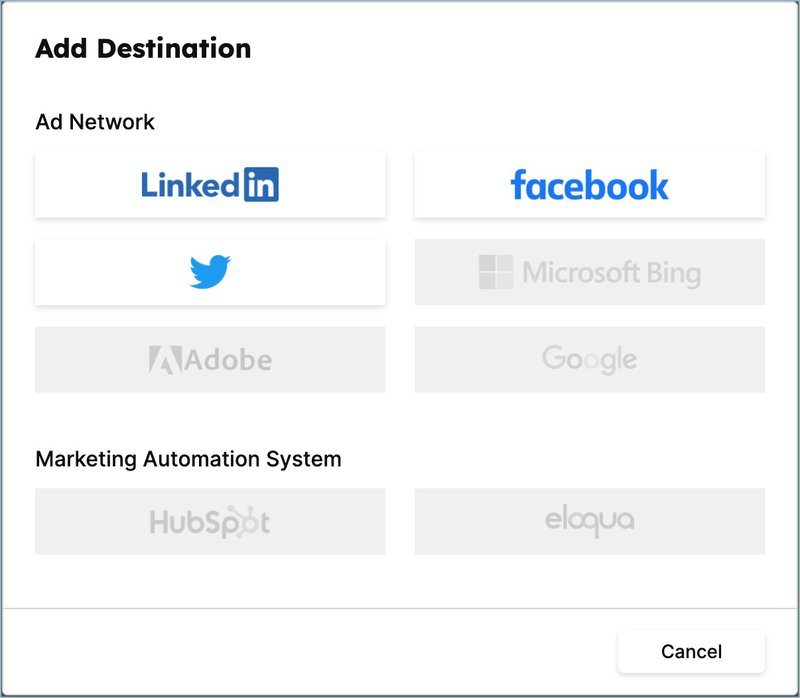
Eventually, when they sign up for your product, you can leverage Userpilot to trigger in-app experiences based on their account-based marketing engagement history from HubSpot and send behavior-triggered emails when they reach key milestones, such as activation or attempts to use premium features.

This is far more targeted than broad retargeting because you’re reaching high-value accounts exactly when they’re experiencing value in your product.
5. Combine multiple data sources for precision high-value account targeting
High-value ABM targeting doesn’t come from a single list or tool. It comes from layering multiple data sources until the signal is strong enough to act on.
For example, knowing a company has 500 employees is okay. Knowing they have 500 employees and just installed a competitor’s product is gold. That intersection is where your ABM wins.
In our case, we didn’t rely solely on LinkedIn targeting. We started with first-party CRM data, especially win–loss analysis, to understand which key accounts historically converted well and why others didn’t. That helped us focus on specific high-value accounts with buying potential, instead of spreading our ABM strategy too thin.
From there, we layered in firmographic and technographic data. Tools like BuiltWith helped us identify companies using specific tools or competitors, while Clay allowed us to enrich and refine target accounts at scale.
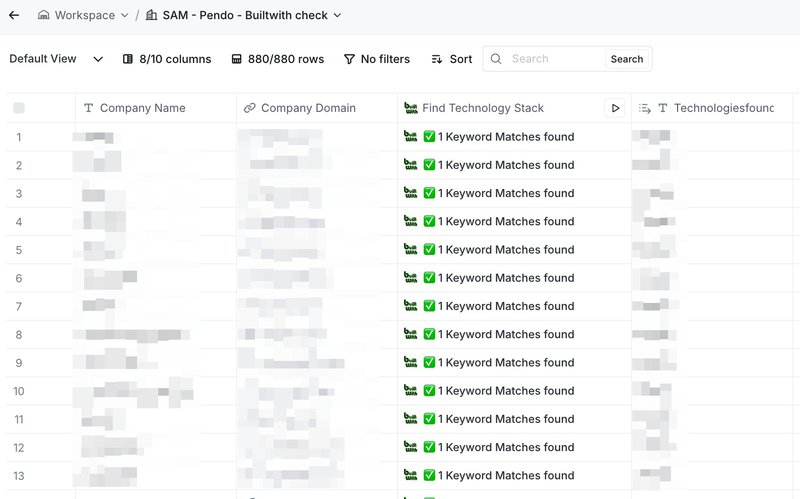
This let us target accounts that not only fit our ICP on paper, but also showed concrete signs they’d benefit from our product.
Once those accounts entered the funnel, HubSpot became the system of record for tracking engagement and progression across ABM programs, supporting alignment across marketing and sales.
And once accounts were converted into trials, Userpilot picked up the baton. We used in-app behavior to validate fit and prioritize follow-up with the most engaged high-value customers.

6. Prioritize platform-native engagement data over third-party tools
When we started running account-based initiatives, I assumed third-party intent data would help us prioritize the right target accounts faster. But in reality, it added more complexity than clarity to our ABM strategy.
As mentioned earlier, we tested website deanonymization and external intent tools alongside our ABM campaigns early on. The promise was better visibility into which key accounts were “in market.”
What we saw instead were low match rates and signals that were difficult to act on. Even after isolating ABM traffic on a dedicated no-index domain, no target accounts were reliably identified. That made it hard for both marketing and sales teams to use the data meaningfully.
That experience changed how I think about signal quality in ABM efforts.
So we stopped chasing inferred intent and focused on direct engagement data from our advertising platforms.
For early ABM stages, we tracked only LinkedIn ad engagement statistics, such as impressions, clicks, and interactions, because these signals were reliable and directly tied to our campaigns. ZenABM pulled this data via API and pushed it into HubSpot weekly, using clear thresholds to move target accounts between stages.
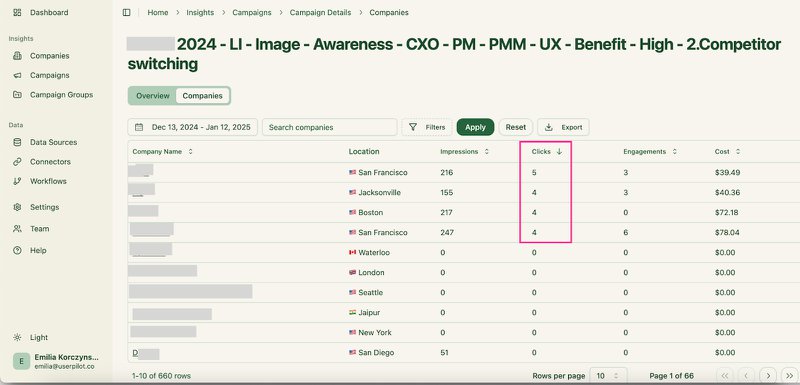
We also made sure to capture qualitative context. Alongside engagement volume, we synced which specific campaigns the accounts interacted with. This gave sales reps a clear context on why an account was warming up and what messaging resonated.
7. Structure campaigns by buying intent, not just demographics
You should structure your ABM campaigns around buying intent (what accounts are trying to achieve) rather than only personas, industries, or company size.
We started persona-first with separate LinkedIn campaigns for PMs, PMMs, CS, and more because it felt like the cleanest way to personalize.
But in practice, it made intent harder to read. Engagement got split across too many small campaigns, and once accounts moved into later stages, some persona audiences became too small to run reliably.
So we rebuilt the structure around intent.
Instead of asking “who is this?”, we asked “what are they signaling interest in?” We grouped campaigns into intent-based campaign groups (each tied to a clear JTBD or pain). Multiple personas could still be included, but the engagement rolled up at the campaign-group level, which made the signal stronger and easier to use for scoring and outreach.
That also gave our BDRs a better context. When an account engaged, we knew they clicked and also which intent theme they clicked into. All of this is because our campaign group’s name was organized by intent.
8. Test asset formats, then double down on winners
You should start with a mix of ad formats so you can see what your audience responds to, then push most of your budget into the formats that consistently drive the next step.
When I first built our ABM campaigns, I didn’t want to guess which creative would work. So we tested broadly across LinkedIn: single image ads, video ads, Thought Leader Ads, DM ads, text ads, and document ads. That gave us clean feedback fast because each format behaves differently in feed, and the cost dynamics aren’t even comparable.
In the first campaign alone, we produced roughly 100 ads across 8 personas. Nevertheless, we didn’t treat all formats equally for long; we followed the performance and concentrated spending where it moved accounts forward.
The results made the decision easy.
According to the LinkedIn ABM Benchmarks Report, Thought Leader Ads (TLAs) outperform many other formats in cost efficiency and engagement. TLAs deliver landing page traffic at a median cost per click of about $3.06, which is roughly 77 % cheaper than single-image ads ($13.23 CPC), and they also show a higher median click-through rate (~2.68 %).
Meanwhile, video ads, despite often receiving a large share of the budget, tend to underperform on CTR and cost efficiency.

Those findings reinforced our own results. Once we identified the formats that worked, we doubled down and used them to support personalized campaigns, tighter account planning, and clearer handoffs between marketing and sales efforts. I know ABM is challenging at every stage, and it’s something we’re constantly refining rather than “solving” once and for all. Even when an account finally signs up, that doesn’t mean the hard part is over. Without context on what happens next, it’s easy to lose momentum or misread intent.
9. Match messaging maturity to funnel stage
You should treat ABM messaging as a progression. One of the biggest mistakes we see in account-based marketing is showing “book a demo” ads to accounts that are still figuring out whether they even have the problem.
In our ABM campaigns, we aligned messaging maturity to the stage. At the top of the funnel, we ran awareness content to build relevance. Once accounts showed real engagement, we moved them into more specific, solution-oriented messaging.
By the time an account reached consideration or selection, the messaging became unapologetically product-led. This is where we leaned into case studies, proof points, and concrete outcomes that matter to key decision makers and multiple stakeholders.
That stage-based structure also made it easier to measure what was working, because we weren’t comparing different messages to the same audience. We were measuring whether the right message helped engage accounts at the right moment.
Later in the funnel, Userpilot becomes our leverage point.
Once a lead is in trial, I look at path analysis to see which areas they navigate through and where they drop off.

I check session replays to understand what they’re struggling with or repeatedly trying to do. Then I pair that with information gathered from a welcome survey (role, goal, biggest challenge) so I’m not interpreting clicks in a vacuum.

That insight flows straight back into retargeting. If trial users from an “Interested” account spend most of their time in analytics dashboards but never activate session replay, we retarget them with “analytics + replay together” proof points and run in-app tooltips that drive them to that feature.
If survey answers say “too many support tickets,” we shift the messaging to in-app education and deflection outcomes.
10. Create dynamic audience flows between campaign stages
You should set up ABM so accounts move themselves through stages. If you’re manually exporting lists and rebuilding audiences every week, you’ll always be behind the data and slow down your account relationships with the right buyers.
The goal is simple. When an account hits an engagement threshold, it should automatically graduate into the next stage and start seeing more relevant messaging. This keeps momentum high and prevents wasted spend on accounts that have already moved past awareness.
We did this by using HubSpot as the routing layer.
Each week, cumulative LinkedIn intent data and engagement scores were pushed into HubSpot at the company level. Active lists were then built around stage thresholds.
When an account crossed a threshold, such as 5+ clicks, it automatically moved from “Identified” to “Interested.” That list membership removed the account from awareness audiences and enrolled it in more solution-focused campaigns.
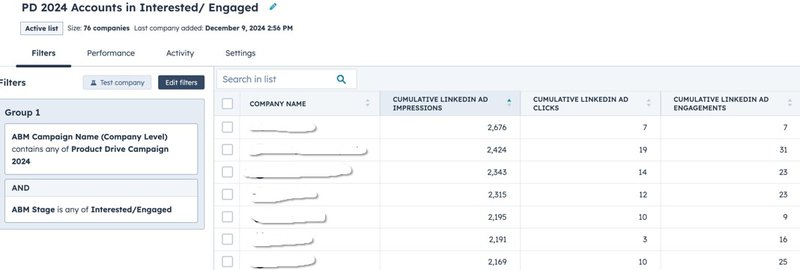
Because those HubSpot lists were synced with LinkedIn Audiences, the audience update carried through automatically. In practice, accounts progressed to the next stage within about 48 hours, keeping our targeting aligned with real-time engagement.
To keep it consistent, we used workflows to update the “ABM stage” company property based on list membership, so sales and marketing teams were always looking at the same stage definition in the CRM.
Upgrade ABM handoffs with in-app insights!
I know ABM is challenging at every stage, and it’s something we’re constantly refining rather than “solving” once and for all.
Even when an account finally signs up, that doesn’t mean the hard part is over. Without context on what happens next, it’s easy to lose momentum or misread intent.
That’s when you need a tool like Userpilot. Not to “fix” ABM, but to keep context once target accounts enter the product. Trial behavior, feature usage, and early friction give you signals that ads and CRM data simply can’t.
So if you want your ABM motion to stay relevant after signup, book a demo!
FAQ
What is account-based marketing?
Account-based marketing (ABM) is a strategic approach in which marketing and sales work together to target key customers rather than broad audiences.
Rather than optimizing for leads, ABM focuses on high-value target accounts that align with clear business objectives, such as pipeline growth or deal expansion.
ABM programs use data to identify the right accounts, prioritize outreach based on sales priorities, and tailor messaging to specific buying teams. Modern ABM relies on marketing automation tools to manage targeting, engagement, and measurement across channels.
At its core, ABM focuses on quality over volume and long-term ABM success through relevance, timing, and coordination across teams.
What is an example of account-based marketing?
An example of account-based marketing is running LinkedIn ads for a defined list of high-value target accounts, then following up only with the companies that show engagement.
Marketing runs ads to those specific companies, tracks clicks and interactions, and passes that engagement data to sales. Sales then contacts the accounts that show interest, prioritizing outreach based on sales priorities instead of form fills.
Throughout the campaign, marketing automation tools are used to manage audiences and track engagement across channels.
What is the 7-11-4 rule of marketing?
The 7-11-4 rule of marketing means buyers usually need 7 hours of exposure, 11 interactions, and 4 channels before taking action. In account-based marketing, this rule is applied to a small set of high-value target accounts instead of a broad audience.
The idea is that repeated exposure across multiple contexts builds familiarity and trust over time. These touchpoints can include ads, emails, social posts, website visits, sales conversations, or product interactions.
The rule highlights that no single message or channel drives conversion on its own. Consistent visibility across several places is what moves buyers toward a decision.
About the author