UXCam Pricing: A Product Manager’s Take on Value, Cost, and Alternatives


UXCam is a powerful mobile app analytics solution that provides session replays, heatmaps, and other behavioral insights, specifically tailored for iOS and Android devices. But when evaluating whether it fits the company budget, you hit a wall: UXCam pricing details aren’t public, and you’ll need to sit through a couple of sales calls to get a ballpark number.
To save you time, I analyzed real-world data from Vendr, G2, and Reddit to uncover the average cost of UXCam, where the real value lies, and when an alternative might be more suitable for product growth.
An overview of the UXCam key features and use cases
UXCam is a mobile-first analytics tool primarily used by product managers, UX designers, and app developers to identify usability issues and optimize user journeys. Here are seven features that I find most valuable:
| Feature | What it does | Why it matters |
|---|---|---|
| Session replay | Records real user sessions, gestures, and user interactions. | Helps teams see exactly where users struggle; speeds up debugging. |
| Heatmaps | Shows aggregated taps, scrolls, and element interaction patterns. | Identifies confusing UI elements and missed CTAs; informs redesigns. |
| Event analytics | Automatically captures custom events and lets you visualize them via different reports. | Measures key KPIs without heavy dev work. |
| Funnel analytics | Tracks drop off across multi-step flows. | Helps improve onboarding, checkout, and conversion-critical flows. |
| User journey analytics | Visualizes the steps users take before/after key events. | Reveals common paths, loops, and friction areas in navigation. |
| Performance monitoring | Tracks crashes, ANRs, slow screens, UI load time, and logs capture. | Helps prioritize severe stability issues impacting retention. |
| Issue alerts | Sends alerts for crashes, frustration patterns, anomalies, or performance issues. | Allows teams to respond proactively before issues escalate. |
How does UXCam pricing work?
UXCam uses a hybrid pricing structure that combines three plans (Starter, Growth, and Enterprise) with a usage-based model. Each plan includes a fixed set of features, and your final cost depends on the number of monthly sessions you expect.
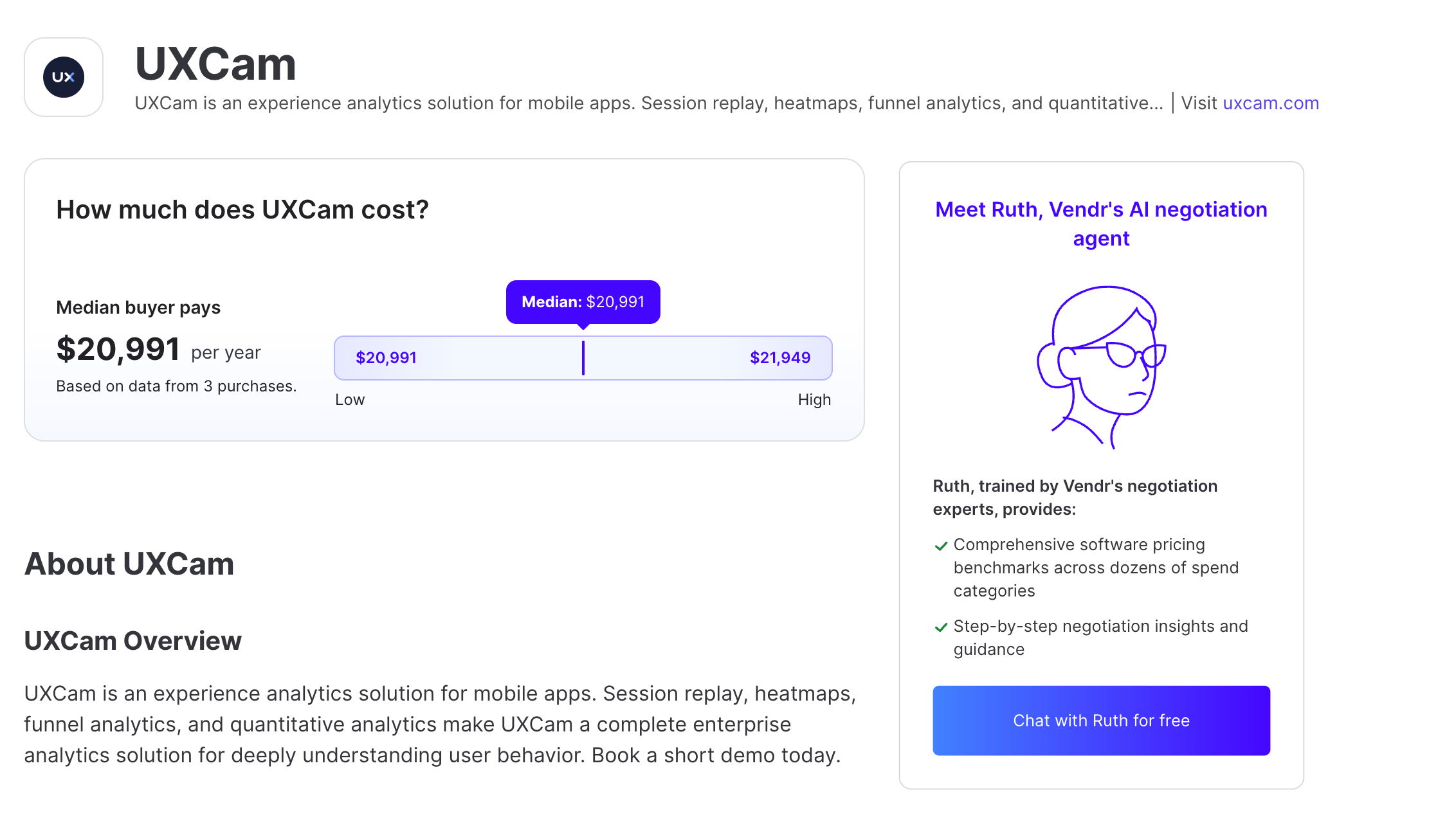
UXCam doesn’t publish its pricing. However, third-party benchmarks offer some clarity. According to Vendr, the median price companies pay for UXCam is about $20,991 per year.
Breakdown of UXCam pricing plans
Now let’s go over the offered tiers, examine what each includes, including customer support, and which types of teams they’re suited for.
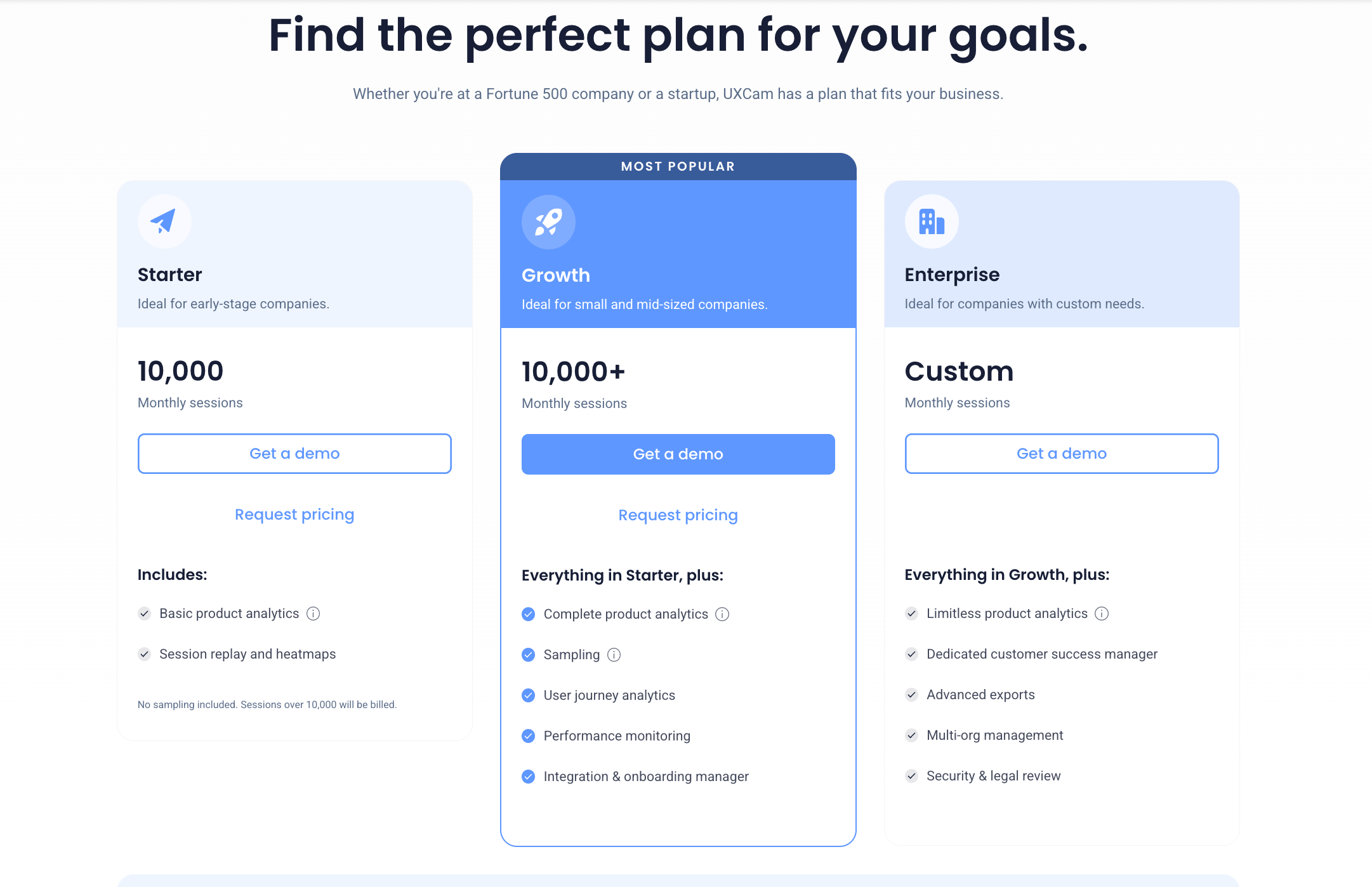
Starter plan
Best for: Early-stage startups or small teams just getting started with user analytics
- Supports up to 10,000 tracked sessions.
- Covers 2 apps and 5 user licenses.
- Provides core user behavior analysis tools, including session recordings, heatmaps, and rage tracking.
- Comes with 1 dashboard, 3 funnels, and basic retention reports.
- Stores session data for 12 months and video replays for 1 month.
Growth plan
Best for: Product teams that have moved beyond the MVP stage and need deeper analytics.
- Supports 5 apps and offers 10 team seats.
- Introduces Smart Events( autocapture).
- Upgrades you to 5 dashboards, 10 funnels, plus more detailed retention reports and cohort analyses.
- Adds performance-monitoring features such as crash analysis, error tracking, session log tracking, and UI freeze monitoring.
- Allows bulk CSV data exports to work with raw data outside the platform.
- Includes personalized onboarding setup and integration support.
- Doubles data access with 24-month session retention.
Enterprise plan
Best for: Large organizations with advanced needs, multiple teams, and custom requirements.
- Offers custom user seats and data retention up to 60 months.
- Provided unlimited customizable dashboards, funnels, and reports.
- Includes a data export API and visualization export, helpful for teams with external reporting tools or BI workflows.
- Offers premium support options such as regular strategy sessions and a private Slack channel.
- Adds enterprise-grade security features like SAML SSO, multi-organization administration, and granular permission controls.
Why do companies choose UXCam?
If the UXCam cost is so high, how come thousands of companies worldwide choose it? The answer is simple: For its intended purpose, UXCam is one of the strongest tools on the market. Here are the capabilities that matter to these companies:
- Fast implementation with an optimized SDK: UXCam’s SDK is powerful yet unobtrusive. Integration is simple, often just a few lines of code, meaning you can start collecting meaningful insights within minutes. Behind the scenes, the SDK’s optimized architecture ensures minimal impact on app speed, memory usage, and battery consumption.
- Industry-leading gesture analytics: UXCam captures the full spectrum of mobile-specific user interactions, including taps, swipes, pinches, rage taps, and unresponsive gestures, all with exceptional precision. This level of granularity goes beyond what traditional analytics tools provide, empowering product teams to uncover friction points unique to mobile experiences.
- A truly holistic view of the user experience: UXCam brings product analytics, qualitative UX insights, and performance monitoring into a unified platform. This ecosystem eliminates data silos and provides context-rich insights, which in turn allows cross-functional teams to stay aligned and connect symptoms with root causes.
Reasons to reconsider investing in UXCam
While UXCam offers strong analytics capabilities, the platform also has several drawbacks that may reduce your overall ROI. Before committing, it’s worth weighing the implications, such as:
UXCam’s pricing model may hinder product-led growth
UXCam’s session-based pricing model means that as new users deepen engagement and adopt your product, your user sessions count rises, and so does your bill, while revenue stays the same. The product doesn’t truly “grow with you”; rather, it punishes your success.
On top of that, the model makes forecasting costs extremely difficult. Session volume can spike due to feature releases, A/B tests, or even bugs that trigger repeated sessions. These unpredictable swings often lead to unexpected charges.
To avoid this, most modern analytics platforms charge based on Monthly Active Users (MAU). Whether a user logs in once or a hundred times, the cost to you remains constant. This aligns the tool’s cost with your revenue potential-you generally make money from the number of users, not sessions. Additionally, this model allows for accurate forecasting.
UXCam’s web analytics features are relatively basic
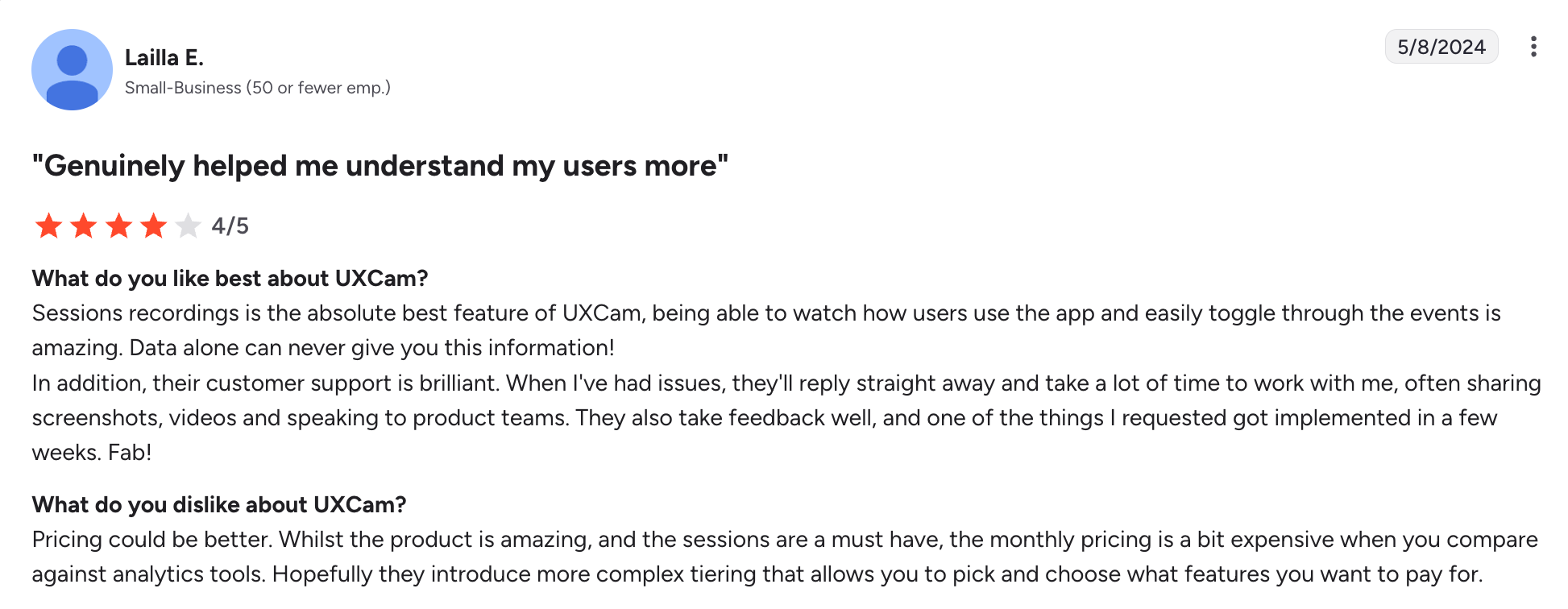
UXCam was built as a mobile analytics tool; the web apps layer was only added a year ago, and it shows. While its mobile capabilities are strong, the web product feels more like an afterthought: lighter, less detailed, and not nearly as mature.
On G2, users often note that funnels, journeys, and behavioral breakdowns don’t offer the same depth as platforms designed for the web from day one. Segmentation is less flexible, cross-platform context is harder to piece together, and key analysis features like funnels aren’t as robust.
UXCam lacks the tools to act on the collected insights
Data is useless if you can’t act on it. Indeed, for many product managers, the goal of analytics is to drive adoption. Imagine spotting a user struggling with using a feature in a session replay. Your logical next step is to trigger an in-app tooltip to guide them in real time. With UXCam alone, you can’t. Instead, you must purchase an additional engagement solution or ask engineers to code guidance into the product. Both options slow you down. Both add to your cost structure. And both create unnecessary operational complexity.
Analytics market leaders like Amplitude and FullStory already account for this and have begun evolving into full Digital Experience Platforms, adding embedded guidance so teams can move from insight to action instantly.
Userpilot: A better alternative for PLG SaaS teams
Userpilot is an all-in-one software designed to help product teams understand user behavior and act on it to improve satisfaction.
It offers the same core analytics capabilities you’d find in UXCam, but expands far beyond them with multichannel engagement and product feedback tools. Because everything works without code, even non-technical users can install, customize, and launch growth experiments quickly.
Why choose Userpilot over UXCam?
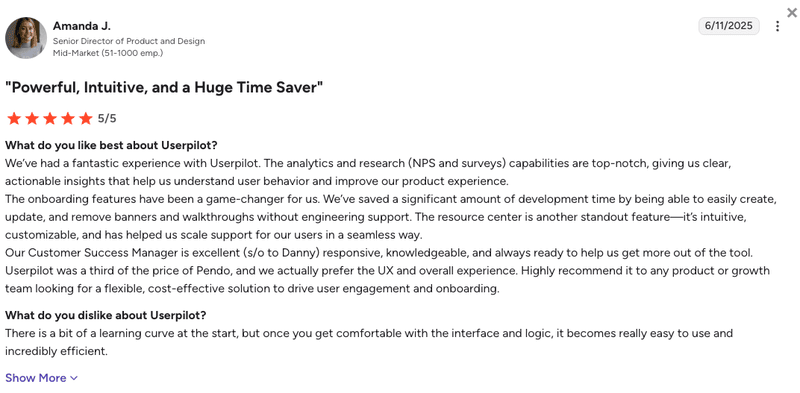
A few core strengths make Userpilot a more practical choice for product teams that want to move faster and act on insights without heavy developer effort. Let’s discuss them:
Predictable MAU-based pricing
Userpilot offers a clear, MAU-based pricing model that aligns with product-led growth.
This transparent pricing structure also simplifies decision-making across teams. Product managers can experiment freely without needing to check usage dashboards, and finance teams can model growth scenarios with greater accuracy.
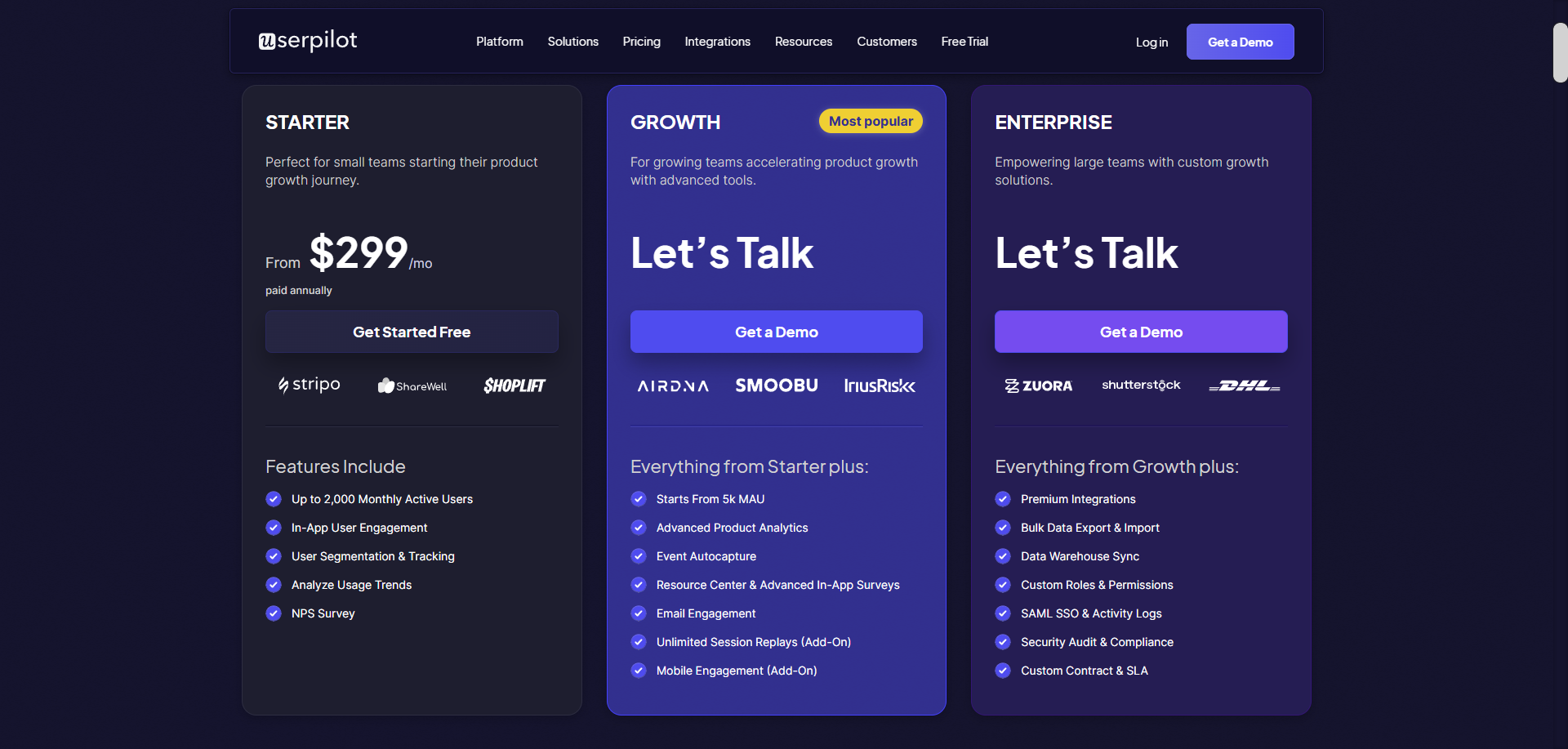
Here’s a quick overview of the three pricing tiers:
- Starter: $299/month (billed annually): It is designed for small teams who need unlimited in-app experiences, core analytics, and feedback tools at an accessible entry price.
- Growth: Custom pricing: Adds advanced segmentation, A/B testing, localization, and mobile app support.
- Enterprise: Custom pricing: Includes everything from Growth plus priority support, dedicated CSM, advanced security, and custom integrations.
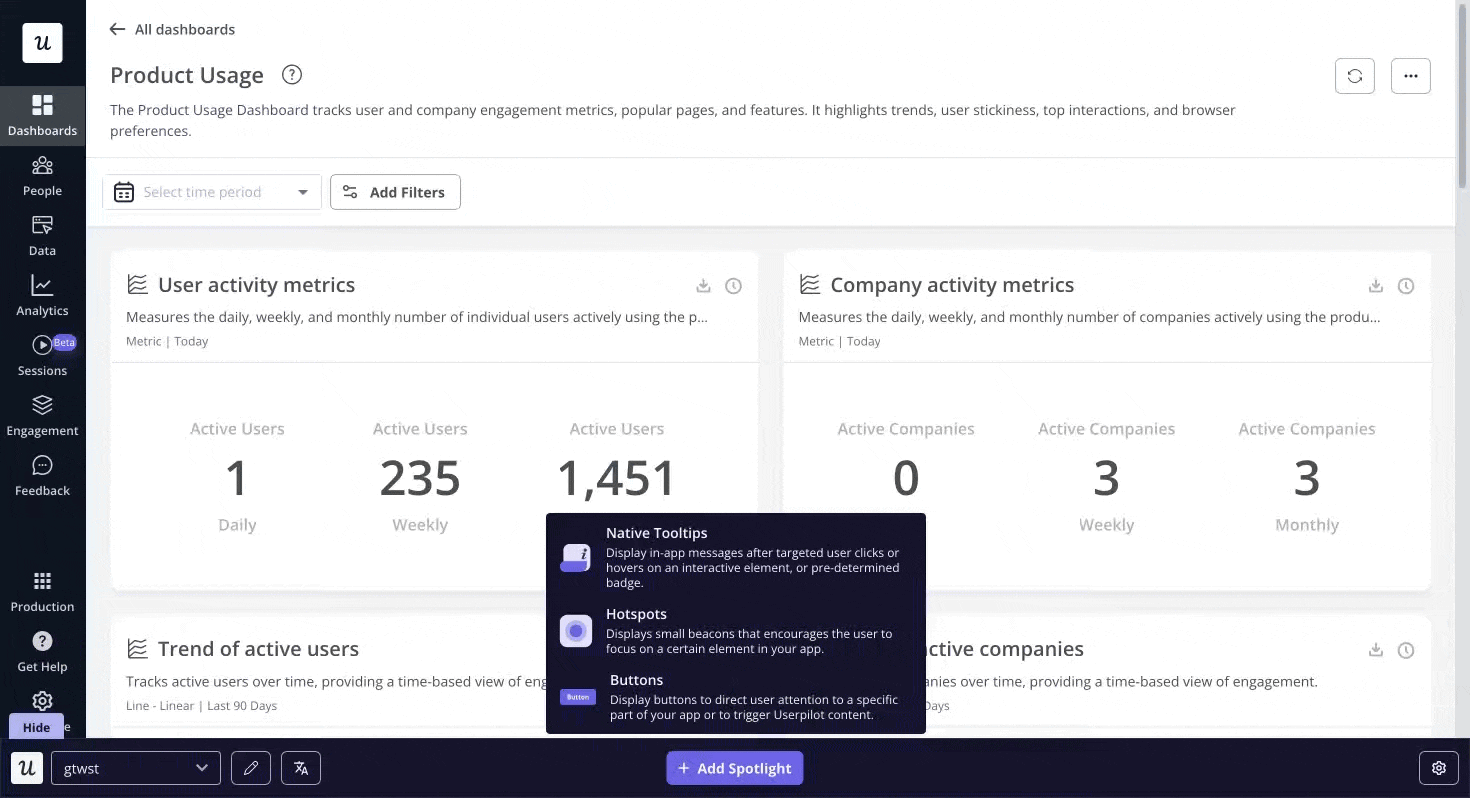
Engagement features to act on data right away
When the data points to friction or opportunity, you can roll out in-app experiences that address it without writing a single line of code.
For instance, if Userpilot analytics reveal that trial users who skip a key feature rarely convert to paid, you can automatically trigger an in-app flow to guide them toward it.
Afterward, you might reinforce the same message with a follow-up email or push notification to bring them back to the app. This seamless coordination between in-product and external channels keeps users connected wherever they are, driving continuous engagement.
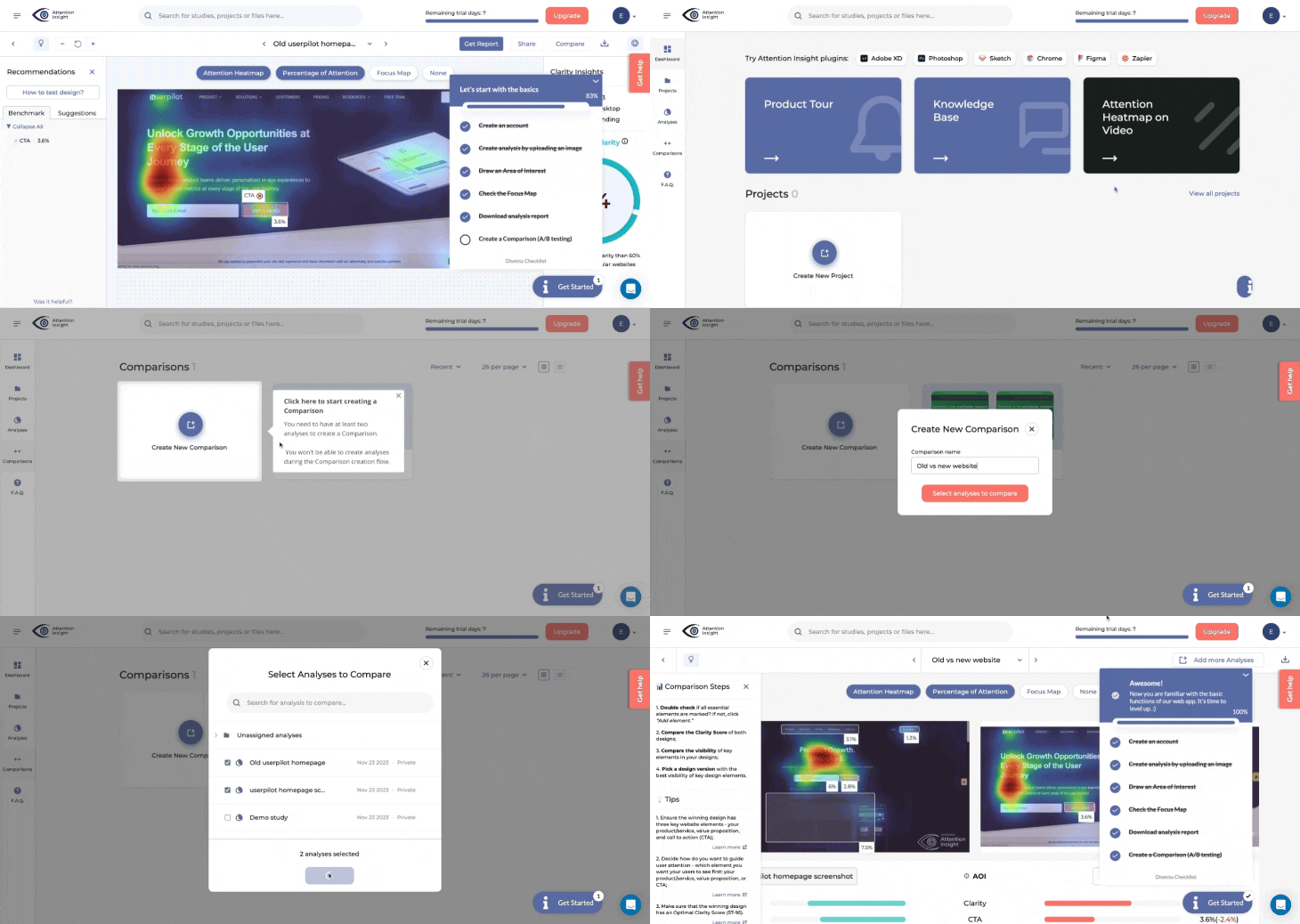
That’s exactly what Attention Insight achieved after adopting Userpilot. The team discovered that trial users weren’t converting because they didn’t stay long enough to experience the platform’s value. Using Userpilot, they built interactive walkthroughs code-free to guide new users more effectively. The result? A 47% boost in activation within a short time.
Final verdict: Is UXCam worth the investment?
If your product is a standalone mobile app, UXCam is the gold standard. Choose UXCam if you need a microscope to debug specific mobile usability issues, gestures, and crashes in a siloed mobile environment. Also, be prepared for the opaque and unpredictable pricing.
However, for the majority of B2B SaaS companies, a unified product growth platform like Userpilot offers a higher ROI by combining analytics with action. Instead of passively watching a session replay where a user struggles, Userpilot allows you to immediately deploy mobile content like carousels and slideouts to guide them. On top of that, Userpilot offers pricing MAU-based pricing tiers that grow with your product.
Ready to see how Userpilot helps you turn insights into growth? Book a demo today.
Userpilot strives to provide accurate information to help businesses determine the best solution for their particular needs. Due to the dynamic nature of the industry, the features offered by Userpilot and others often change over time. The statements made in this article are accurate to the best of Userpilot’s knowledge as of its publication/most recent update on December 27, 2025.
FAQ
What is UXCam?
UXCam is a product and UX analytics platform that helps teams understand user behavior through tools like session replays, heatmaps, event tracking, funnels, and user journey analysis.
Is UXCam suitable for web apps analytics?
Yes, UXCam supports web analytics and provides a mix of quantitative metrics and qualitative UX insights.
Does UXCam have a free plan/ trial?
Yes, UXCam offers a 14-day free trial for Starter and Growth plans.
About the author