
Early in my career, I treated product roadmaps like Gantt charts. I would list features in a neat column, assign arbitrary release dates like “Q3,” and hand them to stakeholders as a promise. It felt productive. It looked organized.
Six months later, when the market shifted, a competitor launched a feature, or user needs evolved, that rigid document became a liability rather than a guide.
I found myself apologizing for missed deadlines on features that no longer mattered. Meanwhile, the engineering team burned out trying to hit dates we’d guessed at during a planning meeting months earlier. We were shipping code, without moving the needle.
A true product roadmap is a strategic communication tool and visual roadmap that aligns your organization around the “why” and the “what” before getting bogged down in the “how” and the “when.” Think of it as your product strategy translated into a visual plan that everyone, from engineering to sales, can rally behind.
Without a clear roadmap, even strong teams waste time building things nobody needs. You need a plan that bridges the gap between product vision and day-to-day execution.
Here’s how I approach product roadmap planning so you can build a plan that actually works.
Try Userpilot Now
See Why 1,000+ Teams Choose Userpilot

What a product roadmap is and what it isn’t
Before we start building, let’s clear up the terminology. Confusion here is a common source of friction between Product, Sales, and Engineering.
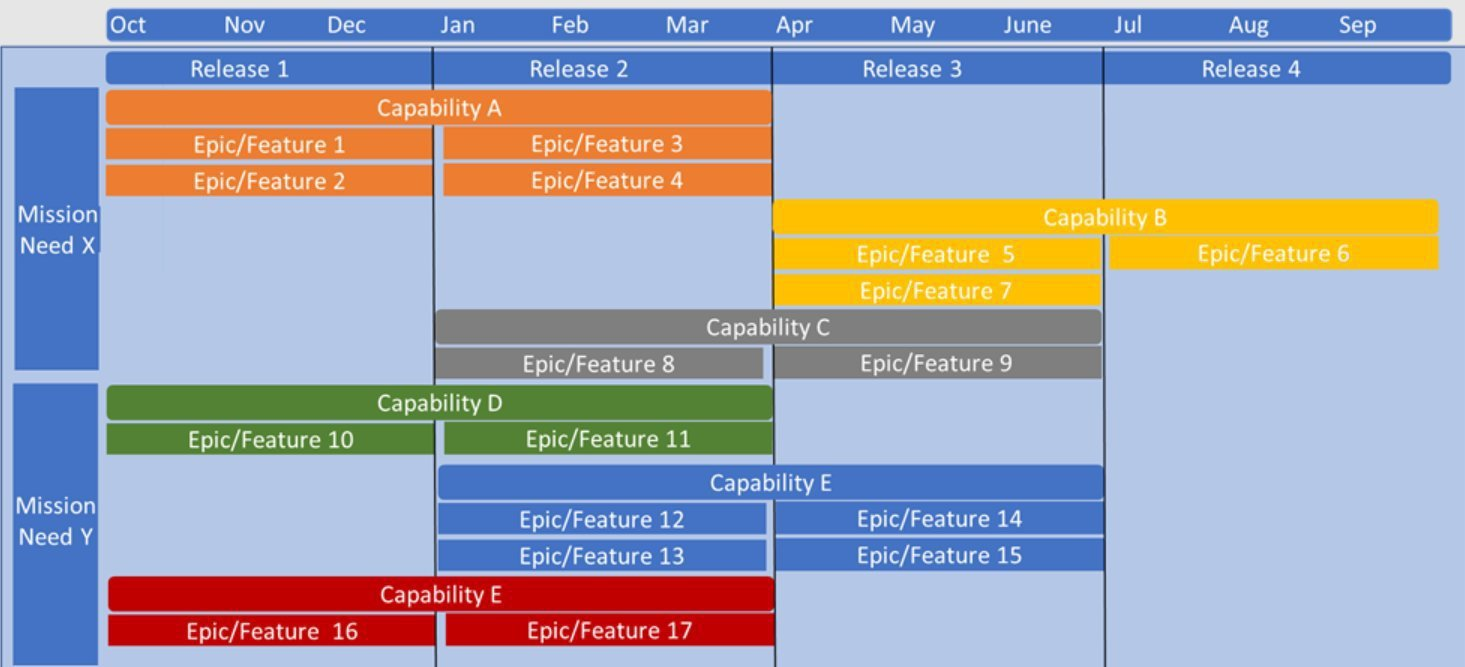
A product roadmap is a shared source of truth that outlines the vision, direction, priorities, and progress of a product over time. It serves as the strategic narrative for how you plan to achieve your business goals.
It is not a product backlog
A backlog is a tactical to-do list. It contains bugs, user stories, technical debt, and granular tasks. The backlog helps the development team manage sprints. The roadmap helps the organization understand direction. If your roadmap reads like a list of tickets, you’ve lost the strategic thread.
It is not a project plan
Project plans focus on resource allocation, delivery dates, and critical paths. A roadmap may reference timeframes like “Now, Next, Later,” yet its role remains strategic alignment, not micromanagement. A project plan explains when a release will happen. A roadmap explains why that release matters.
When I look at a roadmap, I want to see where the product is headed. I want to see how we plan to solve user problems and move toward product-market fit. If all I see is a list of features with deadlines, the team is optimizing for output rather than outcome.

Build Features Users Love by Powering Your Product Roadmap Planning with Userpilot
How to create a product roadmap
Before you open a roadmap tool or start listing features, you need to step back. Roadmap planning is less about sequencing work and more about deciding what deserves attention in the first place. This section focuses on the groundwork that makes every later decision easier and defensible.
Phase I: Define strategy and inputs
Many Product Managers skip this phase and jump straight to features, which creates feature-factory roadmaps. The pre-work is where the real strategy happens.
Specify your product vision
Your product vision is your North Star. Why does your product exist? What problem are you trying to solve for users? If a roadmap item does not move you closer to that vision, question whether it belongs.
I start planning sessions by revisiting our strategic plan and product strategy framework. Every roadmap item should ladder up to a broader goal. This prevents scope creep disguised as “nice-to-have” work and makes prioritization decisions clearer.
Collect the inputs that shape the roadmap
A roadmap built in a vacuum is destined to fail. You need data to validate your intuition. I look at three main sources of input:
- Market research: What competitors are shipping, market trends, and where the competitive landscape is moving. This helps identify market gaps your product can realistically fill.
- Internal stakeholders: Sales and other stakeholders understand what prospects ask for. Customer Success sees why users churn. Engineering flags technical debt that puts the platform at risk.
- User feedback: I rely on user research and automated customer feedback collection to contradict internal assumptions. If you are not listening to the voice of the customer, you are guessing.
Define success metrics upfront
How will you know if a roadmap initiative worked? Metrics need to be defined before anything is built. Focus on outcomes you can act on rather than vanity metrics like raw signups.
I prefer to define a North Star Metric that aligns incentives across teams. For individual initiatives, I use goal-setting frameworks like OKRs. If a roadmap item is “Revamp onboarding,” the key metric should be “Increase activation rate by 15 percent,” instead of simply launching the new UI.
Phase II: Prioritize and structure the roadmap
Once you have your inputs and goals, you will end up with a list of ideas far longer than your engineering capacity. This is where the real work begins.
Prioritize what matters most
Prioritization is the discipline of saying “no” to good ideas so you can say “yes” to the ones that matter most. You cannot rely on gut instinct here, or the loudest voice in the room will decide for you.
I use a feature prioritization matrix to score key initiatives based on impact versus effort. In some cases, we use the RICE model (Reach, Impact, Confidence, Effort). This removes emotion from the decision-making process. A stakeholder request should not displace a critical infrastructure initiative that affects most of your users.
Choose outcomes over timelines
The format you choose shapes how your team thinks and works. I advocate for outcome-based roadmaps over timeline-driven ones.
Timeline roadmaps, such as “Feature X by Jan 15,” create a culture centered on deadlines. Outcome-based roadmaps organize work around themes like “Improve user retention” or “Expand into the enterprise market.” Within those themes, cross-functional teams explore and prioritize specific features using agile methodologies.
I use a simple now next later roadmap structure:
- Now: Initiatives actively in progress. Specs are defined and designs are ready.
- Next: Problems that are clearly defined, but where solutions are still being validated.
- Later: Long-term bets that matter strategically, but remain flexible based on what we learn in Now and Next.
Account for dependencies
Even without strict dates, dependencies still exist. Some work must happen before other work can begin.
Product marketing cannot launch a campaign until a feature is ready. More importantly, frontend teams cannot build interfaces until backend APIs exist. When planning the roadmap, I surface these critical dependencies early to avoid teams sitting blocked or working in the wrong order.
Use milestones to align teams
Key milestones represent progress and alignment points rather than calendar commitments. They help teams track progress across functions.
A milestone might be “Beta launch,” “Feature parity with a key competitor,” or “First 1,000 enterprise users.” These checkpoints keep everyone moving in the same direction.
If Engineering defines a milestone as “Backend complete” while Marketing plans for “Public launch” on the same day, you have a problem. Marketing needs lead time to prepare assets and campaigns. Mapping milestones early exposes these gaps before they turn into delivery issues.
Phase III: Govern and evolve the roadmap
A roadmap is ineffective if no one sees it or if it is created once and never revisited. Governance is about keeping the roadmap visible, relevant, and trusted as a collaborative process.
Tailor roadmap views to each audience
Never show the same roadmap to everyone. Different key stakeholders need different levels of detail. Most product roadmap software and feature roadmap tools allow you to present multiple views from the same underlying data.
- Executives: Focus on strategy, ROI, and market impact. Show themes and outcomes.
- Developers: Highlight dependencies, technical constraints, and acceptance criteria.
- Customers: Keep the view aspirational and flexible. Avoid specific dates and focus on what’s coming next, not what ships on a given day.
The first two views represent your internal roadmap. The customer-facing view functions as your external roadmap.
Create a continuous feedback loop
If you keep the roadmap hidden until it feels “perfect,” you have already failed. Share drafts early.
I review the roadmap with engineering leads to check feasibility before committing to the business. I share it with sales and marketing to confirm alignment with go-to-market activities. This early feedback loop surfaces issues and builds buy-in because internal stakeholders feel involved in shaping the plan.
Treat the roadmap as a living document
Markets change. You learn new things. Your roadmap must evolve.
I review our roadmap monthly and run a deeper review quarterly. If it stays unchanged for a year, it signals the team isn’t learning fast enough. An outdated roadmap actively damages trust when reality diverges from what you published.
Changes still need justification. Update requires a clear ‘why’ that connects to business objectives and desired outcomes. Tie decisions back to the product vision. “We’re delaying Feature X to prioritize Feature Y because customer data shows Y reduces churn” is a defensible change that maintains stakeholder alignment.
How Userpilot supports data-driven roadmap planning
A data-driven roadmap depends on understanding what users actually do and where they struggle. Userpilot provides product usage data and feedback signals that help teams validate priorities before and after roadmap decisions.
Understand current product usage
You cannot plan the future without understanding the present. Our Core Feature Engagement Dashboard helps teams track progress on usage trends and adoption rates for their most important features.
If a core feature shows low adoption, the right roadmap response involves fixing the existing experience rather than adding more functionality. This keeps roadmap decisions grounded in real usage instead of assumptions, ensuring strategic focus on what matters.
Collect user input with in-app surveys
User feedback remains a non-negotiable input. Userpilot supports in-app surveys that gather feedback at scale and in context.
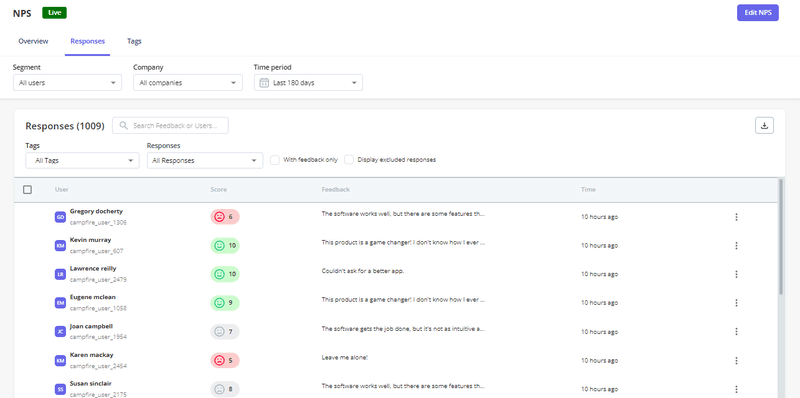
Teams can target specific segments, such as power users or recently churned users, and ask what they need next. NPS surveys and feature request forms help validate demand and feed the backlog with input tied to real users. This transforms customer feedback into actionable customer insights rather than relying on internal opinions.
Use retention and churn data to guide priorities
A roadmap should improve retention. Shipping features without improving retention signals a prioritization problem.
Our User Retention Dashboard shows whether recent releases are actually keeping users engaged. Churn analysis highlights where users drop off in the journey. When a consistent friction point appears, addressing it becomes a clear, high-impact roadmap decision that drives business outcomes.
Measure feature adoption after release
Releasing a roadmap item means you need to understand whether new functionality is being used. Release is the beginning, not the end.
Userpilot allows product and development teams to track feature adoption without code by tagging UI elements and monitoring interactions. This data informs the next roadmap cycle. High adoption may justify further investment, while low adoption may point to onboarding or discoverability gaps.
Segment users to prioritize effectively
Not all users derive value in the same way. Enterprise and SMB users often have different customer needs.
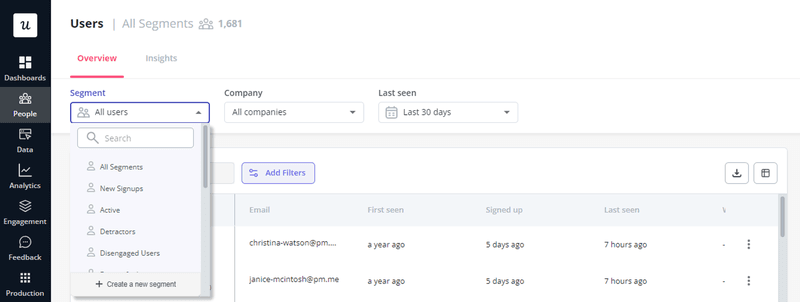
User segmentation makes it possible to analyze these groups separately. A feature may be critical for enterprise accounts and irrelevant for smaller teams. These insights help teams shape roadmap initiatives that serve distinct segments instead of forcing a single solution across all users.
Making the product roadmap work in practice
A product roadmap serves as a living system that helps product teams adapt as customer needs and priorities change. Strong roadmaps rely on clear vision, reliable inputs, disciplined prioritization, and ongoing communication with cross-functional teams.
Shifting from output (features and dates) to outcomes (problems solved and value delivered) turns the roadmap into a decision-making tool that aligns business goals with execution. Data plays a key role here. Understanding feature adoption and user behavior helps teams validate priorities and adjust strategic direction.
Userpilot supports this approach by helping product managers track feature usage, collect in-app feedback, and identify friction that should inform future roadmap decisions. The platform provides the customer satisfaction metrics and behavioral data that keep your good roadmap grounded in reality rather than guesswork.
You can book a demo with Userpilot to see how product data supports roadmap planning and measure progress toward your strategic goals.
Scale Your Strategy and Optimize Product Roadmap Planning with Userpilot
About the author


![What are Release Notes? Definition, Best Practices & Examples [+ Release Note Template] cover](https://blog-static.userpilot.com/blog/wp-content/uploads/2026/02/what-are-release-notes-definition-best-practices-examples-release-note-template_1b727da8d60969c39acdb09f617eb616_2000-1024x670.png)


![10 Free Product Roadmap Templates You Need in 2026 [+Free Download] cover](https://blog-static.userpilot.com/blog/wp-content/uploads/2026/01/10-product-roadmap-templates-you-need-in-2026-free-download_d8269f0b0b9749f6ad7b519ab7ac1833_2000-1024x670.png)