How Jiminny Connects Analytics with In-App Engagement to Drive Feature Adoption and Renewals


Jiminny is a market intelligence platform that helps sales, customer success, and revenue teams capture, analyze, and act on customer interactions. From call recording and conversation intelligence to CRM enrichment and AI-powered insights, Jiminny gives customer-facing teams a complete view of deal health, team performance, and customer sentiment.
| ⚙️ Challenges | Without clear visibility into adoption patterns and the ability to act on insights in real time, Jiminny’s product team risked building in the dark. They needed a solution to connect product analytics with in-app engagement and remove engineering bottlenecks. |
| 🏆 Solutions | ✅ Jiminny combines Userpilot’s analytics with in-app engagements to track feature adoption and act on the data in real time. ✅ Role-targeted in-app guides support onboarding and new feature releases, leading to an increase in user activation and product adoption ✅ No-code event tracking lets the Head of Product label events with no developer involvement. ✅ Trends analytics and custom dashboards help the team monitor adoption patterns across every product launch. |
Challenges: Driving adoption at scale with limited visibility and high developer dependency
Jiminny’s product has evolved significantly from conversational intelligence into a full go-to-market intelligence platform. With an annual subscription model, keeping users engaged and ensuring strong feature adoption is critical for retention and growth.
Before Userpilot, the team faced several obstacles:
- No scalable way to announce and guide: Jiminny previously relied on emails to announce new features. Because of that, the communication had limited reach, and the team couldn’t showcase the features hands-on.
As Galya Dimitrova, Head of Product at Jiminny, explains:
“We used to send emails about new features only to managers and admins, hoping they would inform their teams. Now, in-app engagement helps us reach all the users. Without Userpilot, the adoption would definitely be lower on all of our features.”
- Limited visibility into feature adoption: The team lacked an easy way to track customer interactions with individual features. Without adoption data broken down by user role and segment, it was hard to know where to focus product marketing efforts.
- Developer dependency for tracking: Setting up and maintaining event tracking required engineering involvement, creating bottlenecks whenever the product team needed new data.
Solutions: Connecting analytics with targeted engagement to act on data in real time
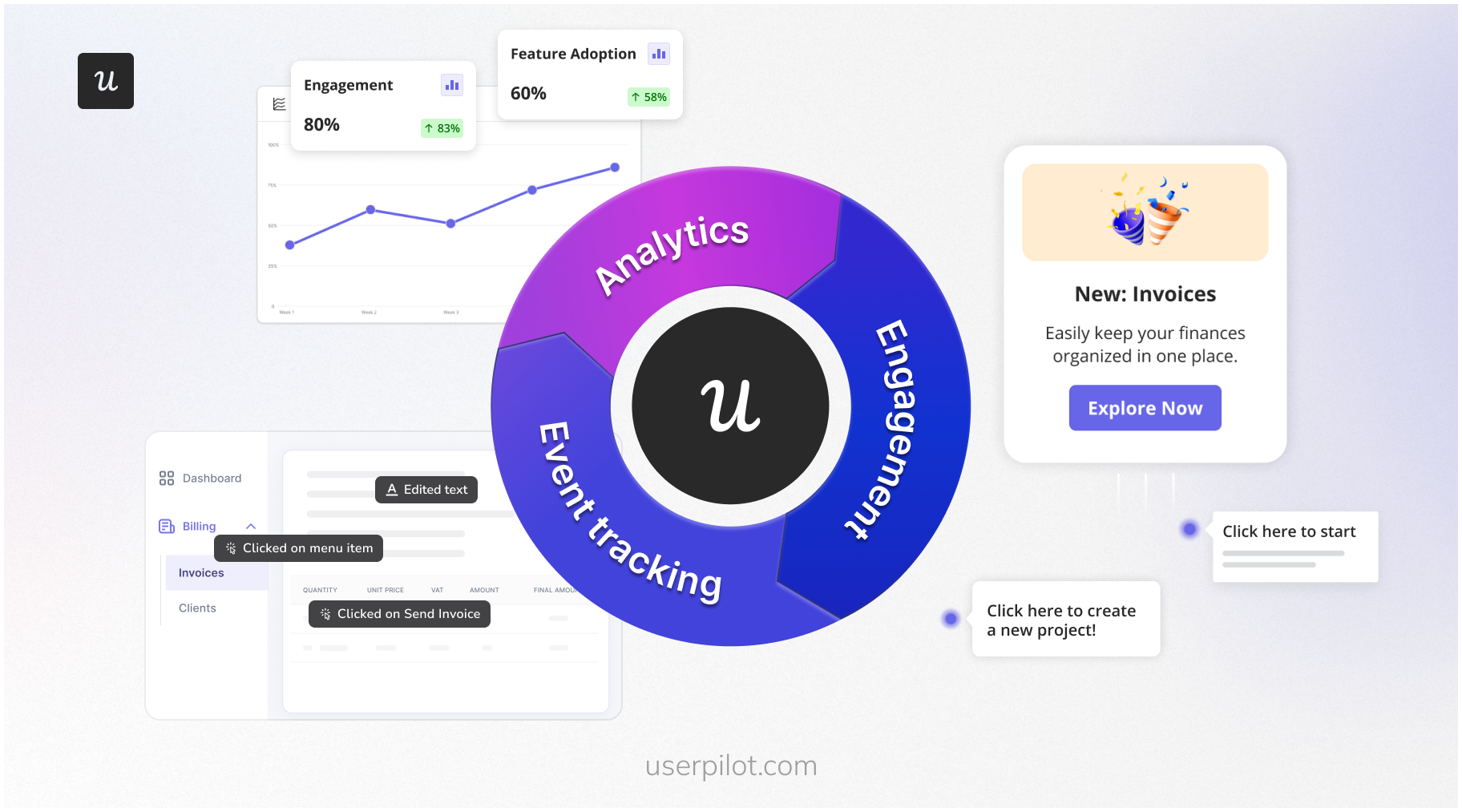
Jiminny adopted Userpilot as a unified platform for both product analytics and in-app engagement. The decision was driven by the need for a tool that could combine no-code event tracking, behavior-based targeting, and contextual engagement flows in one place.
No-code event tracking and trends analytics for adoption monitoring
Galya sets up event tracking herself using Userpilot’s visual labeler. This approach eliminated the need for engineering involvement every time the team wanted to track a new feature.
The team relies on trend analytics report to monitor adoption after every launch. Galya tracks both total usage and individual user activity to distinguish genuine adoption from a small group of power users driving the numbers.
“For new feature adoption, I monitor total clicks, but I also segment them by individual users. I want to see whether there are specific users that are just power users, and that’s causing the fluctuation.”
If a feature isn’t gaining traction, they respond with a follow-up tooltip or modal to re-engage users. Each subsequent nudge produces an additional spike in adoption, though typically smaller than the initial one.
“Userpilot has become an important part of how we launch new features. With in-app flows, we can make sure users actually discover and try them. Tooltips in particular create an immediate spike in engagement because they encourage users to explore what’s new.”
Segmented in-app engagement for product announcements and onboarding
Every medium-to-large feature release at Jiminny is accompanied by an in-app announcement built in Userpilot.
Segmentation lets Galya tailor messages to specific user roles (recorders, managers, admins) and subscription tiers. For customers on higher tiers, announcements walk users directly into the new functionality. For lower-tier users, the team still communicates the update but redirects them to learn more or contact their CSM.
Jiminny has also refined its approach to in-app messaging over time. Seeing that users tended to close multi-step flows after the first step, the team shifted to single-action elements.
“We segment our flows by user roles and focus on presenting the most valuable features for each group. We also segment by the pricing plan. Sometimes, a feature is available out of the box on higher plans. For lower plans, we still want to let the users know it exists, so we show them educational content or encourage them to contact their CSM.”
Driving renewals and personalized follow-ups for enterprise customer success
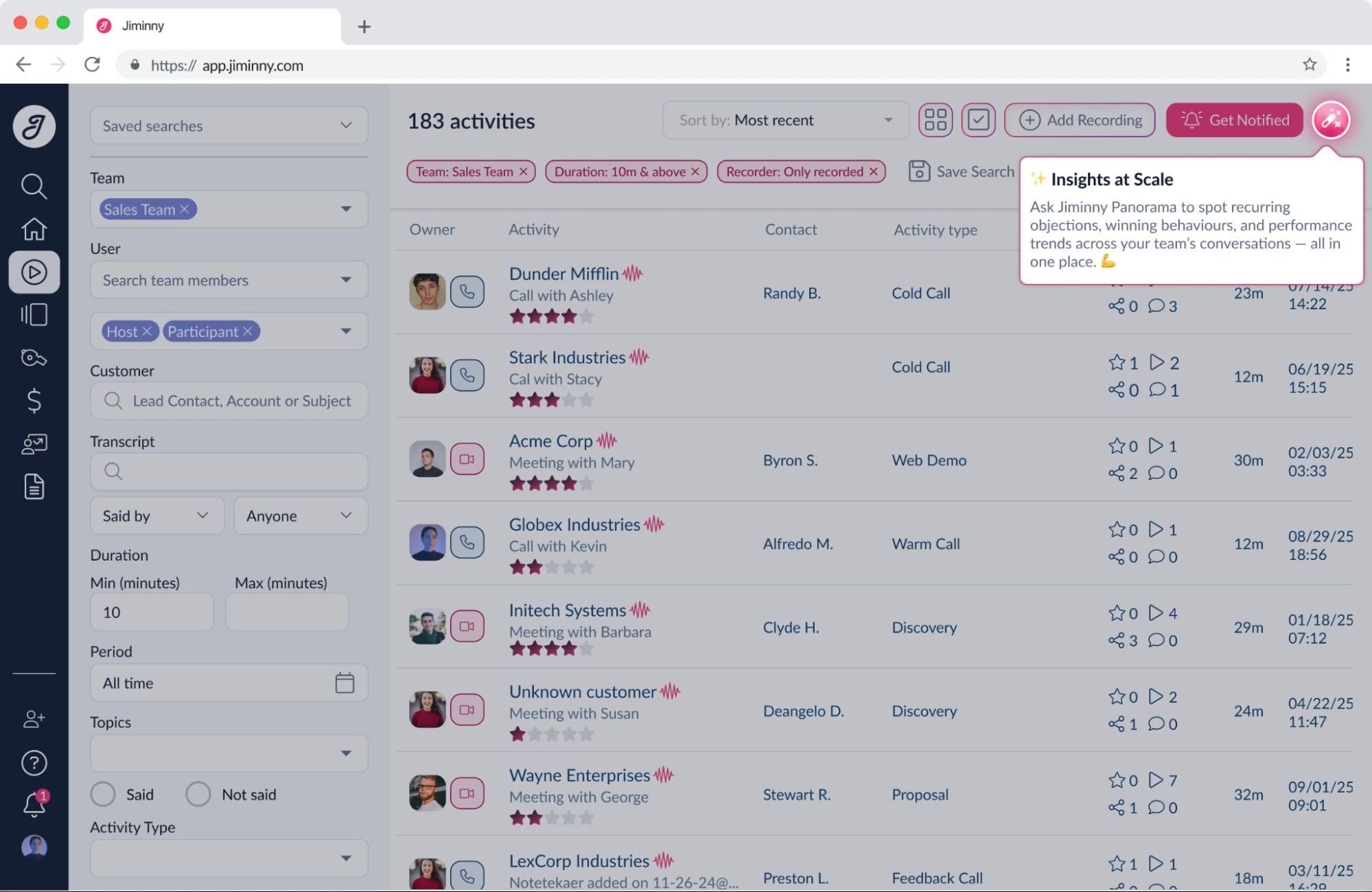
Jiminny’s customer success managers use Userpilot hands-on for post-training follow-ups and encouraging renewals. They monitor feature usage and set up custom Userpilot flows tailored to specific enterprise accounts. As Galya told us,
“The customer success team often works with me so that we can set up some flows that are specific to the customers’ goals.”
Results: Data-backed launches, faster iterations, and adoption that compounds over time
By connecting Userpilot’s analytics to in-app engagement, Jiminny has built a repeatable process to drive feature adoption across every product launch.
Measurable adoption impact across every launch
Every in-app announcement produces a visible spike in adoption. The team sets targets, such as 70% of target-tier customers using a feature within three months, and tracks progress through trends data. For features requiring ongoing engagement, adoption is monitored through return-visit metrics segmented by role.
79% renewal rates for users with custom onboarding flows
Beyond the product team, Jiminny’s customer success managers use Userpilot to monitor feature adoption during renewal conversations, identify gaps, and focus customer attention on underutilized features. The custom flows that support customer onboarding for Jiminny’s larger customers support 79% of renewals.
“79% of the customers for whom we had launched custom flows renewed for another year and are still with us.”
Eliminated developer dependency for tracking and engagement
With Userpilot’s no-code event labeler and the team’s practice of assigning stable element IDs, Galya handles event tracking independently. She creates, launches, and iterates on events and flows without engineering resources, freeing developers to focus on building the product.
Data-driven product prioritization in day-to-day operations
Userpilot’s analytics have become embedded in Jiminny’s daily decision-making. When a customer request comes in, the team checks actual usage data before committing development resources. They deprioritize features used by only a handful of customers in favor of higher-impact work.
“When a feature request comes in, we always look at the data first. If the related feature has very low adoption, it’s usually not something we prioritise on the roadmap.”
Key takeaways: Using analytics-driven engagement to build a repeatable adoption engine with Userpilot
Jiminny’s success with Userpilot demonstrates how connecting product analytics with in-app engagement influences feature adoption and smart development prioritization. Here’s how other teams can apply the same approach:
- Use no-code event tracking to own your data. Userpilot’s visual labeler lets product teams set up and maintain tracking independently, removing engineering bottlenecks and ensuring data is always up to date.
- Connect analytics directly to engagement. Don’t just collect data, but act on it. Launch guides for new features to ensure the customers notice and use them. Check trends data to identify underperforming features, then respond with targeted in-app nudges to close the gap.
- Keep in-app messages short and action-oriented. Single-action engagements with minimal copy outperform multi-step flows when users are short on attention.
- Segment every engagement by role and tier. Different users need different messages. Segmentation ensures relevance and prevents notification fatigue.
- Build an iteration loop. Track, engage, measure, improve. Each cycle drives adoption higher and gives your team more confidence in product decisions.
As Galya summarizes:
“Userpilot is definitely a great tool. It has helped my team and me a lot in our daily, monthly, and quarterly activities. We can see how our work impacts our customers, but also ensure that we can make informed decisions about where to go next and what needs improvement.”
About the author