How to Think About Your App Monetization Strategies in the Post-AI Era (Beyond Usage-Based Pricing)


Vibe-coding is changing the conventional app monetization strategies, and it’s not making them easier.
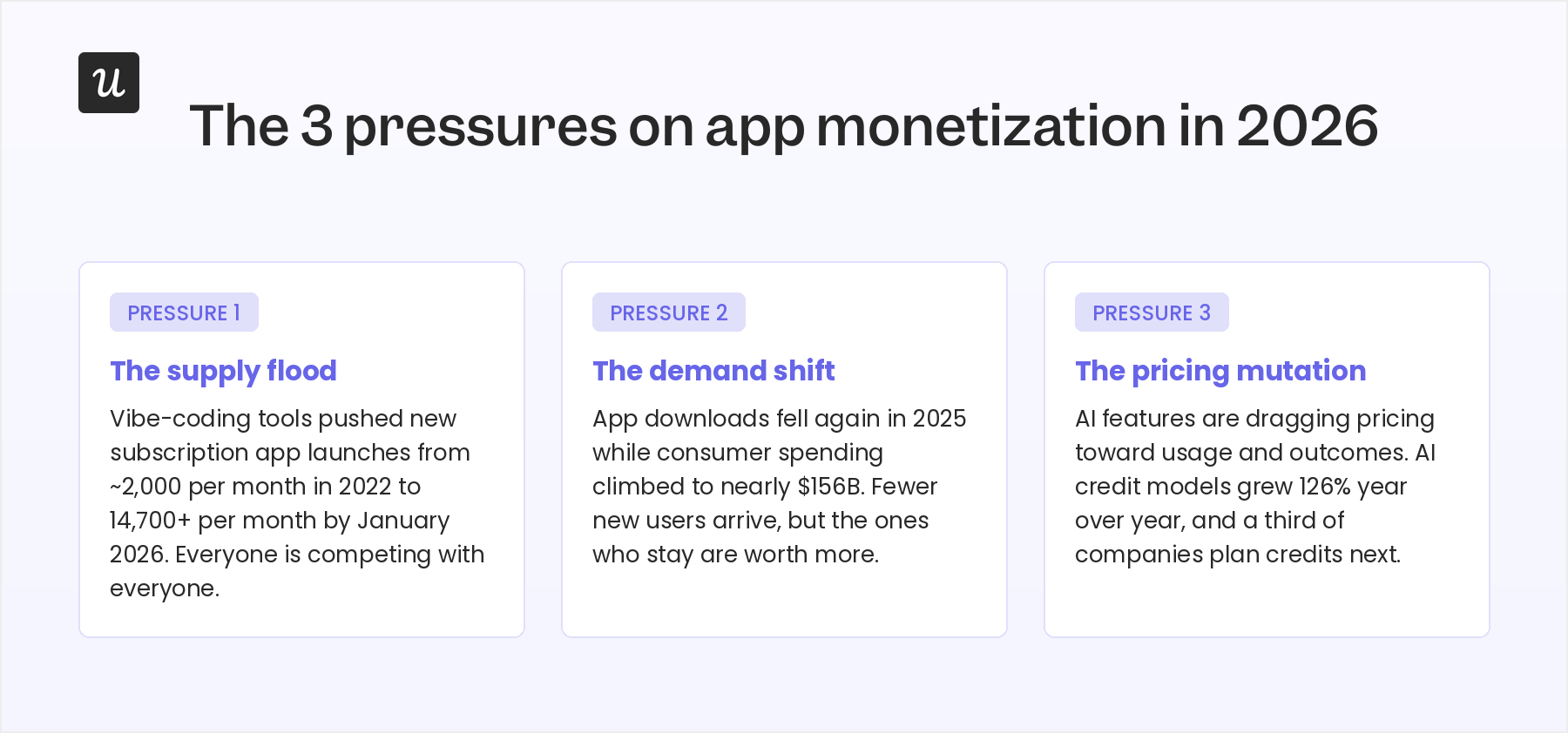
In Q1 2026 alone, developers submitted 235,800 new apps to the App Store, 84% more than the previous quarter. Yet, global app downloads fell 2.7% in 2025 to 106.9 billion, while consumer spending inside apps climbed 21.6% to $155.8 billion. People are downloading fewer apps and paying more for the ones they keep.
This level of competition makes user acquisition and product growth harder than ever, so you must get more value from each user. And for me, the only way to get more revenue from users is to provide even more value before they pay.
I didn’t want to rewrite another list of the same models everyone talks about, so this guide does three things:
- Show what the post-AI app economy actually looks like.
- Give you a practical way to choose and combine monetization models for your app.
- Walk through the strategies that still work for each model in 2026.
The state of mobile app monetization in 2026
Mobile apps usually relied on downloads as a signal of growth. But that’s probably the wrong metric to aim for today. Vibe-coding tools let almost anyone ship an app in a weekend, driving an 84% jump in new App Store submissions in a single quarter and prompting Apple to crack down on the flood of vibe-coded apps.
Additionally, according to RevenueCat’s State of Subscription Apps 2026 (built on 115,000+ apps and $16 billion in tracked revenue), new app launches grew from roughly 2,000 per month in early 2022 to more than 14,700 per month by January 2026.
More apps competing for flat demand produces winner-take-most economics. The same RevenueCat report found that the top 10% of apps grew revenue by 306% year over year, while the median app grew just 5.3%.
For app developers, this changes what’s viable. In-app advertising only pays when you have serious traffic volume, and a crowded store makes that initial user base harder to win. Hence, the era of shipping a free app and living off banner ads is effectively over for new apps.
Then there’s the AI pricing wave. Kyle Poyar, former OpenView operating partner and author of the Growth Unhinged newsletter, polled 230 software companies for his 2026 State of B2B SaaS and AI Monetization report and found AI credit models grew 126% year over year, with adoption at 29% and another 33% of companies planning to introduce credits within 6 to 12 months. His conclusion is clear:
“The general trend is moving away from charging for access to software (seats) and toward a model of charging for the work delivered by a combination of software and AI agents (usage, outcomes).”
You see this shift happening with Salesforce’s Agentforce (which uses per-conversation pricing), HubSpot’s outcome-based pricing (for its Breeze AI agents), and Intercom’s Fin pricing (moving from resolutions to outcomes). Users are more conservative with their spending, but they’re willing to spend more if they’re only paying for what they use.
How to get your app monetization strategy right in 2026
There has never been one best way to monetize a mobile app. But today, the cost of a weak monetization strategy is higher, because a crowded store punishes apps that ask for money before delivering value.
Also, you don’t have to commit to a single monetization model; you can mix and match them across different segments, features, and growth stages. What matters is that your users can get as much, if not more, value for what they pay.
Here’s what you should do to choose the best monetization strategy for your app:
- Understand your app and its users: For example, a meditation app used ten minutes a day has different monetization potential than a travel app opened twice a year, so study user engagement frequency and spending habits before picking a model.
- Segment before you monetize: Different user segments will prefer different models, and customer segmentation tells you which users are candidates for premium features versus ad-supported free tiers.
- Match the model to your growth stage: Early on, it’s recommended to go for low-friction models like freemium or in-app advertising to build your user base. And once the user base is stable, introduce premium tiers. You can focus on maximizing lifetime value through expansion and customer loyalty once your app is more mature.
- Watch out for trial length: Apps keep shifting to 3-day trials even though shorter trials convert worse for most categories. My recommendation is to set the free trial length based on your average time-to-value instead of benchmarks.
- Experiment with strategies consistently: Track mobile app retention, customer churn, and unit economics continuously, and make constant changes to your prices. Don’t expect to get your monetization right at first.
App monetization models and strategies in 2026
Now, to better understand what your app needs, let’s go through each monetization model: how it works, where it fits, and essential customer retention strategies:
1. Freemium model
The freemium model offers a basic, free version of your product while charging for premium or advanced features or capacity. It trades short-term revenue for reach, which is exactly why it dominates acquisition.
Wes Bush, founder of ProductLed, has tracked this for years: when companies first go product-led, 75% choose a free trial or freemium model, but only about 9% of free accounts convert to paid. So I recommend treating freemium as a user acquisition engine that you can combine with other strategies.
Find the right balance between free and paid features
The key to your free tier is to include just enough to help users achieve a meaningful outcome, because that’s what builds the trust needed to convince users to upgrade. This is why premium features are often left for advanced use cases and power users.
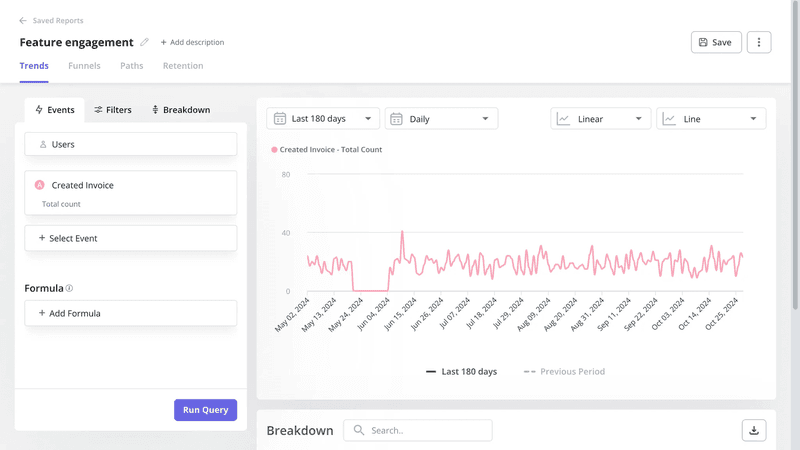
I recommend using product analytics to find which features correlate with long-term app retention and shape the retention curve. This is because feature adoption metrics can reveal which features used by highly engaged users are strong candidates for the paid tier. For instance, you can use trend reports to see which features are popular among different user segments, so you can use product feature analysis to decide what to give for free or gate based on data.
Use reverse trials to compress time-to-value
A reverse trial starts every new user in the premium experience, then drops them to the free tier when the trial ends. It works because users who have already experienced premium features will feel their absence, and loss aversion does the selling for you. It also keeps the free tier alive as an opportunity to lure users into upgrading.
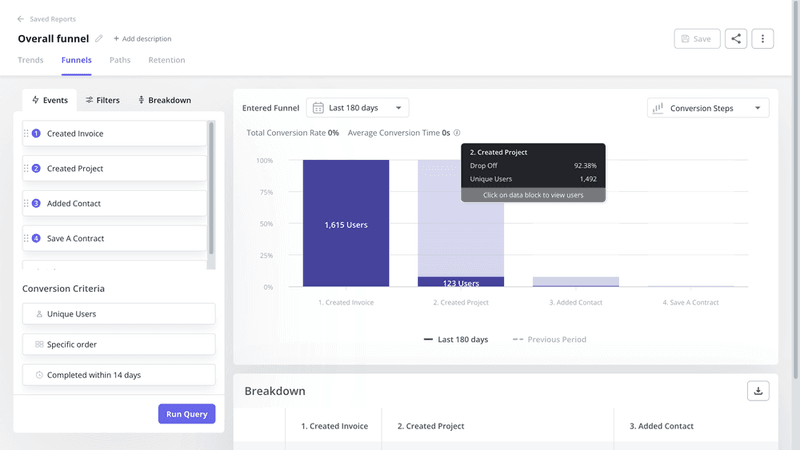
Now, to determine the trial length, I recommend checking your activation metrics. If your app delivers its “Aha!” moment within 3 days, a 7-day trial gives users a buffer to build a habit. For example, you could use funnel analysis on your activation events to see how many days it takes for users to adopt your product.
2. In-app advertising
This model involves displaying banner, native, and video ads within your app and earning from impressions or clicks.
Although it’s becoming old-fashioned, in-app advertising still works. But only when you have the traffic to nurture it, which is becoming harder for any new app given the immense competition.
Here are my recommendations for in-app advertising:
Implement contextual and targeted ads to improve relevance
Many free apps spam users with irrelevant ads, which turns off users. I recommend using demographic data and user behavior patterns to deliver ad formats that match user interests and the app context, such as a meditation app showing ads for meditation books, and so on.
Note: Make sure to block competitor ads in your ad network settings before they appear in your own product.
Incorporate rewarded ads to increase engagement
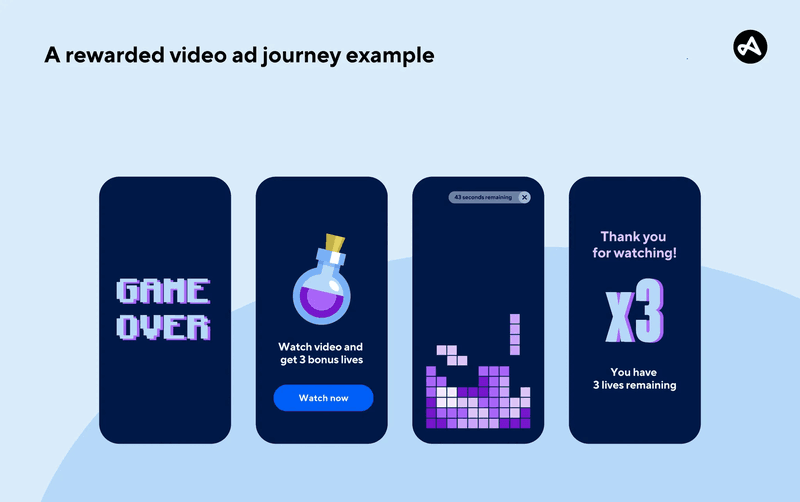
Rewarded ads let users choose to watch a video ad in exchange for something they want, like extra lives in mobile games or continued free access in utility apps. Because users opt in, completion rates are high, and the friction is lower than usual (though not non-existent).
In fact, users who engage with rewarded ads are more likely to make in-app purchases. Just make sure to cap volume at 3-4 ads daily to prevent fatigue, and keep the user experience under the user’s control.
3. Subscription model
The subscription model charges recurring fees for ongoing access, creating more predictable revenue than other models.
That said, subscription fatigue is more common today; every new paid subscription now competes against six or seven other apps that add up to the user’s budget. For this model to work, you must focus on increasing user retention; it’s pretty much an essential part of the subscription model rather than a separate strategy.
Here are some best practices for healthier subscription revenue:
Design tiered subscription plans for different user segments
Multiple subscription plans with increasing benefits let you serve individual users and teams from the same product. A productivity app can sell timers and courses to individuals while an upgraded team plan adds organization-level tracking.
Make sure each tier has a clearly defined value proposition that justifies the price gap, and offer both monthly and annual billing with a discount for the longer commitment. Annual plans retain better simply because payment friction occurs once a year rather than 12 times.
4. Paid app
This model is for apps that charge an upfront, one-time fee for the download. The paid app model gives immediate revenue and a clean value proposition. However, it faces fierce competition from free alternatives and might cap your expansion revenue.
Here’s what I’d recommend for this model:
Deliver continuous value with free updates and paid expansions
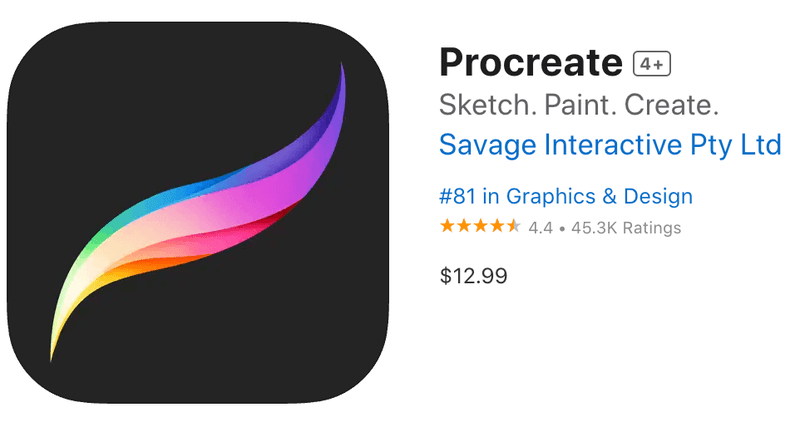
Users who paid once still expect ongoing value, so ship minor updates for free to show commitment while charging for major feature packs. Procreate is an example of this, regularly adding brushes and tools for free while monetizing bigger releases.
Bundle the app with related products or services
Bundling multiple products increases their perceived value, which is the scarcest resource in the paid model. If you have multiple apps, you can cross-promote across your own suite with bundle pricing. Even if you don’t, it’s possible to bundle complementary services instead, like a gallery app pairing with cloud storage. Anything that increases the perceived value of the one-time price works in your favor.
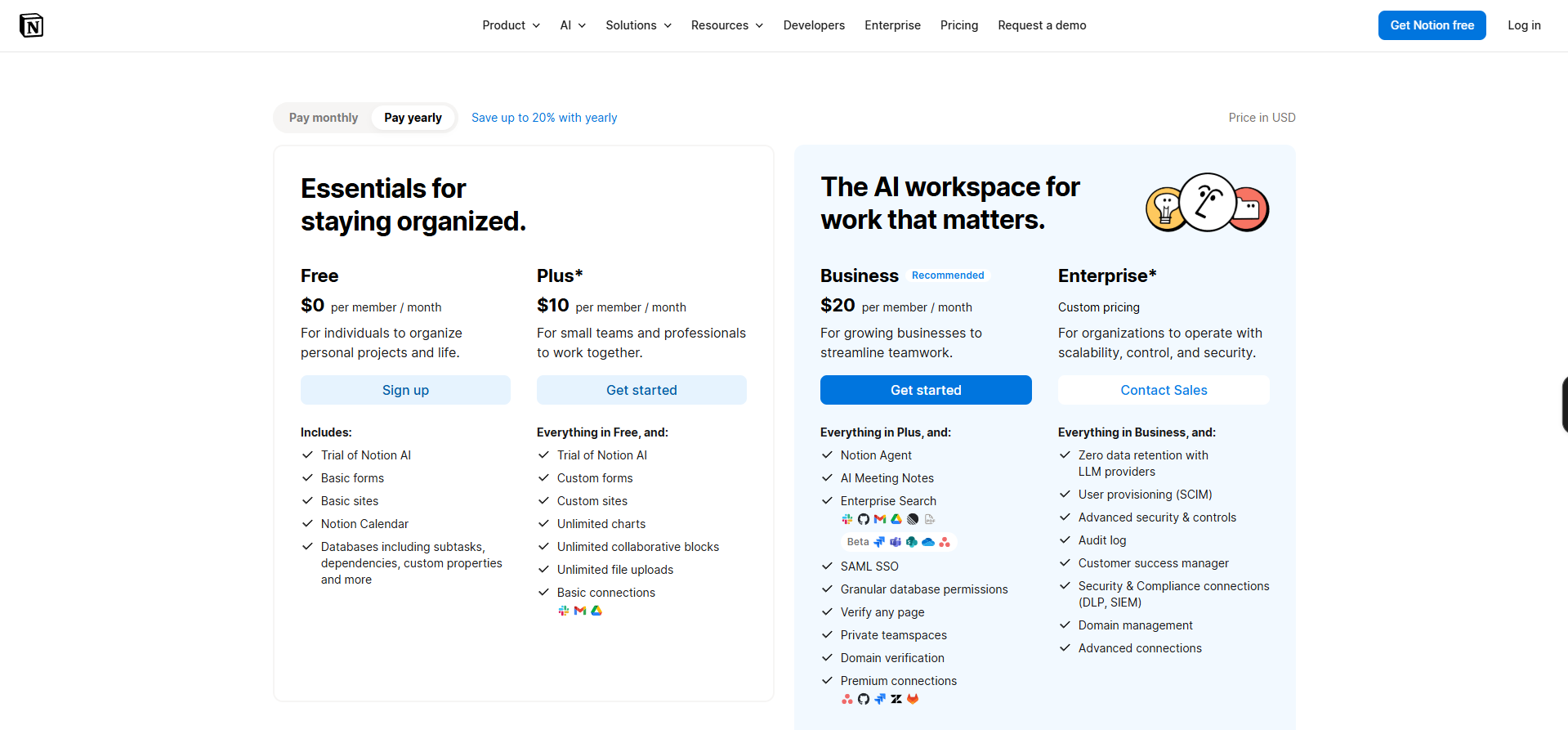
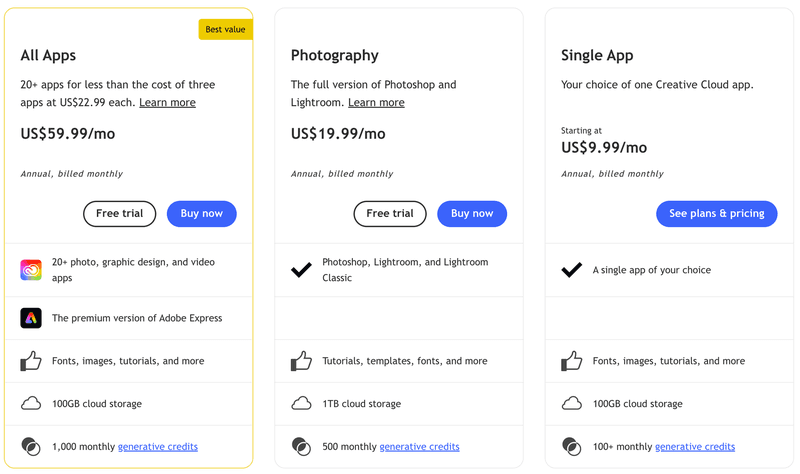
For instance, Adobe sells apps individually, a photography suite (including Photoshop and Lightroom), and an all-in-one plan with 20+ products.
5. In-app purchases
This model is usually for marketplaces or ecommerce apps that sell digital goods as one-off transactions. It’s the single largest share of app revenue (especially in gaming), as it pairs naturally with freemium and hybrid stacks, where you can offer in-app purchases or microtransactions.
Use limited-time offers at natural friction points
The psychological principle behind limited discounts is loss aversion, where users fear missing out more than they desire gaining something. This fear incentivizes them to make a purchase decision quickly.
In general, it’s best to trigger this fear at natural friction points. For instance, someone hitting their storage limit fears losing photos, a language learner hitting the daily lesson cap fears losing a streak, a gamer out of lives fears losing progress. Those are the exact moments to surface a limited-time storage upgrade, a discounted tier, or a pack of in-game items.
Personalize purchase recommendations with behavioral data
Offering personalized recommendations reduces friction behind promotions and makes users more likely to purchase. For instance, you can analyze in-app events and use in-app surveys to understand why users repeatedly tap a premium feature, then offer that segment a targeted discount as the final push.
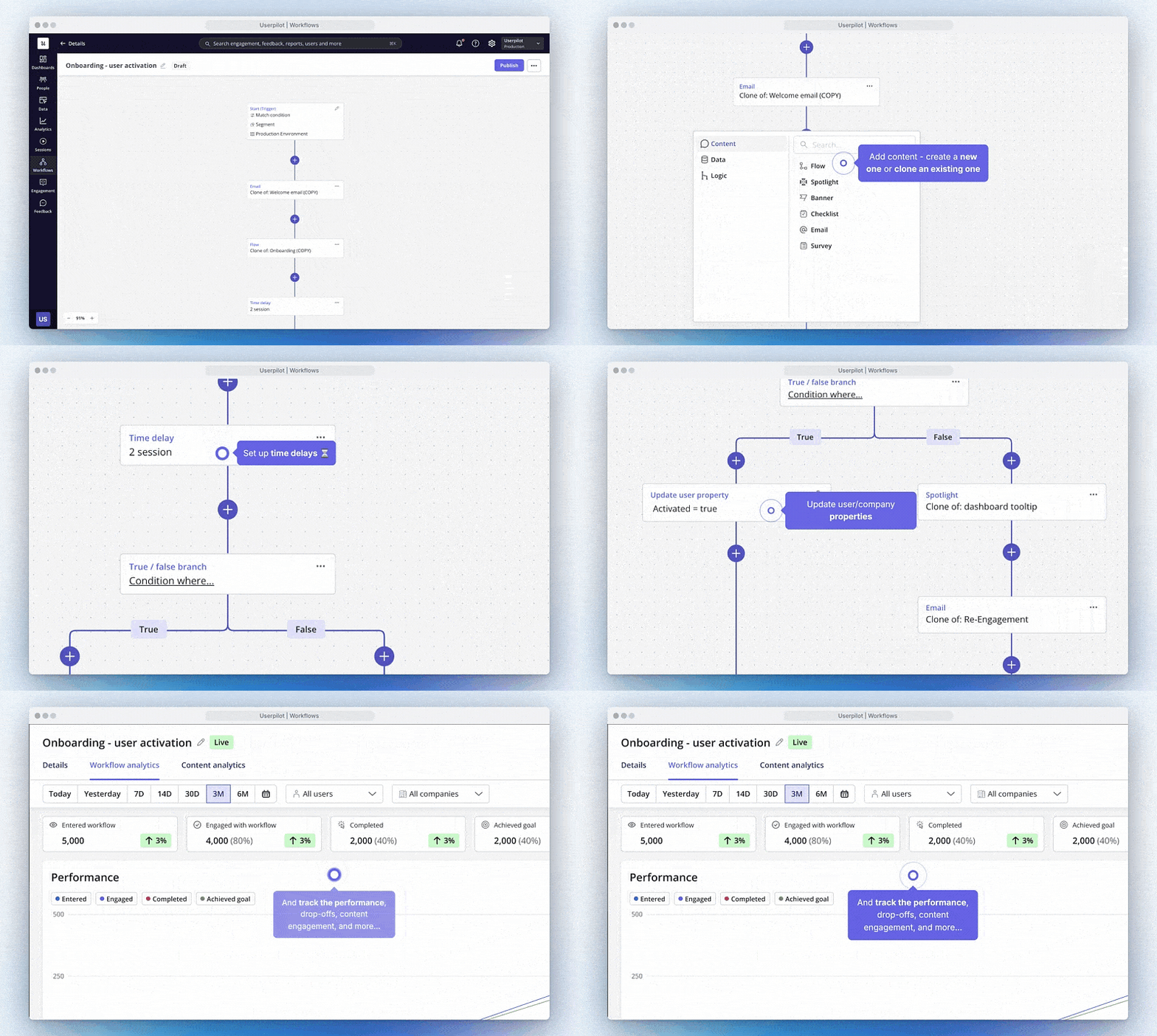
At Userpilot, we can build a behavioral segment once and reuse it for in-app purchases, onboarding, surveys, and analytics, with no engineering needed. With Lia (Userpilot’s AI agent), you just describe the format and the variations you need, and it drafts the targeted experiences and segments for you instead of you duplicating each one manually.
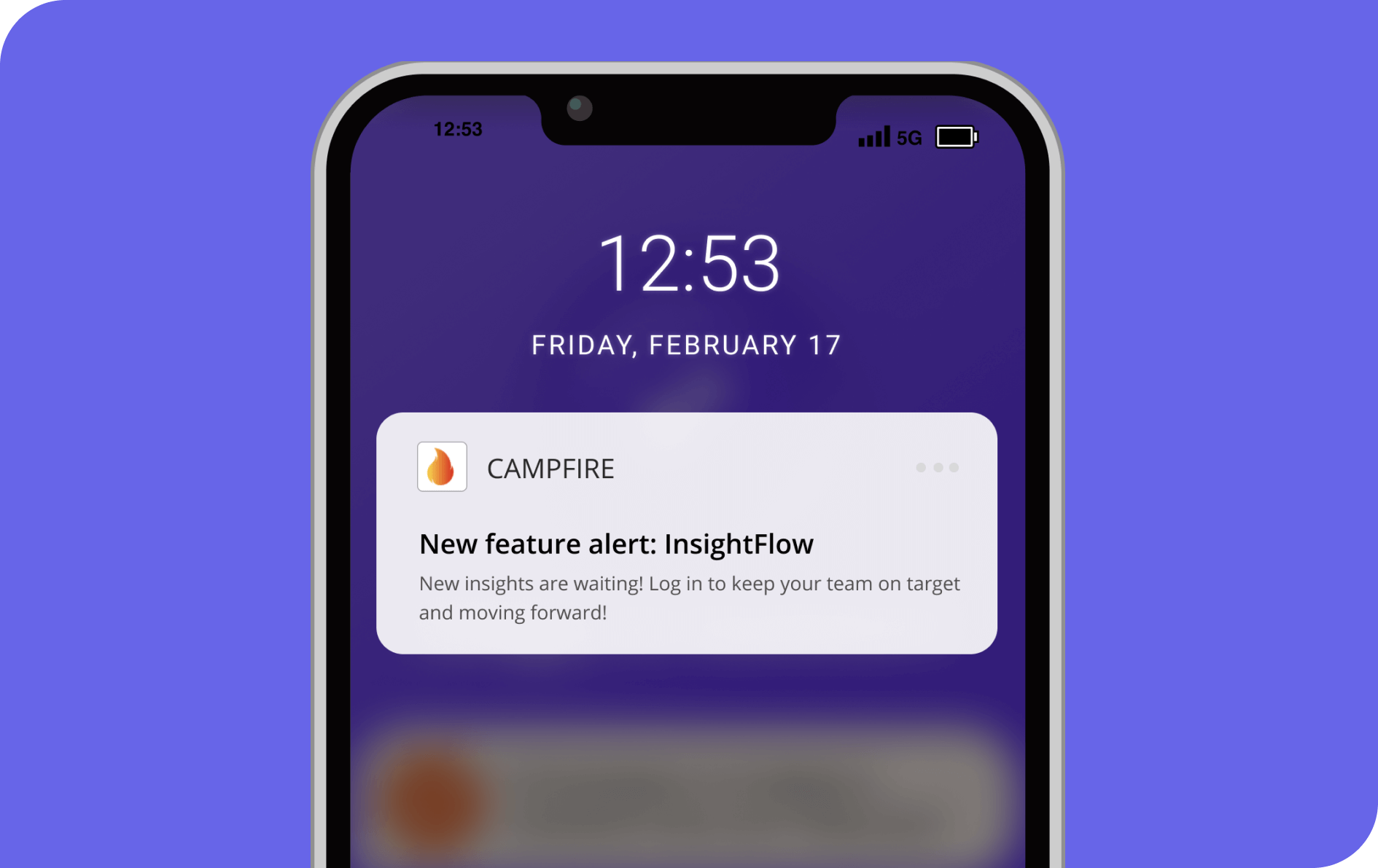
Userpilot also lets you deliver those personalized offers by sending push notifications and through in-app messages, so users don’t miss them if they don’t open your app.
6. Pay-per-use
Usage-based pricing charges for actual usage, consumption, or specific actions. It went from niche to mainstream because AI features carry real marginal costs, and credit systems have become the default wrapper for them, which is the trend Kyle Poyar’s research showed (with 126% growth).
Despite its popularity, this model does not apply to every product. Here’s how I’d recommend using it:
Implement transparent usage tracking and billing
If you have an app with high marginal costs and particularly tough competition, offering transparent usage-based pricing is fairer for both you and your users.
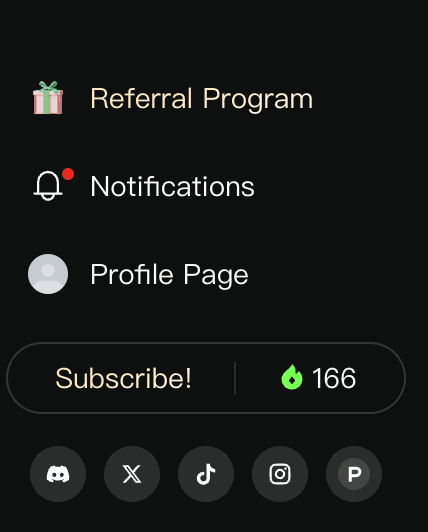
This model works for any app with recurring compute costs, such as AI image generators that sell monthly credit allowances with top-ups. You must show remaining credits in a fixed, always-visible spot and alert users before they hit limits. This way, you avoid billing users for an amount they didn’t expect (and hurting their trust in the process).
Offer microtransactions for specific features or actions
Microtransactions suit occasional users who will never subscribe but will happily pay only for what they need. Think of online PDF editors and background removers who charge small one-time fees for a full-resolution download, for instance.
These microtransactions make a good complement to usage-based pricing. However, keep purchase flows fast and short, because these users came to complete a task, and adding a paywall could create enough friction to turn them off.
Combine with subscription-based pricing
The challenge for a usage-based model is revenue forecasting. Usage varies, and finance teams at vendors and customers struggle to build reliable budgets around highly variable monthly bills. This is why hybrid monetization is the single most popular model in B2B SaaS (37% adoption) in Kyle’s 2026 survey.
With subscriptions, you can capture committed users with predictable revenue, while using usage-based for specific features as a means to expansion revenue.
Products like HubSpot, Figma, Adobe, Cursor, and Lovable all combine usage-based pricing with a subscription model. In fact, hybrid is where most of the investors’ money is going: when Poyar asked which pricing model investors favor, only 5% said seat-based and 10% said flat-fee subscription. Investors favored hybrid (35%), outcome-based (26%), and usage-based (24%).
Monetization that survives the flood
In the era of vibe-coded apps, the best apps make monetization frictionless for users. For this, you must use product usage data to understand your users deeply, deliver value before you ask for money, and trigger the right offers based on behavior.
First, start with one model, then add layers strategically as your app matures. And for this, I suggest using a product growth platform to track data, segment users, and send in-app messages in one place, without dev tickets or stale exports. So if you’re interested, book a free Userpilot demo and see how app behavior data can drive your monetization strategies.
About the author