Product-Led Growth Strategy: Frameworks, Metrics, and Playbooks for SaaS Teams


Product-led growth has become a defining theme in SaaS growth, but it’s often oversimplified. Too often, it’s reduced to a free trial, a freemium plan, or a handful of onboarding tweaks layered onto an otherwise unchanged customer journey. The result is surface-level adoption that looks promising early and stalls just as quickly.
In reality, product-led growth is an operating model. It reshapes how users discover value, how teams prioritize work, how revenue scales, and how growth and expansion revenue compound over time.
This guide breaks down product-led growth as a system. I’ll cover what PLG actually means, why it overtook traditional SaaS models, how the flywheel works, what it takes to be ready for it, how to implement it step by step, and which metrics matter most once it’s in motion.
What is product-led growth?
Product-led growth is a go-to-market strategy that relies on the product itself as the primary driver of customer acquisition, conversion, and retention.
If you’ve used tools like Slack, Zoom, Dropbox, or Calendly, you’ve already seen product-led growth in action. You didn’t need a demo, a long setup process, or a call with a sales rep to get started. You signed up, entered the product, and quickly understood what it did and why it was useful. The experience itself did the selling.
The key benefits of product-led growth for SaaS teams
Product-led growth is gaining traction because it scales more efficiently than traditional SaaS models. Below are the core benefits driving more teams to adopt this approach.
1. Decouple revenue from headcount
Marketing or sales-led SaaS models scale revenue by scaling people. To double revenue, you often need to double the team, along with commissions, enablement, and management overhead. Product-led growth breaks this dependency by shifting how you acquire customers, educate users, and qualify demand into the product itself, removing people as the primary bottleneck to growth.
When users can discover value on their own, customer acquisition becomes far less dependent on human effort. This self-serve motion lowers average acquisition cost and shortens payback periods, freeing up capital that would otherwise be locked into payroll. It’s not a coincidence that top-performing product-led companies invest a larger share of revenue into product development, because the product is doing the work that sales teams traditionally handled.
2. Accelerate time-to-value
The longer it takes for a user to experience real value, the more likely they are to disengage or churn. Product-led growth puts time to value at the center of the experience, treating early activation as a design problem rather than something that happens later in the customer journey.
When users reach value quickly, they’re far more likely to build habits around the product and integrate it into their daily workflows. Shorter time to value also improves customer acquisition efficiency by reducing drop-off and speeding up payback.
3. Expose UX reality for better product market fit
When the product becomes the primary way users discover value, there’s no buffer between the experience and the outcome. Usability issues, unclear workflows, and unnecessary friction show up immediately because the product has to stand on its own.
This level of exposure forces teams to build for the end user rather than relying on explanation or workarounds. Over time, retention becomes a function of how naturally the product fits into real workflows, not how well value is described.

Drive Instant User Activation and Scale Product-Led Growth with Userpilot
Product-led growth vs traditional growth models
So how does product-led growth actually compare to other go-to-market models in practice? I’ve put together a side-by-side table to make the differences clearer across motion, metrics, and team structure.
| Dimension | 🧩 Product-led growth | 🤝 Sales-led growth | 📣 Marketing-led growth |
|---|---|---|---|
| Core philosophy | Product-led businesses treat the product as the primary driver of adoption, retention, and expansion | Sales led companies rely on direct human interaction to move prospects through the funnel | Marketing led growth focuses on campaigns, content, and demand generation to feed downstream motions |
| Primary growth engine | Usage-driven compounding growth powered by in-product experiences | Sales led growth driven by outbound and inbound sales motions | Top-of-funnel awareness and lead volume |
| Entry point | Typically a freemium or free trial model that allows users to experience value before committing | Demos, calls, and negotiated contracts | Gated content, sign-ups, and lead capture forms |
| Target audience at entry | Users who become potential customers through hands-on product use | Economic buyers and decision-makers | Broad audiences segmented by persona or intent signals |
| Role of the product | The product guides the entire user journey from first value to expansion | The product supports the sales narrative | The product is often introduced later in the journey |
| Team structure | Cross-functional growth teams spanning product, engineering, design, and data | Dedicated sales teams with enablement and operations support | Marketing teams optimized for acquisition and lead nurturing |
| Revenue expansion | Expansion revenue emerges organically as usage deepens and spreads | Expansion handled through account management and renewals | Expansion depends on re-engagement campaigns |
| Retention signal | Net revenue churn reflects whether users continue to grow inside the product | Churn often managed through contracts and renewals | Retention measured through reactivation and engagement rates |
| Distribution dynamics | Built-in sharing and collaboration can enable viral growth | Distribution scales with sales capacity | Distribution scales with budget and channels |
| Strategic posture | Often adopted by product-led companies as a long-term business strategy | Optimized for high-touch, high-ACV deals | Optimized for reach and awareness rather than depth |
Product-led growth readiness checklist
Before committing to a product-led growth model, it’s worth assessing whether your product and organization are actually set up to support it. Use the checklist below as a quick reality check.
- Is your “Aha!” moment immediate? Can a new user experience the core value of your product within minutes of signing up, without human assistance? If meaningful value only appears after complex setup or multi-day integrations, pure PLG will be hard to sustain.
- Is your pricing transparent and self-serve? Product-led growth depends on users being able to evaluate and upgrade on their own. If pricing requires a conversation to understand, you’re introducing friction at the exact moment users are ready to convert.
- Do you have a clear value metric? Your pricing should scale with usage that reflects real customer value, such as seats, volume, or activity. This alignment ensures revenue grows as users succeed, rather than in spite of it.
- Is your product usable without explanation? In a product-led approach, the interface has to teach. If users need documentation or a human guide just to get started, friction will show up early and often.
- Does the product encourage sharing or collaboration? PLG drives business growth faster when usage naturally expands to more people. Invites, shared outputs, and collaborative workflows create organic customer acquisition loops that reinforce growth over time.
- Have you defined product-qualified leads? Usage signals matter more than form fills in a PLG model. You need a clear definition of which behaviors indicate user intent, readiness, or expansion potential inside the product.
- Is your product built to scale without requiring constant involvement from support and customer success teams? High-touch support doesn’t scale to thousands of free or trial users. Documentation, in-app guidance, and self-serve help need to handle the majority of questions without manual intervention.
How to implement product-led growth step by step
If you checked off five or more items in the readiness checklist above, you’re likely in a strong position to adopt product-led growth. In this section, I’ll cover a practical, phased approach to implementing a product-led strategy in a way that’s deliberate, measurable, and focused on how users actually behave
Phase 1: Engineer the shortest path to value
Granting quick access to your product means very little if users don’t experience immediate value. After years of working with SaaS tools, I’ve realized what matters most in a product-led growth model isn’t how much of the product users see, but how fast they experience a result that feels relevant to their job to be done.
This is why I prioritize speed over polish when designing new user onboarding flows. The faster a new signup reaches a moment of value that clearly maps to why they showed up in the first place, the more likely they are to keep exploring, adopt key features, and build momentum inside the product.
So how do you actually shorten time to value? There are three tactics that consistently make the biggest difference for us at Userpilot:
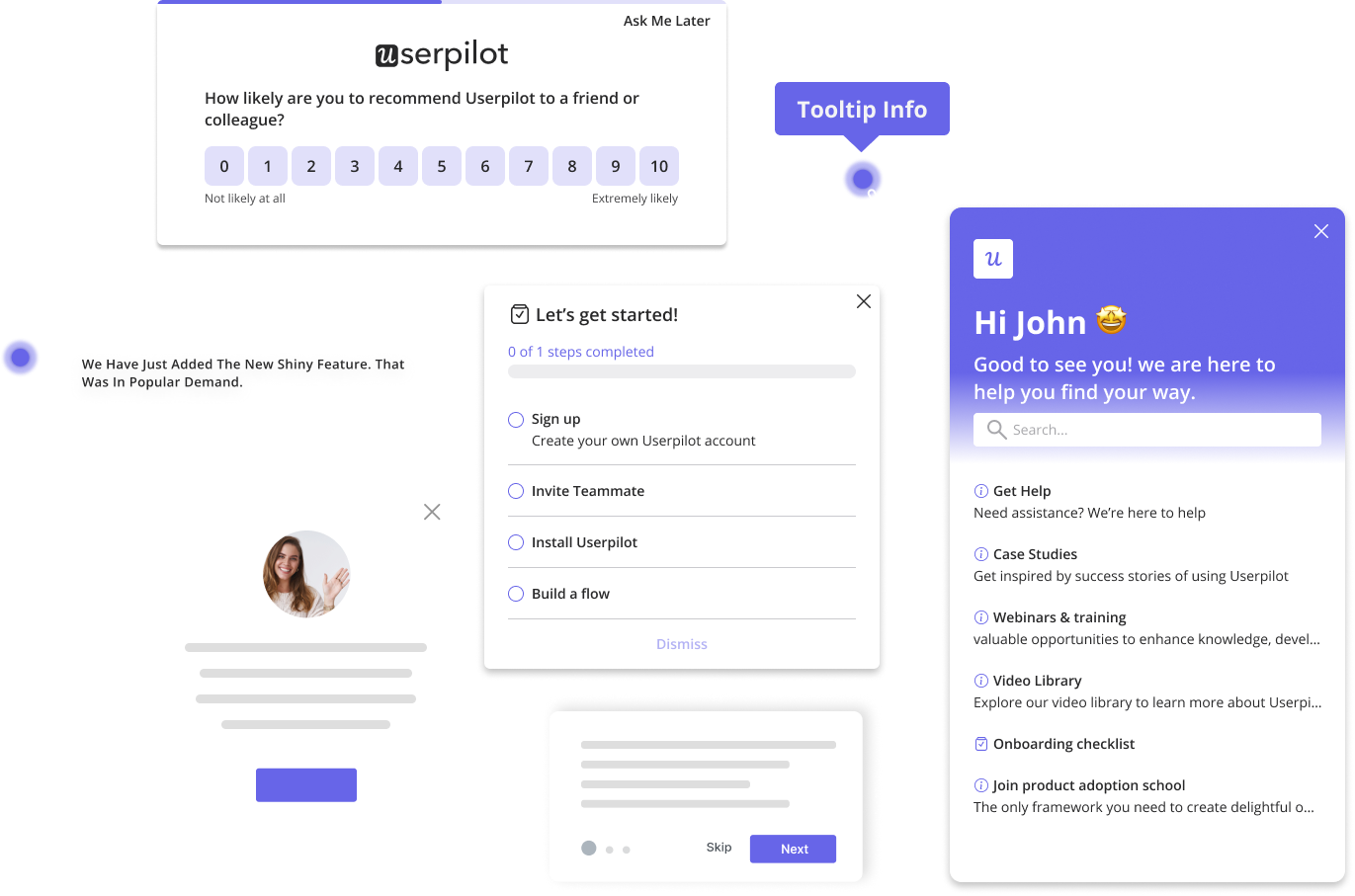
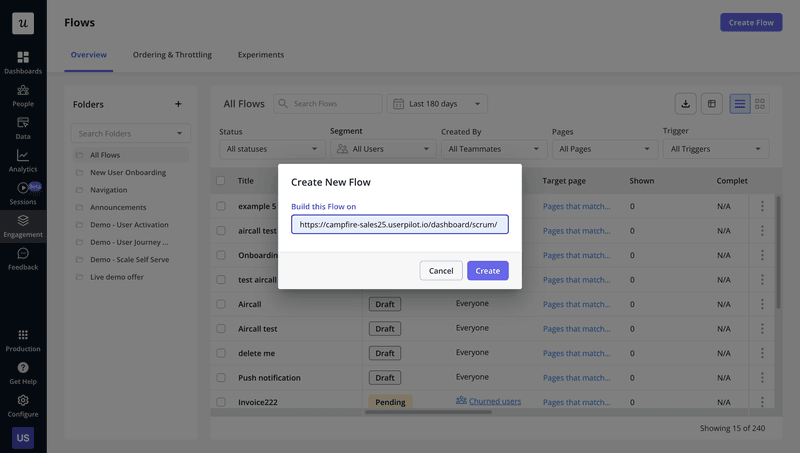
- Build interactive walkthroughs: I’m a strong advocate for interactive walkthroughs because they teach through action. Instead of passive tours that point at features and explain what they do, effective walkthroughs guide users step by step through a real task. The user performs an action, sees the outcome, and then moves forward. By the time the onboarding flow ends, users are already fairly acquainted with your product enough to decide if it’s for them.
- Eliminate early friction: Every unnecessary step between signup and value works against you. Audit your signup flow and first session experience with one question in mind: Does this step directly help the user reach value right now? Remove anything that doesn’t. Credit card fields, long forms, email verification gates, and forced configuration steps all slow momentum. If your product depends on data to be useful, provide demo data so users aren’t staring at empty states and wondering what to do next.
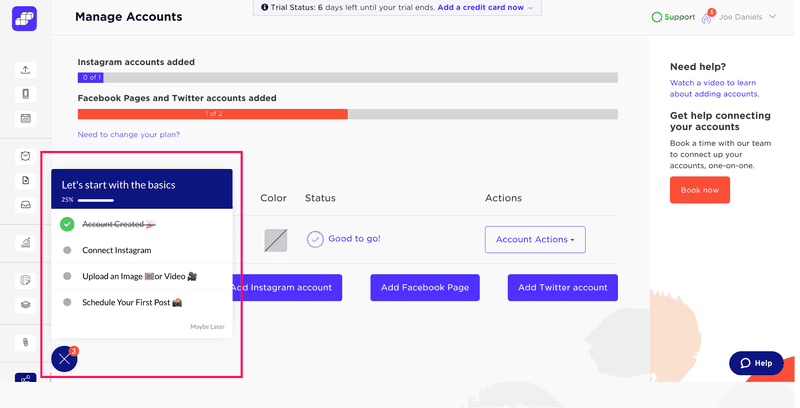
- Deploy onboarding checklists: Onboarding checklists give users structure and a clear sense of progress. When paired with a progress bar, they also introduce a light sense of momentum that nudges users forward. Each completed step reinforces that they’re getting closer to something worthwhile. This works particularly well when your checklist items are tied to meaningful actions rather than generic setup tasks. Sked Social is a good example. By introducing an onboarding checklist using Userpilot, without writing any custom code, the team was able to guide users toward key activation actions more consistently. That single change led to a threefold increase in conversion, simply by helping users reach value faster and with more clarity.
Phase 2: Adapt the product experience as intent becomes clearer
Once users reach initial value, they’ve interacted with the product enough to reveal what they care about and how they’re trying to use it. At this stage, growth no longer depends on speed alone. It depends on relevance. The goal shifts from helping users get started to helping them move in the right direction.
This is where customer data, especially behavioral and contextual signals, becomes essential. With a product analytics and engagement tool like Userpilot, you can observe how different users interact with key features and then adjust the experience to match their intent. Here’s how:
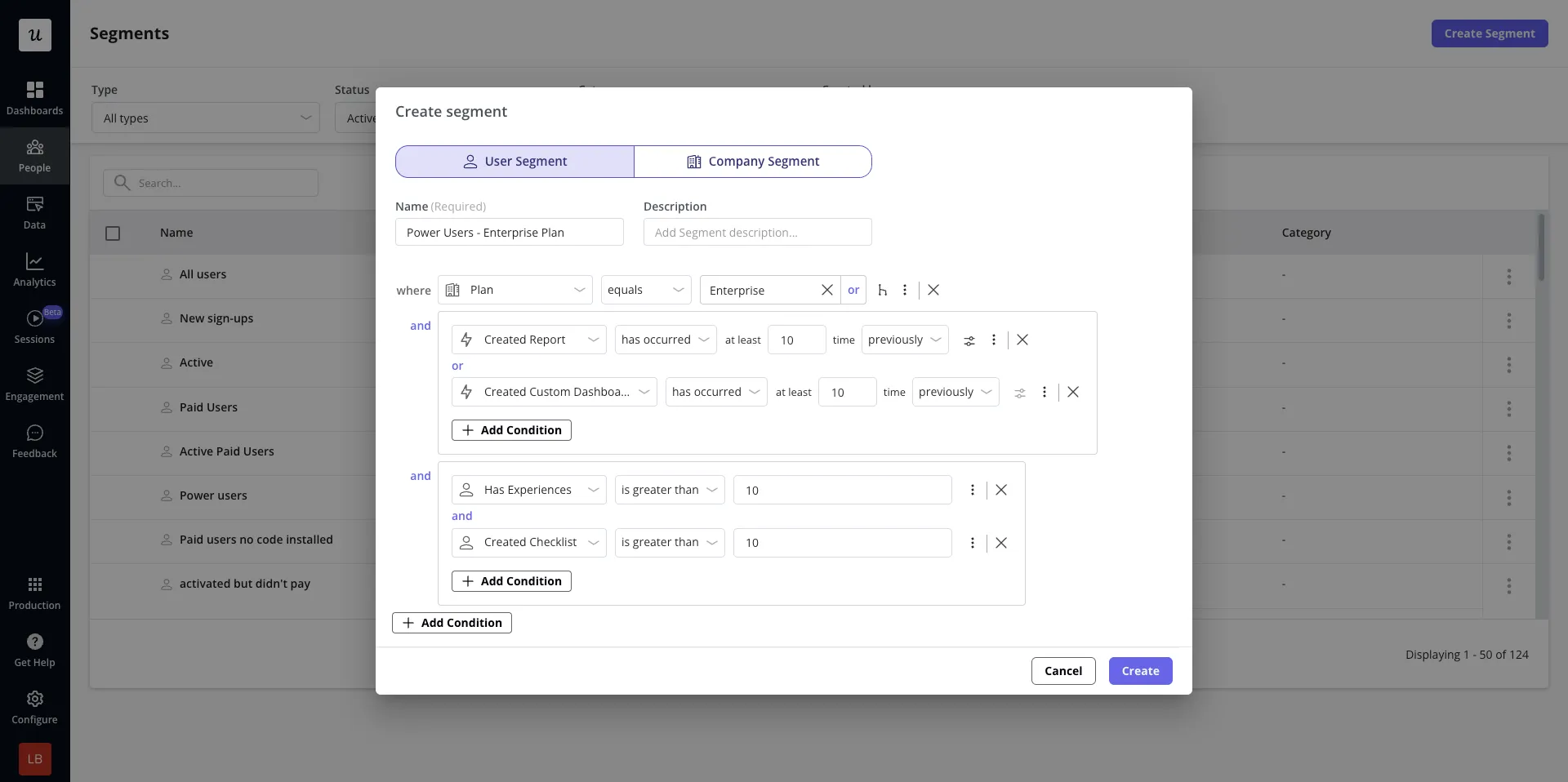
- Group users by what they’re trying to achieve: Start by moving beyond surface-level attributes like role or company size and focus on intent. Two users with the same title may want entirely different outcomes. One marketer might be focused on reporting, while another is trying to launch their first campaign.Use early signals such as selected goals, first features used, or repeated actions to create intent-based segments. For example, users who immediately build analytics dashboards likely need different guidance than those who spend time setting up integrations. Userpilot makes this sort of granular segmentation easy:
- Guide users toward the most relevant next action: SaaS users are often faced with dozens of features and no clear sense of priority. Your job is to reduce that cognitive load. Instead of promoting everything at once, highlight the next action that’s most likely to deepen adoption for each segment. For instance, that might mean nudging a reporting-focused user to schedule their first automated report, while encouraging a collaboration-focused user to invite teammates. Each of these nudges helps them realize increasing value in your product, which in turn drives engagement and retention.
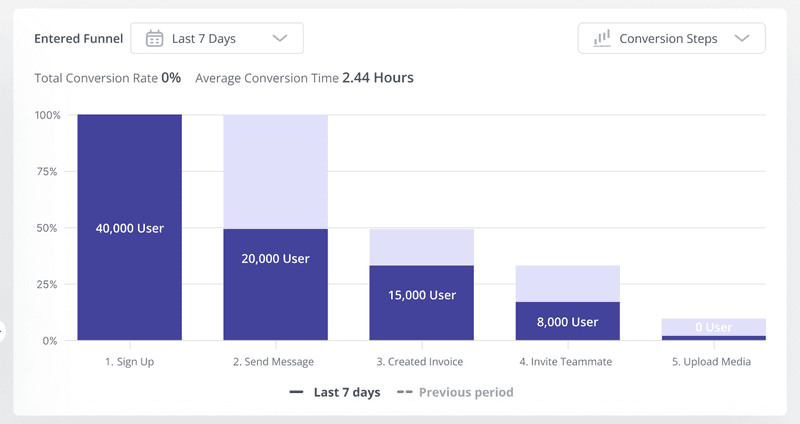
- Let real usage patterns shape what you improve next: Behavioral data shouldn’t stop at informing in-app messages. It should actively guide product decisions. With a platform like Userpilot, you can track user paths, feature adoption, and drop-off points to see where users slow down, hesitate, or abandon key workflows. For example, if a funnel report shows that a large percentage of users create a project but never invite teammates, that’s a clear signal that collaboration value isn’t landing. The fix might not be more messaging, but a change in the flow, such as surfacing an invite prompt immediately after project creation or adding contextual guidance that explains what collaboration unlocks.
Phase 3: Operationalize product-qualified leads
Product-qualified leads (PQLs) are users who’ve demonstrated value through behavior. They’ve crossed meaningful thresholds that signal intent, fit, or expansion potential, not because they filled out a form, but because their usage shows the product is doing real work for them.
The onboarding flows and contextual experiences you designed in phases one and two will, on their own, convert users to a point. In most products, though, there’s a natural ceiling to self-serve. As usage deepens or spreads across a team, some users need reassurance, alignment, or help navigating internal buying processes before they’re ready to commit and become paying customers.
The advantage of a product-led motion is that sales engagement no longer depends on guesswork. Instead of reacting to vague interest, your team can engage users at moments where behavior clearly indicates readiness. In practice, I look for a combination of four signals to identify strong PQLs:
- Confirm demographic fit: Start by filtering for accounts that resemble your ideal customer profile. Company size, industry, and use case still matter, especially when long-term retention or expansion is the goal. Strong usage without ICP alignment can signal short-term engagement, but it rarely leads to durable revenue.
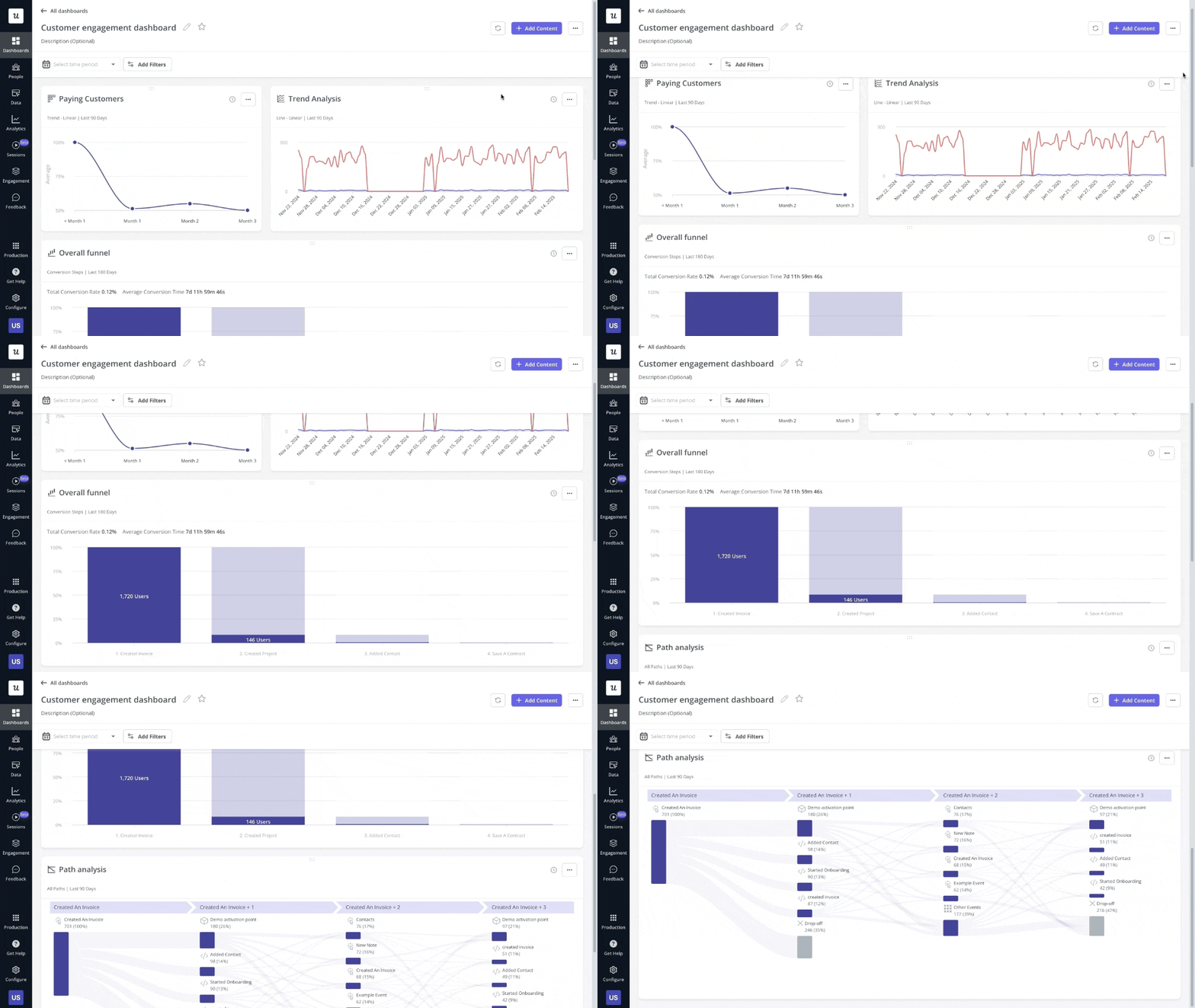
- Verify meaningful engagement: Look for behaviors that correlate with retention, not just initial activation. Repeated use of core features, consistent return sessions, or progression into more advanced workflows all suggest the product is solving a real problem rather than being casually explored. Userpilot helps you filter engagement data by company or user profile so you can identify which accounts are consistently using high-value features and prioritize outreach based on real product adoption.
- Watch for buying intent signals: Certain actions signal active evaluation. Visiting the pricing page, hitting usage limits, attempting to unlock gated features, or inviting teammates all suggest a user is weighing whether the product is worth paying for. These moments create natural opportunities for timely outreach.
- Assess expansion potential: Finally, pay attention to how product usage spreads. Single-user adoption can convert, but multi-user engagement often signals higher deal value and longer-term commitment. Invitations, shared assets, or activity across teams usually indicate that a purchase decision will involve more stakeholders and benefit from guidance.
Phase 4: Automate growth loops and support
Once users are consistently reaching value, moving through relevant workflows, and signaling intent through usage, the next constraint becomes scale. At this point, relying on manual intervention actively limits how far your product-led motion can go.
Here’s how to build systems that allow you to scale more easily:
- Design growth loops that expand usage naturally: Start by identifying moments where users create output that has value beyond themselves. Once identified, make it easy for users to share that output with others in a way that feels useful, not promotional. Canva does this by letting users share designs for feedback or collaboration, while Calendly turns scheduling into a shareable action that introduces the product every time someone sends a new meeting link. However, not all growth loops need to reach outside your customer’s organization. Some are designed to deepen adoption among existing customers. Features like inviting teammates, sharing workspaces, assigning permissions, or co-editing assets will expand usage within an account and embed the product into daily workflows. While these actions may not immediately bring in new customers, they increase reliance on the product and often become the foundation for long-term retention and expansion.
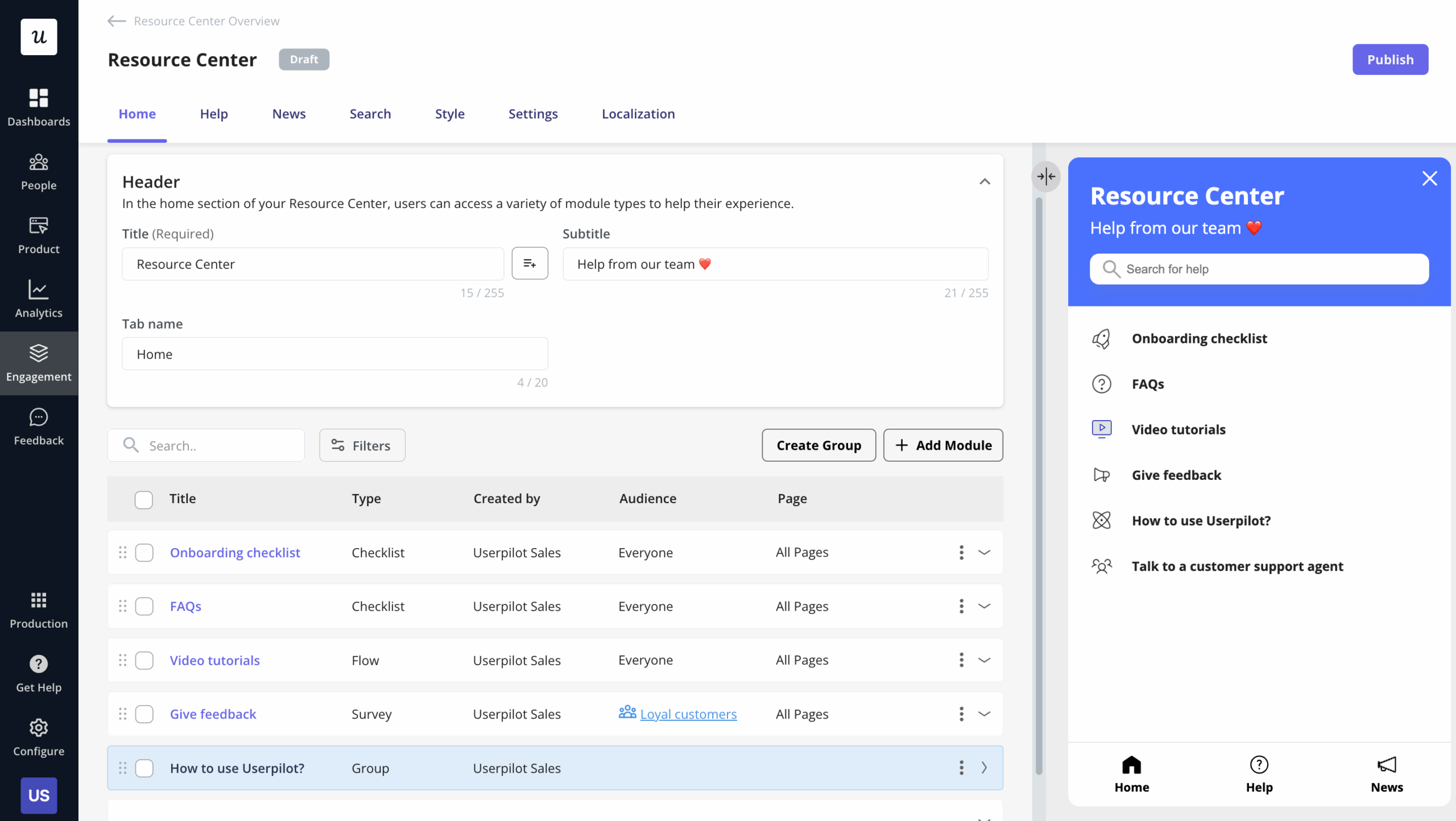
- Shift support from reactive to self-serve: Move help closer to where problems occur. Instead of waiting for users to submit tickets, surface answers inside the product at the moment they’re needed. This includes contextual tooltips, searchable documentation, short videos, and guided walkthroughs that can be triggered on demand.Userpilot makes this practical by letting you build in-app resource centers without code. You can centralize help docs, FAQs, video tutorials, and even offer a clear path to contact support when self-serve isn’t enough. This approach reduces support load while giving users faster resolution and a smoother experience.
- Automate expansion: As usage grows, expansion shouldn’t rely on sales noticing it late or users asking what to do next. Build clear, predictable expansion paths directly into the product. Common tactics include visible usage limits, seat thresholds, feature gates, and plan comparisons that make the next step obvious at the moment it becomes relevant. For example, when a team hits a collaboration limit, show how upgrading enables more seats or shared workspaces. When they reach a usage threshold, explain what additional capacity unlocks and why it matters for their workflow. This reduces friction for users who are ready to expand and prevents revenue growth from depending on ad hoc conversations or delayed follow-ups.
Key metrics for measuring product-led growth
There’s no shortage of metrics you can track in a product-led organization, but not all of them are equally useful. The most effective PLG metrics focus on how quickly users reach value, how deeply they adopt the product, and whether that usage translates into durable revenue over time.
Below are six metrics I rely on most when evaluating a product-led motion.
1. Time to value
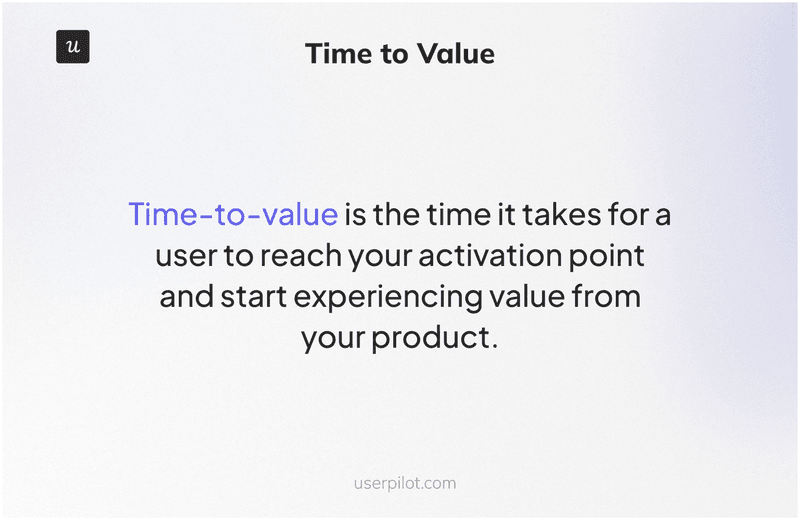
Time to value measures how long it takes for a new user to experience their first meaningful outcome with your product. When users reach value quickly, they’re more likely to continue exploring, adopt key features, and build habits around the product. When time to value is long or inconsistent, drop-off often happens quietly, before users ever reach activation.
To measure this metric, start by defining a clear first value event. This should be a specific action or outcome that signals real benefit, such as publishing a first design, scheduling a first meeting, or generating an initial report. Once defined, time to value is calculated by measuring the difference between when a user signs up and when they reach that first value event.
2. User activation rate
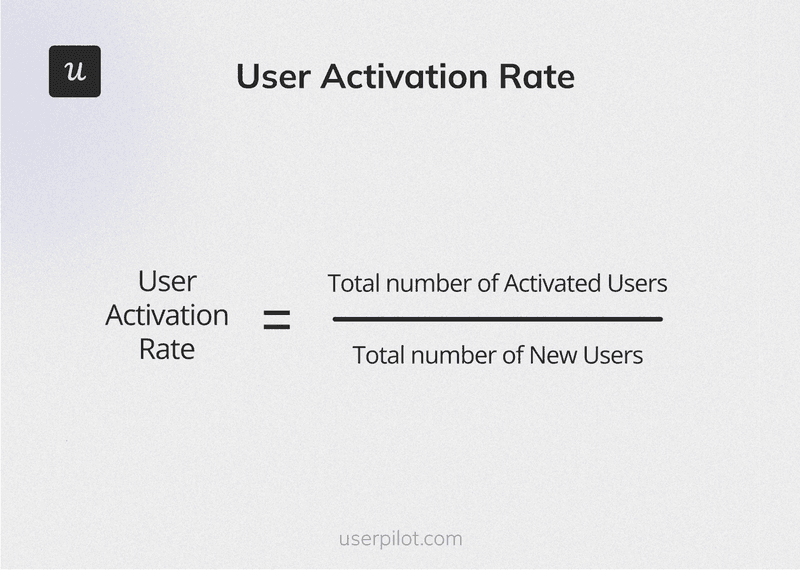
While time to value tells you when users find value, activation rate tells you whether they find it at all. I define an activated user as someone who’s completed a set of actions that indicate they’ve moved beyond exploration and into real use. For example, in a product design tool, that might mean creating multiple designs or exporting an asset. For a collaboration tool, it could be inviting teammates or sharing a workspace.
To measure activation rate, start by defining a single activation milestone based on behaviors that reliably predict retention. Then calculate activation rate by dividing the number of users who reached that activation milestone by the total number of users who signed up, and multiplying the result by one hundred.
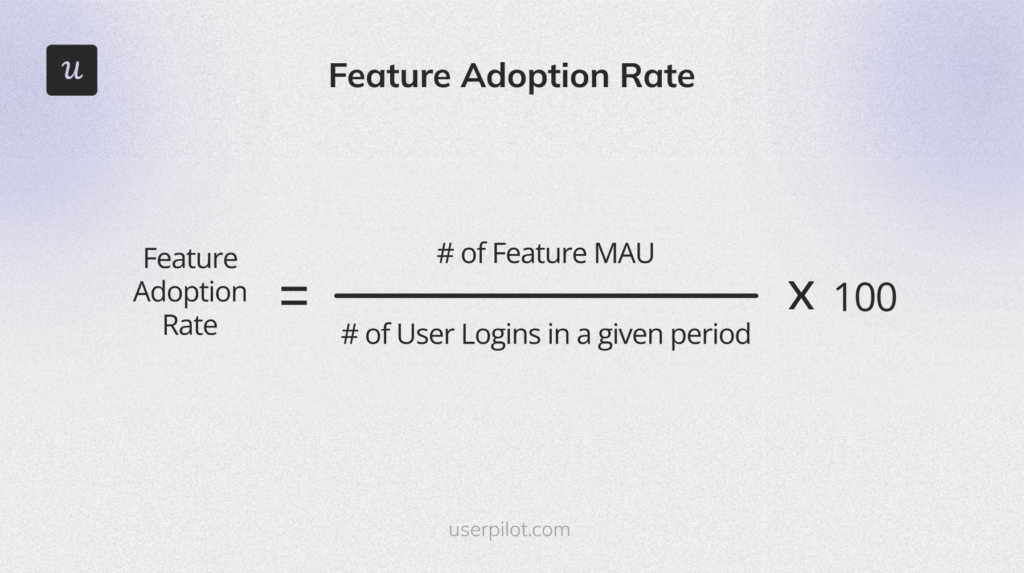
3. Feature adoption rate
Feature adoption rate shows how many existing users are actively using a specific feature relative to your overall active user base. In a product-led model, this metric helps you understand whether users are engaging with the parts of the product that actually drive value, not just logging in or clicking around.
To calculate, choose a specific feature and identify how many active users interacted with it during a given period. Then divide that number by the total number of active users in the same period and multiply by one hundred.
4. User retention rate
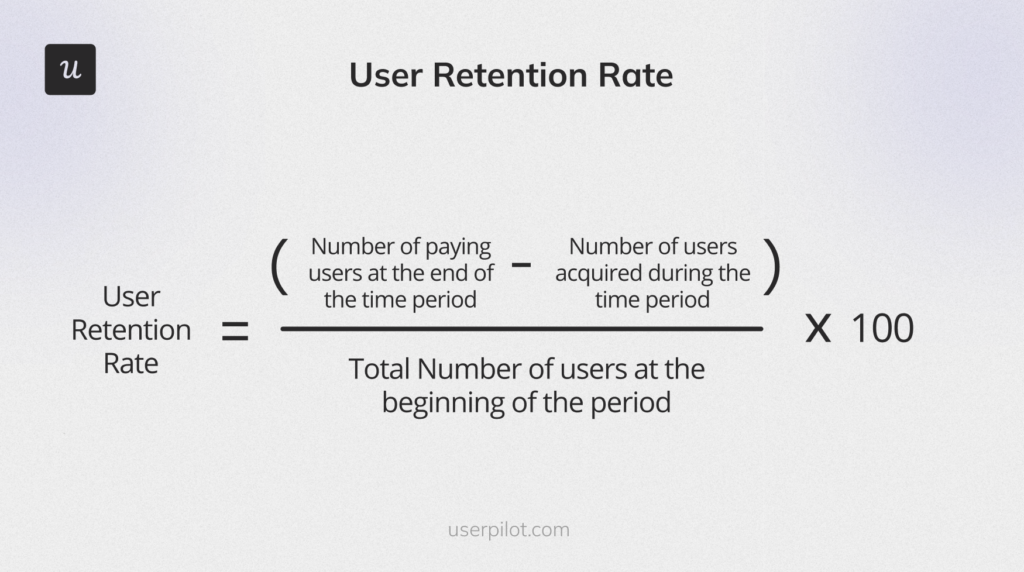
User retention rate measures how many users continue using your product over time.
I pay close attention to retention because it reveals whether usage is becoming habitual. Strong retention suggests that users rely on the product to do their work, not just to try something new. Weak retention, on the other hand, often points to gaps in feature adoption, unclear value after onboarding, or friction that only appears after repeated use.
To measure user retention rate, start by choosing a time period, such as weekly or monthly. Then subtract the number of new users acquired during that period from the total number of users at the end of the period, divide that result by the number of users at the start of the period, and multiply by one hundred.
5. Free-to-paid conversion rate
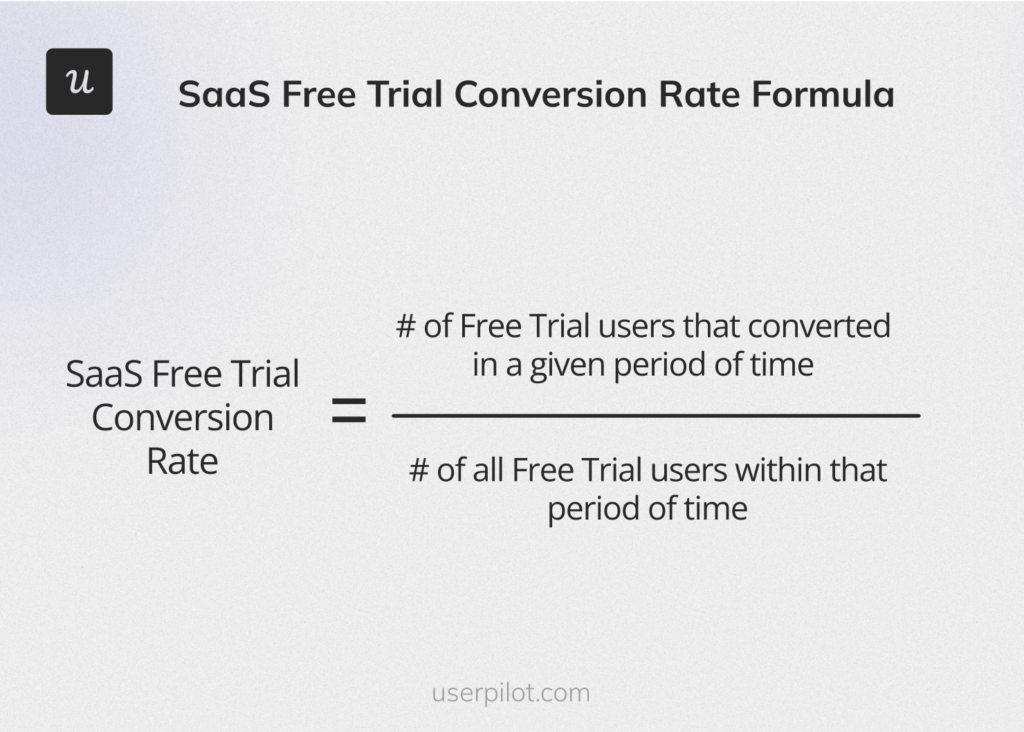
This metric rate measures the percentage of users who move from a free trial or freemium plan to a paid subscription. It acts as a reality check that tells you whether users are realizing enough value on their own to justify paying for the product without heavy persuasion or incentives.
To measure free-to-paid conversion rate, divide the number of users who became paid customers by the total number of trial or free users in the same period, then multiply by one hundred.
6. Average revenue per user
This metric measures the revenue generated from each active customer over a given period.
I rely on ARPU to get a clearer view of customer lifetime value trends and account expansion effectiveness. When ARPU increases over time, it usually reflects deeper adoption, successful upsells, or broader usage across teams. When it stagnates or declines, it can signal pricing misalignment, weak expansion paths, or a product that delivers value without capturing it.
To calculate ARPU, divide your total monthly recurring revenue by the number of active customers for that same month.
Turn product usage into sustainable growth
Product-led growth works when it’s treated as a connected system rather than a set of tactics layered onto an existing business model or go-to-market motion. It starts with enabling users to reach value quickly, continues by keeping the experience relevant as intent becomes clearer, and scales through usage signals, expansion paths, and self-serve systems that reduce friction over time.
Userpilot is built to support SaaS teams across each stage of that system. From welcome surveys that capture user intent at signup, to interactive onboarding flows that shorten time to value, to segmentation and analytics that surface meaningful usage patterns, our platform can help you design product experiences that evolve as users grow. Ready to see it in action? Book a demo to discuss your needs today!
Master Product-Led Growth and Shorten Your Time-To-Value using Userpilot
About the author