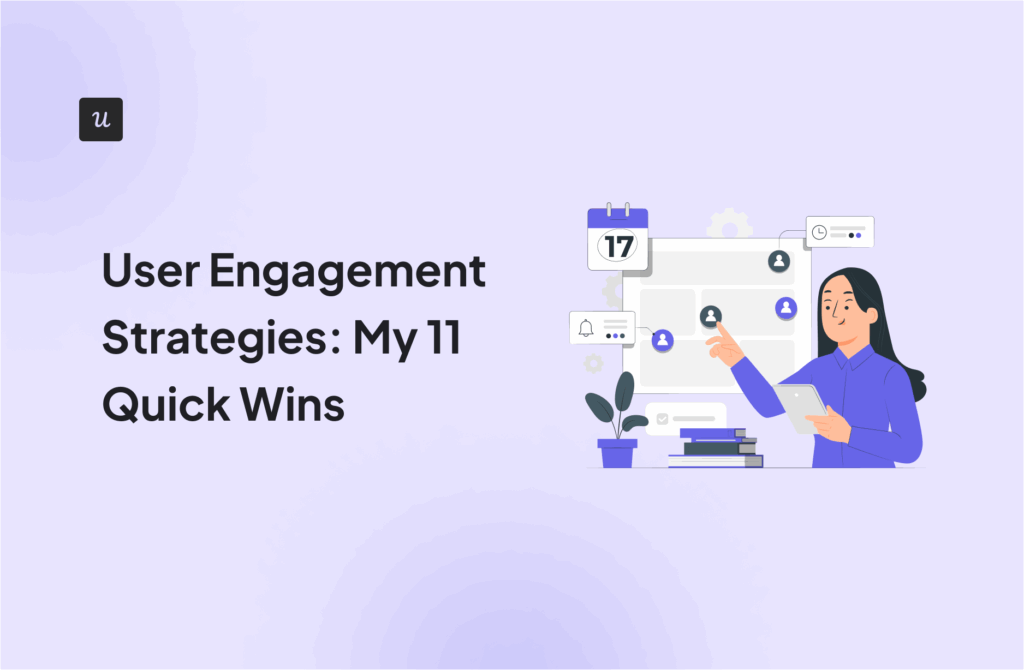
User Engagement Strategies: My 11 Quick Wins

I always believe user engagement strategies are core to product growth.
Engagement is the signal that users are finding repeatable value, and in SaaS, those signals are the bedrock of retention, expansion, and higher customer lifetime value. You can acquire all the users you want, but if they’re not having meaningful interactions with the product, you’re burning both capital and trust.
And from my experience, understanding why user engagement is important starts here: great customer engagement strategies don’t just nudge users, they guide them to success, reinforce habits, and make the product feel indispensable. An effective engagement strategy to increase user engagement shows up in thoughtful onboarding, timely messages, and even how new features are rolled out.
So in this breakdown, I will cover my 11 favorite user engagement strategies, the ones I’ve implemented, tested, and seen move key metrics in products using Userpilot’s engagement platform.
1. Replace the “empty state” with personalized guidance
The worst thing a new user can see is a blank dashboard. It is intimidating. It requires them to do work before they see any value. For a long time, I assumed a generic “Welcome” modal was enough. It wasn’t.
The strategy that changed the game was implementing a dedicated SaaS welcome screen that does more than just say hello. I use this screen to collect critical data about the user’s role and their specific “Jobs to be Done” (JTBD).
By asking a simple question like “What are you here to do today?”, I can immediately segment based on customer behavior. If they say they are a marketer, I don’t show them developer documentation. I drop them into a flow designed specifically for that target audience.
This sets the stage for personalized onboarding. Instead of a one-size-fits-all tour that 80% of users skip, I can deliver a tailored experience. In Userpilot, I can set up custom user properties based on these welcome screen responses. This allows me to trigger specific flows that align exactly with what the user told me they wanted.
This has become a common practice across SaaS, and the more interesting evolution is the AI agent layer being added on top of it. Companies like Airtable now use the data you collect at signup to surface a curated set of templates and workflows that fit your use case, rather than a generic library of hundreds of options.
Miro is taking this further with a beta AI agent for personalized onboarding that adapts in real time to what you’re building, rather than asking a set of static intake questions.
The end goal is the same regardless of the approach: create immediate engagement by getting the user to their “Aha! moment” as quickly as possible, removing friction between their stated goal and the feature that delivers it.
2. Kill the linear product tour
I used to inflict 15-step product tours on every new signup. You know the ones: “Click here,” then “Click here,” then “Look at this button.” It was boring. It was passive. And the data showed that everybody hates product tours that force them into a linear path.
A good example of what not to do is Baserow. To their credit, they’ve added an AI assistant, which is genuinely useful. But it’s buried behind a 10-step unskippable product tour that users have to sit through before they can do anything meaningful.
That’s why I switched to interactive walkthroughs. These are different because they wait for the user to act. The second step doesn’t trigger until the user actually completes the first step.
It forces engagement. If I want them to learn how to create an analysis, the flow pauses until they actually click “Create New Analysis.”
To make this work technically, I use page changes in my flow settings. If a user needs to navigate to a settings page to complete a task, the flow detects that URL change and triggers the next tooltip automatically. This feels less like a lecture and more like a co-pilot sitting next to them, actively engaging them through the actual work rather than narrating it from a distance.
The key rule I apply when creating these: the walkthrough should always be built around getting users to do the very task that helps them experience value. Not a tour of the interface, but a guided execution of the outcome they came for.
And keep five steps as the ceiling with every interactive walkthrough, allowing users to skip options at each step. Users who skip are telling you they are annoyed, and forcing them through the flows doesn’t change their minds.
But I know building interactive walkthroughs well takes time.
If you find yourself spending hours configuring flows and testing step triggers, we’re working on simplifying the workflows significantly with our upcoming Userpilot AI agent. It is designed to let you generate and deploy guided flows from a plain-language description of the customer journey. If that sounds useful, join our beta waitlist.
3. Leverage the “checklist” psychology hack
There is a psychological itch that humans need to scratch: we hate unfinished tasks. I used this by implementing an onboarding checklist. But not just any checklist. I used a specific psychological trigger called the Zeigarnik Effect, which states that people remember interrupted or incomplete tasks better than completed ones, creating a mental pull that encourages users toward finishing what was started.
The trick is to give the user a head start. If my checklist has five items, I mark the first one (usually “Create Account”) as already completed.
When a user opens the app and sees they are already 20% of the way there, they are significantly more likely to finish the rest. I build these using the checklist builder. I map key milestones to actual events in the app. For example, the “Invite a Teammate” task only checks off when the system detects the invite_sent event.
This connects the visual progress bar directly to meaningful product adoption, including feature usage patterns that show whether users are truly internalizing the product. It is simple, but the completion rates skyrocketed compared to when I just left users to figure out the steps on their own. In effect, a well-built checklist is one of the easiest forms of gamification you can implement: it rewards completing onboarding steps and celebrating user milestones, turning a routine setup task into a rewarding experience.
That impact is well-documented. Attention Insight used Userpilot’s checklists as part of a broader onboarding overhaul and achieved a 47% increase in user activation rate. The checklist gave new users a clear path through the product and removed the guesswork that was causing them to drop off before they ever reached the core value.
4. Implement secondary onboarding for feature discovery
Onboarding doesn’t stop after the first week. One of my biggest mistakes was assuming that once a user was “active,” my job was done. Then I noticed that retention plateaued. Users were sticking around, but they weren’t growing. They were using the same two features they learned on day one and ignoring the rest.
I introduced secondary onboarding strategies. This targets specific user groups with contextual onboarding for advanced features. I don’t show these flows to newbies, it would overwhelm them. I wait until a user has mastered the basics.
The same logic applies to new features, product updates, and even bug fixes. Retention depends on two things working together: continuously delivering value by giving users tools and key features that address customer needs in increasingly better ways, and communicating those improvements effectively. Users can’t benefit from features they don’t know exist. Without proper communication, even your best updates go unnoticed and underutilized.
Using segmentation capabilities, I analyze user behavior to create a segment of users who have “Signed Up > 30 Days Ago” but “Have Not Used [Advanced Feature],” signaling low feature usage in that area.
When these users land on a relevant page, I trigger a subtle slideout or hotspot that introduces the feature in context.
This helps drive feature adoption among existing users while ensuring customer success by making every improvement reach the users who need it most.
Amplemarket, for example, uses Userpilot to spot when someone is around an underused feature and instantly shows targeted walkthroughs to boost engagement.
Awni Shamah, Staff Product Manager at Amplemarket, attributes that lift directly to the timing and context of the in-app guidance: “Whenever I add a nudge to a new feature, it boosts adoption by 5x, even 10x.”
5. Collect valuable feedback via customer feedback surveys to fix friction
You can look at analytics all day, but sometimes you just need to ask the user what is wrong. The problem is that long email surveys have terrible response rates. By the time a user opens their email, they have forgotten the annoyance they felt inside the app.
My winning strategy here was deploying in-app customer feedback surveys immediately after specific interactions. If a user completes a complex workflow, I trigger a Customer Effort Score (CES) survey to gauge customer satisfaction on that specific task. It is just one question: “How easy was it to do X?”
I also use these same microsurveys to assess whether the in-app guidance itself is working. After a user completes an interactive walkthrough for a complex feature, I’ll trigger a one-question survey asking if the guidance helped them understand what to do next. If the answer skews negative, that’s a signal to revise the flow before it burns more users.
If they rate it poorly, I use survey logic to immediately ask a follow-up question: “What stopped you?” The user feedback is valuable, raw, and immediate.
With this, I found bugs and UX confusion that our QA team never caught because I asked the user right at the moment of frustration.
6. Build the “resource center” as a safety net
I used to bury our help docs in a separate knowledge base that required opening a new tab. Users would hit a roadblock, try to find the help link, get frustrated, and leave. They didn’t want to leave the app to learn how to use it.
Research consistently backs this up: according to Zendesk, 69% of customers want to resolve as many issues as possible on their own. Yet in many SaaS products, the help portal is still buried under a profile dropdown, redirecting users to an external site. That UX pattern defeats the whole purpose of self-serve support.
Visibility matters and for that, I moved support inside the product using a Resource Center. This is an always-on widget that sits in the corner of the screen. I packed it with search functionality that pulls from our knowledge base, but I also added interactive modules. If a user searches for “How to invite users,” they don’t just get an article. They get a launcher that triggers the “Invite Users” interactive flow.
This concept of self-service support reduced our ticket volume and helped retain users because they could solve their own problems without waiting for a human.
Groupize is a good example of this done thoughtfully. They built their onboarding so users can skip any guidance step if they prefer to explore on their own. But if they ever need to revisit those instructions, all the interactive modules are accessible through the resource center. The result is an experience that respects both the users who want to be guided and the ones who’d rather figure things out independently.
If you have an existing knowledge base on Zendesk, you can easily integrate it with Userpilot.
I also heavily rely on Userpilot’s search term analytics for the resource center. It shows me exactly what users are searching for, including searches that return no results indicating unaddressed issues. Those empty-result queries are also your content roadmap.
7. A/B test your flows to boost customer engagement
I know my first draft is not going to be perfect.
So, if we launch a critical upsell flow, I always run an A/B test. I create two variations. Version A might use a modal. Version B might use a slideout. Or perhaps I test two different headlines. Userpilot splits the traffic automatically. After a few weeks, I look at the data. If Version B converts 20% better, that’s free revenue we would have missed if we just guessed.
Smoobu 17% more conversions by running an experiment to optimize a key part of their customer journey.
“We’re trying to improve the product, but also create a stronger connection with our users, especially when our personas are less tech-savvy.” – Dasha Frantz, Product Designer at Smoobu
By testing different flow formats and trigger timing, they identified the variation that moved their completion rates without increasing friction elsewhere in the product.
8. Embed videos for complex concepts
Some features are just too hard to explain with text alone. When we release a complex new module, I record a short Loom video explaining how it works and then embed it directly into a modal or slideout. This 30-second walkthrough delivered by a real person, in context, at the exact moment a user needs it, lands completely differently than a bulleted list of steps.
Some companies take this further by encouraging user-generated content in the form of community-created tutorials, but for most teams, a short internally recorded video is the highest-leverage starting point.
Many SaaS companies have figured this out. Clay is a good example: their onboarding uses short video explainers that speak directly to how users interact with their key features. Loom does something similar by embedding product tutorials within the flows that introduce their own features, which also doubles as a subtle demonstration of the product’s use case.
We have found that video walkthroughs significantly increase the completion rate of complex onboarding tasks compared to text-only guides. The format is simply more forgiving since users can watch without parsing. And the pacing of the explanation reduces the cognitive load that causes people to give up on a task before finishing it.
9. Spot opportunities to engage customers with product analytics
In-app guidance only works if it’s paired with the right timing. I use product analytics for tracking user engagement and to analyze user behavior and customer behavior patterns before I build anything.
Path analysis is where I start. It shows me the most common routes users take to reach a specific goal inside the product, including which feature usage patterns appear along the way. When I find a path that correlates strongly with activation or retention rates, I treat it as a template. My job then becomes replicating that successful path for new users through in-app guidance.
I also use retention analysis to spot where active users fall off during their lifecycle, and session replay when I need to understand exactly what happened at a specific friction point. Session recordings are particularly useful after a survey tells me users are struggling with something, because I can watch the actual experience rather than guessing based on the written feedback.
The combination of these three tools, path analysis to find what works, retention analysis to find where things break, and session replay to diagnose specific problems, gives me valuable insights into where my engagement strategies need to focus.
10. Re-engage the dormant
Churn doesn’t happen overnight. It happens slowly. A user logs in daily, then weekly, then monthly, then never again. You need to re-engage users during the “weekly to monthly” slide.
I always dedicate a specific customer health segment for “At-Risk Users,” for example, users who haven’t performed a key action in 14 days.
For these users, in-app messaging alone won’t work because they aren’t logging in. Reaching them requires multiple channels. I sync this segment to HubSpot or Salesforce to trigger a re-engagement campaign.
Instead of a “We miss you,” your email should remind them of the value they are missing, drawing on their usage and purchase history, or surfacing a new capability that aligns with their role. The goal is to get them back into the app.
Intercom does this well with their product update emails. Rather than a generic re-engagement nudge, these emails surface specific features the user hasn’t tried, with enough context to make the feature feel relevant to what the user was doing before they drifted away.
Once they log in, my in-app engagement flows take over to re-onboard them and get users active again.
11. Increase customer lifetime value with loyalty programs
Engagement doesn’t stop at activation or even retention. The most valuable users, the ones who’ve been with you long enough to become genuinely proficient with the product, are also the ones who can do the most to drive business growth through advocacy.
I use NPS survey data to identify promoters automatically. When a user submits a high NPS score, I trigger a conditional follow-up that invites them to participate in a case study, leave a G2 review, or join a beta program.
For power users, especially enterprise clients, I think the most effective loyalty programs are the ones that help them do their jobs better, not just the ones that offer discounts on renewals.
That means things like early access to the product roadmap, invitations to virtual events and co-design sessions, private online communities and social media groups where they can talk directly with the team, and beta access to features.
High customer satisfaction from these programs compounds: a user who shapes your roadmap is far more invested in your success than one who got 10% off their renewal. The most effective loyalty programs aren’t just the ones that reward customers with discounts.
The underlying principle is that customer loyalty is built through inclusion and emotional connection, not just reward. When your loyal customers feel like partners in the product, strengthening relationships over time, they stop being customers and start being advocates.
Power your user engagement strategies with Userpilot
The strategies I’ve outlined here compound over time. For instance, personalized onboarding improves early engagement and reduces early churn, which means more users reach the stage where secondary onboarding and feature discovery matter.
Microsurveys surface the friction that A/B tests help you eliminate and customer engagement metrics, overall, make every flow smarter.
Userpilot gives you the infrastructure to run all of it without engineering dependencies. You can drive digital adoption with personalized onboarding flows, interactive walkthroughs, in-app surveys, and resource centers, then connect them to your CRM and measure user engagement through built-in analytics.
If you’re ready to move beyond generic engagement tactics and build a system that actually guides users to value, book a Userpilot demo to see how it works in practice.
FAQ
What are the 4 P's of customer engagement?
The 4 P’s of customer engagement are personalization, participation, purpose, and partnership. Personalization means tailoring experiences to individual users based on their role, behavior, and goals. Participation means creating opportunities for users to actively participate in the product rather than passively consume it. Purpose means connecting product usage to outcomes the user actually cares about. Partnership means treating your best users as collaborators, not just customers, by involving them in feedback loops, roadmap decisions, and community building.
What are examples of engagement strategies?
Examples of user engagement strategies to increase user engagement include personalized onboarding flows triggered by welcome screen responses, interactive walkthroughs that require users to complete real product tasks, onboarding checklists that leverage progress psychology, in-app customer feedback surveys deployed at friction points, contextual secondary onboarding for feature discovery, self-service resource centers with search and interactive modules, A/B testing of in-app flows, embedded video walkthroughs, path and retention analytics to inform guidance design, dormant user re-engagement via email and in-app sequences, and loyalty programs that turn power users into product advocates.
What are the 3 C's of engagement?
The 3 C’s of engagement are content, context, and continuity. Content is the quality and relevance of what you put in front of the user. Context is whether you deliver it at the right moment in the right part of the product, rather than in a generic blast. Continuity is the idea that engagement is not a single event but ongoing engagement that evolves as the user matures from new signup to power user. All three have to work together. Great content delivered in the wrong context fails. Contextually relevant content that isn’t sustained past the first week fails too.
What is an example of user engagement?
A practical example of user engagement is a B2B SaaS product that asks new users one question at signup (“What are you trying to accomplish?”), uses their answer to drop them into a role-specific onboarding checklist with five steps, marks the first step as complete to trigger psychological momentum, sends an interactive walkthrough when they reach the relevant feature page, and then follows up 30 days later with a slideout introducing an advanced capability for users who haven’t discovered it on their own. This is what makes user engagement important: each of these steps is a distinct engagement touchpoint, but together they form the entire customer journey from first login to habit formation, and the gaps between those touchpoints are where churn hides.
About the author