How to Use AI Agents to Identify and Prevent Customer Churn


Customer churn is the ultimate bane for every SaaS company. Paying customers leaving translates to lower revenues and a higher average customer acquisition cost. And that’s why it’s necessary to plug that leak by identifying churn signals before they turn into a decision to leave.
However, most churn prevention tactics built over the last decade are flawed. Instead of predicting churn, they rely on monthly or quarterly reviews to track it.
AI agents change that math by helping you move proactively to retain the customer. Here’s how.

How to calculate customer churn?
Two numbers still anchor every churn conversation, and skipping either one hides half the picture. Customer churn tells you how many accounts you lost. Revenue churn tells you how much monthly recurring revenue left with them, and the two rarely move in lockstep.
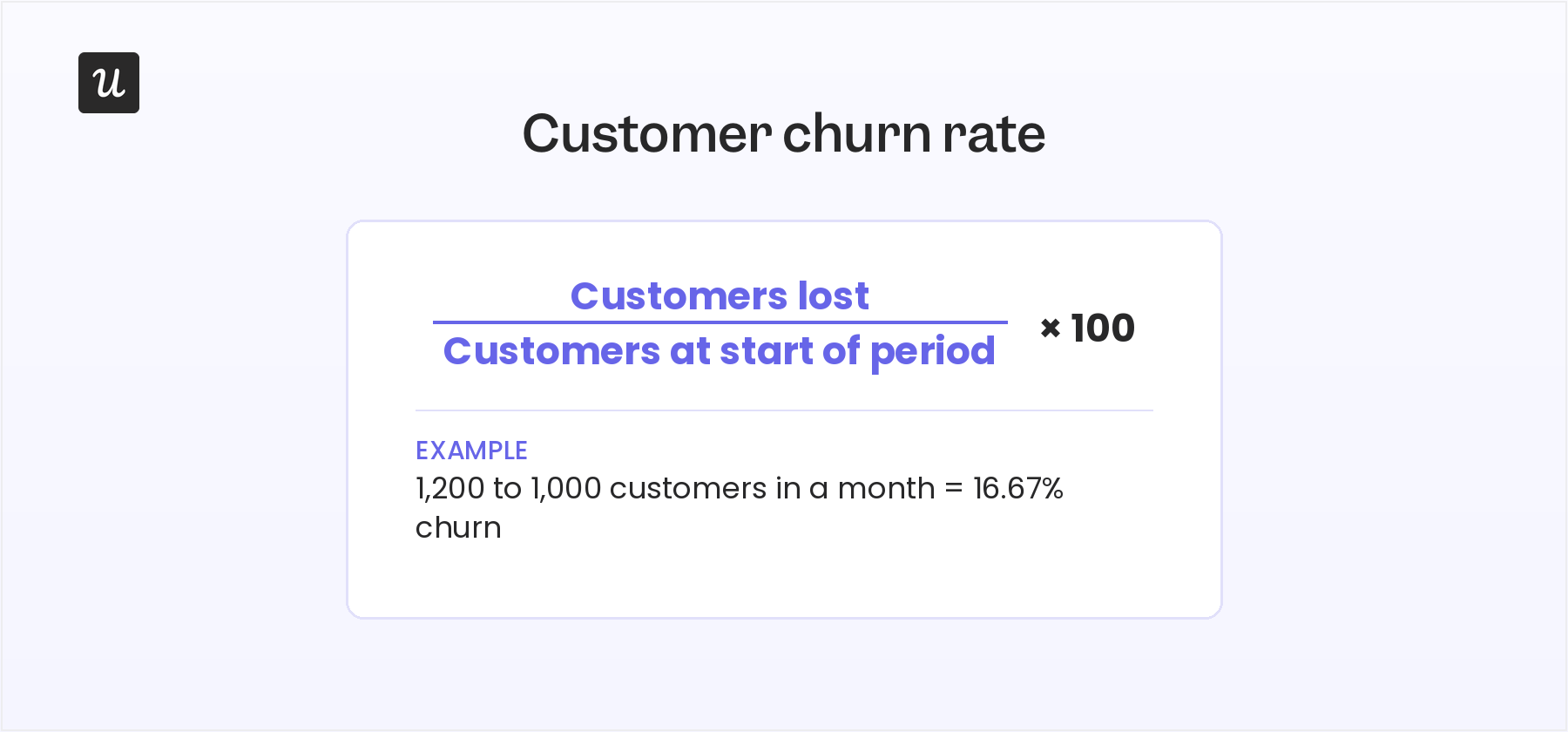
Say you had 1,200 paying customers in February and 1,000 in March with no new signups. The SaaS churn calculation is 200 divided by 1,200, times 100, which gives a 16.67% customer churn rate for the month.
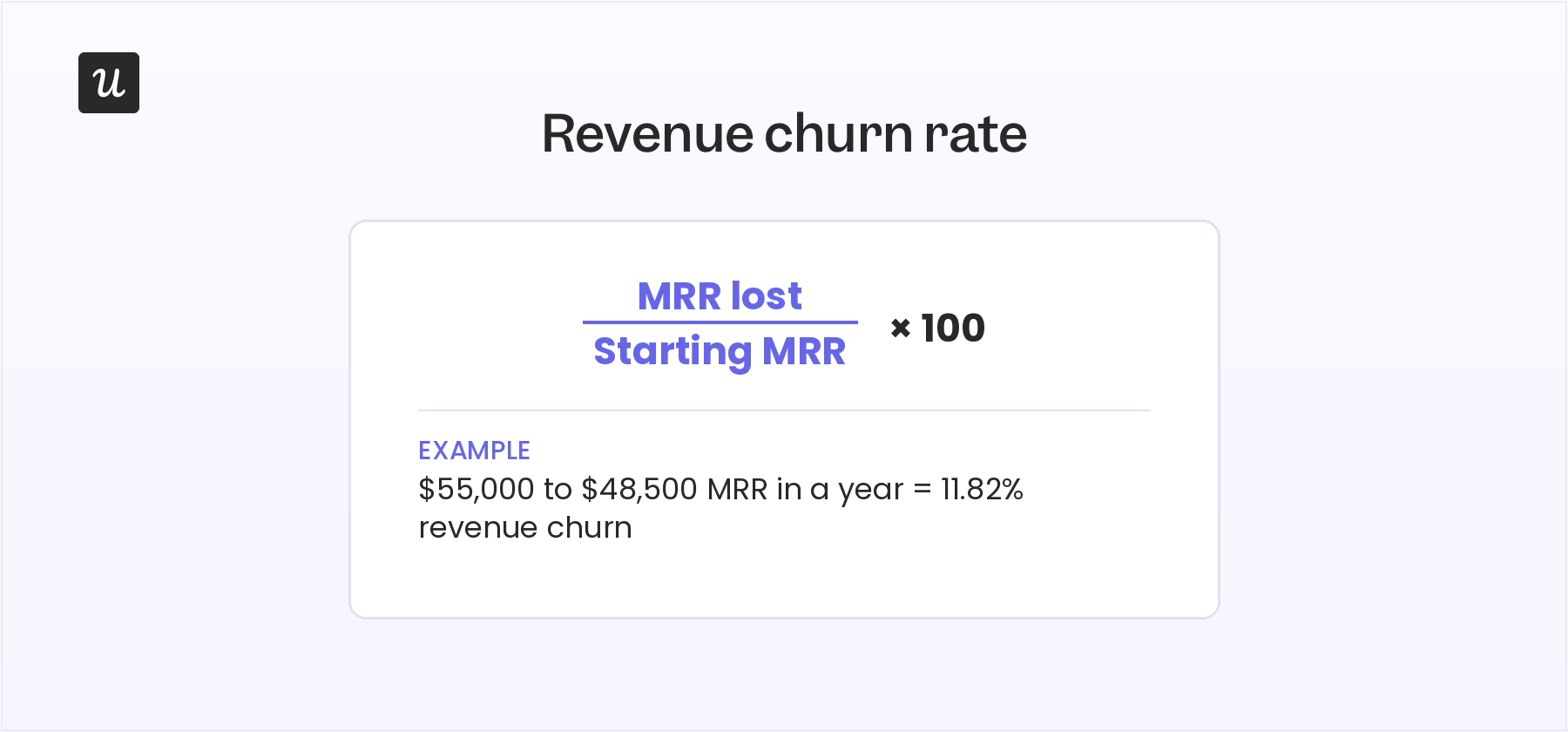
Revenue churn works on dollars instead of the number of users. If your MRR was $55,000 at the start of the year and $48,500 at the end, your annual revenue churn is $6,500 divided by $55,000, or 11.82%. The key difference here is that downgrades are counted in revenue churn even when the account itself stays.
A SaaS business with a healthy net revenue retention number can still be leaking customers underneath it, because expansion in the accounts that stay quietly covers for the ones that leave. That’s exactly the gap a retention calculation done at the account level catches and a single blended churn rate hides.
It’s the reason why you should calculate both customer churn rate and revenue churn rate to get a complete picture.
What are the best practices for churn prevention?
Most churn prevention strategies weren’t designed to monitor every account continuously. Instead, they relied on improving your product as a whole, so it’s worth implementing them:
- Personalizing the customer onboarding process, so a UX designer and a product manager see different flows inside the same tool
- Decreasing time to value with user onboarding checklists, so new customers reach their first real win faster
- Providing in-app guidance instead of static product tours, so users learn by doing
- Offering self-service support through a resource center to make it easier for customers to solve problems without waiting on a ticket queue
- Collecting feedback with in-app surveys and NPS capture user sentiment continuously without having to guess
Every one of these still belongs in a churn prevention program. What they were missing is the layer that decides which customer needs which tactic, right now, based on what that specific account is actually doing.
That’s the piece analytics couldn’t provide: a system that watches usage patterns and engagement signals on every account at once, instead of a human checking a dashboard once a week or month.
What does predictive churn prevention look like with AI agents?
An AI agent changes churn prevention by doing the one thing manual health checks can’t: watching every account daily without anyone assigning the task.
Lia, Userpilot’s AI agent, connects usage events, feature data, NPS, surveys, session recordings, and content engagement into a single picture per account, then answers questions about what’s happening in plain language.
That means you can ask Lia for a churn prediction on a specific account the same way you’d ask a colleague and get a real answer within seconds.
Yazan Sehwail, Userpilot’s CEO, has described where this is heading for the whole product category, not just churn specifically:
“You literally do not need to do anything. It’s gonna look like you just go, you create a project, you tell it what you want, and it should do the rest. You’re no longer operating. The AI is operating. You’re just basically evaluating and monitoring the agent workflow.”
Applied to churn, that means the CSM’s job shifts from hunting for risk signals across five tools to reviewing what an agent already found and deciding how to act on it.
Ask Lia anything: 24/7 Monitoring beats the quarterly check-in
Most account health reviews still run on a schedule, monthly at best, quarterly at most companies. A churn risk that develops between reviews simply doesn’t get seen until the next one, and by then the customer’s decision is often already made.
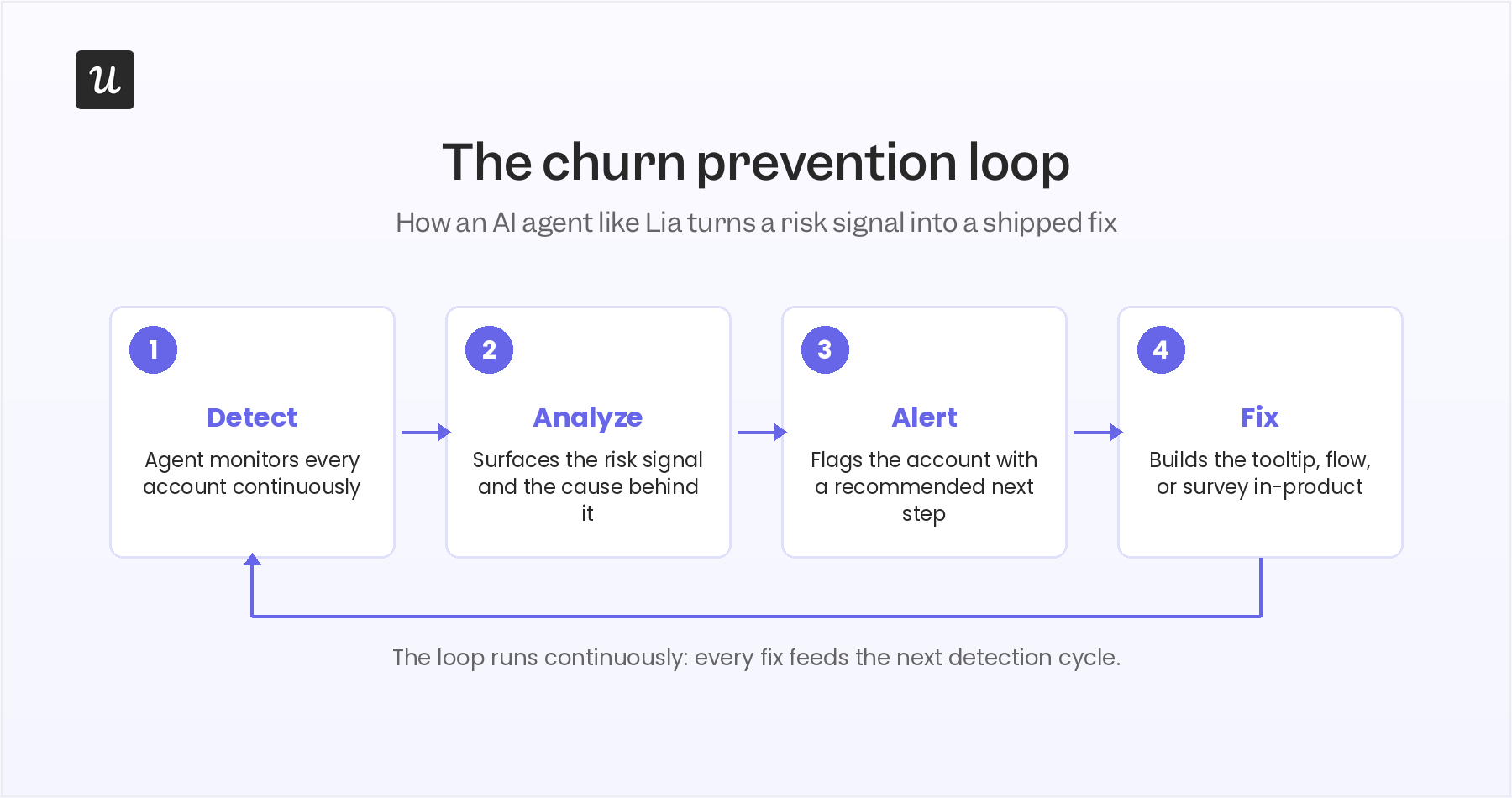
Lia doesn’t work on a schedule. It runs continuously, monitoring across a company’s key product metrics 24/7, watching for the same risks a person would be looking for, minus the gap between reviews. It automatically alerts you when it notices an account displaying signs of churning and prompts you to take corrective measures even before it turns into real risk.
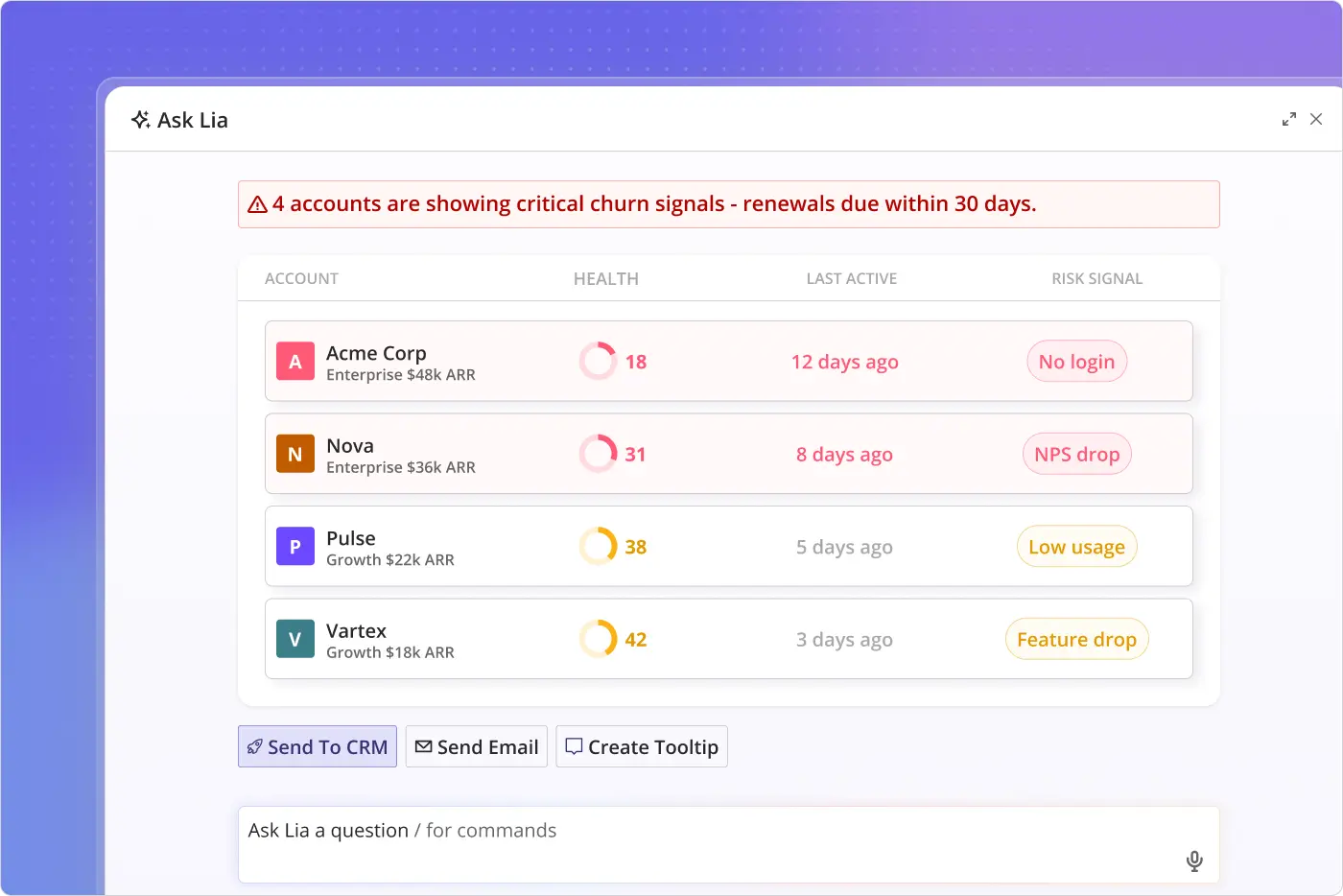
Using an AI agent like Lia, you can use several tactics to prevent customer churn. Here’s what you can do:
1. Analyze account health regularly
Ask Lia to analyze account health, and you get a full picture back: usage, engagement gaps, and risk signals for that specific account, not a generic health score with no explanation behind it. That’s the difference between knowing a score dropped and knowing why it dropped.
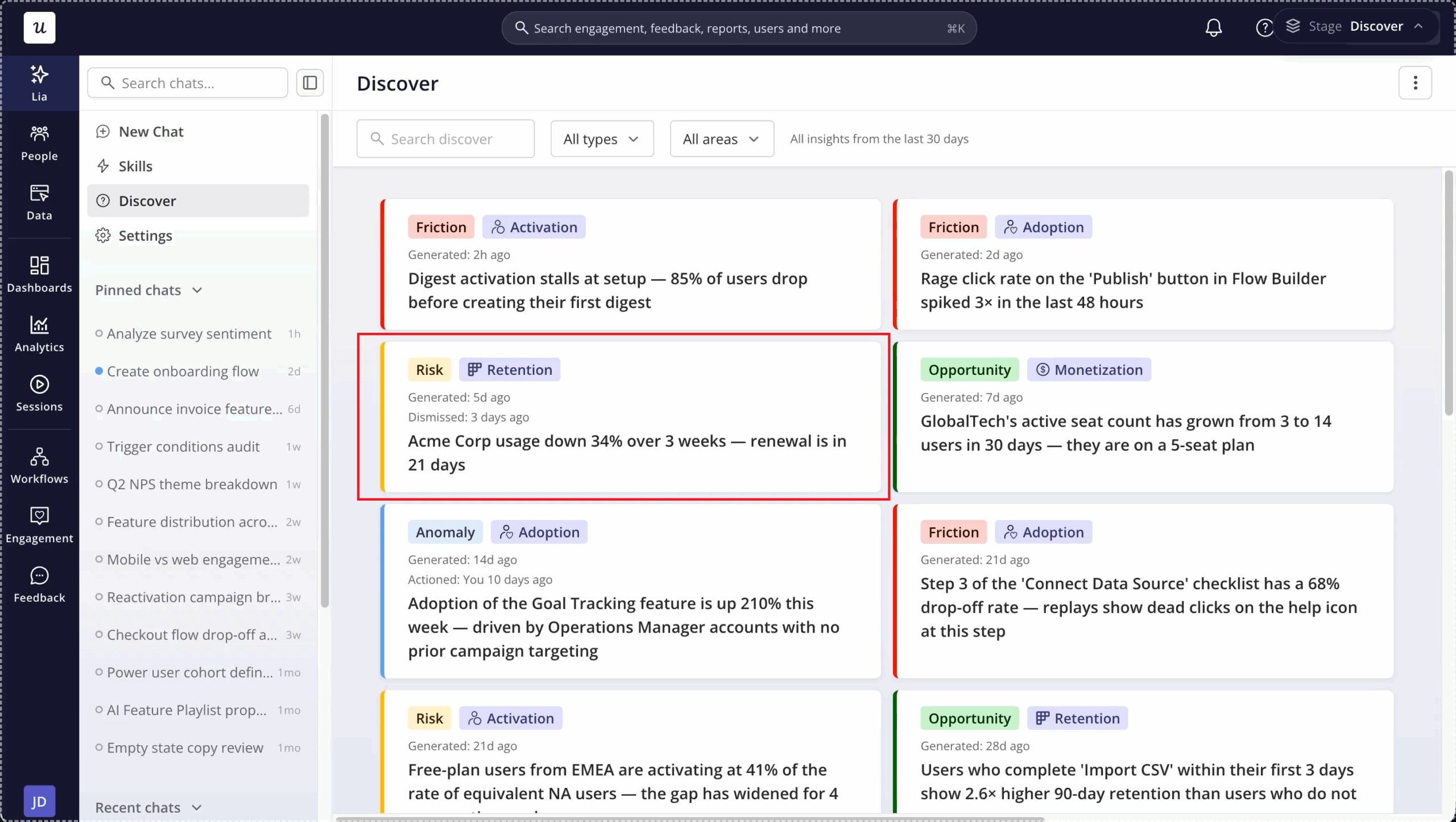
2. Analyze individual segments
While Lia can identify churn signals for individual accounts, it’s also possible that whole customer segments can drift the same way as individual accounts. It’s easy to miss this when you’re only looking at accounts one at a time. Lia can run a segment-level analysis, covering activation, usage, user retention, and sentiment together, and flag it the moment one segment’s engagement drops against its own baseline.
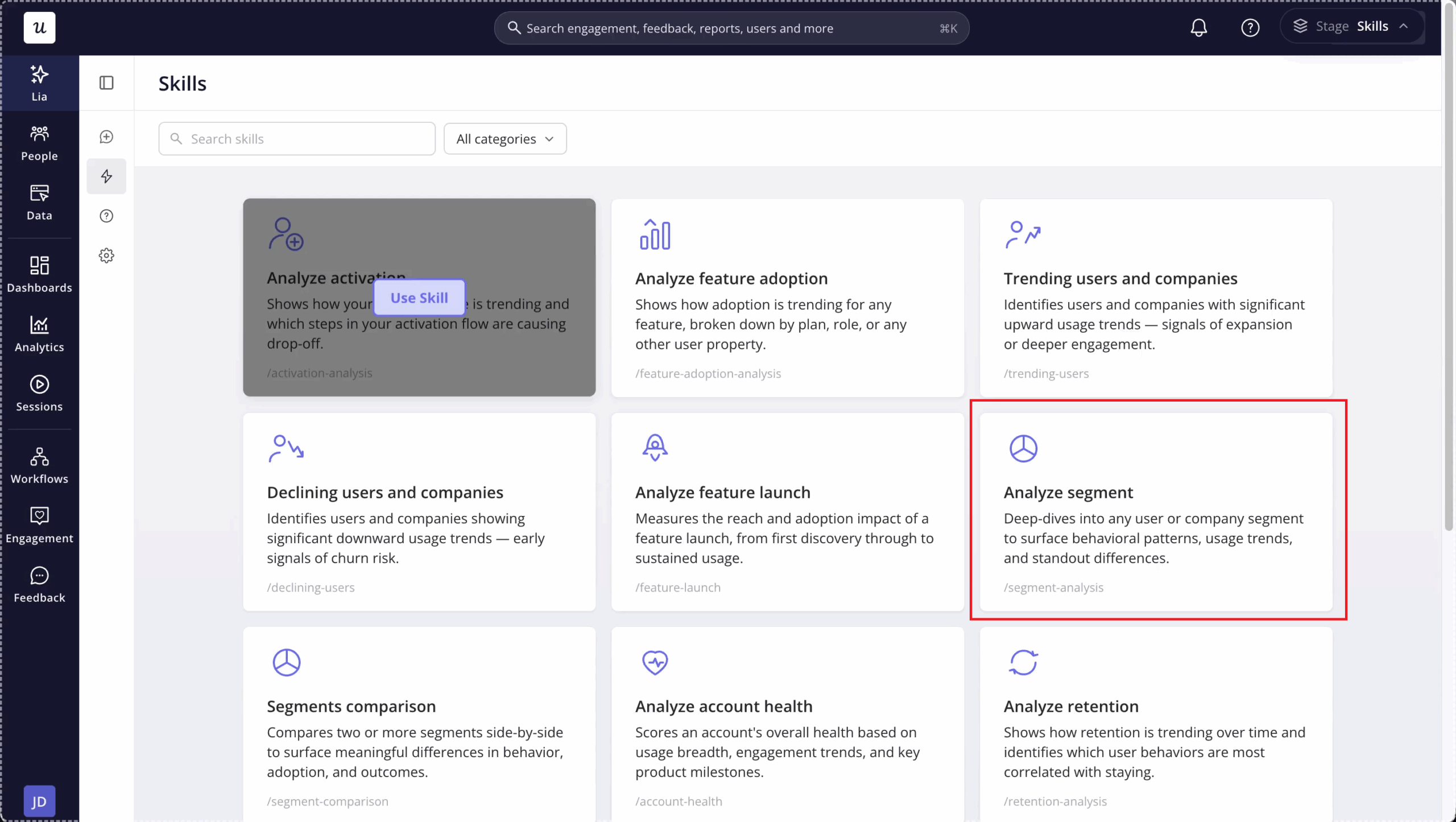
3. Find friction spots and fix them
A lot of churn starts as friction that nobody escalated. Lia can surface where users are getting stuck inside a specific flow, pulling from session replay and usage data, so you can fix the friction point directly instead of waiting for it to show up as a support ticket or a churn survey response weeks later. For instance, note how it pointed out dead clicks in a flow:

4. Create churn surveys with AI agents
Building a churn survey used to mean opening a survey builder, writing questions, setting up targeting, and testing it before it ever reached a customer. With Lia, you can describe the survey you want in one prompt and get a working churn survey back, ready to trigger at cancellation.
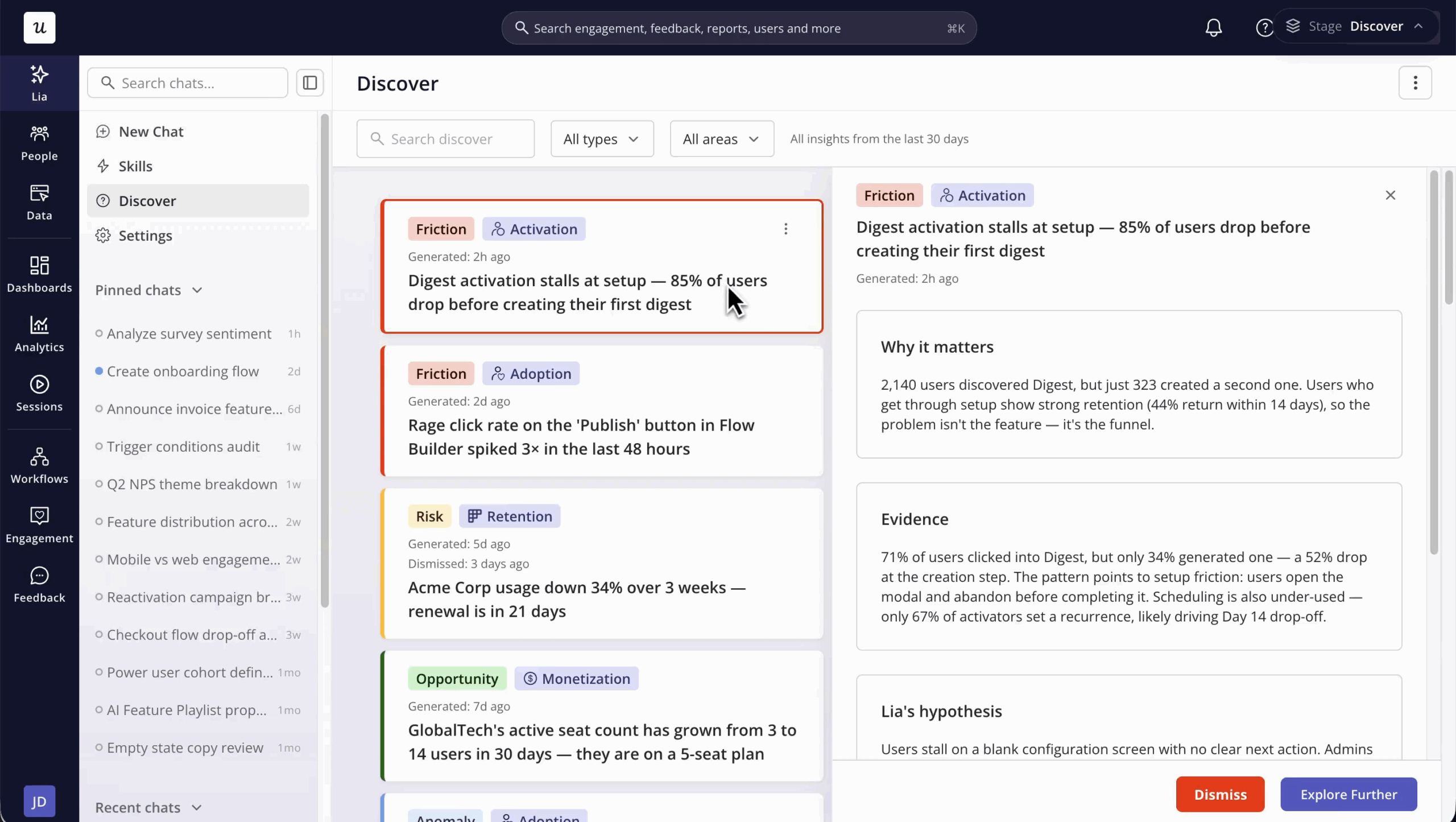
5. Discover user activation issues and resolve them
SaaS activation problems are often the earliest churn signal there is, and they’re also some of the fastest to fix once you can actually see them. Lia can point out these issues and deliver hypotheses and solutions for them to help you fix them before they lead to customer churn.
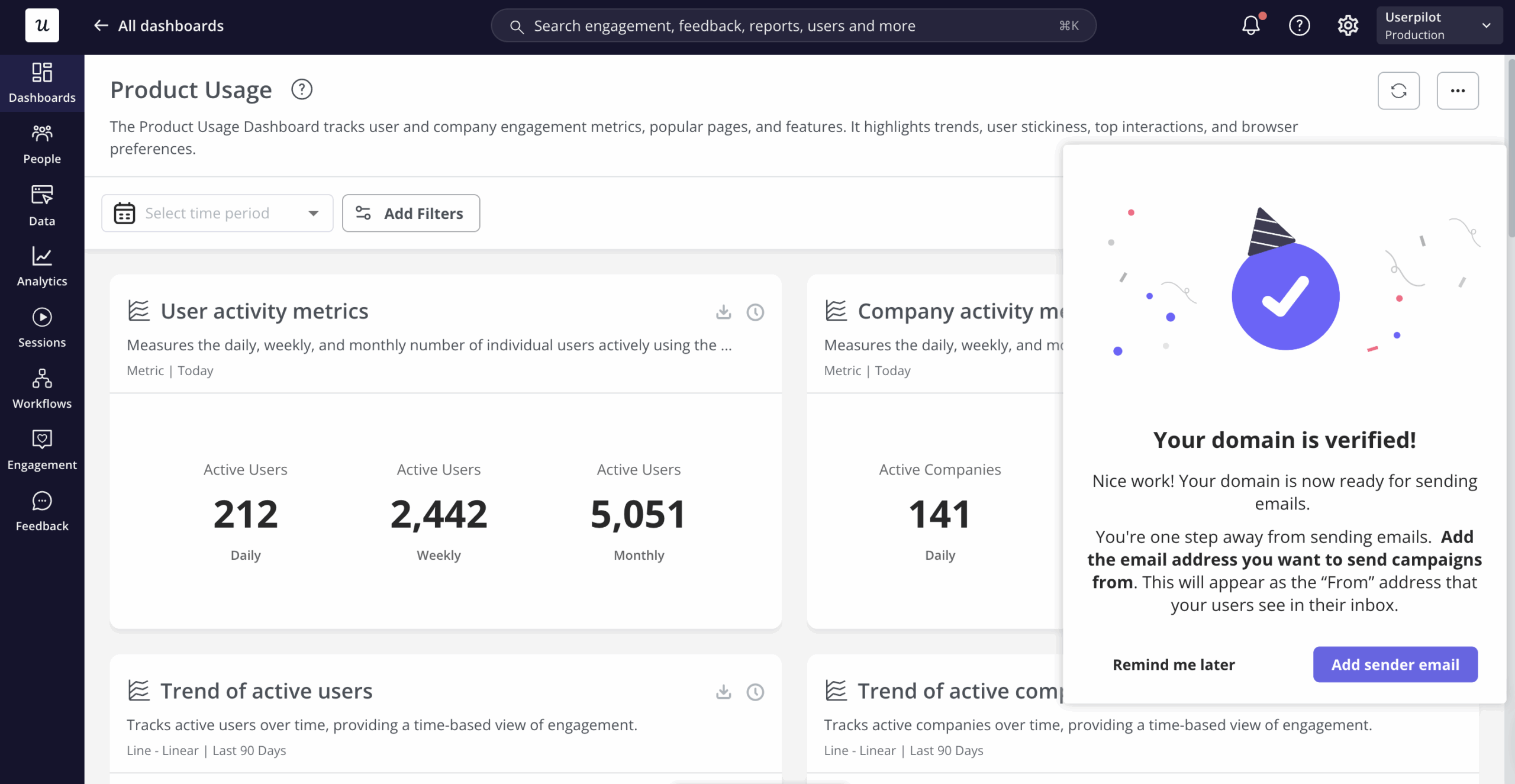
Abrar Abutouq, one of our product managers, ran into exactly this when Userpilot’s own email feature shipped and the activation funnel showed a sharp drop-off at domain verification. Instead of filing an engineering ticket and waiting, she built the fix directly inside the product. In her words:
“Within a few hours, I just created a targeting tooltip and showed it to users and highlighted the correct steps for them to make it clear what to do next. That helped a lot on reducing friction and supporting users in real time without involving our dev team.”
The drop-off closed within days.
Why does a single platform for analytics and resolution help prevent churn?
A tool that tells you an account is at risk and stops there hands you a problem with no next step. You still have to jump into a different product to actually build the fix, whether that’s a tooltip, a checklist, or a survey, and every jump between tools is time a churning customer doesn’t have.
This is the part of the “analyze, advise, act” workflow that matters most. Lia doesn’t just diagnose the friction point behind a churn signal, it can turn that diagnosis directly into the tooltip, flow, or survey that fixes it, inside the same Userpilot account where the risk was found.
Abrar’s tooltip fix above is the model at human speed. An AI agent doing analysis and resolution in one platform is the same model, and it cuts down on brainstorming time by providing potential solutions immediately.
Turn churn signals into churn prevention
Every tactic in the old churn prevention playbook still has a place. What’s changed is the layer underneath it. An AI agent now watches every account continuously, tells you what’s actually happening in plain language, and helps you fix it without leaving the platform.
The accounts that churn quietly, the ones with no complaint and no ticket, are exactly the ones a 24/7 agent catches and a quarterly review misses.
Start a free trial of Userpilot now to see how Lia analyzes account health, catches churn signals, and builds the fix on your own product data in minutes.
FAQ
What's the difference between churn prevention and churn reduction?
Churn prevention means addressing the causes of churn before a customer decides to leave, while churn reduction is the reactive save play you run once a customer has already signaled they’re canceling, like a discount offer or a win-back email.
Why is churn prevention important for a SaaS business?
Recurring revenue businesses lose more than the immediate contract when a customer churns, since every account lost also wastes the customer acquisition cost (CAC) already spent to win it. Every churn means a future expansion opportunity lost and a low lifetime value (LTV). A higher CAC and lower LTV lead to reduced profitability.
What causes customer churn in SaaS?
Most churn traces back to lack of product-market fit, a poor first-time experience, or price without enough demonstrated value. Sometimes, you just need to nudge the customer in the right direction to help them unlock value. And that’s where in-app engagements like tooltips and checklists come in handy. Fixing friction also helps you reduce churn.
About the author