Customer Loyalty in SaaS: Your Product Is the Only Loyalty Program That Matters

Every quarter, I review churn and retention data, and I see the same pattern: accounts with plenty of logins, decent NPS scores, and even the occasional referral that still choose not to renew despite participating in customer loyalty programs.
Antavo’s 2026 Global Customer Loyalty Report puts a number to the disconnect:
82.6% of marketers believe their loyalty efforts make customers feel valued, yet only 56.2% of customers agree.
This is a sign that many companies are measuring loyalty through program engagement rather than the outcomes that actually keep customers around.
And that gap is becoming harder to ignore in 2026. AI agents are increasingly involved in software evaluation and renewal decisions, and they don’t care about rewards or loyalty tiers, but that your product delivers value.
So, what actually creates loyalty in B2B SaaS? And how do you build it now that both humans and AI increasingly judge products by outcomes rather than incentives?
That’s what I’ll discuss in this article.
The key takeaway
- Why the B2C playbook doesn’t translate: Points, tiers, and rewards were designed for frequent, low-consideration purchases, not subscription software where loyalty is a rolling judgment about product value.
- What actually creates loyalty in SaaS: Consistent value delivery, personalized in-product experience, and proactive CS intervention timed to behavioral signals, not to the quarterly calendar.
- The signal hiding in your product data: Feature adoption, milestone progression, and session depth predict loyalty weeks before NPS ever drops. High login counts mean nothing without outcome data to go with them.
- Where loyalty programs fit (and where they don’t): Referrals and community access work in B2B SaaS. Points and tiers rarely do. The Antavo 2026 data shows a persistent gap between what marketers think programs deliver and what customers actually experience.
- The 2026 complication: AI agents are making renewal decisions on behalf of humans. They have no brand affinity. Your product’s value needs to be legible to automated systems, not just felt by human users.
- How to build for it: Activation first, then adoption, then habit. Churn prevention only works early; by the time a customer says they’re leaving, the decision is already made.
Why SaaS teams keep importing the wrong loyalty playbook
Customer loyalty programs have worked in B2C for decades. Airlines use miles to encourage repeat bookings. Coffee chains use rewards to build habits. The model is familiar.
That’s why SaaS teams keep adopting it. The problem, however, is that SaaS renewals work differently.
When a B2B customer reaches renewal, they’re not asking, “What rewards have I earned?” They’re asking, “Is this product still helping us achieve our goals?” The renewal discussion revolves around outcomes, not incentives.
That’s why loyalty programs rarely influence the final decision. Customers evaluate whether the product saves time, generates revenue, reduces costs, or improves workflows. If the answer is yes, they stay. If not, points, perks, badges, or any reward system won’t change the outcome.
So, what works?
What actually drives customer loyalty in B2B SaaS?
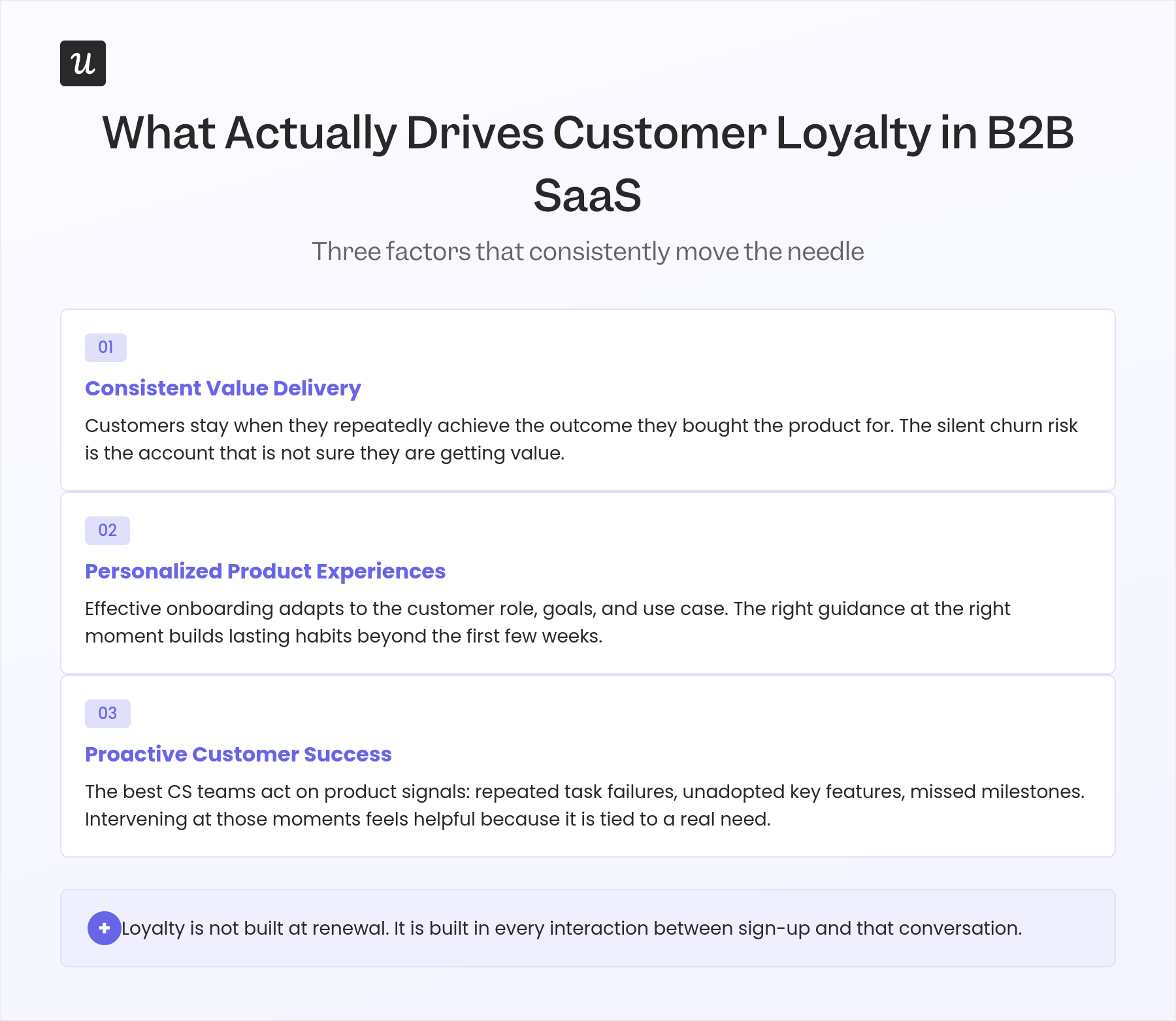
In my experience, three things consistently move the needle:
1. Consistent value delivery
Customers stay when they repeatedly achieve the outcome they bought the product for.
The risk isn’t always the unhappy customer. It’s often the customer who isn’t sure whether they’re getting value because reporting is unclear, adoption is incomplete, or the workflow never fully clicked. Those accounts tend to surface as churn risks only at renewal.
2. Personalized product experiences
Generic onboarding flows treat every customer the same. Effective onboarding adapts to the customer’s role, goals, and use case.
The right guidance, delivered at the right moment, helps users reach value faster and build lasting habits. That’s what creates user engagement that survives beyond the first few weeks.
3. Proactive customer success
The most effective customer success teams don’t wait for customers to ask for help.
Instead, they act on product signals: a user repeatedly attempting a task without success, a key feature that hasn’t been adopted, or a milestone that should have been reached but wasn’t. Intervening at those moments feels helpful because it’s tied to a real need rather than a scheduled check-in.
These drivers all point to the same conclusion: loyalty starts with activation.
What your product data is actually telling you
One of the most counterintuitive lessons I’ve learned in customer success is that high login isn’t necessarily a good loyalty signal. I saw this firsthand with an account that logged in consistently week after week. On the surface, everything looked healthy. But when we looked closer, the outcomes weren’t there. The team wasn’t publishing flows, building segments, or reaching the milestones we’d expect from a successful customer.
When I dug deeper and spoke with the executive stakeholder, I uncovered the friction preventing product adoption and helped the team get back on track. Had I only monitored login activity, I might have missed the warning signs entirely.
Bottom line: Metrics like NPS and CSAT are valuable, but they’re often lagging signals. By the time a customer gives you a low score, they’ve usually experienced weeks or months of frustration.
Product usage, on the other hand, data tells the story earlier. And that’s why I recommend leading signals like:
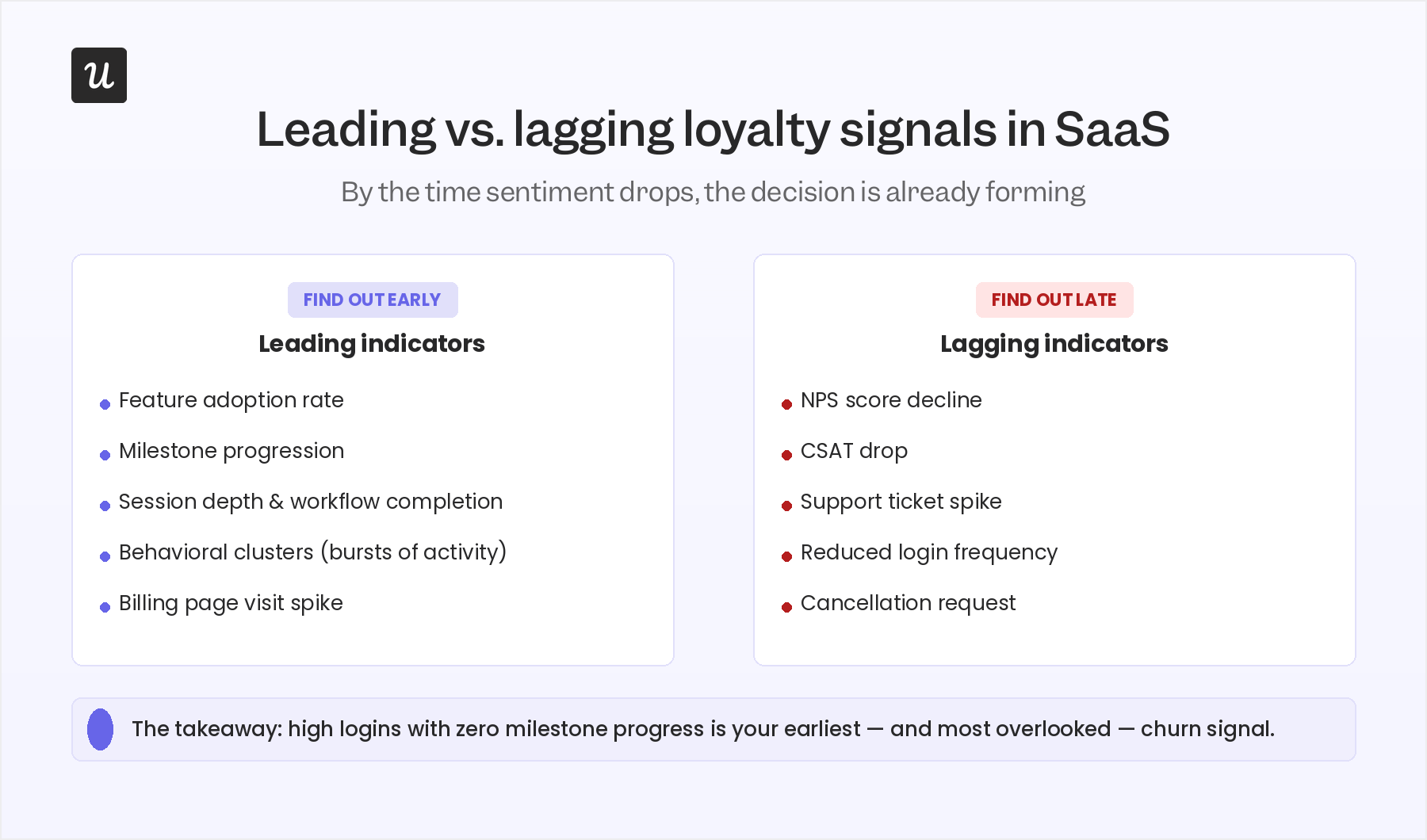
These patterns reveal whether customers are making progress toward value or drifting away from it. This is where Userpilot’s analytics layer does most of its work for our own CS team. I can see that a user is logging in, but more importantly, the features they’ve touched, where the drop-off rate is happening, and when a behavioral pattern that correlates with churn starts forming. Lia, Userpilot’s AI agent, monitors these signals continuously and flags the accounts that need attention — before any CSM would catch them through manual monitoring across a large book of accounts.
Where loyalty programs actually fit in SaaS (and where they don’t)
This isn’t an argument against loyalty programs. Some work extremely well in SaaS. The key is knowing the difference. And I often use a question as a guide: Are we reinforcing product value or distracting from it?
What works: Programs tied to customer value
Referral programs are one of the most effective loyalty mechanisms in B2B SaaS because they’re aligned with the product itself. Dropbox’s referral program is a classic example of this. Users received additional storage for referring others, while new users received the same benefit. The reward wasn’t separate from the product experience; it was the product experience.
Community access and product influence also work. Giving power users early access to features, opportunities to shape the product roadmap, or direct access to the product team creates a deeper level of engagement. These customers become invested not just in what the product does today, but in what it will become tomorrow.
What doesn’t work: Loyalty Programs built around engagement metrics
Where SaaS companies often struggle is with points, tiers, and rewards systems borrowed directly from B2C. The issue with this isn’t that customers dislike rewards. It’s that rewards rarely influence a renewal decision. Customers renew because they’re getting value, not because they’ve accumulated points.
In summary, Loyalty programs work in SaaS when they reinforce the value customers already receive. They struggle when they’re used as a substitute for that value.
The 2026 wrinkle: Loyalty when the decision-maker is an AI agent
There’s a shift underway that most SaaS loyalty strategies aren’t designed for yet. PYMNTS put it plainly:
“The most consequential customer a SaaS company acquires this year may never read a promotional email, respond to an NPS survey, or feel the pull of an exclusive loyalty tier. It will be an artificial intelligence (AI) agent, querying product catalogs, comparing subscription value and executing purchases on behalf of a human who has already delegated the decision.”
Yazan Sehwail, Userpilot’s CEO, described where this is heading when we were discussing what AI changes about how SaaS products need to be built:
“People don’t wanna do any of this. That’s the truth. What it’s gonna be is that you literally do not need to do anything. It’s gonna look like you just go, you create a project, you tell it what you want, and it should do the rest. You’re no longer operating. The AI is operating. You’re just basically evaluating and monitoring the agent workflow.”
That shift has a specific implication for loyalty: agents have no brand affinity. They optimize for outcomes, API reliability, and how cleanly your product’s value can be measured and reported back. A loyalty points balance means nothing to a system evaluating integration depth and uptime SLAs. The emotional pull of a tiered rewards program doesn’t factor into an automated renewal recommendation.
For SaaS products, this raises a real question: is your value legible to a machine? Structured data, clean integrations, and a clear signal of what the product does for the account. These are what determine how an AI agent evaluates whether a renewal is worth recommending.
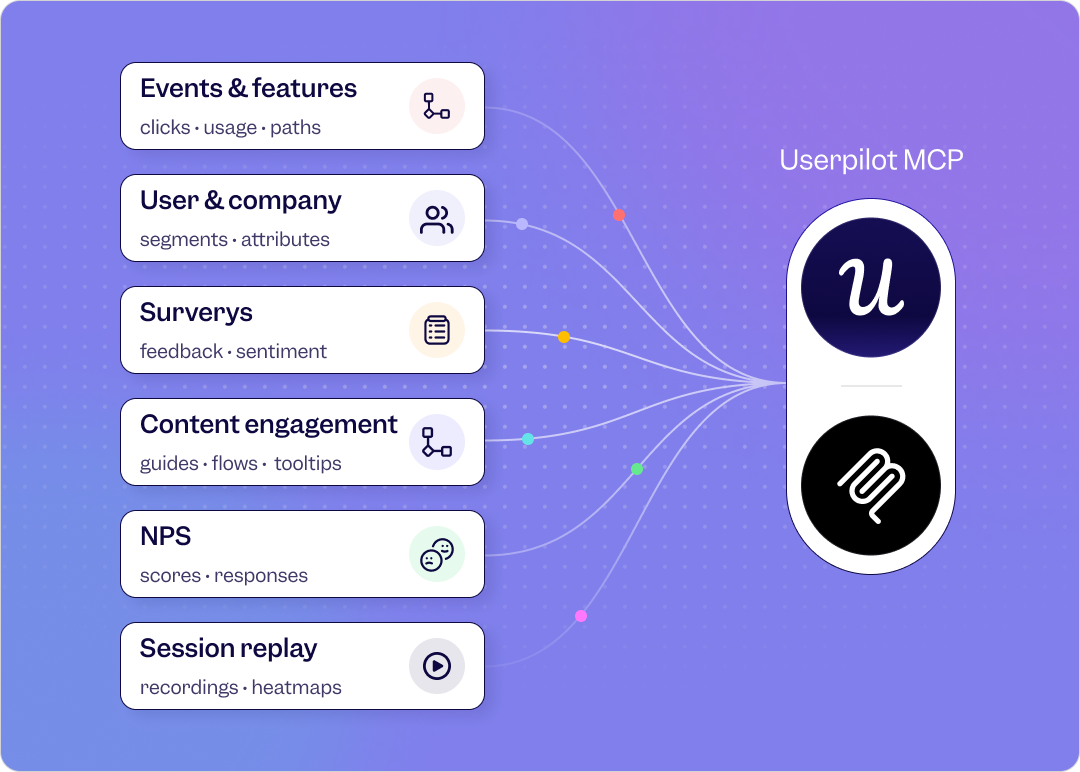
At Userpilot, our MCP Server was built precisely for this: so that agents querying product usage metrics, survey results, and behavioral analytics can surface value without a human having to extract and interpret it manually.
How to build for loyalty in 2026
The sequence looks like this:
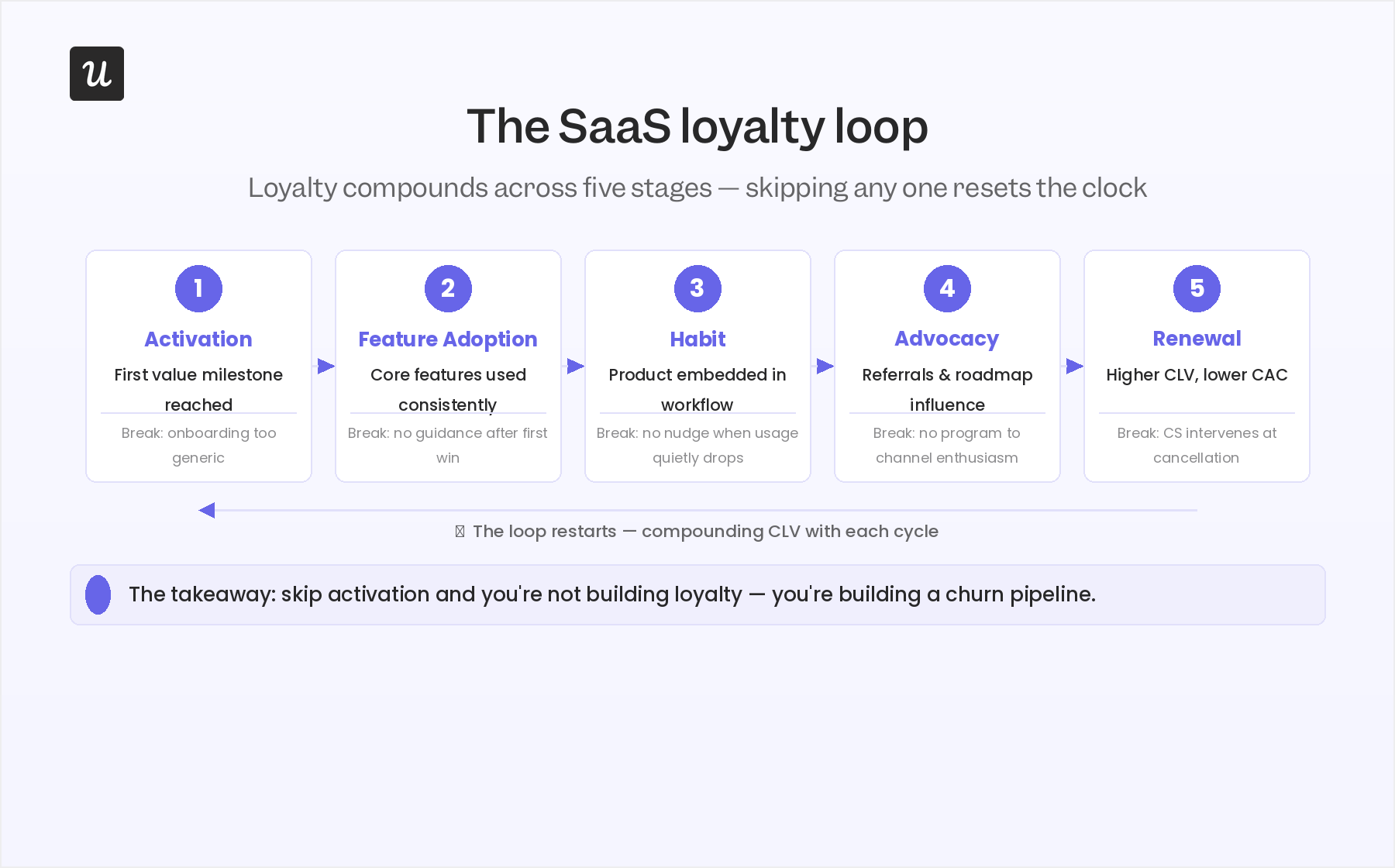
Miss activation, and customers may never experience value. Miss adoption, and they won’t build workflows around your product. Miss habit formation, and every renewal becomes a fresh evaluation rather than an obvious decision.
That’s why loyalty and churn prevention are really the same conversation. The best time to prevent churn isn’t when a customer clicks “Cancel.” It’s weeks or months earlier, when they’re still trying to succeed and are open to guidance. Once customers disengage, winning them back becomes significantly harder.
So, what does building for loyalty look like in practice?
- Personalize onboarding by use case: Avoid sending every customer through the same onboarding flow. Different user segments have different goals, and the fastest path to value isn’t always the same.
- Trigger guidance based on behavior: Don’t wait for a quarterly check-in to discover a problem. Use behavioral signals, such as stalled feature adoption, missed milestones, or repeated failed actions, to deliver help when it’s most relevant.
- Collect customer feedback at key moments: Survey customers throughout their journey, not just after they churn. And when a customer does decide to leave, use cancellation surveys to uncover the root cause before it becomes another data point in a report.
- Monitor the signals that predict churn: Look beyond login counts. Pay attention to patterns such as:
- High activity but low feature adoption.
- Missed onboarding or adoption milestones.
- Usage spikes followed by prolonged inactivity.
- Visits to billing or cancellation pages with little recent product engagement.
Bringing all of this together requires more than good intentions. You need visibility into customer behavior and the ability to act on it.
Userpilot helps teams manage onboarding, in-app engagement, feedback collection, and behavioral analytics in one place. Combined with Lia’s account health monitoring, teams can identify churn risks, spot expansion opportunities, and intervene before small issues become renewal conversations.
Loyalty isn’t a program you launch
The SaaS companies building the most loyal customer bases aren’t running more sophisticated reward mechanics. They’re building products that consistently deliver outcomes, monitoring the behavioral signals that show when that delivery is slipping, and intervening before the customer decides to look elsewhere. That’s the whole strategy, compressed.
Loyalty programs are a useful multiplier when the foundation is solid. Referrals, community access, and early product input genuinely reinforce retention and advocacy in the right context. But none of them substitutes for the work of getting customers to real value and keeping them there, which happens inside the product, not inside a points ledger.
In 2026, with AI agents evaluating renewals and integration depth lowering switching costs, the only durable version of customer loyalty is a product that’s clearly worth keeping. Build for that first. Everything else is detail.
If you want to see how Userpilot handles the in-product side of this, onboarding flows, behavioral analytics, and proactive engagement, get a demo here.
FAQ
What are the 4 C's of customer loyalty?
The 4 C’s represent four categories of customer loyalty:
- Captive: Customers that are stuck with your brand merely due to a lack of alternatives.
- Contented: Satisfied customers who appreciate your brand but may not be actively engaged.
- Convenience-seeker: These customers prioritize ease and efficiency.
- Committed: Highly loyal customers who actively advocate for your brand.
What are the three R's of customer loyalty?
Use these three R’s to help build customer loyalty:
- Reward: Offer tangible hard benefits for favorable customer behavior to acknowledge their value, like discounts or redeemable loyalty points.
- Recognition: Show appreciation through gestures like complimentary upgrades or exclusive access, delivering soft benefits that improve customer relationships.
- Relevance: Connect with customers to foster deeper engagement, taking the time to understand their needs and gather customer feedback.
How does customer loyalty benefit customers?
While customer loyalty helps businesses drive lifetime value and customer retention in the long run, it also benefits customers in several ways. For instance, it provides customers with rewards, personalized experiences, exclusive offers, and better customer support, enhancing their overall satisfaction.
About the author