6 Product Management Trends in 2026: The PM Role Is Splitting


Product management in 2026 feels more fragmented than it used to.
A few years ago, most PM teams were optimizing around the same things: shipping velocity, roadmap execution, and feature adoption. Now the role is splitting in multiple directions at once. Some PMs are becoming deeply technical and AI-adjacent. Others are moving closer to growth, lifecycle, monetization, or customer expansion. And teams are hiring for those differences much more aggressively than before.
You can see the shift in the market already.
Product management job postings were up 14% year over year as of May 2026, yet companies continue to describe hiring as unusually difficult. At the same time, MIT research found that 95% of enterprise product pilot projects in AI fail to produce measurable ROI, while Pragmatic Institute research reported that 64% of product teams have already integrated AI into their products.
That gap between adoption and business impact came up repeatedly in conversations I had with PMs while researching this piece, including a discussion with our CEO at UserPilot, Yazan Sehwail, about how product organizations are changing internally as AI becomes operational instead of experimental.
Below are the six product management trends I think matter most right now.

1. The PM role is dividing into two (and the middle is collapsing)
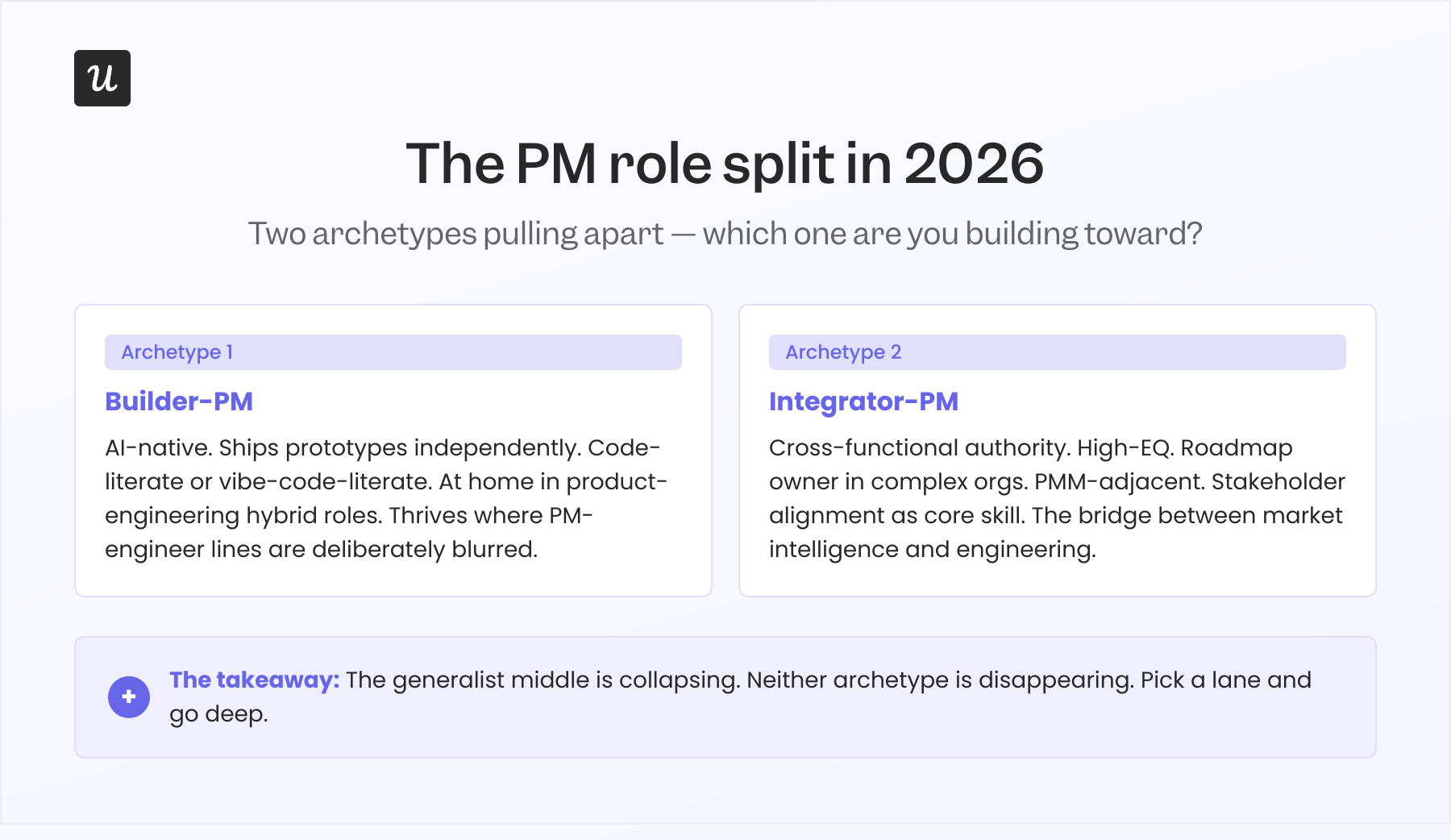
My fellow PMs and I have felt the same about this: the generalist role is splitting in two, and it’s been obvious since mid-2025.
- The first archetype is the builder-PM: AI-native, ships prototypes themselves, working on teams that deliberately blur the PM/engineer line. You may have already noticed how LinkedIn killed its Associate PM program last year and replaced it with a “Product Builder” track — one rotation across product, design, and engineering. In this evolving product team structure, the old 1:8 PM-to-engineer ratio is collapsing because the job now includes shipping code, not just speccing it.
-
The second is the integrator-PM: High-EQ, cross-functional, owns the roadmap in messy B2B environments where internal alignment is still a human problem. My bet is this archetype drifts toward PMM over the next few years. Once AI absorbs execution, the value will be market intelligence, positioning, and translating between teams that wouldn’t otherwise understand each other.
If you’re sitting in the middle, I’d start picking a side. Own one thing people come to you for, or spend your career cleaning tech debt.
Neither archetype is inherently safer than the other. Builder-PMs are more exposed to commoditization as AI closes the gap on prototype-quality software. Integrator-PMs are more exposed to top-down directive pressure when capital is tight. The group under the most pressure is the one doing neither archetype role distinctively, operating in the middle at a mediocre level for both, and calling it a range.
I keep telling PMs who ask me where this is going that everyone is about to be able to build. Nevertheless, the problem was never building but building the right thing.
2. PM specialization is becoming the new advantage
Aakash Gupta, a product growth expert formerly at Apollo, Affirm, and Google, was tracking the shift in specialization two years ago. He argued that AI was making functional specialization more valuable, not less: “tuning large-scale LLM models is very different than core product for a news feed,” and the PMs with direct domain experience consistently outperform those without it.
“The rise of things like AI has made it more clear than ever how important it is for PMs to have functional specialization. We’ll continue to see fewer ‘General PM’ searches at big tech and a shift towards specific searches: AI PMs, API PMs, Consumer PMs. Overall, PMs will have to grapple with specialization or see slower career growth when job hopping.”
— Aakash Gupta, product growth expert, formerly at Apollo, Affirm, and Google
The salary data now confirms the prediction. Pawel Huryn, product coach and author of The Product Compass, who actively tracks PM compensation, puts the 2026 US figure at roughly $245,000 for AI-focused PMs, compared with $123,000 for traditional PMs. The $122,000 gap represents a different career track altogether, with a different ceiling.
Companies recruiting in the 30-150 person B2B SaaS range tell a consistent story: they want specialists in specific growth subfunctions: monetization, onboarding, packaging, AI infrastructure, and regulated verticals. Not someone who “has experience across the full product lifecycle.” That phrase, which signaled range in 2021, now signals indecision.
It is also worth being precise about scale here. AI PM roles currently account for 8-10% of all open PM positions globally. The premium is concentrated in a relatively small part of the market. For PMs whose roles don’t carry the AI PM label (which is most people), the specialization lesson still applies in a different subfunction. Onboarding specialists, monetization PMs, and growth-focused product roles are all commanding premiums over their generalist equivalents. The mechanism is the same even when the domain differs.
3. AI is pushing PMs toward governance work
Yazan Sehwail, Userpilot’s CEO, described the core shift when we talked through what he is seeing inside product teams at scale:
“Instead of every quarter releasing one or two features, now you’re releasing 7, 8, 9. What happens is it becomes even harder for product teams to manually have to track each one and understand usage for each one and come up with hypotheses and insights on each one. You definitely need to automate a lot of this.”
— Yazan Sehwail, CEO, Userpilot
For most of the last decade, the bottleneck was engineering capacity when the question was: Can the team build this fast enough?
The rapid adoption of SaaS AI tools has fundamentally changed that equation. Teams can now ship significantly more, faster. Which means the bottleneck moves somewhere else:
- Understanding what’s happening across a much larger product surface.
- Identifying which signals matter.
- Diagnosing friction.
- Deciding what deserves intervention.
That’s the shift from operator to governor.
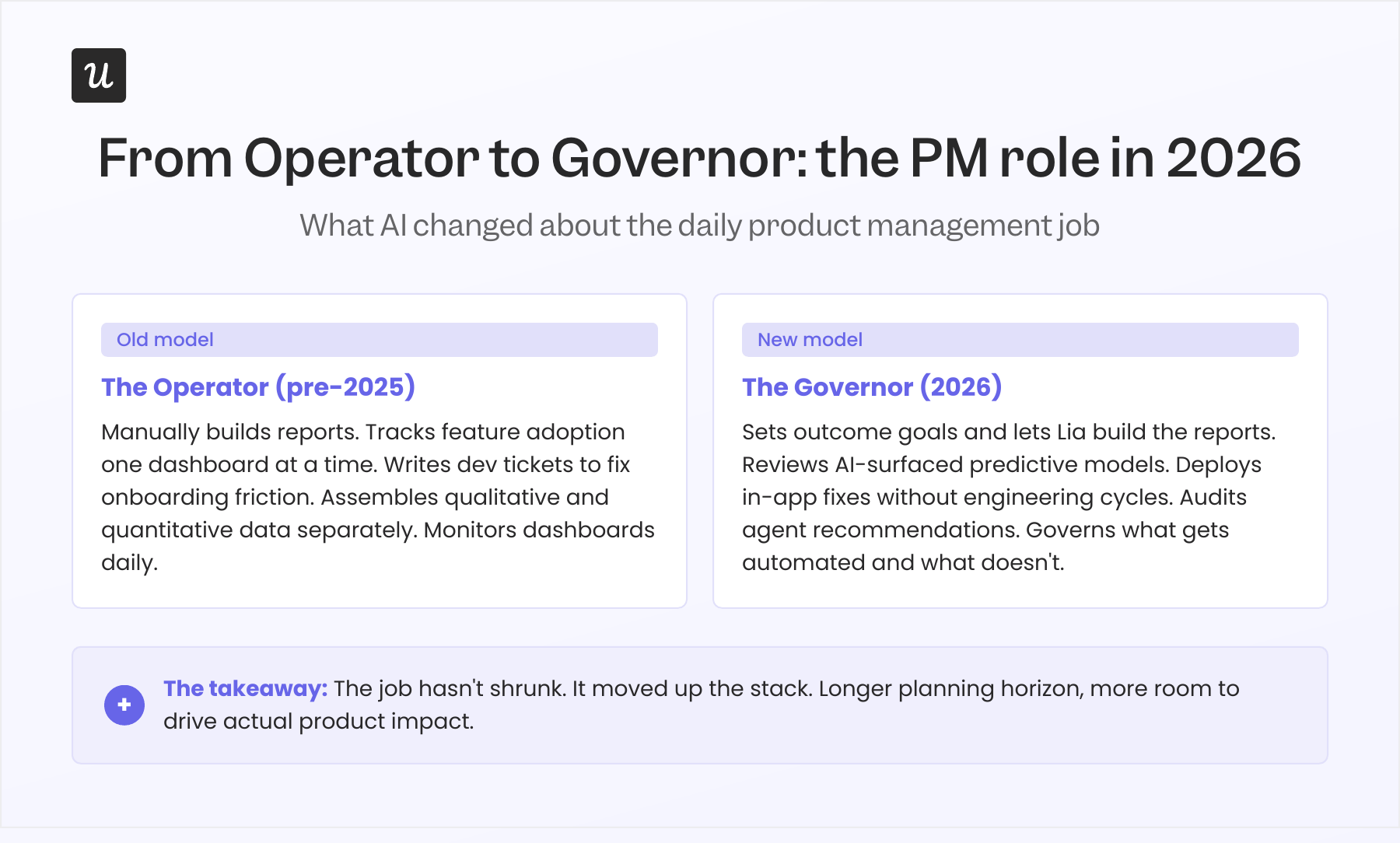 Or, as Yazan described it:
“You’re no longer operating. The AI is operating. You’re basically evaluating and monitoring the agent workflow.”
That description feels increasingly accurate in my own workflow. A lot of the manual “assembly work” PMs used to do is starting to disappear. I no longer need to spend hours jumping between dashboards or cross-referencing feature usage just to understand why user activation dropped. I can just ask AI.
At Userpilot, that’s exactly the direction we’ve been building toward with Lia — our AI agent for product teams.
For example, one of the capabilities we’re introducing this end of June is conversational product insights. PMs can simply ask questions in plain English to understand why a metric changed, or where users are getting stuck.
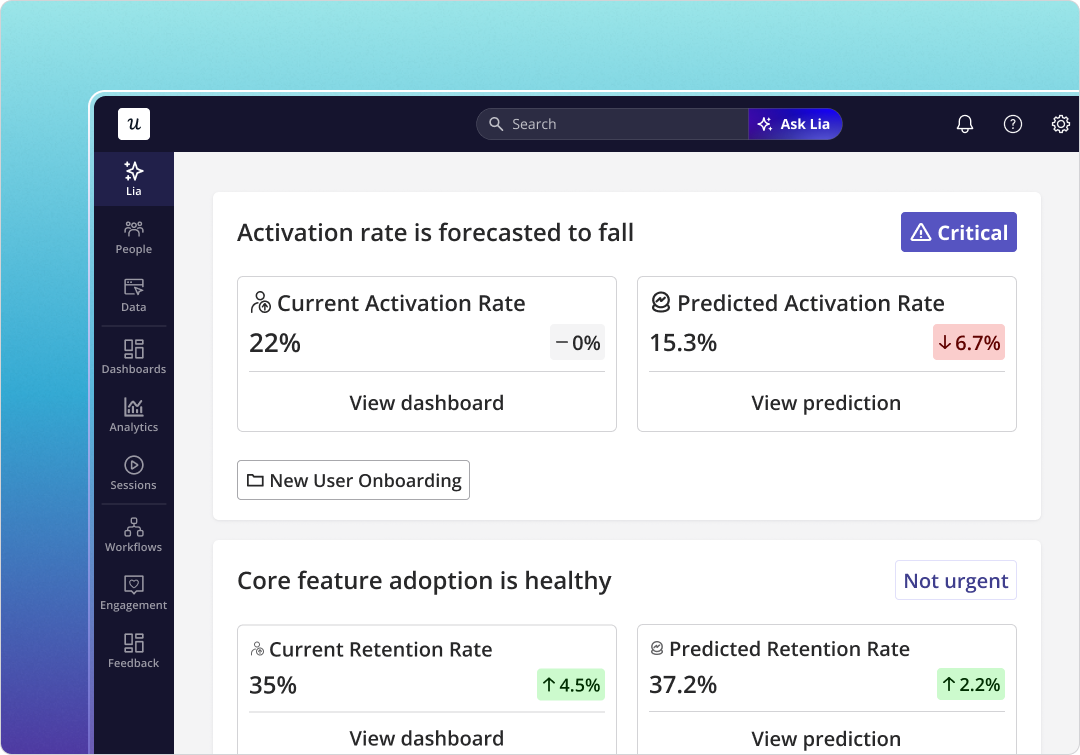
This is also why outcome-driven product management becomes far more viable in an AI-native environment. The shift from feature roadmaps to outcome-based product roadmaps is not new. What AI changes is the operational reality of maintaining them at scale.
This also aligns with what Marty Cagan has been arguing over the last two years. AI strips away a lot of the performative work around product management and leaves behind the most demanding skill, which is judgment.
That judgment layer is becoming even more important as products start serving not only human users, but AI agents as well.
Which means product teams increasingly need visibility into two separate behavioral patterns:
- Human behavior signals.
- Agent behavior signals.
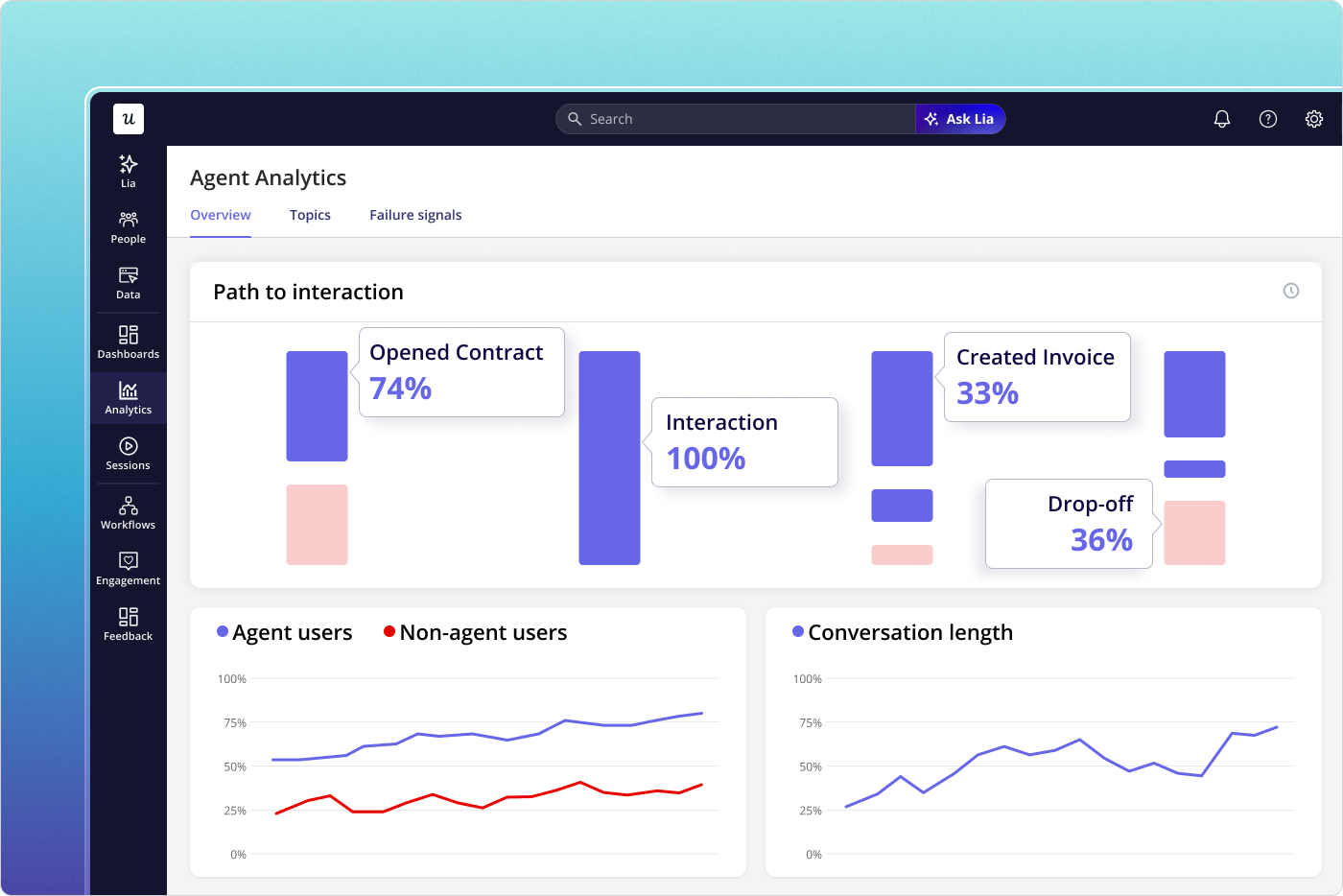
That’s part of what we’re thinking about with Agent Analytics: understanding what agents attempted to do, where workflows failed, which tasks completed successfully, and how autonomous interactions differ from traditional user behavior analysis.
Because the future challenge for PMs is how to govern increasingly autonomous product systems well.
4. Go-to-market is now a PM survival skill
The most upvoted observation in any practitioner community discussion of where PM is heading comes from a working product leader who has been watching the space for years.
“Go-to-market is the hardest part to me, and that doesn’t change.”
Gathering customer feedback and translating it into product decisions. Pricing and packaging. Training the sales org on what a new feature does and why it matters. PR briefs. Executing conversion funnel optimization to turn trial users into paid accounts without a sales rep in the room. None of this compresses under AI in any meaningful near-term way, because all of it requires someone who understands the product deeply, can read a room, and can translate between customer language and engineering constraints.
This is why the prediction about PM-to-PMM convergence deserves more attention than it gets. Despite the discourse around whether PMs should code, the gravitational pull right now is toward market adjacency: PMs picking up market research, pricing experiments, creative briefs, and ownership of the activation funnel. The PMs who own GTM will outlast the ones who specialize only in writing requirements documents.
More companies are committing to product-led growth in 2026, making GTM ownership more urgent. McKinsey data show companies are increasingly comfortable spending $500,000 to $5 million on a single purchase through self-service channels, which means the product itself is the sales motion, and someone has to own the experience that converts a trial user into a paying customer. Partho Ghosh, VP of Product at SecurityScorecard, described where this is heading:
“More companies will start to understand the difference between PLG as a motion and being ‘Product-Led.’ More companies will start building better products to simply use human capital in more important areas in an effort to be efficient.”
— Partho Ghosh, VP of Product, SecurityScorecard
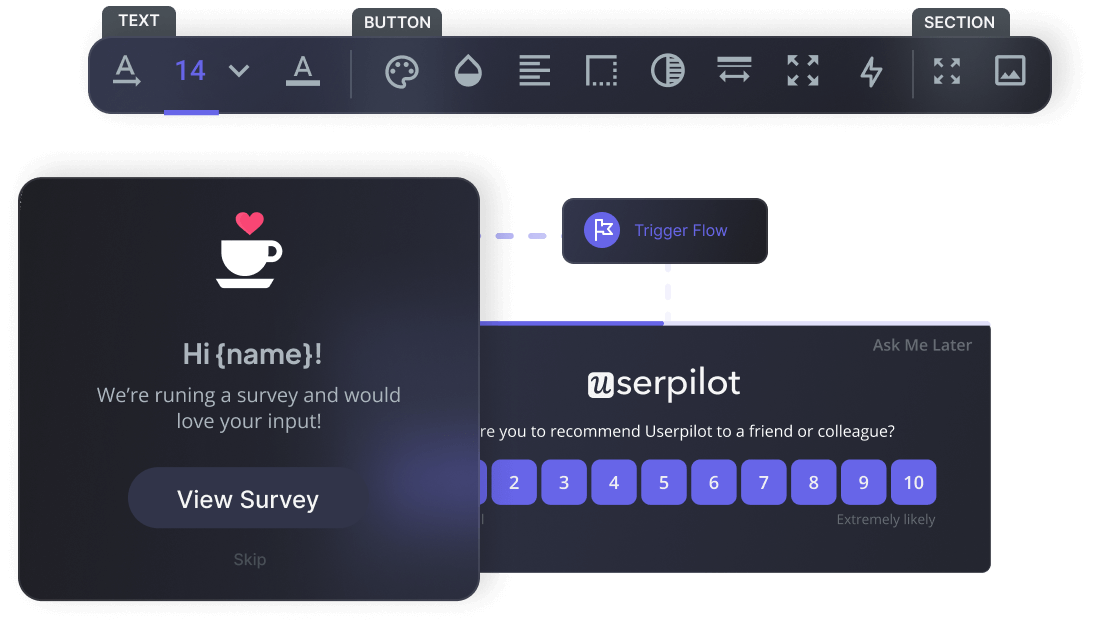
The skills that matter in a PLG environment (user onboarding teardowns, activation rate optimization, in-app engagement design, trial conversion) sit exactly at the intersection of product and GTM. User engagement tools are the infrastructure for this motion: contextual tooltips that guide users at the moment they encounter a new feature, personalized onboarding flows that adapt to what the user has and has not completed, and in-app surveys triggered at precisely the right moment. All of it runs without an engineering cycle for every change.

Inclusivity as a GTM motion is also growing in importance. As competitive pressure pushes companies into new markets, inclusive product design (including localization) becomes a distribution decision, not just a values one. The PM who owns the localization call is making a GTM call.
5. PM hiring is recovering, but the signal problem is getting worse
Product management hiring has recovered. Ant Murphy, product coach and founder of Product Pathways, tracked roughly 42,000 open PM roles on LinkedIn in early 2026, double the count from the same period the year before. Lenny Rachitsky, author of Lenny’s Newsletter and one of the most widely-read voices on product careers and growth, documented 6,000-plus open roles globally in 2025, 53.6% above the 2023 low. May 2026 data from LinkedIn shows the market up 14% year-over-year, with Associate PM roles growing at 33%. Companies are rebuilding bench strength rather than expanding at the senior level.
But the reality underneath those numbers is more complicated. The problem in 2026 is no longer a lack of openings but a collapse in hiring signals. Roles that would have filled in six to eight weeks in 2022 are staying open for six to twelve months in a candidate surplus.
When everyone can generate a competent-looking application in minutes, differentiation at the application layer starts disappearing. That’s the paradox product hiring managers are now dealing with: There are more qualified-looking candidates than ever, but less reliable signal about who can actually do the job.
This changes the career advice I would give aspiring PMs quite a bit. The strongest signal now comes from things that are much harder to synthesize convincingly with a language model:
- Recorded talks or presentations.
- Published writing or personal takes.
- Detailed teardown projects.
- Visible decision-making frameworks.
- Warm introductions and long-term network relationships.
In other words, the market increasingly rewards demonstrated product thinking.
For teams on the hiring side, the implication runs the other direction. If your screening process depends on CVs to shortlist candidates, you are screening for the quality of someone’s AI prompting. The companies getting hiring right in 2026 are moving quickly to structured work samples, interviews that cannot be prepped with a language model, and warm-channel sourcing as the primary input rather than job boards.
The broader market is also splitting unevenly. AI-focused PM roles continue to command premium compensation and attract disproportionate attention, but they also require experience that many applicants simply do not yet have, like AI workflow design, LLM product integration, evaluation frameworks, etc.
6. Capital pressure is reshaping PM decision-making
Most explanations for the PM identity crisis since 2022 frame it as a technology story. They blame AI for changing the role and companies for restructuring.
But I think the bigger driver is macroeconomic.
PM strategic authority tracks capital cost. When interest rates are low and capital is abundant, companies invest in growth, strategic bets are cheap, and PMs get latitude to set product direction. When capital becomes expensive, companies pivot toward profitability and efficiency, leadership consolidates strategic authority, and PMs become execution arms that implement directives handed down from above.
Essentially, data has presented the same thing:
- ProductPlan’s 2025 report documented a 5% increase in senior leadership deciding product strategy compared to the year before, alongside a rise in tracking “items completed on a roadmap” as the primary success metric.
- Productboard’s CPO Survey found that nearly 39% of product investments were failing due to a lack of a clear product strategy (up from 25% the year before).
- Atlassian’s State of Product 2026 put the cost plainly: 84% of product teams are concerned that what they are building will not succeed in the market.
This is simply what happens when strategy is set somewhere above the PM level without enough product input to make it coherent.
The skill response to this environment shows up in the same data. Productboard’s CPO Survey found 59% of product professionals believe strategy and business acumen are the most important product management skills for the next two to three years. Atlassian framed the role shift as moving from “owner of the roadmap” to “architect of impact.”
If you’re no longer the one setting direction, the only way to stay relevant is to get fluent in the language of the people who are. Connecting product outcomes to P&L, pushing back on directives that don’t make product sense in terms that leadership will hear. Those are the skills that survive across macro cycles
Büşra Coşkuner, product management coach, identified where the organizational response to all of this pressure is heading:
“Product Ops is becoming a serious thing. Companies will try to implement the product ops team and role. Some will fail and rant against it, some will be successful and become advocates.”
— Büşra Coşkuner, product management coach
Product operations is the organizational response to what all six trends above create simultaneously. When strategy is set above the PM level, when the feature surface keeps expanding, when data fluency is expected but nobody owns the infrastructure to make it consistent… something has to hold that together. Product ops is increasingly that function.
What makes 2026 hard for product managers
With multiple shifts happening right now, I can only think that both product decisions and career growth are getting worse.
The first challenge is staying relevant while the definition of a “good PM” keeps moving.
Generalist product management is becoming harder to defend because companies increasingly want clearer specialization: AI-native PMs, growth PMs, monetization PMs, platform PMs, and GTM-oriented PMs. The practical question you should ask yourself now is “Which type of product manager am I becoming?” That distinction affects hiring leverage, compensation, influence, and long-term positioning much more directly than it did a few years ago.
At the same time, companies are still struggling to separate meaningful AI investment from AI theater. Dr. Bart Jaworski described the dynamic well:
“For every AI success story, there will be 4 stories of useless features.”
That already feels true across SaaS. A lot of AI features today are technically impressive but strategically thin. They demo well, generate launch announcements, and still fail to materially improve the customer experience or business outcome underneath.
That’s why I think one of the most valuable PM skills right now is knowing both how to use AI tools and when AI actually deserves to exist in a product at all.
That same judgment problem shows up in analytics, too.
As AI makes quantitative data analysis easier, the risk is that teams become overwhelmed with signals while understanding users less deeply. Marty Cagan warned about this years ago:
“Too many product teams get so focused on the data that they stop spending time actually talking to their users and customers.”
I think that warning matters even more now. At Userpilot, we constantly see how quantitative and qualitative signals need to work together. Funnel data, feature adoption metrics, surveys, and session replay each answer different questions. The PM’s job is to interpret what the combination means.
I saw this directly while working on Userpilot’s mobile capability. The raw adoption rate initially looked low, around 10%. But one simple in-app survey question completely changed the interpretation by revealing that only a subset of customers had mobile apps to support. Among eligible customers, adoption was closer to 25%. So the initial number was just incomplete.
That feels like a good description of modern product management in general. PMs are no longer struggling to access information. They’re struggling to determine which information matters, which signals are misleading, and which decisions deserve action.
That’s why I think Lenny Rachitsky’s observation gets repeated so often:
“PMs who use AI will replace those who don’t.”
Product management in 2026 is not dying. But I think the more important distinction is this: PMs who use AI well, in terms of governing systems instead of just operating them, are building leverage that is much harder to replicate. The PM who picks a lane, builds genuine specialization, moves from operating to governing, and owns the GTM work that AI cannot touch will have more room to work in 2026 than a generalist PM had at any point in the last decade.
About the author