How to Wow a Customer: Stop Chasing the Moment and Build the System

The conventional advice on how to wow a customer says to build personalized onboarding flows, send milestone celebrations, deploy in-app guides, and use touchpoints to delight customers. Despite all that, customer experience quality still hit an all-time low for the second consecutive year, with 25% of brands’ scores declining and only 7% improving.
The problem? Teams frames customer delight as a gesture or campaign instead of fixing slow onboarding or investing in predictive analytics.
Shep Hyken, CX expert and keynote speaker at Shepard Presentations, LLC, suggests a solution. He argues that wow-ing customers isn’t a one-off tactic; it’s the result of consistently delivering an experience that is better than customers expect. But how?
In this article, I break it all down: why the wow-first playbook misdirects CS teams, how to build a system where the real retention impact sits, and when to actually deploy wow moments.
Quick summary
-
Deliver value quickly: The majority of SaaS churn happens within the first quarter of a customer’s lifecycle, which makes onboarding your highest-impact retention investment, not a formality to pass through.
-
Proactive support: Getting to customers before they hit friction, through behavioral health scoring, session replay, and timely outreach, consistently outperforms reactive support on every retention metric that matters.
-
Personalization that feels personal: Consumers spend 54% more with brands that personalize effectively; the gap between “we do personalization” and “we’re actually good at it” is wide enough to measure in revenue.
-
The feedback loop that closes visibly: Collecting feedback is table stakes; the loyalty driver is when customers can see something in the product changed because of what they told you.
-
When to deploy the unexpected moment: Surprise works best as a targeted tool, deployed at milestones, renewals, and moments of genuine customer effort, not as a campaign that compensates for a weak baseline experience.
-
What this looks like in practice: Grammarly, Spotify Wrapped, and Semrush each produce loyalty moments that look like “wow” from the outside, and each one is backed by a system rather than a gesture.
The problem with the wow-first approach
Commenting on Forrester’s 2025 CX Index Rankings, Pete Jacques, the Principal Analyst, said:
…even a minor improvement to a brand’s customer experience quality can reduce churn and increase share of wallet.
That insight is what the wow-first approach fundamentally fails to capture. It assumes customer delight (and loyalty) comes from memorable gestures like milestone celebrations. However, in practice, a series of isolated moments won’t fix the gaps in your customer journey.
-
A thoughtful gift won’t fix a slow onboarding process.
-
A personalized email won’t make up for unresolved support issues.
-
No amount of surprise-and-delight tactics will compensate for a long time-to-value.
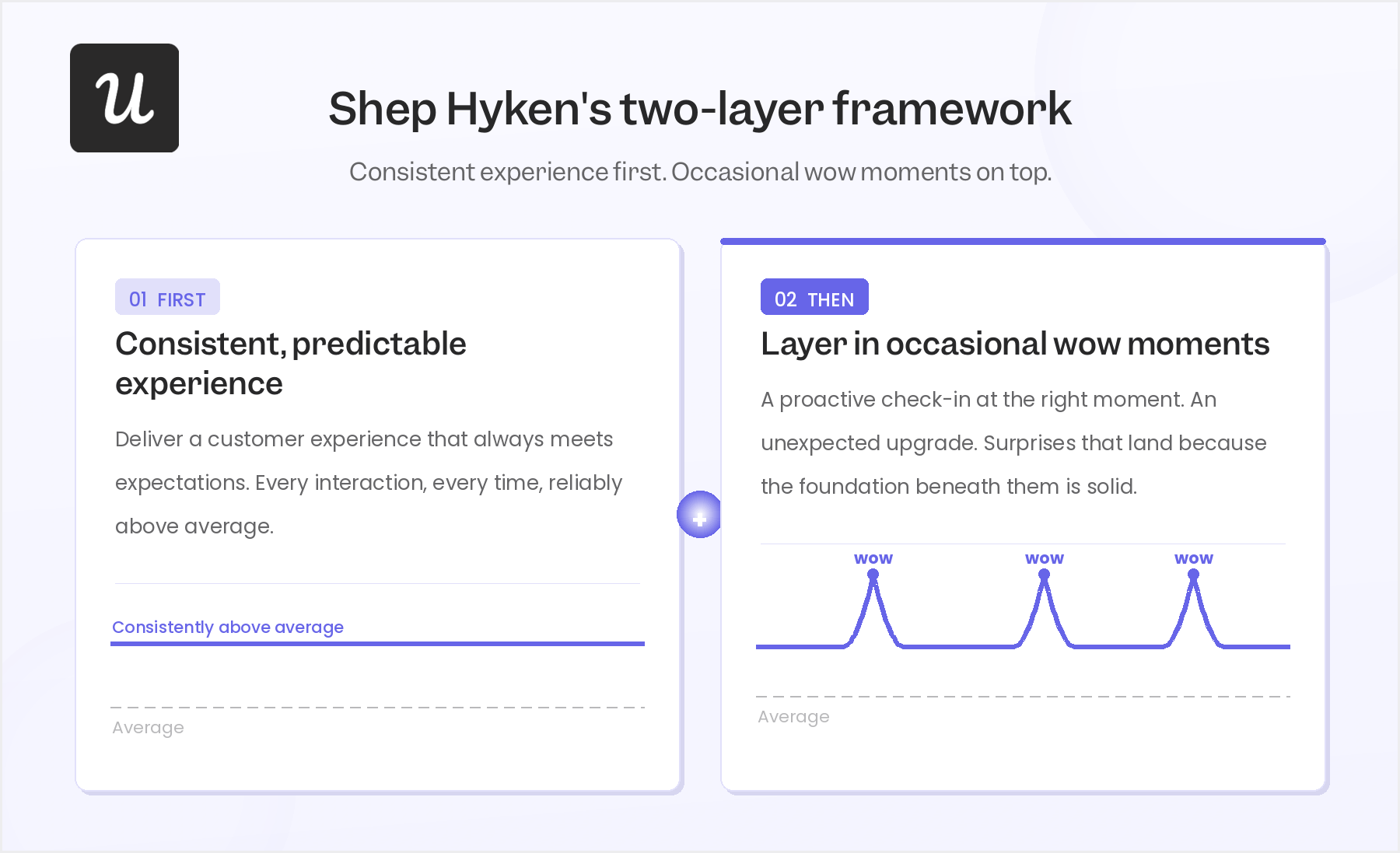
What works instead is Shep’s framework: First, deliver a consistent and predictable experience that ALWAYS meets customers’ expectations. Then, layer in occasional wow moments, such as a proactive check-in or an unexpected upgrade.
So, what now? Deliver value early, provide proactive support, personalize experience based on users’ actions, and close the feedback loop. I explain each step in detail below.
Get customers to value before they lose momentum
I’ll say start by measuring your time-to-value. The median is 1 day, 12 hours, and 23 minutes. But it varies by industry.
💡 Check the benchmark TTV for your industry!
When customers reach value early, they build confidence in your product. They trust it, adopt it more, and become even more receptive to your delight tactics.
Besides, it reduces churn, too. An example here is Chargezoom. With just four CSMs supporting more than 2,500 customers, their team had limited visibility into which accounts were progressing and which were quietly stalling. As Erin Gordy, Director of Customer Success, explained:
“We just didn’t have any insight into what our customers were doing. People were dropping off, and we didn’t know why.”
Instead of launching a customer delight initiative, Chargezoom focused on helping customers reach value faster. Using Userpilot, their team implemented behaviour-triggered checklists, contextual guidance, and milestone-based onboarding to keep users moving forward.
In the end, they reduced churn from 4.06% to under 2.3%, improved expansion revenue from 1.38% to 4% in a single quarter, and boosted NPS scores from 0-3 to regular 10s.
Reach out before customers ask for help
Instead of waiting for customers to tell you they’re struggling, look for behavioral signals that suggest they’re stuck. Are they abandoning key workflows? Ignoring important features?
That’s proactive support. And from a customer’s perspective, it feels far more impressive than a generic check-in like “how are things going?” It shows you understand where they’re struggling and can help fix the friction.
Done well, proactive support can revive feature adoption and prevent churn.
Also, there’s a counterintuitive pattern I’ve seen play out enough times that I now treat it as a rule: teams often flag a spike in support tickets as a churn risk signal. But the absence of tickets can be just as concerning, if not more so. A customer who was actively raising issues and then suddenly goes quiet hasn’t found their footing; they’ve checked out.
Cleeng experienced this firsthand. After a UI update, the adoption of Cleeng’s core features dropped by 92%. Customers weren’t opening support tickets or reporting problems, but session replays revealed the issue immediately: a key button had become difficult to find.
“Session replays were super useful when we changed the navigation. We could see what exactly the users were clicking and if they were visiting the pages we want them to visit.” — Anna Sobiak, Product Designer
The team didn’t wait for complaints to pile up. They deployed an in-app tooltip in Userpilot to guide users while a permanent fix was being developed. As a result, adoption recovered by 75% within days, and the friction never had the chance to turn into churn.
Of course, spotting these signals manually becomes difficult as your customer base grows. This is where Userpilot’s account monitoring, combined with Lia’s always-on health intelligence, makes the difference. Lia automatically surfaces churn risks and positive engagement signals.
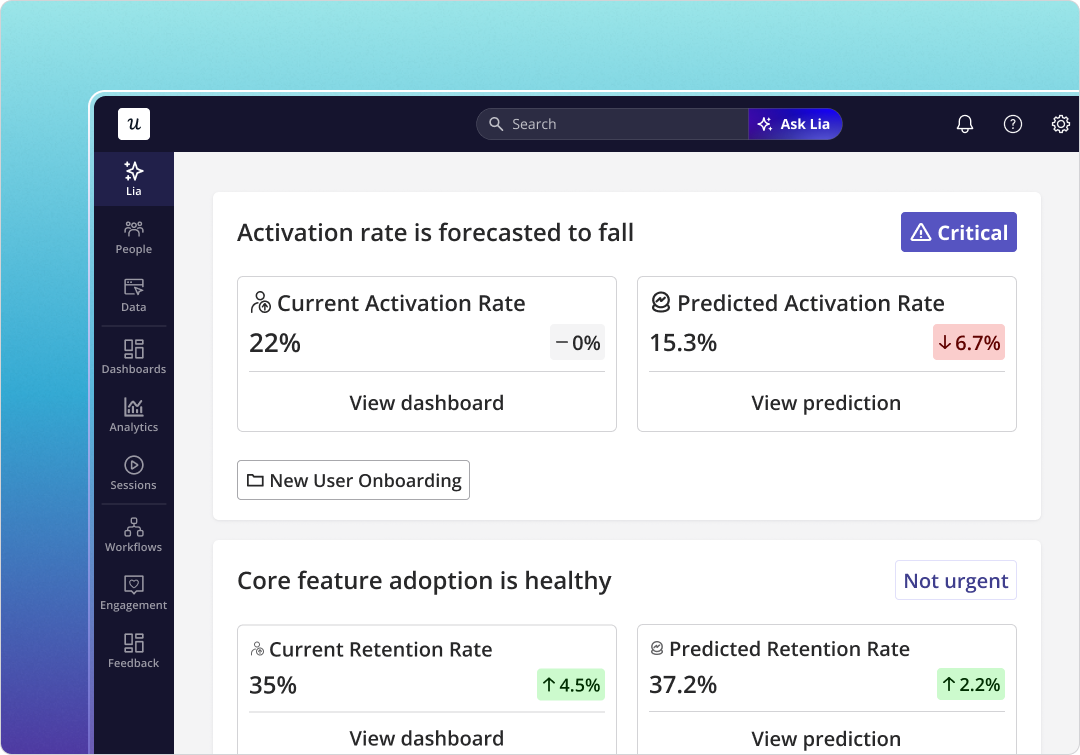
Lia monitors account health across your entire customer base and surfaces both churn risk signals and positive engagement moments before your CSMs have to go looking for them.
Personalize the experience based on what customers do
Jess Bergson, Head of CX at Clay, shared that after landing the “Clay role,” several vendors reached out. They have her data in their products, yet they sent generic messages carrying her “first name.” And of course, she ignored. Because that’s not the kind of personalization customers care about.
What feels personal is when the experience adapts to what customers are actually trying to achieve. For example:
-
Triggering an onboarding flow based on the job-to-be-done selected at signup.
-
Recommending the next feature after a customer reaches a milestone.
-
Surfacing guidance when a user stalls on a key task.
That’s behavioral personalization. Done well, it pays off: consumers spend 54% more with brands that personalize effectively, and companies generate 40% more revenue from personalization initiatives.
Chargezoom also adopted this approach. The team stopped announcing new features solely through email. They switched to in-app messages targeted to specific user behaviors using Userpilot.
“Emails took forever, and things slipped through the cracks. We would sometimes go months without realizing someone canceled because it was impossible to keep up manually. Now users get immediate help through in-app experiences without waiting for a support response.” – Erin Gordy
Show customers that their feedback matters
One mistake I see with many feedback programs: They only collect feedback and don’t act on it. Teams send surveys, gather responses, and discuss them internally, but customers never see the outcome. As a result, the effort generates insights without strengthening the relationship.
The fix is to close the loop:
-
Start by collecting feedback when the experience is still fresh. For example, trigger an in-app survey after a user completes a task or interacts with a new feature. The closer the survey is to the moment, the more useful the feedback will be.
-
Then make changes visible. That might mean adding a tooltip where users reported confusion, updating an onboarding step that caused friction, or improving a feature in response to recurring requests.
And when customers can connect a product improvement to their feedback, they feel heard and are more likely to stay.
When to layer the unexpected gestures
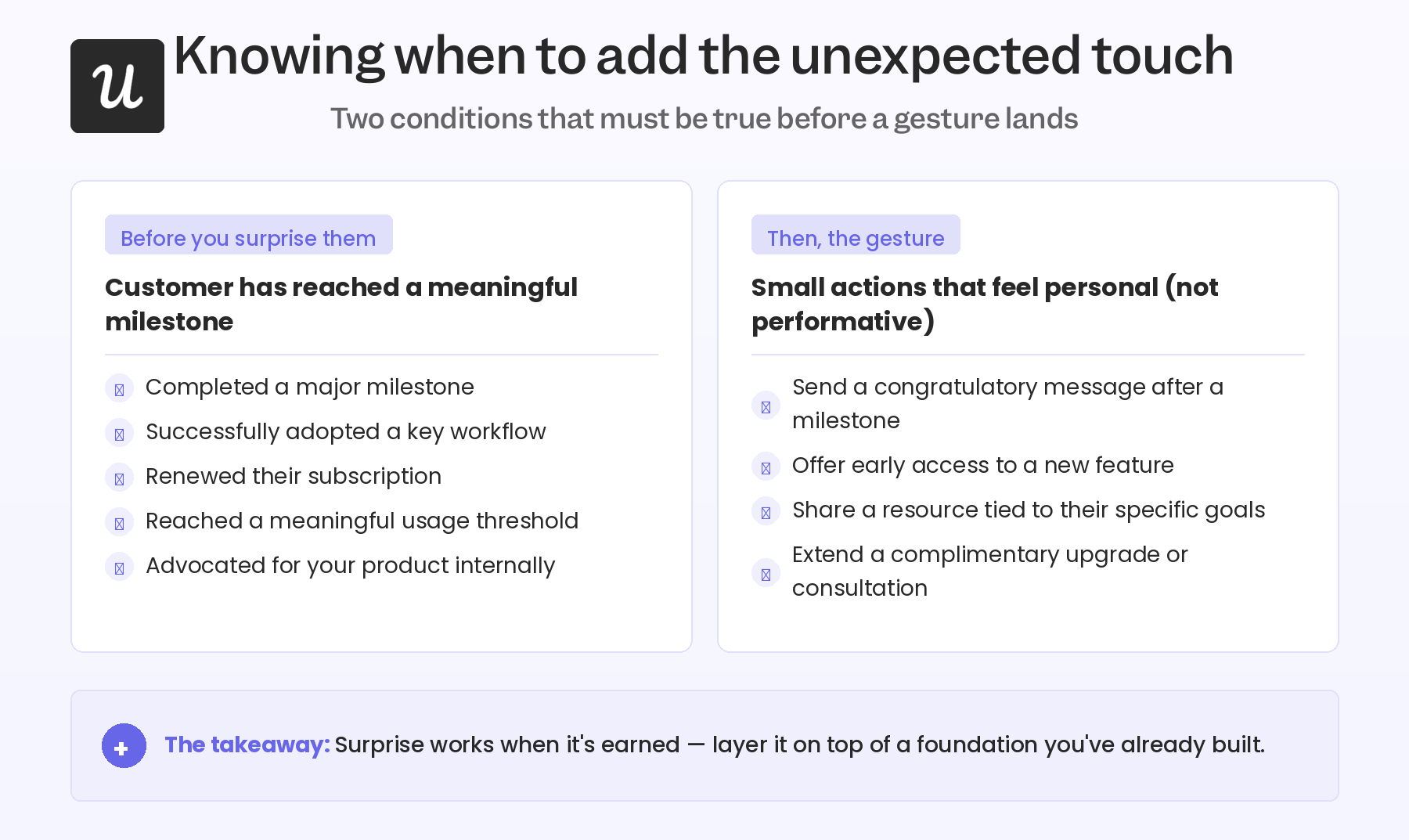
Once you’ve built the foundation of helping customers reach value, proactively removing friction, personalizing their experience, and acting on their feedback, you’ve earned the right to surprise them.
But two conditions must be true:
Many SaaS companies met these conditions well. Take Grammarly, for example. Every week, it sends users a personalized writing report with metrics like words written, accuracy rate, common mistakes, and streaks maintained. The report isn’t surprising; users expect it. What makes it effective is that it turns progress into a reward and reinforces the habit of using the product.
Spotify Wrapped follows the same principle on a larger scale. Each year, users receive a personalized recap built entirely from their listening behavior. The experience feels special because it reflects something they invested in throughout the year.
Even Semrush applies this thinking. The team consistently responds to social media interactions, whether it’s a support question, product feedback, or a joke, with specificity and personality. Over time, those interactions build trust. The wow factor comes from the consistency, not a one-off campaign.
Freemium users are another overlooked opportunity. Most companies reserve extra attention for paying customers, but highly engaged free users are often the easiest accounts to convert. Fast support, proactive guidance, and a personal check-in at the right moment can create a memorable experience before competitors have a chance to win them over.
Building the conditions for delight
The “wow your customers” framing promises a shortcut: do this one memorable thing and earn loyalty. Retention data and Forrester’s trend make a different argument.
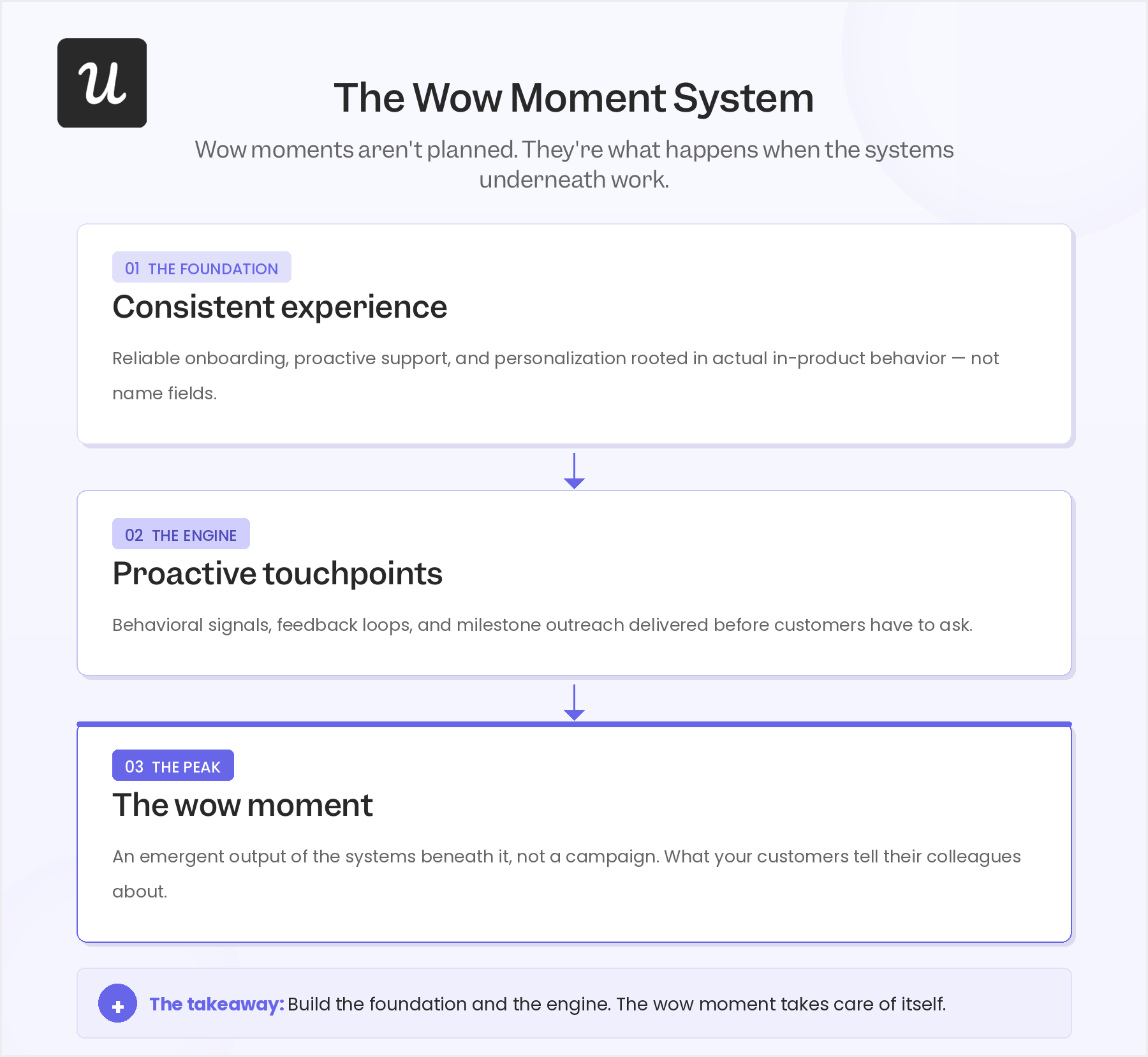
In practice, what separates companies with strong NRR from everyone else is the infrastructure underneath the memorable moments:
-
An onboarding journey that gets users to value before they lose patience.
-
Behavioral monitoring that surfaces churn risk before customers voice it.
-
Feedback loops that close visibly, and the personalization built on what customers actually do rather than who they are on a CRM record.
Combined, they lead to a customer experience that’s reliably above average. And you achieve it with your product using Userpilot. Use it to build onboarding flows, behavioral segmentation, in-app surveys, proactive health monitoring, and let Lia run always-on account intelligence so the CS team can spend their time on the conversations that actually move things forward.
Book a demo today to test it out!
About the author