The Aha Moment: How to Identify It with Data, Not Assumptions


Every ‘Aha!’ moment article uses the same SaaS examples you’ve seen before like Slack’s 2,000 messages, Grammarly’s demo text, and Zoom’s first video call. While those examples illustrate the concept well, they stop short at the most actionable part, which is finding it inside your own product. As the Head of Customer Success at Userpilot, I’ve seen firsthand the cost of skipping that step countless times. A team picks “publishing their first flow” as their activation milestone because it seems like the obvious choice and builds their entire onboarding around it, yet still can’t explain why retention hasn’t improved in months.
Cognitive science refers to these confident-but-wrong assumptions as false insights, but the more concerning part is the behavioral data that could’ve corrected the assumption was likely sitting within the product all along.
In cognitive science, a confident-but-wrong insight has a name: a false insight, and the behavioral data that would have corrected it was sitting in the product the entire time. User activation benchmark show that a 25% increase in activation results in a 34% increase in MRR over a year. This makes identifying the right Aha moment one of the most impactful decisions a product team can make. I wanted to write something more actionable than another examples roundup, so this guide will dive deeper into how to identify your product’s Aha moment and guide users towards it.

What makes a valid Aha moment?
The Aha moment is best described as a sudden shift from not understanding to understanding, or a solution that was opaque suddenly becoming obvious. In the context of SaaS products, the Aha moment is the instant a user understands why your product is worth using for their specific problem, making it the first time that perceived value becomes concrete rather than theoretical.
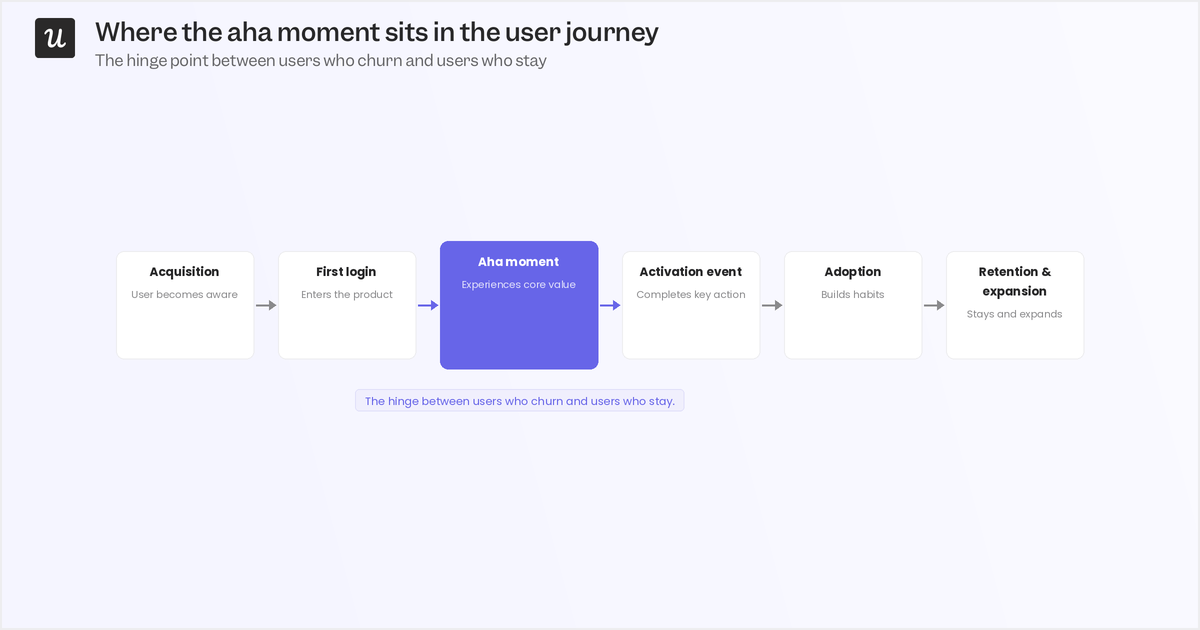
Not every activation event qualifies as a genuine Aha moment, but the ones that do share four characteristics:
- Tied to core product value, not setup: Canva’s Aha moment is completing a first design, not signing up or browsing templates. Completing a design is the moment the product’s actual promise is proven, whereas profile completion and account setup tasks are mere prerequisites rather than value events.
- Achievable by most users within a short window: An event that only 5% of users ever reach is not a viable activation target, regardless of how well it predicts cohort retention for the small cohort that gets there. The event must be within reach for the majority of new users, ideally during their first session but at least in the first few days.
- Strongly correlated with long-term retention: Users who reach the candidate event should retain at meaningfully higher rates than users who don’t. A small differential means you’ve found a correlated behavior pattern with no guaranteed causality. The cohort validation step below is specifically designed to test this distinction.
- Variable by user persona and use case: Most products have more than one Aha moment. A sales team and a marketing team using the same platform will often reach value through different paths, and customer onboarding that routes them identically will underperform for one or both segments.
Zoom makes the fourth point concrete. A new user who clicks an invite link and joins their first call realizes that the product is easy to enter without creating an account.

The person who then schedules and hosts their own first meeting experiences the retention Aha moment and understands why Zoom is worth keeping.
Both Aha moments are valid and can each predict different downstream behaviors (conversion versus retention). Designing for both means your onboarding serves the full user population rather than just the fastest path to a first session.
There are actually three types of Aha moments that recur across SaaS products:
- User Retention: The event that makes users decide to keep coming back.
- Conversion: The event that triggers a paid upgrade or a permanent account.
- Virality: The event that makes users feel compelled to share.
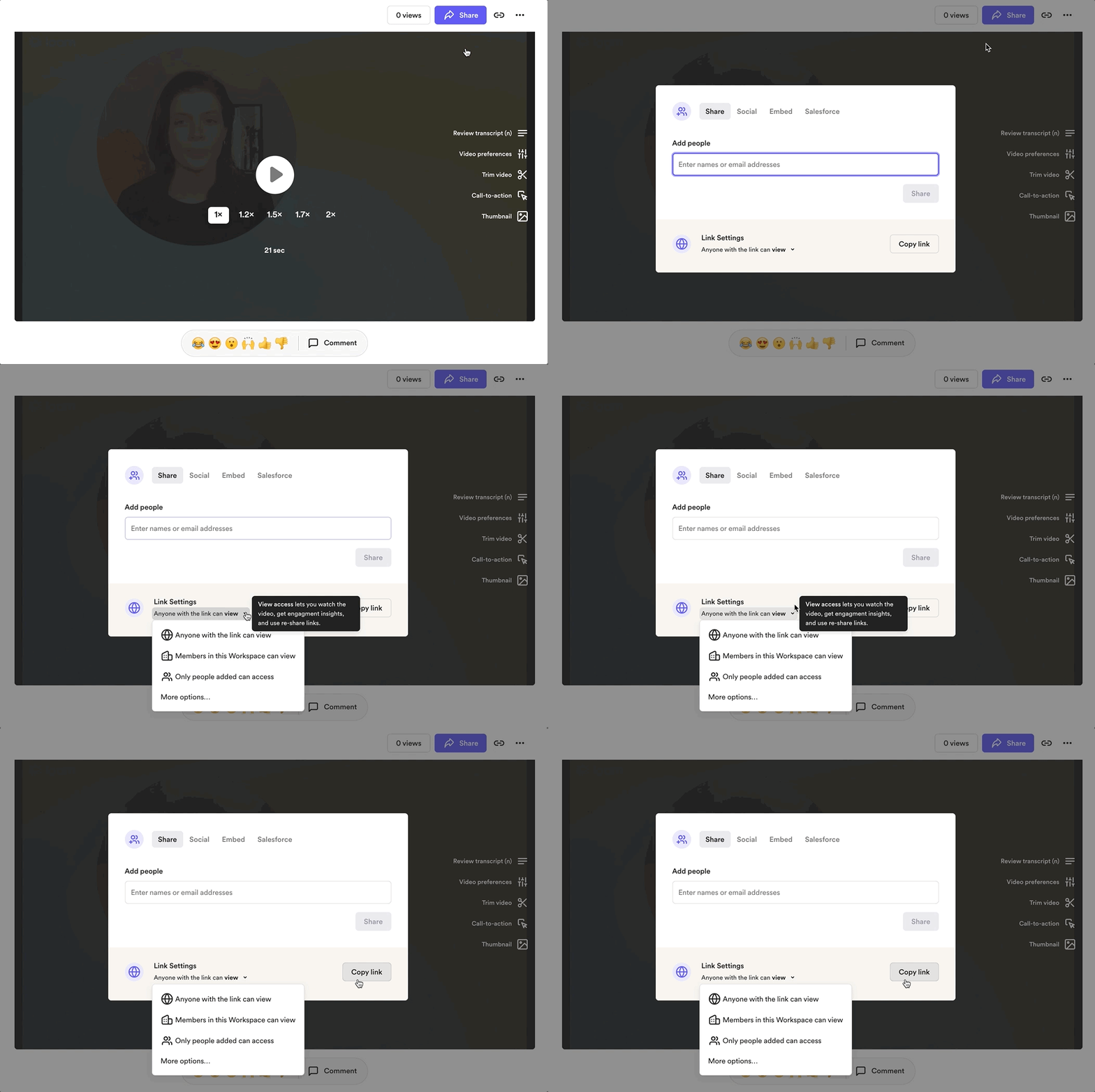
Loom’s viral Aha moment is built into the product mechanic itself. Whenever someone receives a Loom video, they’re able to experience the product’s value without signing up, and likely end up joining because of that first experience.
How to identify your product’s Aha moment?
To be completely honest, nailing down the Aha moment has taken real effort, even for us at Userpilot. Our product covers enough ground that “what does an activated customer look like?” has no single obvious answer. Publishing a first flow is one candidate, but so is setting up a dashboard, creating the resource center, or running funnel analysis for the first time. The answer depends on the use case, which is exactly why the persona-first approach in the first step below matters just as much as all the data work that follows it.
Identifying the Aha moment is an analytical process, not an internal consensus exercise so here’s a five-step process that actually works.
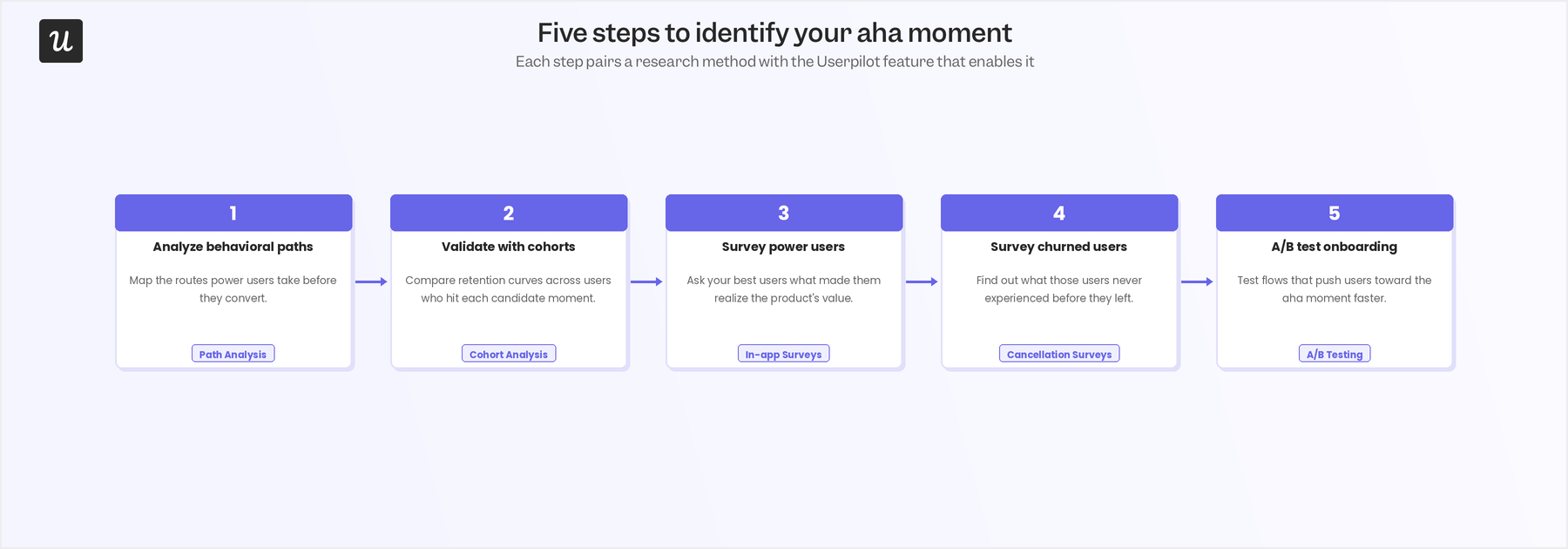
Step 1: Analyze the behavioral paths of retained versus churned users
The starting question is: what did users who stayed do in their first session that users who churned didn’t? Path analysis reveals the sequences of actions that most reliably precede long-term retention. You’re not looking for which features users visited most; you’re looking for the specific event sequences that correlate with staying. Break the analysis by user segment from the start. The behavioral path that predicts retention for a sales team may be entirely different from the path that predicts it for a developer using the same product.
Analyze user behavior within each segment separately, comparing retained users against churned users from the same segment rather than across the full user base. This step should give you a shortlist of the specific events that appear significantly more often in retained user paths than in churned user paths, broken down by segment. Those events then feed into the second step for cohort validation.
Step 2: Validate with cohort analysis
Candidate events from Step 1 need retention testing before they become hypotheses worth building onboarding around. Build two cohorts: users who completed the candidate event within their first three days, and users from the same signup period who didn’t. Then measure 30-day retention for each group: the event with the largest differential is your strongest Aha moment candidate. Loom ran this analysis and found that sharing a video, not recording one, was the event with the strongest retention lift.
Recording feels like the obvious candidate because it is the core action, but sharing is what proved the product’s value: the user got a response, understood the format worked, and wanted to keep using it. Behavioral data corrected an assumption that internal intuition would have kept in place indefinitely. One pattern I see repeatedly in customer success work is what I’d call “high logins, zero outcomes”. This describes accounts with strong surface user engagement signals but behavioral data that tells a different story: lots of activity but without any meaningful milestones being reached.
Cohort analysis makes that divergence visible by separating surface engagement from the events that actually predict whether a user will stay.
Step 3: Survey power users to confirm the moment of value realization
Behavioral data shows you what users did; it doesn’t show you when they understood why. Survey your most engaged, most retained users with a single focused question: “At which point did you first feel this product was worth using regularly?” Give them multiple-choice options that map to the major product events using your shortlist from the previous step, and always include an open-ended “Other” field so they aren’t forced into any choice. Power users can often articulate what other users experienced intuitively, and their language tends to produce the most precise Aha moment descriptions.
An in-app survey is the right delivery mechanism here because power users are actively engaged with the product and can respond with recent context. Keep the survey focused: a multiple-choice question with a clear framing converts far better than an open-ended question that requires users to reconstruct the memory from scratch. Strong clustering around one event confirms your cohort analysis finding. When responses split across two or three events, you likely have distinct Aha moments for distinct user segments, which is the normal outcome for products serving more than one user persona type.
Step 4: Survey churned users to understand what they never reached
The Aha moment is often most clearly visible in its absence. Embed a survey in the cancellation flow that asks which feature users wanted to try but never got to, or what would have made them stay. Customer churn without reaching your candidate event is showing you exactly where your onboarding is failing to deliver value quickly enough. For trial users who churned before you could reach them in-app, send an email survey instead to understand the reason for churn. Churned users who respond are usually motivated to explain what went wrong.
Pair their answers with their session data to understand whether they attempted the Aha moment event and failed, or never reached the point where attempting it was even possible.
Step 5: Test by designing onboarding around the candidate event
With a candidate event validated through cohort analysis and confirmed through two rounds of survey data, design an onboarding flow that takes users as directly as possible to that moment. Remove every step that doesn’t contribute to reaching it. Then A/B test the new flow against your current onboarding, measuring activation rate and 30-day retention as the primary outcomes. A genuine Aha moment will produce a measurable retention lift for users who complete the new flow. Marginal improvement means the event is a correlated behavior rather than a causal driver, so you return to your Step 2 shortlist for the next strongest candidate.
Multivariate testing is worth running if you have enough traffic to test several candidate flows simultaneously and want to compress the validation timeline.
How to guide users to the Aha moment once you’ve found it
Once you know what your Aha moment is, it’s time to build the yellow brick road leading there.
Personalize onboarding by job-to-be-done segment
Different user personas often have different Aha moments, so routing them toward the right one from signup is the first design decision. Use a welcome survey to segment users by use case and trigger the relevant flow. The same product, different paths to value. Slack illustrates this well. A sales team using Slack for deal coordination and an engineering team using it for incident response both reach an Aha moment, but the specific channel configuration and workflow that make the product indispensable to each is different.
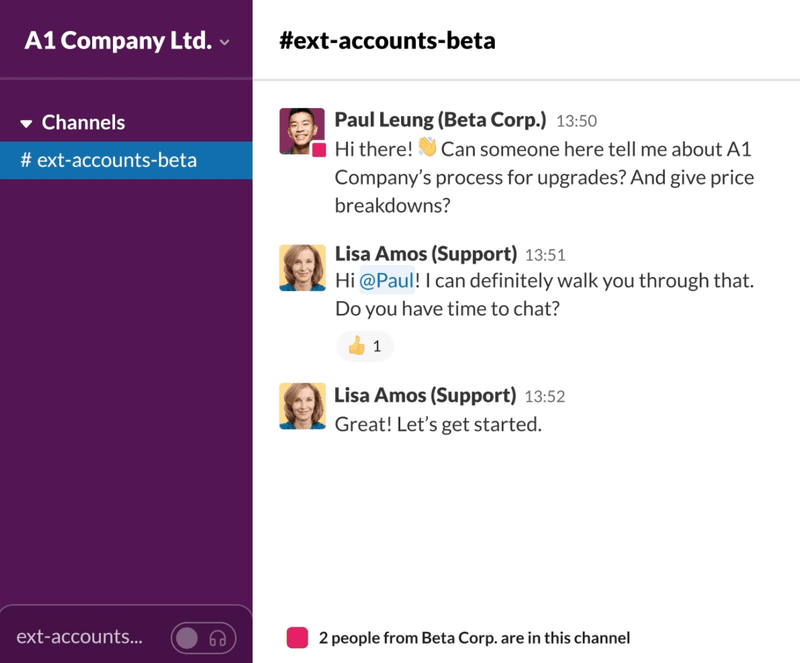
Onboarding that routes each team toward the features most likely to produce their specific Aha moment consistently outperforms a single generic flow, because it gets users to value faster along the most relevant path.
Use interactive walkthroughs to lead users directly to the value event
Interactive walkthroughs are the most direct mechanism for getting users to the Aha moment, because they don’t just show users what to do: they prompt each action in sequence. Design the walkthrough to end at the Aha moment event, not at product setup or profile completion. Every step in the flow should earn its place by moving the user closer to value realization, and any step that doesn’t do that is friction. You don’t need to build these flows manually anymore. Lia, Userpilot’s AI agent, builds in-app onboarding experiences autonomously using AI product analytics. All you have to do is describe the result you want, and Lia ships the experience.
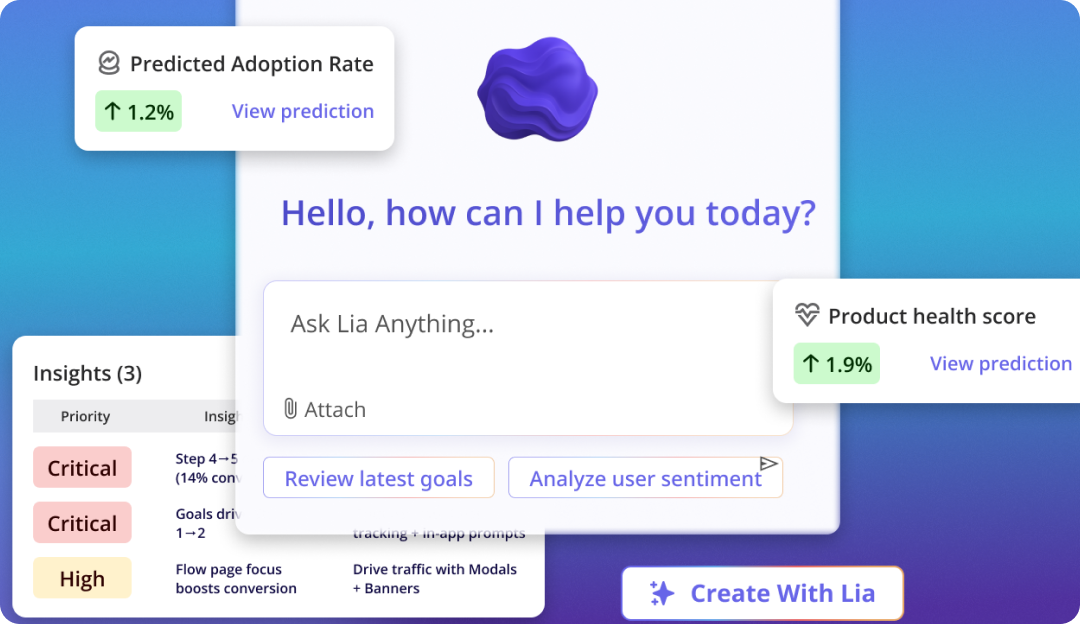
For product teams iterating on Aha moment flows, this means testing multiple walkthrough variations without the engineering overhead that typically slows down onboarding experiments.
Remove unnecessary friction from the path to value
Friction between signup and the Aha moment is the most common reason users churn before they reach it. Conversion funnel analysis identifies where users drop off between the steps that lead to your Aha moment event. Each drop-off point is a friction problem, not a motivation problem: the user wants to reach value, and something unnecessary is blocking them from getting there. Session replay is the next layer. Funnel analysis shows you where the drop-off is happening, while watching actual sessions shows you why.
The footage surfaces the unnecessary constraints in your onboarding path that aggregate data alone cannot identify. Removing them is the fastest way to reduce friction before it prevents users from reaching the Aha moment.
Surface proactive support for users who stall
Some users will attempt the Aha moment event and not complete it on the first try. Behavioral triggers that fire when users show stalling signals are more effective than generic follow-up sequences. Someone who spends 10 minutes on a configuration step without completing it needs to be sent a push notification, not a ticket queue, which is why a resource center built into the product is the right infrastructure for this kind of on-demand, in-context support. Timing matters as much as content. When users are actively working through a feature, that’s when contextual help lands.
Waiting for a scheduled check-in to cover the same ground means the user has already had a mediocre experience with that feature and moved on, and recovering from that is much harder than preventing it.
Aha moments in the agentic era
In products where AI agents execute tasks on a user’s behalf, the Aha moment model shifts. Agents either complete tasks or fail; they don’t have subjective realizations. The human overseeing the agent still experiences Aha moments vicariously, the first time the agent successfully completes something meaningful on their behalf without requiring them to do it themselves. This is why the vicarious Aha moment is the new activation target for agent-assisted products. Designing toward it means tracking agent task completion rates alongside human activation events and treating “first meaningful agent success” as the event to optimize for in agent-heavy accounts.
Most analytics stacks haven’t caught up to this measurement problem yet, but it’s the right question to be asking as agent-assisted workflows become the default rather than the exception.
Confirm the destination before you build the path
The Aha moment is the most important destination in your onboarding design, but it only becomes actionable once you’ve confirmed what it actually is for your product and your users. Before you have a data-validated Aha moment, every onboarding decision is a guess. Once you have it, the path becomes clear: segment users to the right Aha moment for their use case, remove the friction between signup and that moment, and guide them there as efficiently as possible. Most teams are still designing around their best guess but the five-step process above is how you replace that guess with onboarding that actually moves retention instead of just looking like it should.
Book the demo to see how Userpilot’s path analysis, cohort reports, in-app survey builder, and A/B testing tools can help you identify or validate your product’s Aha moment to help you build better onboarding flows!
About the author