Hotjar Pricing 2026: Plans, Limits & What You’ll Pay



Today, Hotjar pricing runs through Contentsquare, and new customers get its heatmaps, session recordings, funnels, and surveys through Contentsquare plans. You can no longer buy Hotjar on its own.
Contentsquare organizes Hotjar pricing across Experience Analytics, Voice of Customer, and Product Analytics.
Experience Analytics starts at $0 or $49/month on Growth, Voice of Customer starts at $0 or $99/month on Growth, and Product Analytics uses quote-based pricing.
For a real-world benchmark, Vendr reports a $20,000 annual buyer benchmark for Contentsquare, with observed purchases ranging from about $14,711 to $91,369. This third-party purchasing data covers different deployment sizes, products, usage levels, and commercial terms.
If you’re a product manager, growth manager, or UX researcher, this covers what drives the final price and when Userpilot fits alongside or instead of Hotjar.
Executive summary
- Hotjar pricing now sits within Contentsquare’s pricing structure: New buyers choose separate plans for Experience Analytics, Voice of Customer, and Product Analytics, not one standalone Hotjar plan.
- Experience Analytics Growth starts at $49/month and Voice of Customer Growth at $99/month: Product Analytics publishes usage bands but requires a quote.
- Your actual cost depends on usage and product mix: Growth tier prices increase through preset session or response allowances, so the capacity you purchase may be higher than your exact monthly usage.
- The right fit depends on what you need after identifying user friction: Hotjar helps you understand where users struggle and why, while Userpilot can complement it with targeted in-app guidance or combine analytics and engagement in one place.

How Hotjar pricing works today
The Hotjar pricing model has two moving parts: Which product(s) you choose and how much usage capacity you need. Contentsquare offers Experience Analytics, Voice of Customer, and Product Analytics, each with Free, Growth, Pro, and Enterprise tiers.
The usage metric works differently for each product:
- Experience Analytics uses monthly sessions: Within Growth, the session allowance you choose determines what you pay, so two customers on the same Growth plan can have different monthly prices.
- Voice of Customer uses monthly responses: Growth starts with 500 responses per month and scales up to 100,000, so the amount of feedback you need to collect also changes the price.
- Product Analytics uses monthly session bands, but Contentsquare doesn’t publish pricing for any tier.
Billing choices can lower that final cost. Paying annually in-app by card or PayPal gives you a 20% discount before VAT.
If you combine two paid Growth products, Contentsquare also discounts the lower-priced plan by 10%. That can apply on top of the annual discount where eligible.
Experience Analytics pricing
Experience Analytics is free for up to 200,000 monthly sessions, while Growth starts at $49/month and reaches $739/month at 200,000 sessions, then moves to quote-based pricing at higher volumes.
This is the Contentsquare product closest to Hotjar’s original behavior-analytics use case. You can use heatmaps, session replay, funnels, and other tools to track user interactions and understand where users struggle.
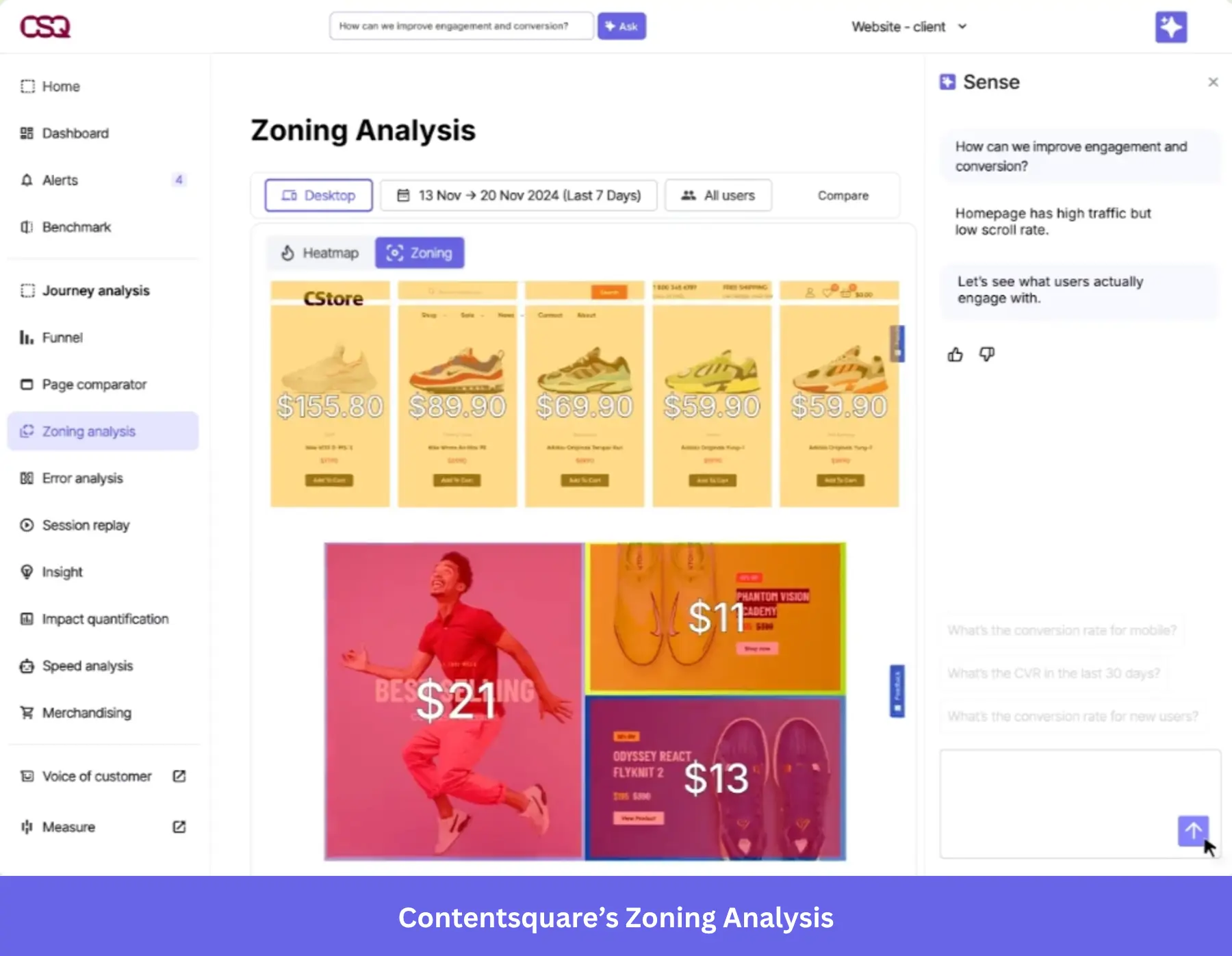
Here’s how Experience Analytics tiers compare on price, session allowance, and the features that materially change as you move up plans:
| Tier | Starting price | Monthly sessions | Notable features |
|---|---|---|---|
| Free | $0 | Up to 200K | Replays, heatmaps, funnels, basic surveys, 1 project |
| Growth | $49-$739/month (up to 200K sessions), quote-based above that. | 7K–10M | 13-month analytics access, 3 projects, Journey Analysis, zone-based heatmaps, Impact Quantification |
| Pro | Quote-based | 1M–unlimited | Retroactive precision filtering, multi-session replay summaries, revenue analysis |
| Enterprise | Quote-based | 1M–unlimited | Enterprise-scale capacity, custom terms, SSO/SAML, dedicated priority support and service level agreements |
The free version covers the basic features most teams need to start analyzing behavior, including heatmaps, replays, funnels, and basic surveys. Growth adds more advanced analysis and higher paid usage tiers.
Free’s 200,000-session allowance doesn’t carry over if you upgrade; Growth is priced on its own session tiers starting at 7,000. Growth also adds advanced features such as longer analytics data access, Journey Analysis, zone-based heatmaps, and Impact Quantification.
So a team with meaningful traffic moving from Free to Growth isn’t just paying for the added functionality; they’re also re-priced on Growth’s steeper per-session rate for whatever volume they have. Two Growth customers can therefore pay very different amounts even on the same plan.
Replay allowance is another limit to check when estimating how much usable data you need. If session replay is central to your workflow, the session tier tells you how much traffic is analyzed. The replay capture rate tells you how much of that traffic you can inspect session by session.
Contentsquare’s own example shows that a Growth account tracking 100,000 monthly sessions may capture 15% of them as replays. You still get analytics across all 100,000 sessions, but only a portion are available to watch back as replays. That matters if you rely on replay for deeper insights into what users did during those sessions.
Voice of Customer pricing
Voice of Customer is free for up to 100 monthly responses, while Growth starts at $99/month and reaches $1,479/month at 100,000 responses. Pro uses quote-based pricing.
Experience Analytics already includes basic survey functionality, so teams with light feedback needs may not need to add Voice of Customer separately.
This product becomes more relevant when you need higher response capacity, unlimited surveys and feedback widgets, or more advanced targeting, branding, and analysis.
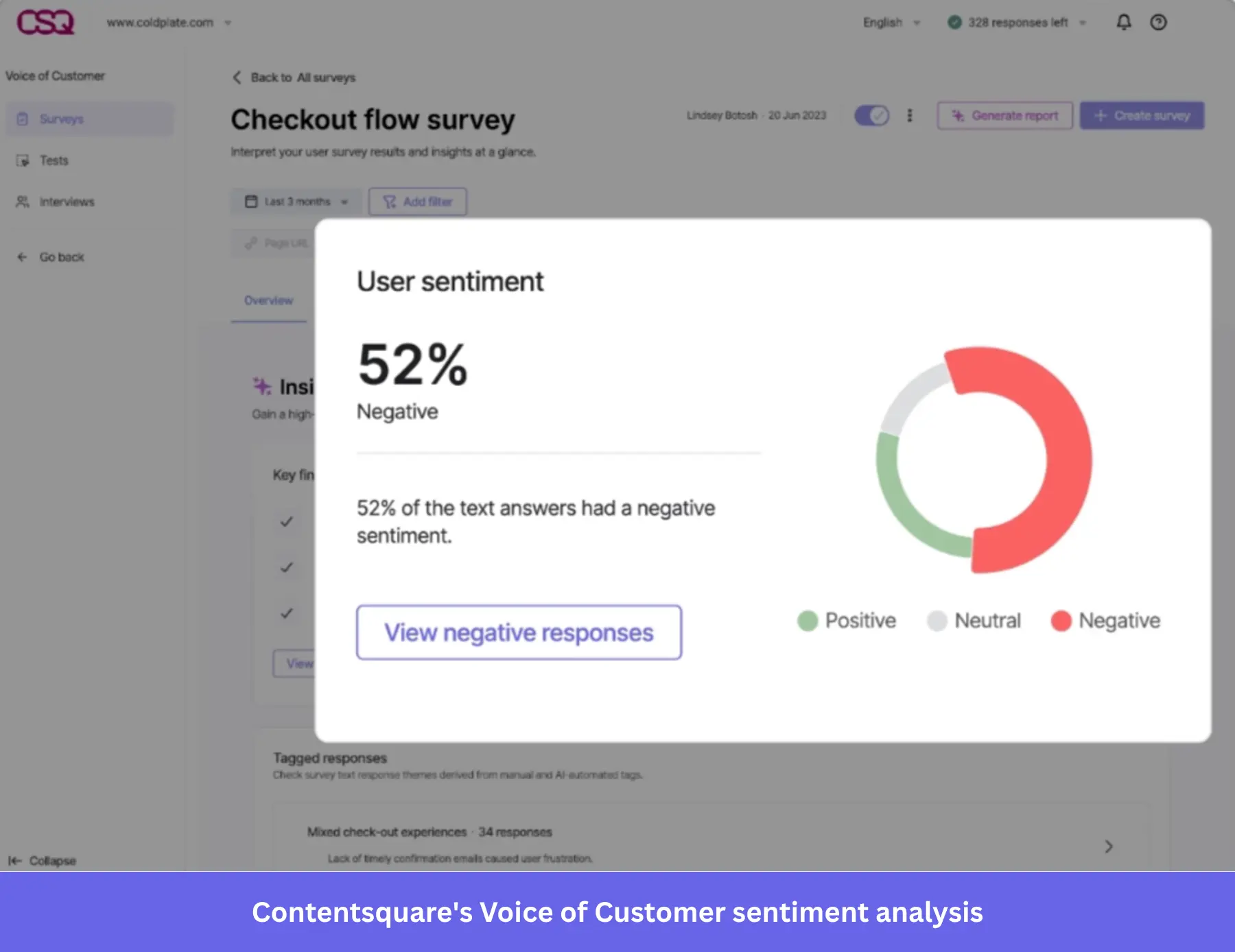
Here’s how Voice of Customer tiers compare on price, monthly response allowance, and included capabilities:
| Tier | Starting price | Monthly responses | Notable features |
|---|---|---|---|
| Free | $0 | 100 | 3 surveys or feedback widgets, AI survey generation and summaries |
| Growth | $99-$1,479/month (up to 100K monthly responses) | 500–100K | Unlimited surveys/widgets, higher response capacity, advanced targeting and branding |
| Pro | Quote-based | Up to unlimited | Notable features: Higher response capacity and advanced plan capabilities |
Voice of Customer pricing is based on monthly responses. A monthly response is an individual response collected through your surveys or feedback widgets. All responses count toward one account-wide monthly allowance shared across your projects.
That shared allowance matters when estimating what you need. If several surveys or domains are collecting feedback at the same time, they all draw from the same monthly total. When you reach the limit, surveys and feedback widgets stop showing until the allowance resets or you upgrade.
Product Analytics pricing
Product Analytics uses quote-based pricing across every tier, so Contentsquare doesn’t publish a self-serve starting price.
With Product Analytics, you can understand multi-session user journeys, retention, and engagement across your websites and apps.
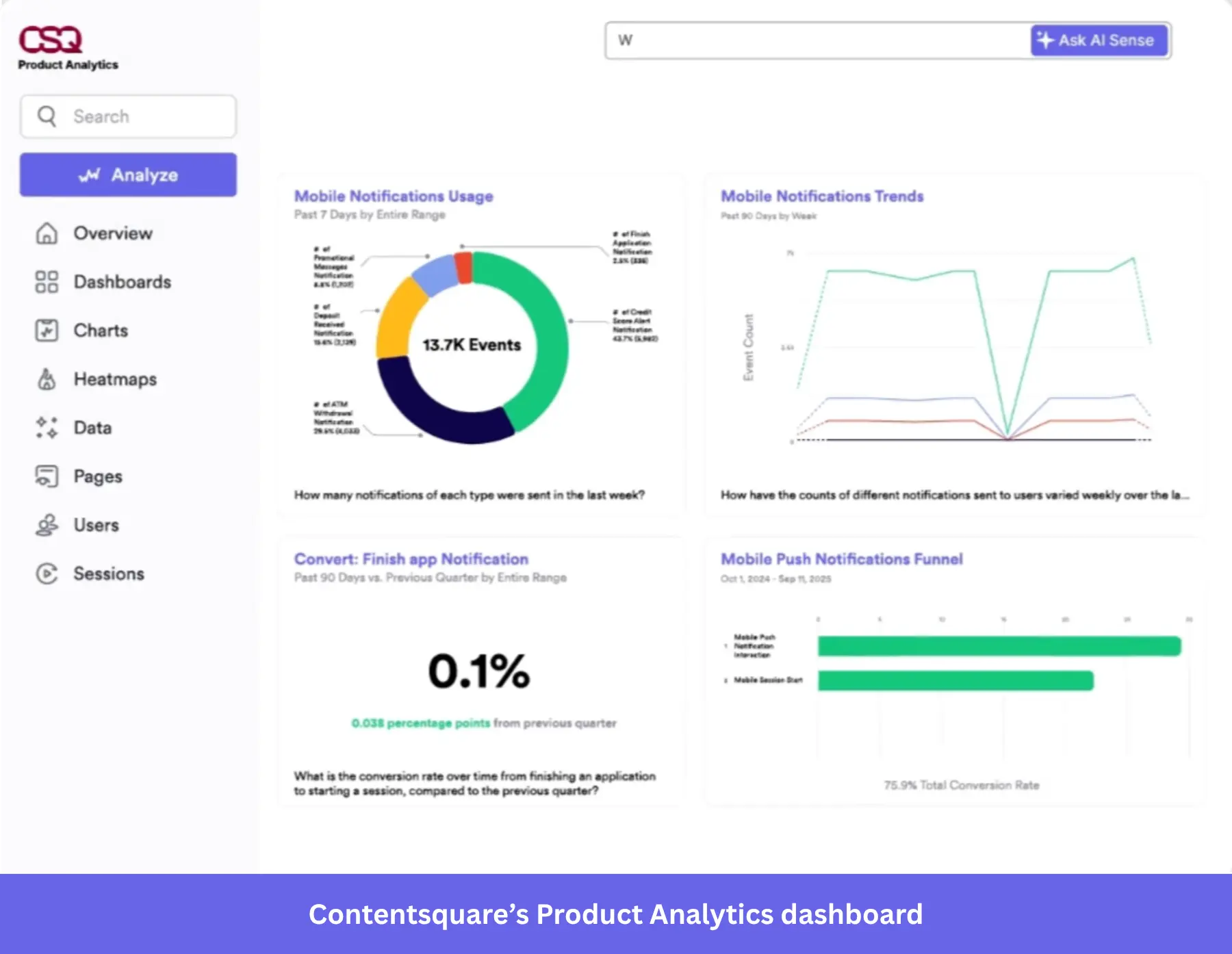
Contentsquare organizes its plans by monthly session bands and provides pricing through a sales quote. These session bands help you identify the likely tier, but they don’t tell you what you’ll pay. Your final price depends on the plan and capacity included in your quote.
Here’s how the current Product Analytics tiers compare on session volume and included capabilities:
| Tier | Starting price | Session volume | Notable features |
|---|---|---|---|
| Free | Quote-based | Up to 10K | Core analytics capabilities |
| Growth | Quote-based | 17K–80K | Unlimited users & reports, chart customization, higher capacity |
| Pro | Quote-based | From 33K | Account Analytics, Engagement Matrix, alerts, optional add-ons |
| Enterprise | Quote-based | From 1M | Data Connect, behavioral targeting, unlimited projects, advanced permissions |
Product Analytics currently runs as a separate application while Contentsquare works toward bringing all three products into one platform. If you’re evaluating Hotjar to consolidate tools, keep that in mind. The three products don’t yet operate as one fully unified application.
How much does Hotjar cost in practice?
Contentsquare’s public pricing page shows what a specific self-serve plan and usage allowance can cost. Larger Hotjar deployments can look very different because the contract may cover higher usage, multiple products, implementation or professional services, and negotiated commercial terms.
For example, a $49/month Experience Analytics Growth account and a negotiated Contentsquare contract aren’t two prices for the same setup because they reflect different usage levels and deployment complexity.
Self-serve and small-team pricing
If you’re buying self-serve, Contentsquare’s published Growth pricing is the more useful reference. You can start with a relatively small session or response allowance and increase capacity as your usage grows.
In Vendr’s dataset, “small deployment” covers roughly 500,000–2 million monthly sessions, with annual contract values commonly ranging from $30,000 to $80,000. So Vendr’s “small” benchmark describes the lower end of its negotiated-contract dataset, not a typical small team buying the entry-level self-serve plan.
Larger negotiated contracts
At larger scale, you may move from self-serve pricing to a custom plan or negotiated contract. That can include separately priced implementation or professional services on top of the software subscription.
Contentsquare prices some professional services separately based on the scope and complexity of the engagement, so the software subscription may not represent the full contract value.
Vendr’s data puts Contentsquare’s annual buyer benchmark at $20,000, with observed purchases ranging from about $14,711 to $91,369. Its larger deployment benchmarks go higher: mid-market contracts commonly fall around $80,000–$200,000 per year, while enterprise deployments can reach $200,000–$500,000 or more.
Treat those ranges as third-party purchasing benchmarks, not official Hotjar prices. They show how much larger negotiated deployments can cost, but your quote will depend on your contract’s scope.
Plan overages
What happens when you exceed your usage limit depends on the type of plan you have.
On Free and Growth, hitting the included allowance stops new collection until the limit resets or you upgrade.
Pro and Enterprise plans work differently because your contract defines usage limits and overage terms.
For Experience Analytics, once a Free or Growth account reaches its monthly session allowance, Contentsquare stops collecting new sessions and capturing new replays for the rest of the cycle. You can still analyze previously collected data and watch existing replays.
Voice of Customer follows the same logic. When you exhaust the monthly response allowance, surveys and feedback widgets stop showing until the allowance resets or you upgrade.
If you’re on Pro or Enterprise, check your Order Form because excess-usage treatment is contract-specific.
Contentsquare’s current Master Service Agreement says it may invoice over-usage fees when Page View, Session, or Response limits are exceeded. The fee can use its then-applicable rate or the overage rate specified in your contract.
Costs beyond the base plans
Larger Contentsquare deployments can include separately priced services beyond the software subscription.
What you pay depends on the scope and complexity of the engagement, including implementation, integrations, configuration, and other technical support needs.
Onboarding and Technical Account Management use fixed-fee packages, while other professional services can be billed on a time-and-materials basis.
Contract value can also change at renewal. Contentsquare’s Master Service Agreement says fees may be revised annually at the start of each renewal term, with increases capped at the greater of 3% or the annual increase in the Consumer Price Index, unless the Order Form says otherwise.
Who Hotjar is built for, and where it’s not enough
Hotjar makes the most sense when your main job is to analyze user behavior and understand where users struggle and why. If you also need to change the in-product experience based on those insights, you may need an additional engagement tool.
Suppose you build a funnel around your onboarding flow and see a large drop-off when users configure their workspace. That tells you where user frustrations may be surfacing, but not necessarily why.
Experience Analytics can help investigate that friction with funnels, session replay, heatmaps, and Journey Analysis. The funnel shows which step loses users, while session replay lets you inspect what happened in sessions around that drop-off.
If diagnosis is the end of the job, that may be enough. But if the evidence suggests users need more contextual guidance at that step, the next action could be a tooltip, walkthrough, checklist, or another targeted in-product experience.
Diagnosing the problem and changing the experience are separate jobs. That distinction matters when comparing Hotjar alternatives because you’re deciding whether behavioral analysis is enough or whether you also need a tool that can act on those insights in-product.
Userpilot: Get the analytics and the in-app action in one platform
Userpilot connects product analytics with in-app engagement.
You can use no-code tools to build in-app flows and surveys, identify funnel drop-offs, and review session replays to understand what happened, then launch targeted in-app guidance for affected users without relying on engineering for every change.
These experiences can help you to onboard users, guide them toward key features, and respond to friction you uncover in the analytics.
You can also collect user feedback and measure product experience through in-app surveys and NPS. That gives you direct feedback alongside the behavioral data when you need more context.
The comparison is less about matching Hotjar feature for feature and more about whether you need behavioral analysis alone or analytics connected directly to in-app action.
Userpilot picks up where Hotjar stops
In the onboarding example, one option is to keep Hotjar for behavioral analysis and use Userpilot for the in-app intervention. If Hotjar’s analysis depth is important to your team, that complementary setup can make sense.
The other option is consolidation. On our Growth plan, you can use a funnel to identify the onboarding drop-off and review session replays from affected users. You can then create a segment of the users who dropped off and target that segment with an in-app experience.
That keeps the funnel, replay, affected-user segment, and in-app intervention in one workflow instead of rebuilding the audience across separate analytics and engagement tools.
Our AI agent, Lia, can run this workflow conversationally. You can ask Lia to find the drop-off instead of manually working through the funnel, replays, and segmentation as separate steps.
Lia then finds the insight and proposes a fix for you, such as a tooltip, checklist, or flow, for you to approve before she builds it. That differs from Contentsquare’s AI tooling, which helps you query the data but doesn’t build or launch the resulting in-app experience.
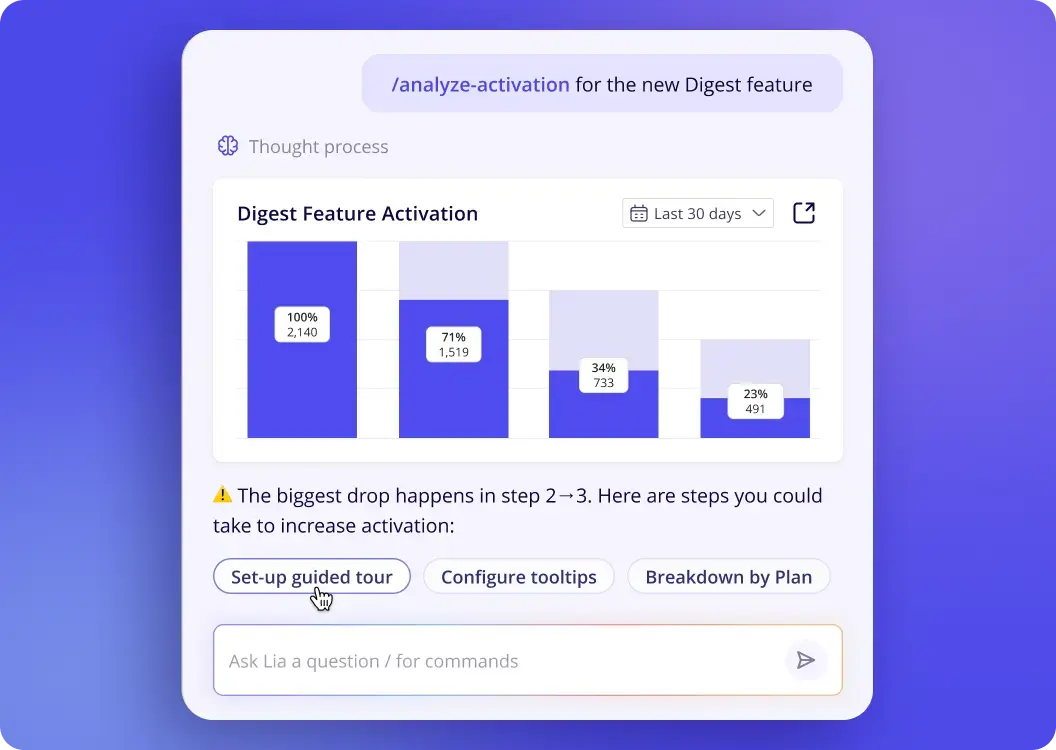
When comparing Userpilot vs. Hotjar, the complementary stack may make more sense if you need specialist behavioral-analysis depth alongside in-app action.
If your analytics needs are covered within Userpilot, you can keep analysis and in-app action in one platform.
Userpilot pricing
Our pricing plans scale with monthly active users (MAUs). We count an MAU as a user who takes a tracked action in your product during the month.
Our paid plans include:
- Starter: $299/month for up to 2,000 MAUs.
- Growth: starts at $849/month with 2,000 MAUs included, and pricing scales as you increase capacity up to 100,000 MAUs.
- Enterprise: custom pricing.
Here’s the difference between Hotjar and Userpilot’s pricing logic:
| Hotjar/Contentsquare | Userpilot | |
|---|---|---|
| Primary usage metric | Sessions or responses, depending on product | Monthly active users |
| Pricing structure | Separate product-specific plans | MAU-based plans |
| Core job | Digital/product behavior analysis | Product growth through analytics + engagement |
| In-app intervention | Not the primary proposition | Built into the workflow |
Our pricing model isn’t directly comparable with Contentsquare’s session- or response-based pricing because they measure usage differently. One active user can generate several sessions in a month while still counting as one MAU.
If you’re evaluating Userpilot specifically for the funnel → replay → in-app action workflow described above, Growth is the relevant entry point.
Starter includes in-app engagement, segmentation, usage trends, and NPS. Growth adds advanced analytics, event autocapture, and a larger session replay allowance.
Turn Hotjar-style insights into in-app fixes with Userpilot
When comparing Hotjar pricing with alternatives, ask whether identifying user friction is enough or whether you also need to act on that behavior in-product.
If your main need is behavioral and digital experience analysis, Hotjar may cover that on its own.
If you also need targeted in-app guidance, Userpilot can complement Hotjar or combine analytics and engagement in one platform.
Book a demo to see how Userpilot can help you find product friction and target affected users with in-app guidance from the same platform.
Disclaimer: Userpilot strives to provide accurate information to help businesses determine the best solution for their particular needs. Because the industry is dynamic, Userpilot and other platforms’ features often change over time. The statements made in this article are accurate to the best of Userpilot’s knowledge as of its publication/most recent update on October 8, 2026.
FAQ
Does Hotjar/Contentsquare offer a free trial?
Yes. Every new Contentsquare account starts with a 15-day free trial on Growth plans. You do not need to enter payment details, and there are no automatic charges. After the trial, you can choose a paid plan or continue on the free plan.
What happens if I reach my Hotjar session or response limit?
On Free and Growth, new collection stops until the monthly reset or an upgrade. Voice of Customer surveys and feedback widgets also stop showing once the response allowance is exhausted. Pro and Enterprise limits depend on your contract.
Does Hotjar offer annual pricing or bundle discounts?
Yes. Contentsquare offers a 20% discount when eligible annual billing is paid in-app by credit card or PayPal. If you subscribe to two paid Growth products, it also discounts the lower-priced plan by 10%.
Are Hotjar prices charged per site?
No. Contentsquare does not charge a separate subscription for each site. Pricing and usage allowances apply at the account level, while websites or domains are organized into projects. The number of projects available depends on your plan.
Is Hotjar the same as Contentsquare?
Yes. Hotjar is now part of Contentsquare, and new customers access its familiar heatmaps, recordings, surveys, and other capabilities through the Contentsquare platform. The broader Contentsquare suite also includes capabilities that did not come from Hotjar.
Does Hotjar publish Pro and Enterprise pricing?
No. Hotjar’s Pro and Enterprise plans use quote-based pricing, so you need to contact Contentsquare for a price based on your usage and requirements.
Can you use Hotjar free?
Yes. Experience Analytics and Voice of Customer both offer free tiers, although the usage limits and included features differ by product.
About the author