9 Best User Behavior Analytics Tools for Product Teams in 2026


On average, only 37.5% of new users reach activation across the 62 B2B SaaS companies, according to Userpilot’s SaaS product metrics benchmark report. User behavior analytics tools show you where the rest get stuck and why. In 2026 the job is bigger, because some of the activity in your product now comes from AI agents.
Start with two questions: What do you need to understand as a PM, growth manager, or UX researcher? And where does that behavior happen?
For example, measuring drop-off across a web app needs a different tool than watching why users struggle in a mobile app.
In this article, I discuss other use cases, review nine user behavior analytics tools, explain who each one fits best, and show you how to choose based on your needs.
Executive summary
Use these different use cases to guide your pick:
- You have no analytics budget: Start with Microsoft Clarity. Use its heatmaps and session recordings to pinpoint friction points at zero cost.
- You’d rather diagnose and fix friction in one platform: Choose Userpilot. You can spot the drop-off, see why it’s happening, and fix it with in-app guidance without switching tools.
- Your UX researcher needs session recordings and surveys: Try Hotjar (now Contentsquare) or Fullstory rather than Clarity. They can investigate and collect user feedback.
- You want to dig deep into funnels, retention, and experiments: Go with Amplitude or Mixpanel, and pair them with Userpilot when you’re ready to fix what you find.
- Your engineers own analytics: Go with PostHog for analytics, replays, and feature flags in one place. It’s built with developers in mind.
- Your team keeps going back and forth on whether it’s a bug or a UX issue: LogRocket shows replays next to console errors and network requests, so product and engineering are looking at the same thing.
- You have a mobile-first product: Try UXCam. Its architecture and feature set are designed primarily for mobile replay and analytics.
Use this table to compare and see which might be a good fit at a glance.
| Tool | Primary job | Best-fit role | Platforms | Data capture | Pricing |
|---|---|---|---|---|---|
| Userpilot | Analyze behavior and act in-app | Product and growth teams | Web apps and native mobile apps | Automatic capture and custom events | MAU-based; free trial; paid from $299/month |
| Amplitude | Deep product analytics | Data-driven PMs and growth teams | Web and mobile apps | Autocapture and custom events | Event-based; free up to 2M events/month; paid plans scale with event volume |
| Mixpanel | Funnels, retention, and behavioral analysis | Analytics-focused product teams | Web and mobile apps | Autocapture and custom events | Event-based; free up to 1M events/month; paid billed per event after that |
| PostHog | Technical analytics and experimentation | Engineering-led teams | Web and mobile apps | Autocapture and custom events | Usage-based per product; free allowances per product; paid scales with usage |
| Fullstory | Deep UX investigation at scale | UX and product teams | Websites and web apps; mobile as an add-on | Automatic behavioral capture | Session-based; free up to 30,000 sessions/month; paid by quote |
| Hotjar (Contentsquare) | Heatmaps, replays, and surveys | UX researchers | Websites and web apps | Automatic capture; surveys configured separately | Session-based; free up to 200K sessions/month; paid from $49/month |
| LogRocket | Replay connected to technical diagnostics | Product teams working with engineering | Web and mobile apps | Automatic session and diagnostic capture | Session-based; free up to 1K sessions/month; paid from $83/month |
| Microsoft Clarity | Free heatmaps and session replay | PMs and UX researchers starting out | Websites, web apps, mobile apps via SDKs | Automatic; minimal event setup | Free, with no traffic limits |
| UXCam | Mobile replay and analytics | Mobile product teams | iOS, Android, React Native, Flutter | Automatic capture and custom events | Session-based; free trial; paid by quote |
My 9 picks for user behavior analytics tools by use case
Most of these tools now cover several jobs. So, to help narrow down your options, I focused on four things:
- The behavior question: Do you need to quantify drop-offs across a funnel, understand retention patterns, watch sessions to see why users struggle, or a combination of these?
- Platforms and setup: Where do you need to track behavior: a website, web app, or mobile app? And does the tool capture user interactions automatically, require custom events, or support both?
- Pricing: Does the cost depend on events, sessions, tracked users, or monthly active users? And how quickly does it grow as usage increases?
- Insight to action: Once you identify friction, can you address it and measure the outcome in the same tool? Or will you need to pair analytics with session replay, surveys, experimentation, or in-app engagement?
That last question matters more than it seems, because most teams end up combining what the numbers say with what they see in sessions. As Kevin O’Sullivan, Head of Product Design at Userpilot, puts it:
“The best way of conducting any sort of research is not to follow one method only… try to marry the quantitative with the qualitative. So that’s where session replay is. It is that perfect tool… a blend of a qualitative method, watching sessions, at a quantitative scale.”
Below are nine tools I settled on:
1. Userpilot: Best for understanding user behavior and acting on it in one platform
When users drop off before activation, a few questions pop up: Where do they struggle? Why? More importantly, what is the fix?
Userpilot helps product teams answer these questions. You can build funnels, paths, and retention reports to find where users drop off, segment them by plan, behavior, or company, and watch session replays for exactly that segment.
Then you can ask them what went wrong with an in-app survey, guide them with a tooltip, checklist, or flow, and track whether the metric moves.
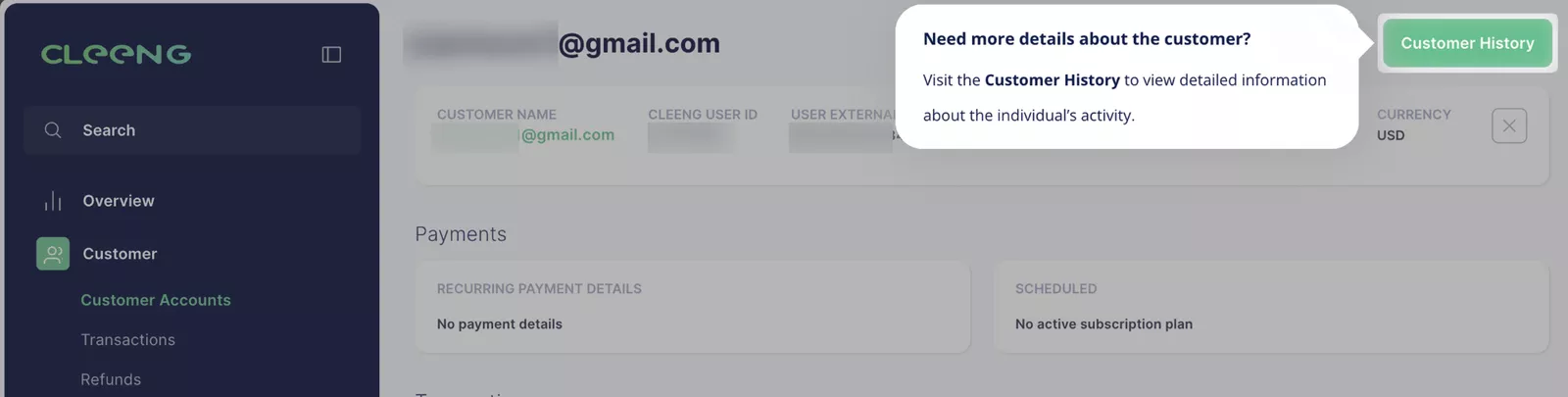
Here’s how that played out for Cleeng:
- Cleeng spotted a 92% feature usage drop on Userpilot’s page analytics dashboard after a UI redesign.
- Session replays revealed the reason for the drop: users missed the feature’s new location.
- The team rolled out targeted tooltips, onboarding flows, and a resource center to guide users to and through the feature.
- The result was 75% more page visits within days, and confidence to roll out a new, data-driven UI design.
Anna Sobiak, Product Designer, said:
“Newly registered users were a bit lost and didn’t know where to go at first. So, we made a Userpilot onboarding flow to welcome and orient users.”
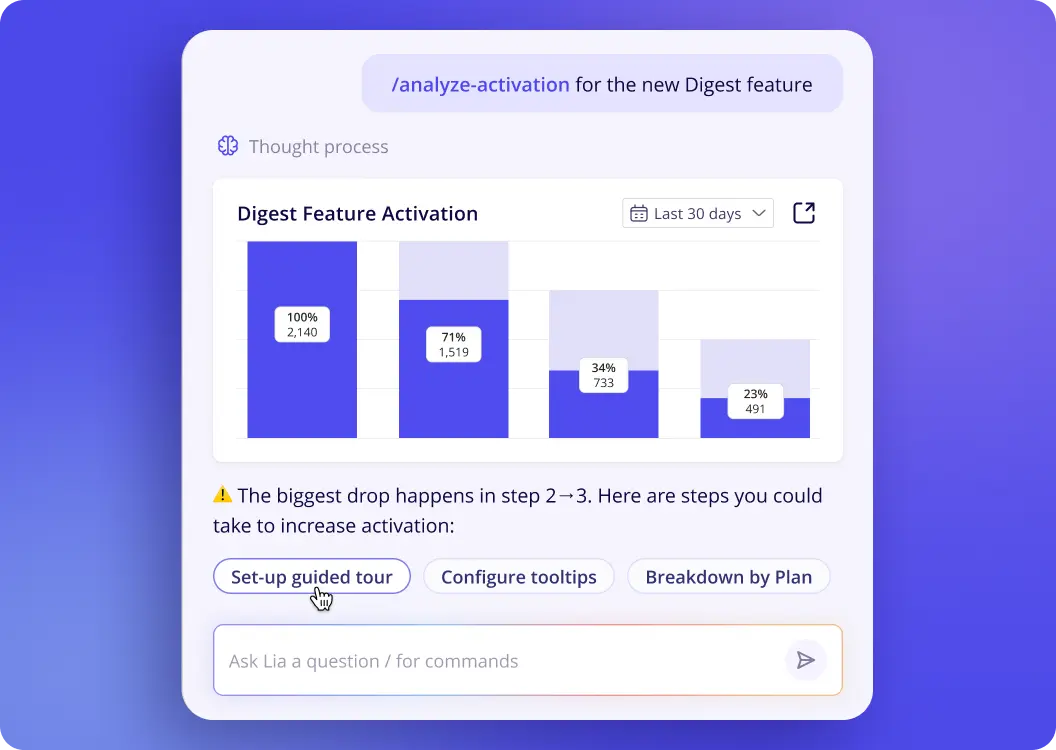
Let Userpilot agent, Lia, do the investigating if you prefer a more hands-off alternative to Cleeng’s approach. You ask about your behavioral data in plain language, and it digs into the data, recommends fixes, and builds the flows. All you have to do is review and apply.
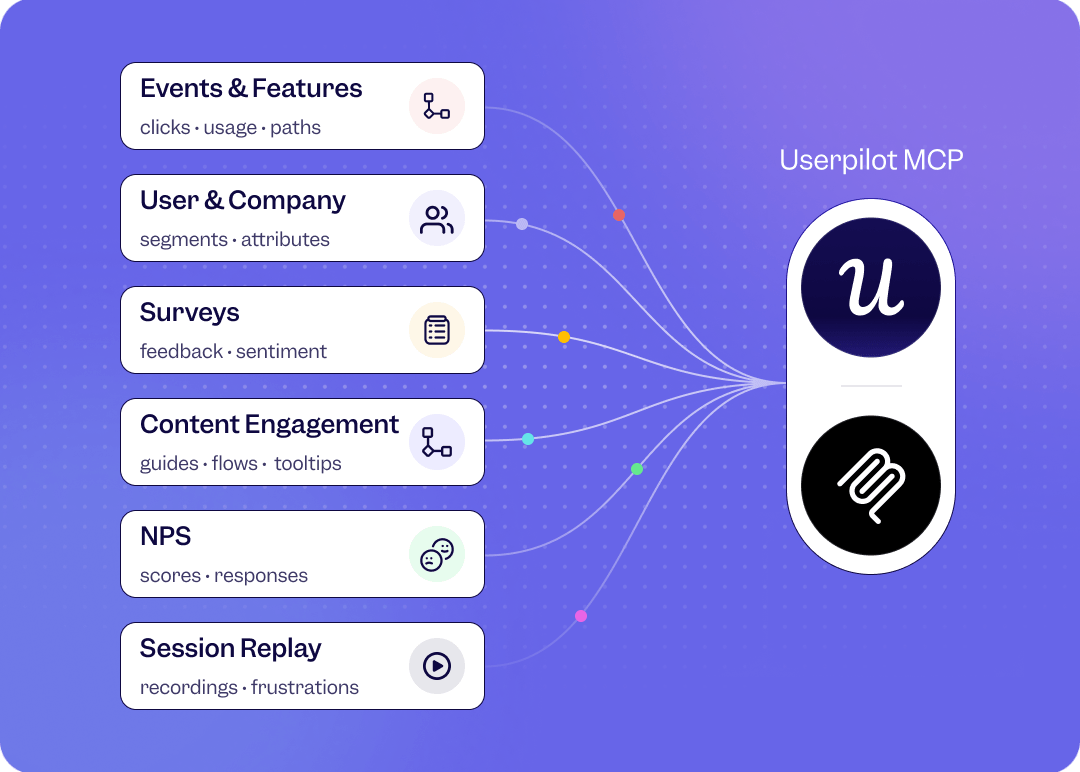
If you or your team would rather work in AI tools like Claude or ChatGPT, Userpilot’s MCP Server fills that gap. It lets you analyze funnels, trends & retention, create user segments & reports, and draft surveys from your AI tools.
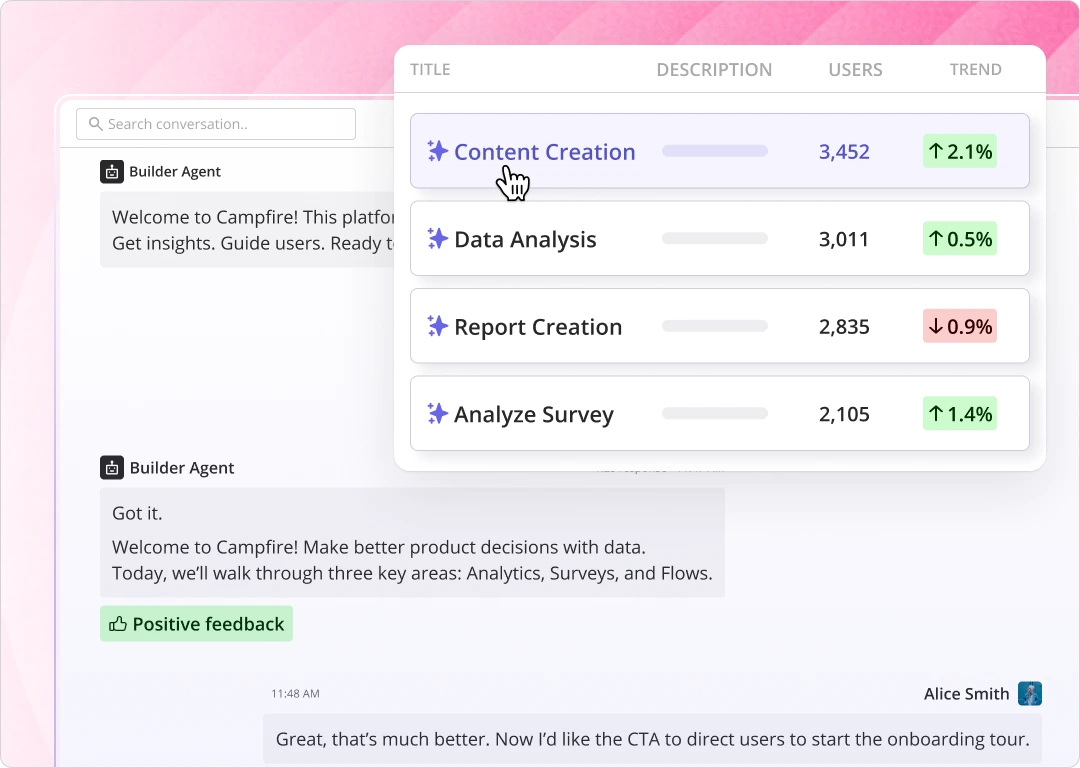
And because in-app behavior no longer comes from users clicking through the UI alone, Userpilot Agent Analytics helps you track what users do with your AI agents.
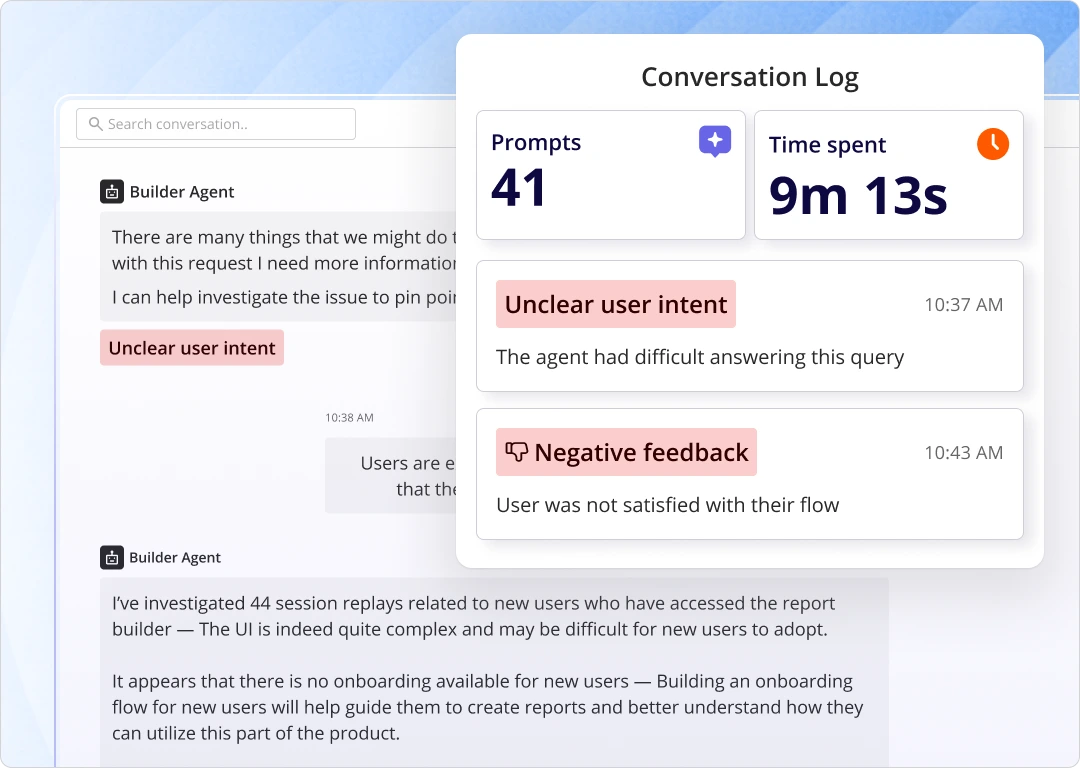
Unlike engineering tools that focus on traces and tokens, it’s product analytics built for PMs. It groups what users ask into topics and tracks where agents fail.
Since it sits within Userpilot, you can segment users who hit a failure and launch an in-app flow to help them complete the task.
It also runs on the existing Userpilot SDK, so if you already use Userpilot, you’re set.
For event tracking, Userpilot supports automatic capture and custom events across web apps and native mobile apps.
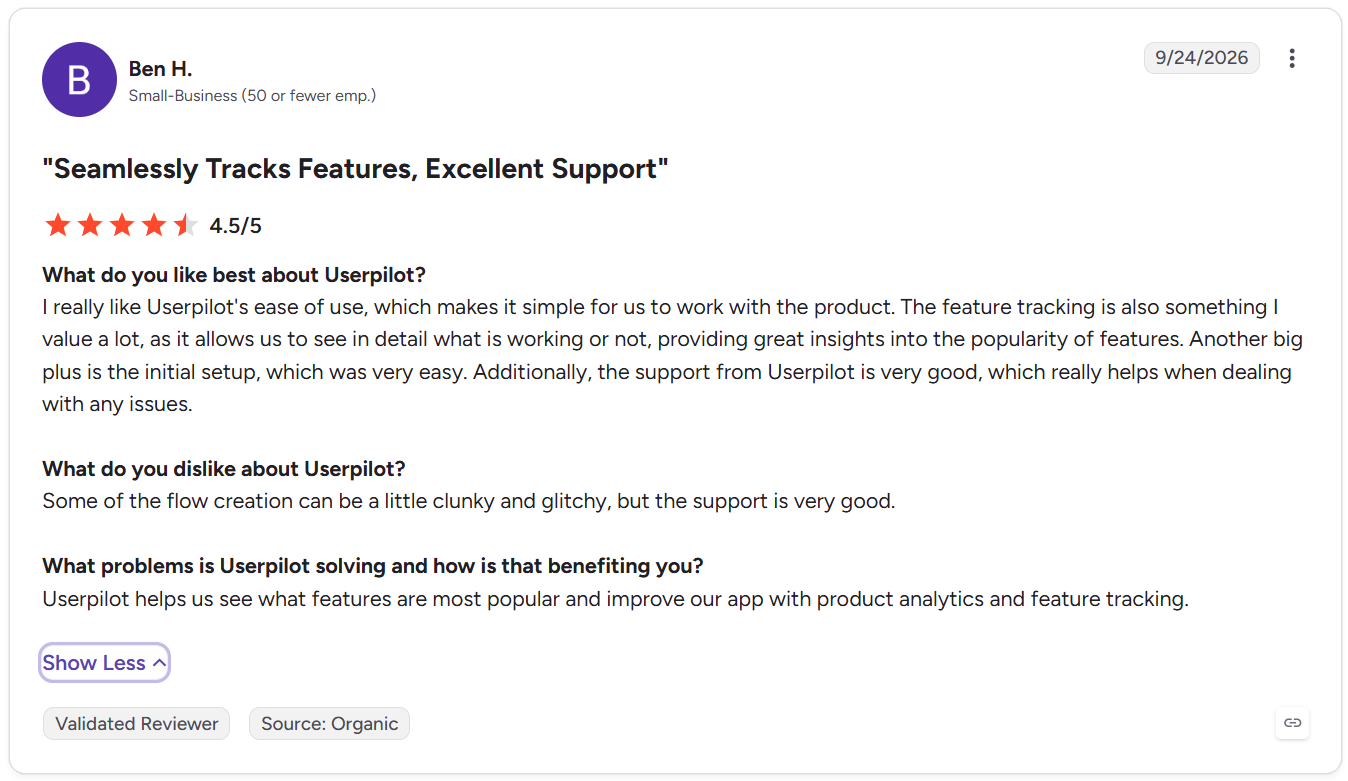
Pricing is based on monthly active users (MAUs), and plans start at $299/month billed annually.
Overall, choose Userpilot if you need product analytics software to investigate user behavior, improve onboarding, collect feedback, and act on the insights right there.
Userpilot may not be the best fit if you need a free tool, or if your product is mobile-only and you’re starting on a smaller plan. Mobile analytics, native iOS and Android support, and push notifications are all available as an add-on on Growth, or included on Enterprise.
2. Amplitude: Best for analytics-first product teams with data resources
If you manage complex user journeys and need to run retention analysis and experimentation, Amplitude may be a good fit. It also offers in-app Guides and Surveys alongside its core behavioral analytics capabilities.
Its AI agents, including Global Agent, let you ask questions about your data in plain language, and you can also query Amplitude directly from Claude or ChatGPT.
Say you’re testing a new onboarding flow to improve activation. Amplitude lets you…
- Use a feature flag to roll it out to a specific group.
- Run an experiment comparing the new experience with the existing one.
- Analyze conversion across user segments to see which version drives more users to their first key action.
After identifying the winner, you can roll that flow out at scale and continue monitoring activation.
Amplitude is flexible, too. It works across web and mobile apps, with web analytics for marketing sites. And its data capture options include autocapture and custom events.
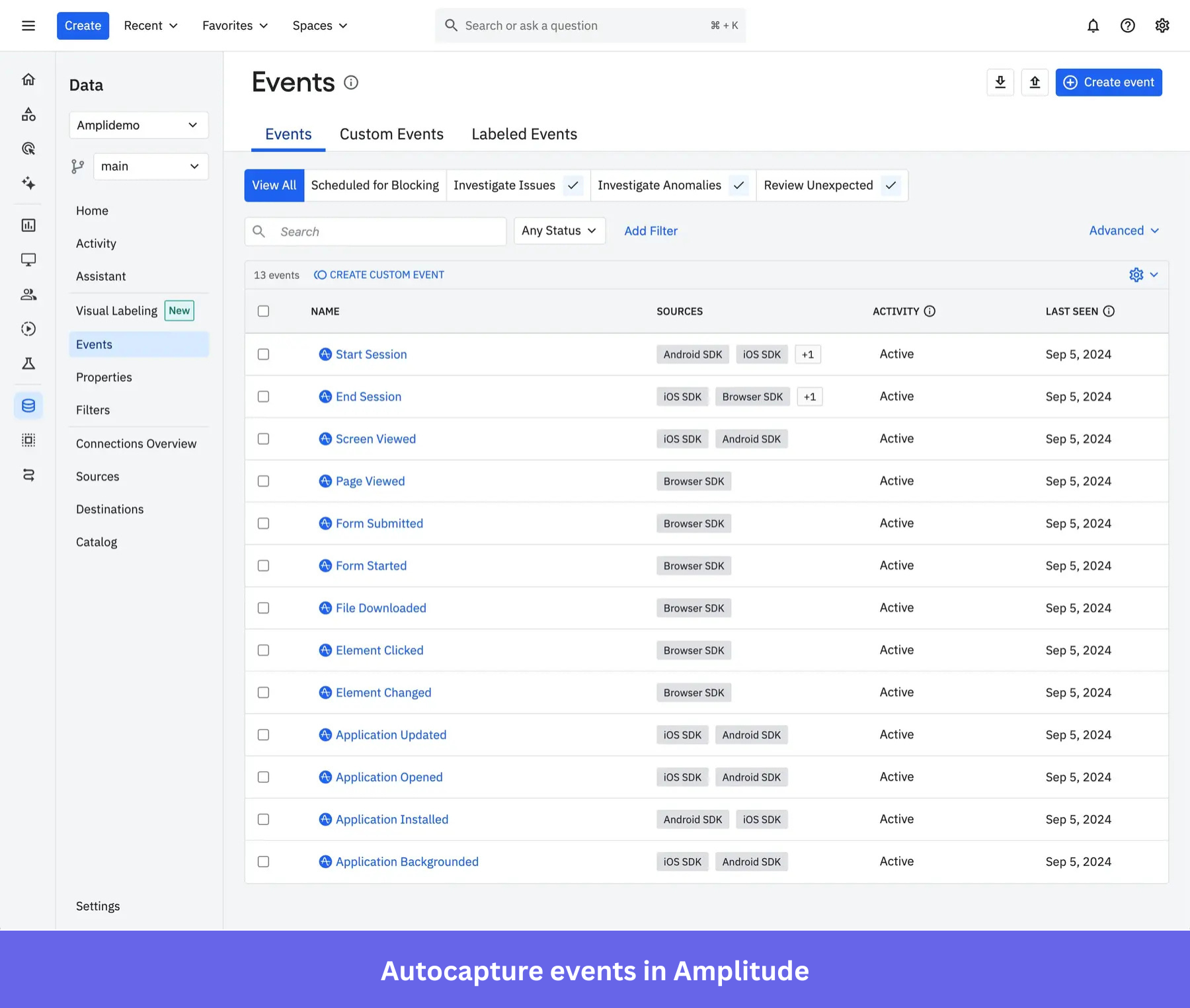
On pricing, Amplitude’s self-serve Plus plan starts at $0 and scales with event volume, with the first 2 million events free.
Overall, I’d say try Amplitude for product analytics and experimentation, but only if you have the resources to manage the event data.
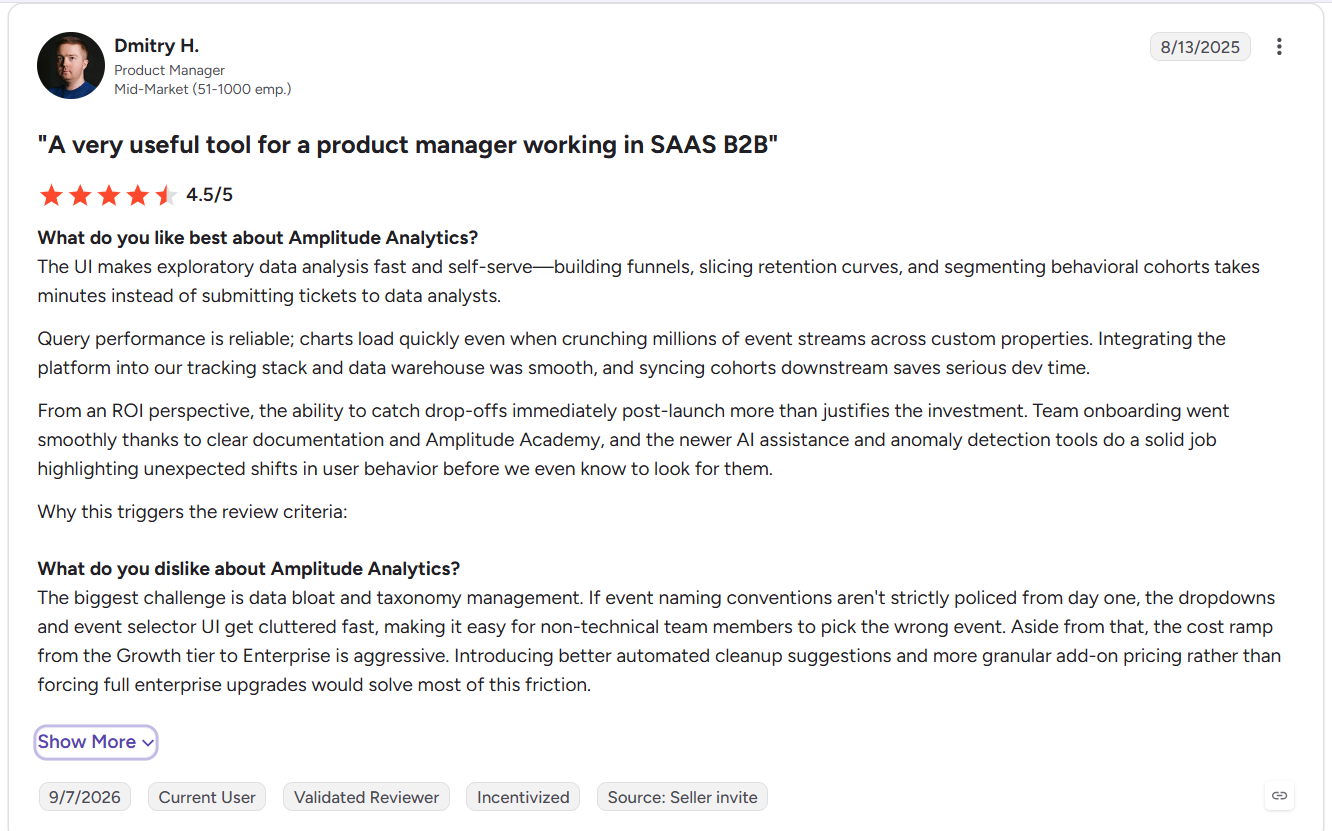
Skip Amplitude if you mainly need highly customizable in-app onboarding.
3. Mixpanel: Best for deep product analytics, especially in B2C
If you manage high-volume B2C products, Mixpanel analytics is a good fit, especially for user engagement and retention. If users are dropping off after sign up, you can:
- Compare funnels by acquisition source and user cohort.
- Inspect paths to find where journeys diverge.
- Identify behaviors linked to retention.
- Test changes with feature flags or experiments.
You can perform such analyses across web apps, mobile apps, and marketing websites. And for event tracking, Mixpanel supports autocapture and custom events.
It also summarizes session replays, both one by one and across playlists, and its MCP server lets you query your data from tools like Claude, ChatGPT, or Cursor.
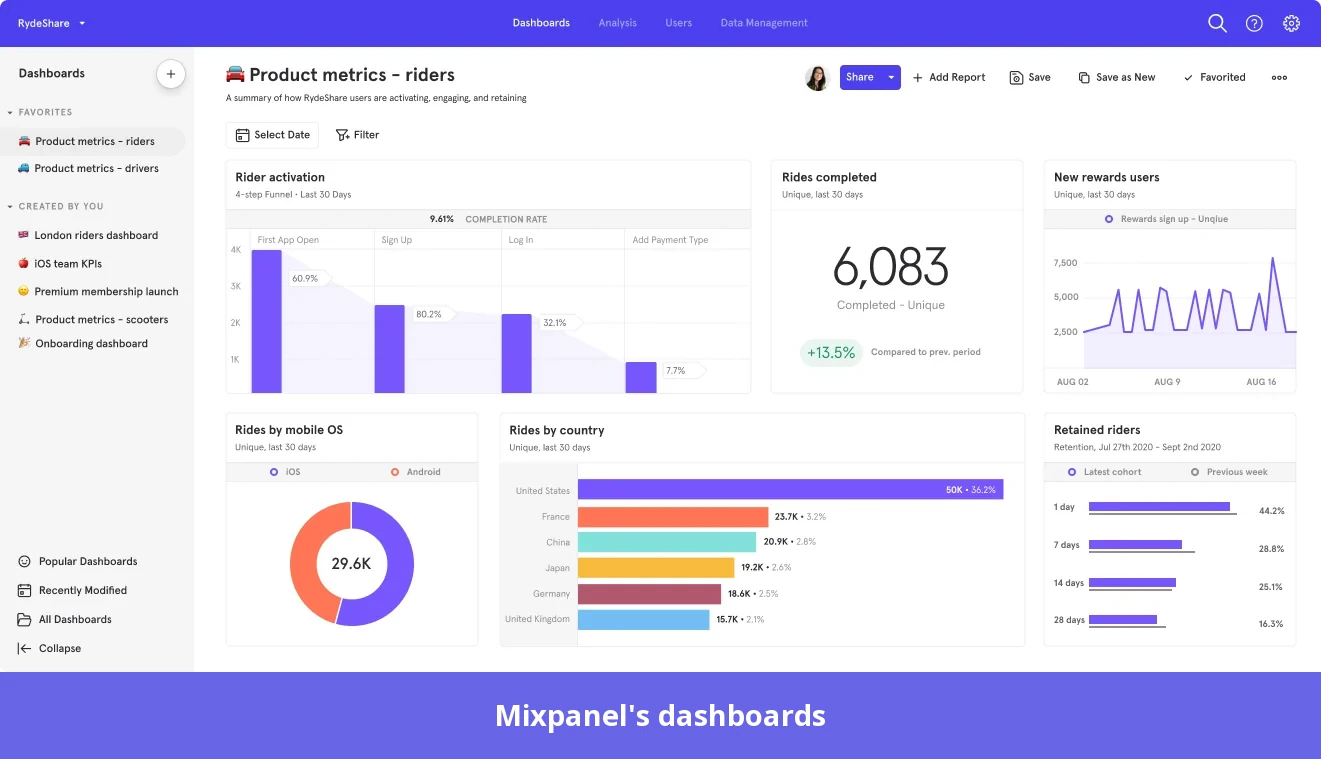
The events tracked decide your billing. Even so, Mixpanel pricing is transparent. The Growth plan, for example, starts at $0 and includes the first 1 million events monthly free, with additional events billed per event.
In summary, I’d recommend Mixpanel if you need flexible analytics and have the engineering resources to manage event data.
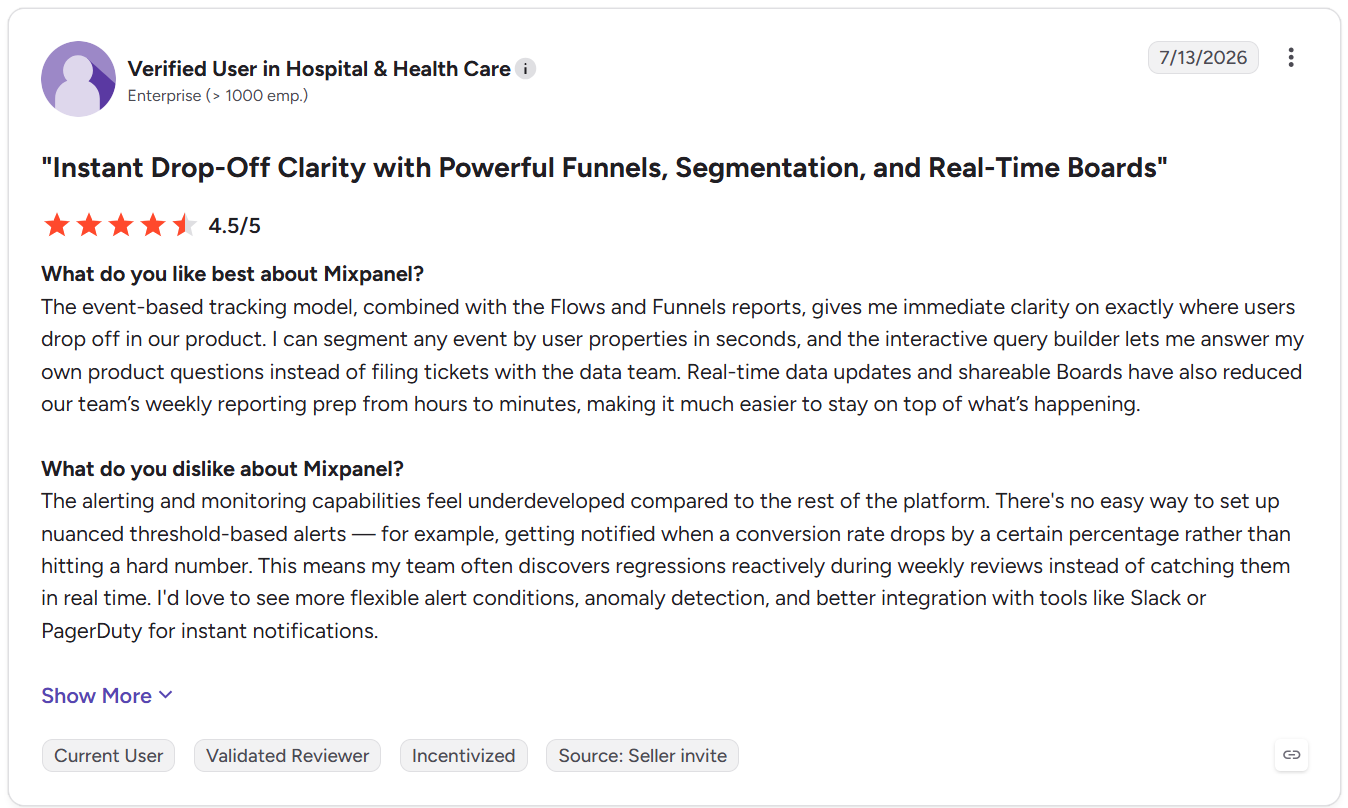
But it isn’t a full in-app onboarding platform. Pair it with a tool like Userpilot to deliver guidance and feed engagement data back into your analysis.
4. PostHog: Best for engineering-led product teams
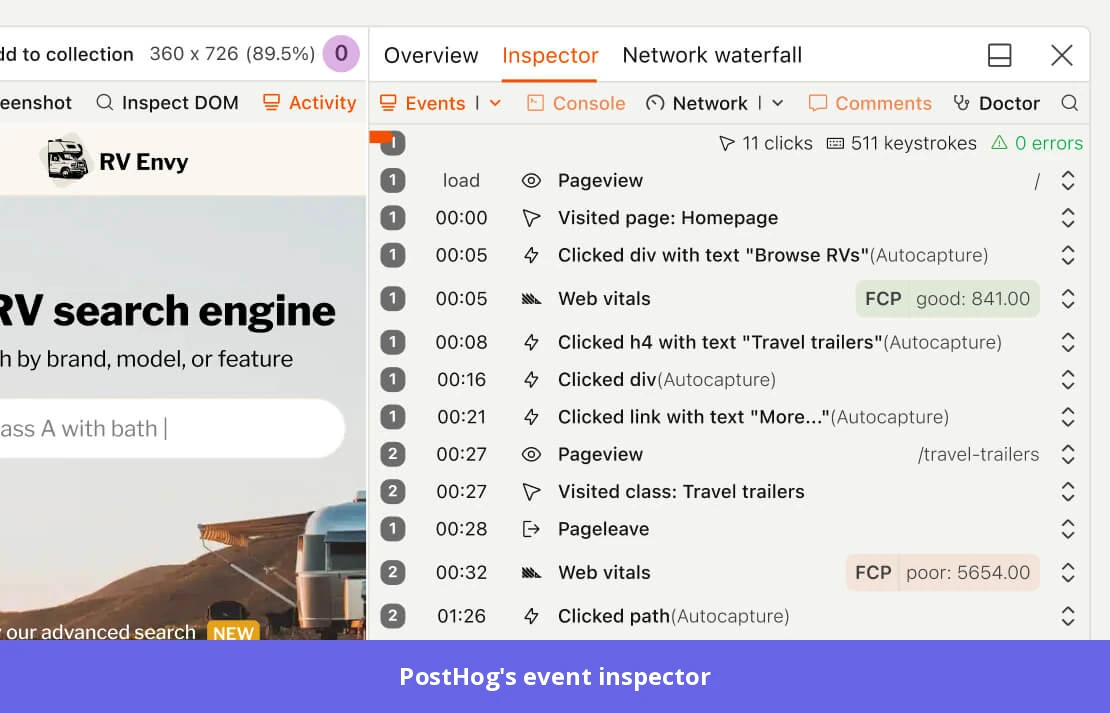
PostHog analytics connects behavioral data to debugging and product changes. This makes it ideal for technical teams that need product analytics, error tracking, session replay, surveys, and feature flags through the same SDK.
Its built-in assistant, PostHog AI, can answer product questions in plain language, build insights and dashboards, and find and summarize session replays.
Here’s how it works: Say you want to know why activation drops after a release; PostHog lets you…
- Build a funnel from signup to activation.
- Segment by device or plan.
- Open session replays for the affected users.
- Identify the UX issue.
- Test a fix with feature flags.
- Measure the impact.
PostHog works across web apps, mobile apps, & websites, and supports automatic capture and custom events.
Its pricing is usage-based, with separate allowances for each product.
Take the free tier. It includes 1 million events, 5,000 session recordings, and 1 million feature flag requests per month. Beyond those limits, each product has its own usage meter, so costs can increase as you add products or usage grows.
In short, go for PostHog if you need an engineer-friendly behavioral analytics tool that supports experimentation. But skip it as a non-technical PM who prefers simpler, no-code analytics tools. Our list of self-service analytics tools shows what each one still needs from engineering.
5. Fullstory: Best for deep UX investigation at scale
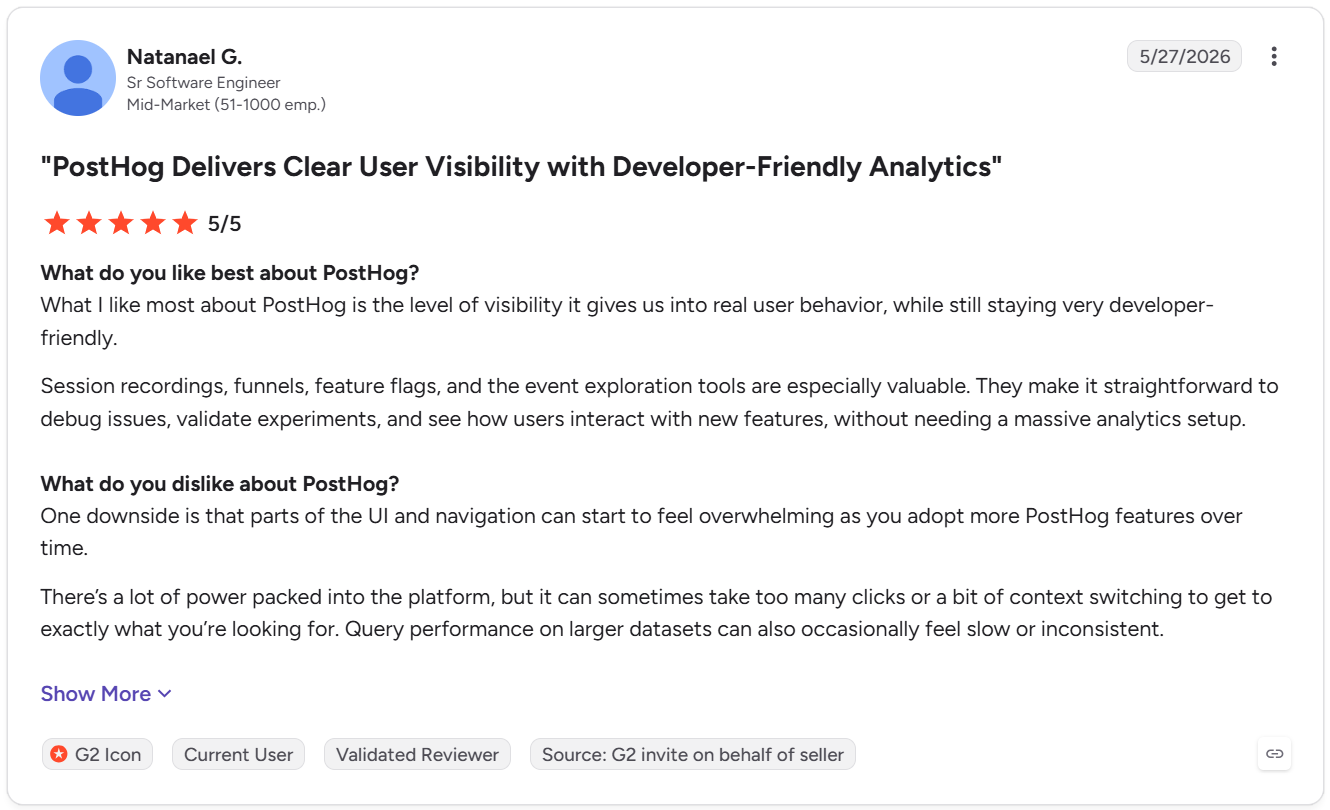
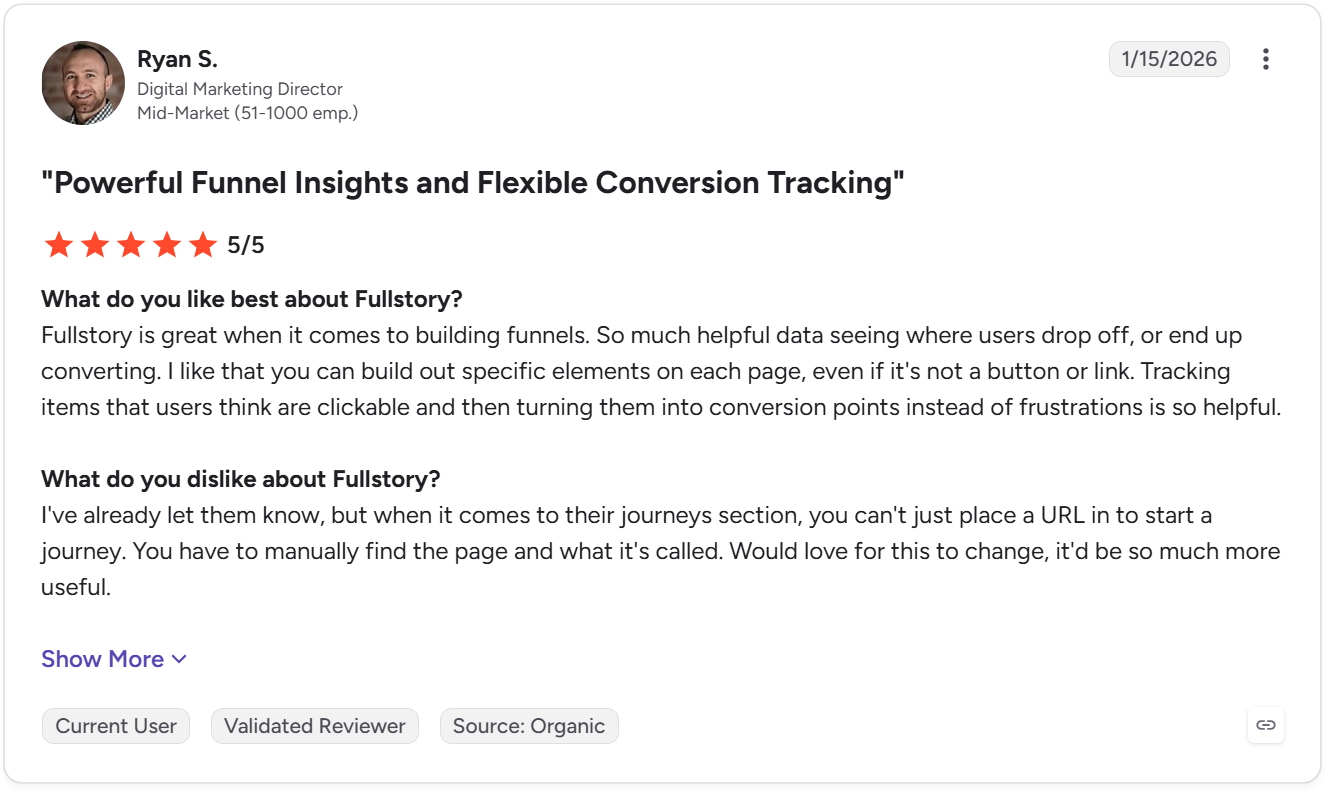
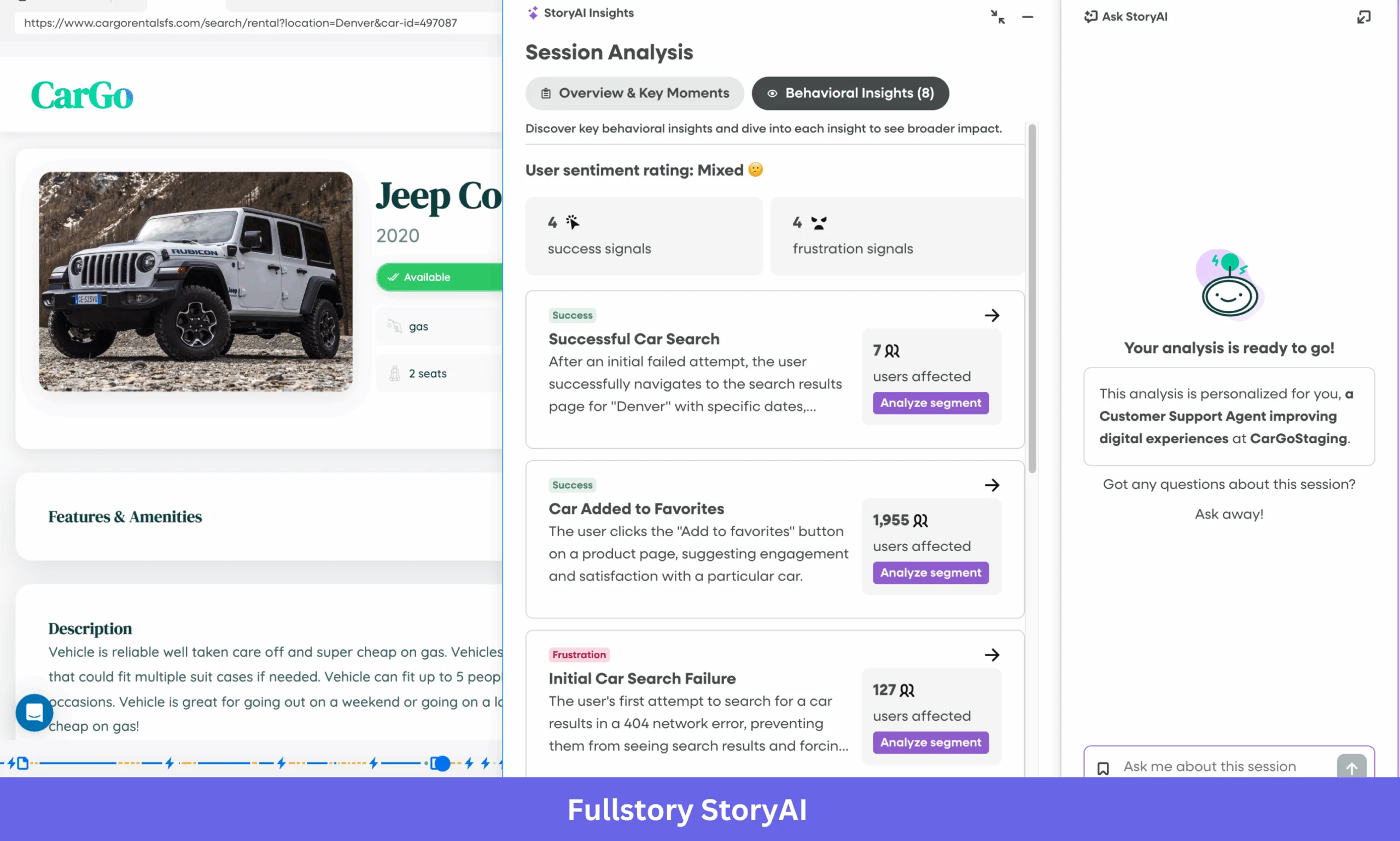
If you’re investigating friction across complex user journeys, Fullstory might be a good fit. Beyond session replay, it offers product analytics, guides and surveys, StoryAI, and an MCP server that lets you explore behavioral data through AI tools.
Here is how it works: Say users are abandoning at checkout, but you don’t know why. With Fullstory, you can…
- Compare checkout funnel conversion across devices to identify where abandonment is highest.
- Filter sessions from users who dropped off.
- Watch replays and inspect frustration signals to spot confusing steps or broken interactions.
- Use surveys to ask users about the checkout experience.
- Roll out guides to provide contextual help.
Fullstory covers web apps and websites; mobile analytics is available as an add-on. Like most user behavioral analytics tools, it captures interactions via autocapture (Fullstory Snippet) and custom events.
The pricing is session-based, and paid plans are available on request. The free tier (FullstoryFree) includes up to 30,000 sessions per month, 10 user seats, and 12 months of analytics and replay retention. On the flip side, users say sorting through the sessions is challenging.
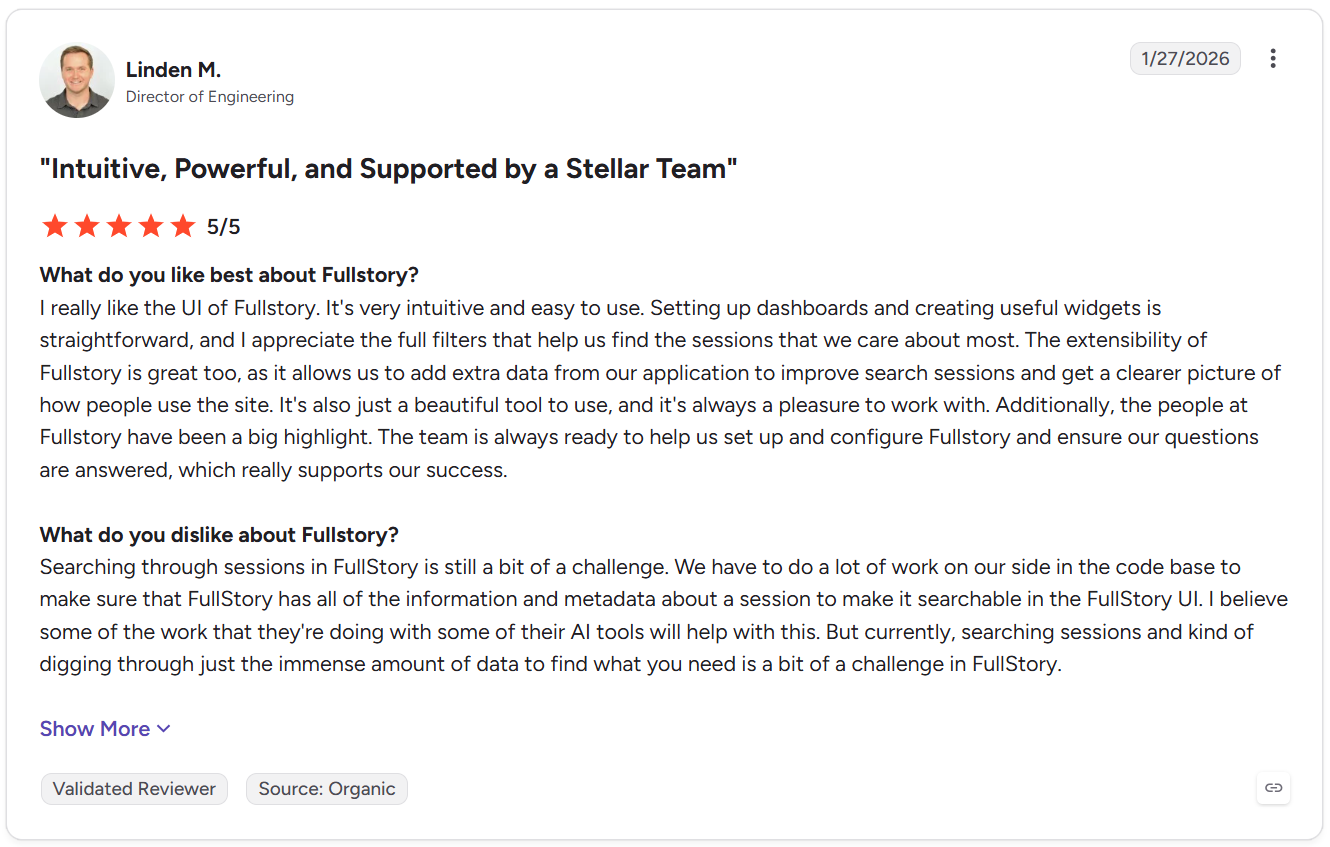
Regardless, Fullstory is a good choice for detailed UX investigation across large volumes of sessions. But I’d skip it if the priority is a straightforward product analytics platform.
6. Hotjar (now Contentsquare): Best for UX research with heatmaps, replays, and surveys
Hotjar, now part of Contentsquare, helps UX researchers visualize user behavior and collect feedback in the same platform. Sense AI summarizes session replays and heatmaps and answers questions about your data, though it isn’t part of the free plan.
Here’s how it works:
Say users keep abandoning a feature’s onboarding flow. With Hotjar, you can…
- Use heatmaps to see which elements users click, ignore, or struggle to find.
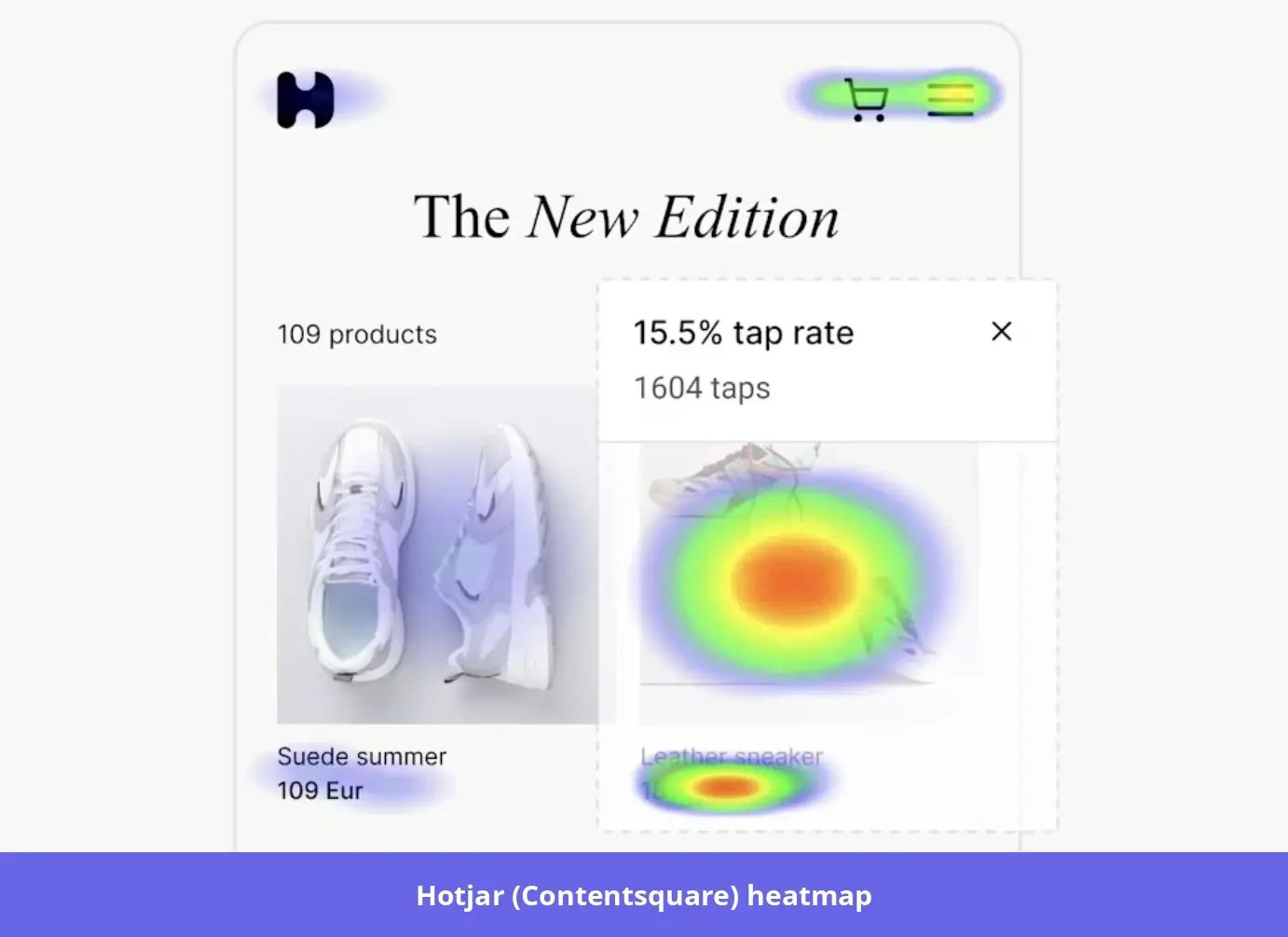
- Watch session recordings to see where users hesitate or abandon the flow.
- Trigger a survey to collect feedback about the confusing step.
Afterward, you can adjust the interface or onboarding guidance. Then, review subsequent sessions to see if behavior changes.
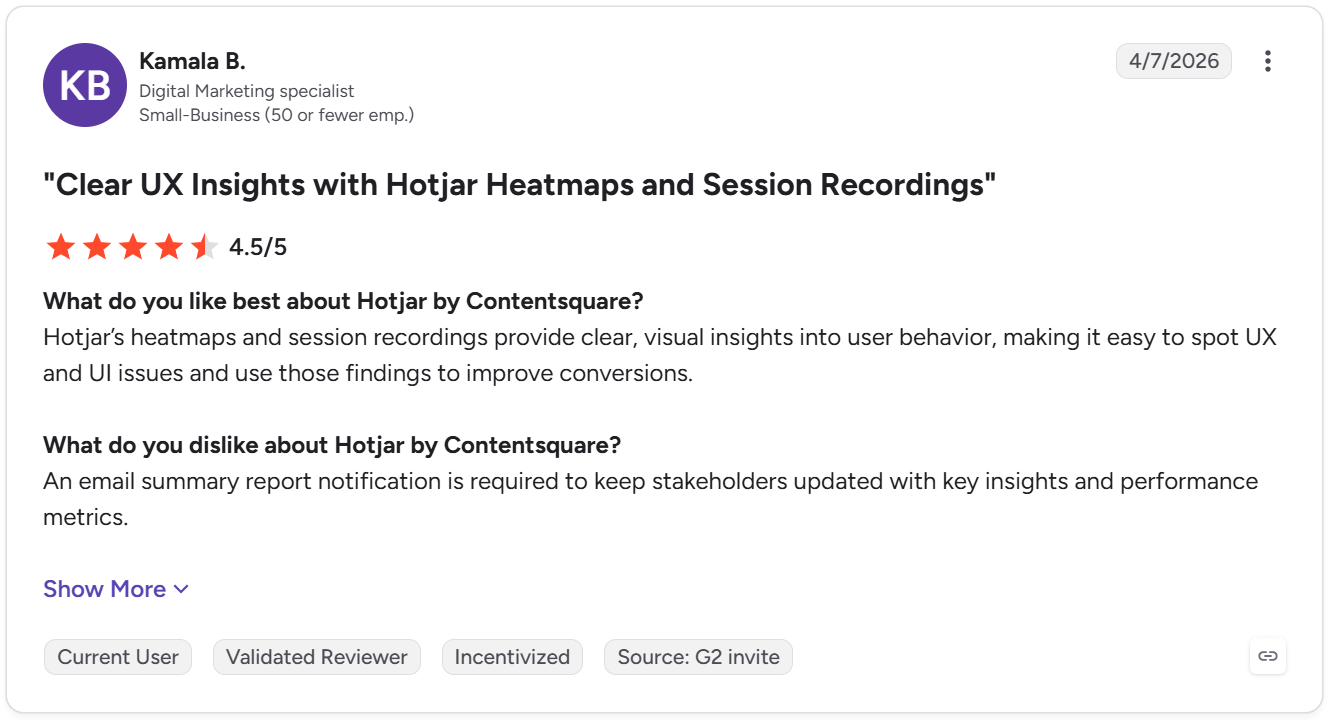
Hotjar supports websites and web-based apps, as well as autocapture and manual tracking. However, its strength in visual UX research comes with a limitation: it doesn’t offer the depth of event-based product analytics. So, you may need to pair it with a dedicated analytics tool or consider other Hotjar alternatives.
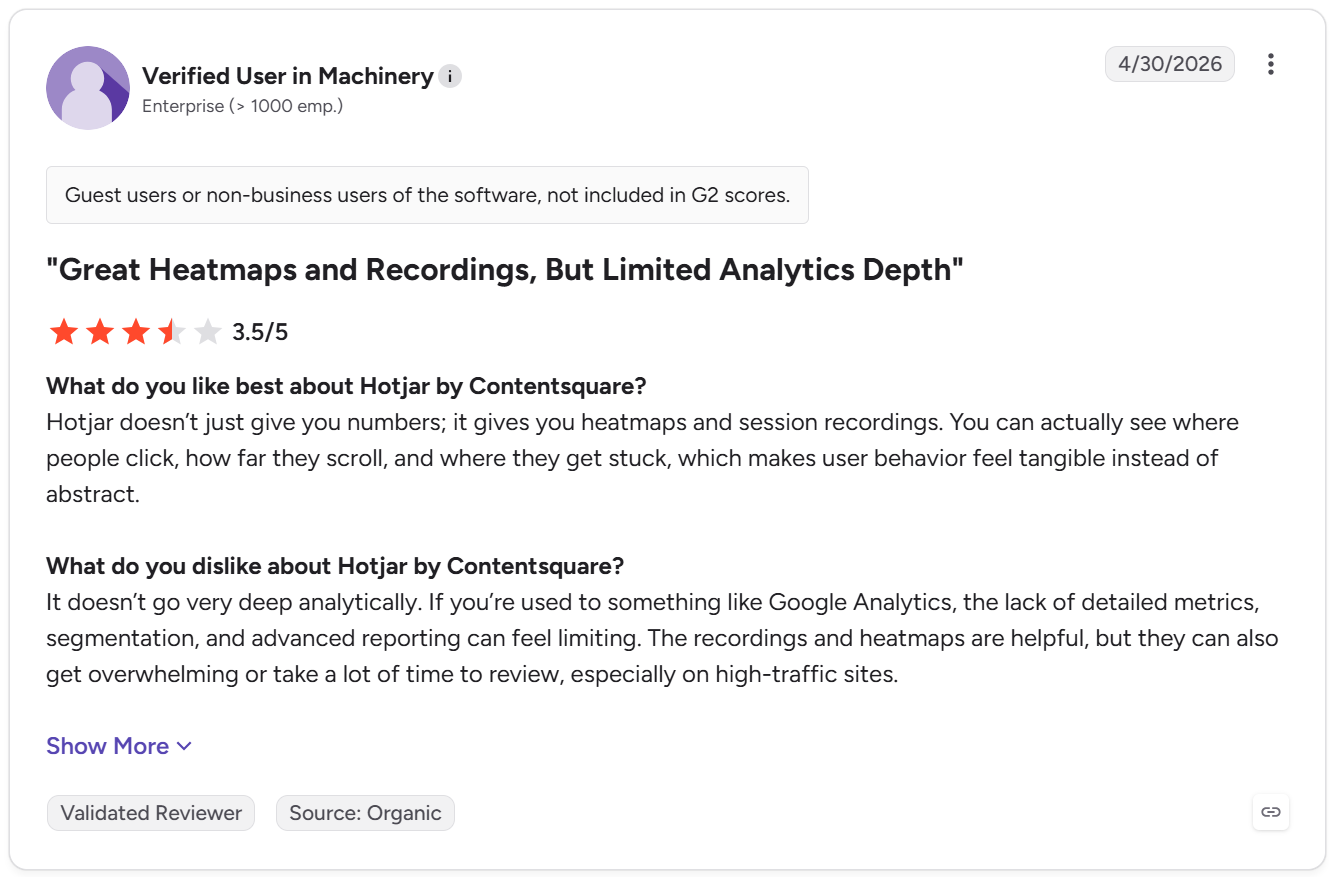
Pricing is another factor to consider. The free plan includes up to 200,000 monthly sessions, heatmaps, replays, funnels, and basic surveys. Beyond that, Hotjar pricing scales based on session volume, the products and features you need, and data-retention limits.
In summary, Hotjar remains a good pick if you only want to do UX research and visualize users’ behaviors. For event-based product analytics, however, I’d say skip or combine it with a dedicated tool.
7. LogRocket: Best for product teams working closely with engineering
LogRocket connects session replay with frontend errors and network requests. This makes it a fit when product and engineering teams need to work together to investigate friction points.
Here is how it works: Say the behavior question is “Why does checkout fail for some users?” LogRocket lets you…
- Filter sessions for checkout errors.
- Replay affected sessions alongside console logs and network requests.
- Identify the failing request or UI state.
- Share evidence with engineering.
- Verify the fix.
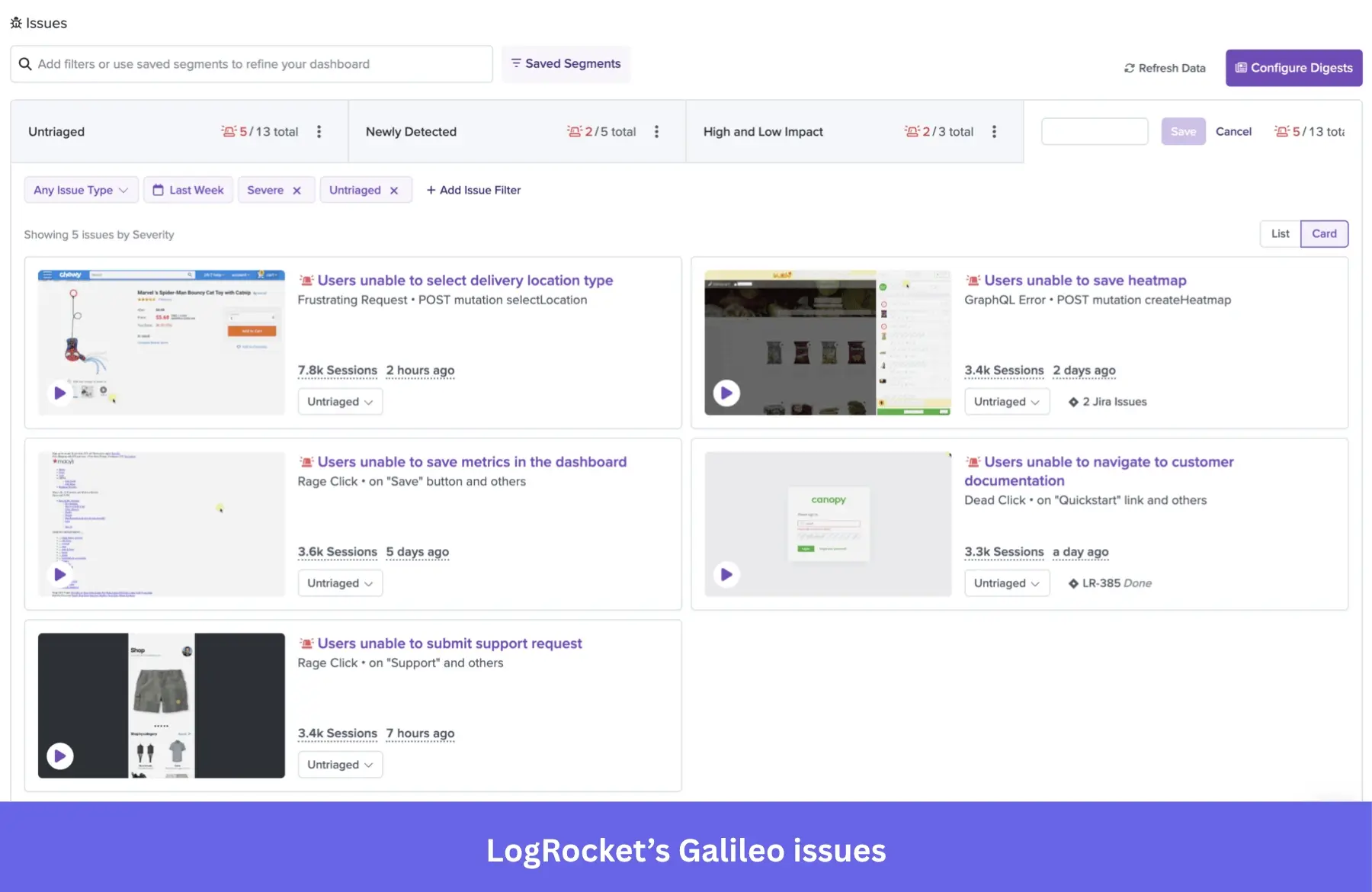
LogRocket covers web and mobile apps. While popular for autocapture, it also supports manual/custom tracking via its dedicated API.
Its pricing scales with captured sessions:
- There’s a free plan limited to 1,000 sessions/month; you start paying from 10K sessions ($83).
- The Core plan (< 100,000 sessions/month) includes session replay, unlimited analytics, error events, logs, heatmaps, funnel and path analysis.
- AI capabilities, such as Galileo AI and AI funnel & heatmap insights, are available from the Pro plan.
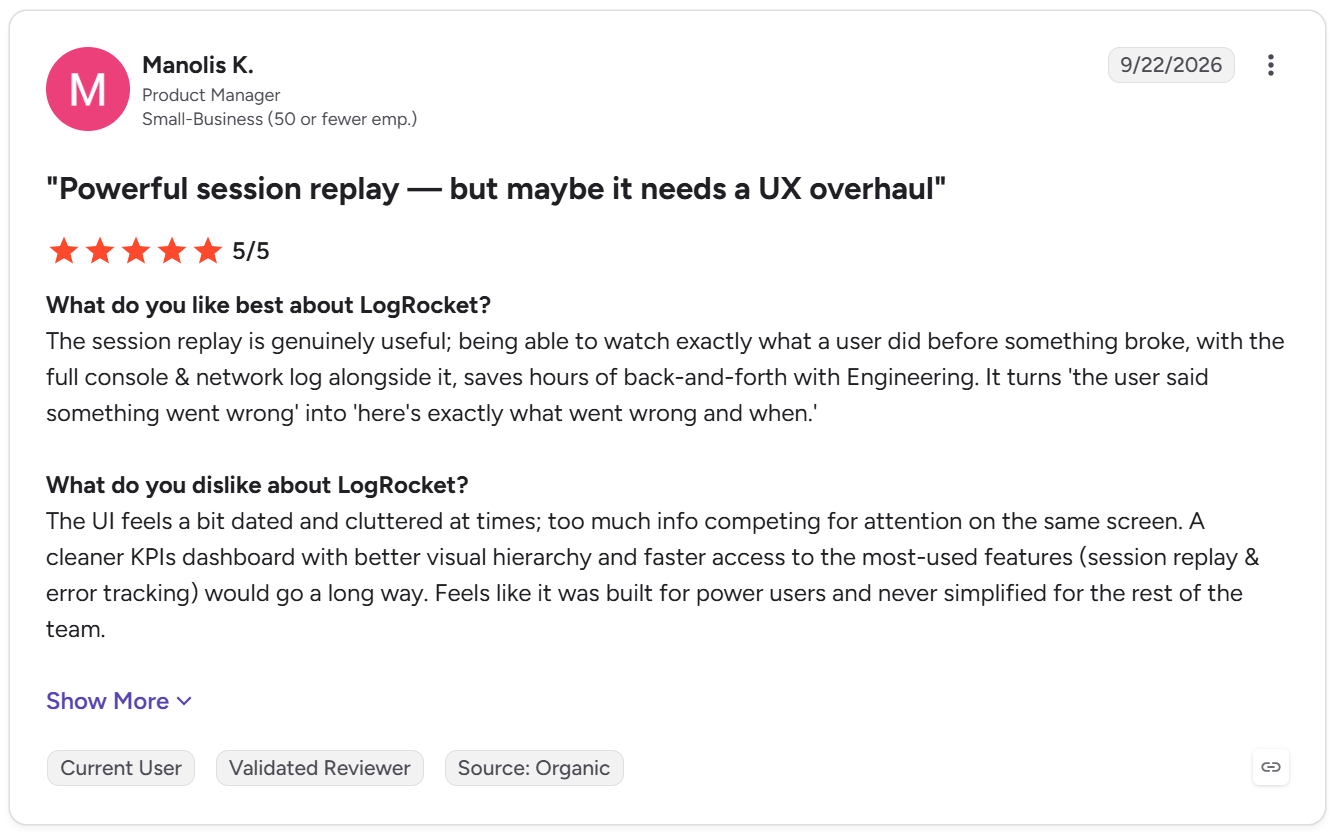
Overall, LogRocket is ideal when product and engineering teams collaborate to diagnose UX issues. But if you only need basic behavioral analytics without technical diagnostics, skip it.
8. Microsoft Clarity: Best for free UX insights
Microsoft Clarity is a good fit if you need a free starting point for identifying friction points. It has no traffic limit and offers session recordings, heatmaps, and Copilot, an AI assistant that summarizes heatmaps and answers questions about your dashboard data. Here is how it works:
Say users keep abandoning an onboarding checklist before completing their first key action. With Clarity, you can…
- Check heatmaps to see which checklist items users interact with or ignore.
- Watch recordings of users who leave before completing onboarding.
- Spot confusing screens, dead clicks, or interactions that don’t work as expected.
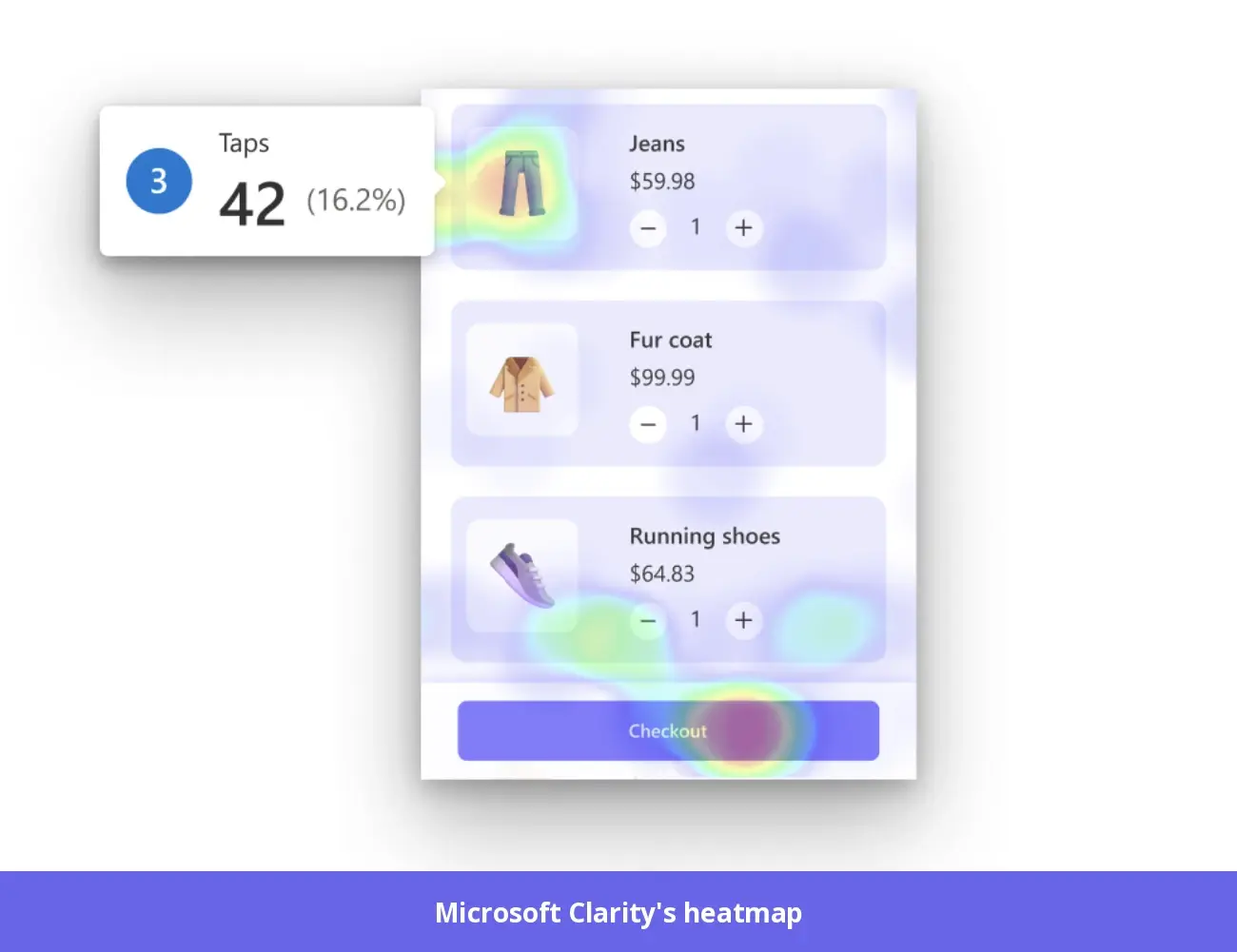
Clarity covers websites & web apps, and mobile apps through dedicated SDKs. It also supports autocapture and manual tracking.
For pricing, all features, from heatmaps to AI insights, are free. But it falls short if you need surveys, A/B testing, or retention analysis.
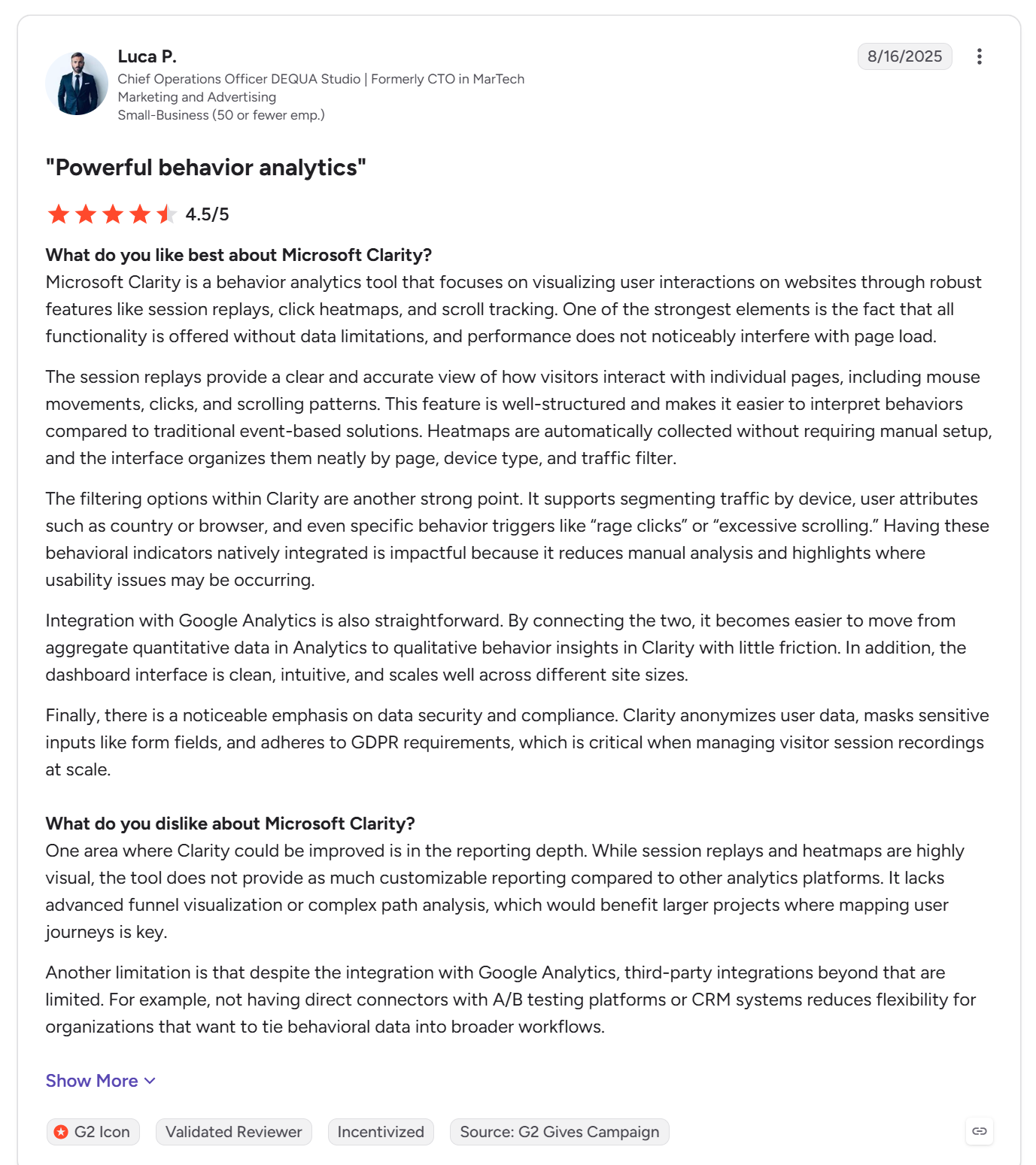
So, you’ll need to pair it with a product analytics tool. That aside, it’s ideal as a quick, easy-to-use, free tool for investigating friction points.
9. UXCam: Best for mobile-first product teams
If you’re mainly investigating drop-offs in your mobile apps, UXCam might be a good fit. But for in-app engagement, e.g., targeted tooltips, you may need to pair it with another tool.
Its AI analyst, Tara, watches sessions for you, surfaces friction, and suggests next steps.
Say users keep leaving your app before completing a key task. UXCam lets you:
- Analyze user journeys to identify the screens where most users exit.
- Filter recordings by device, app version, or user segment to identify patterns.
- Replay affected sessions from those screens to spot confusing UI, repeated taps, or technical issues.
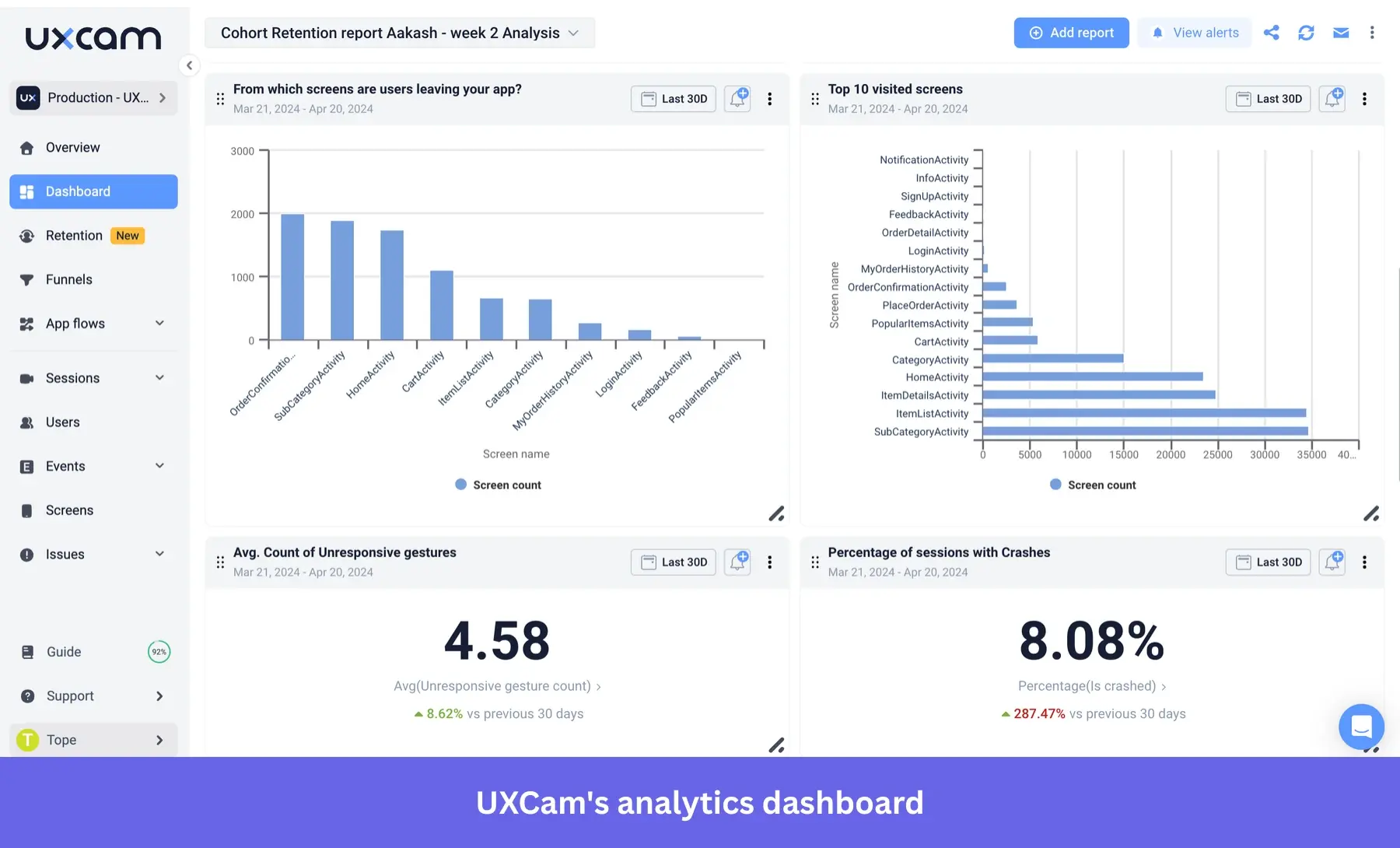
UXCam mainly supports iOS, Android, React Native, and Flutter. Web support is also available. Across devices, it covers autocapture and manual tracking.
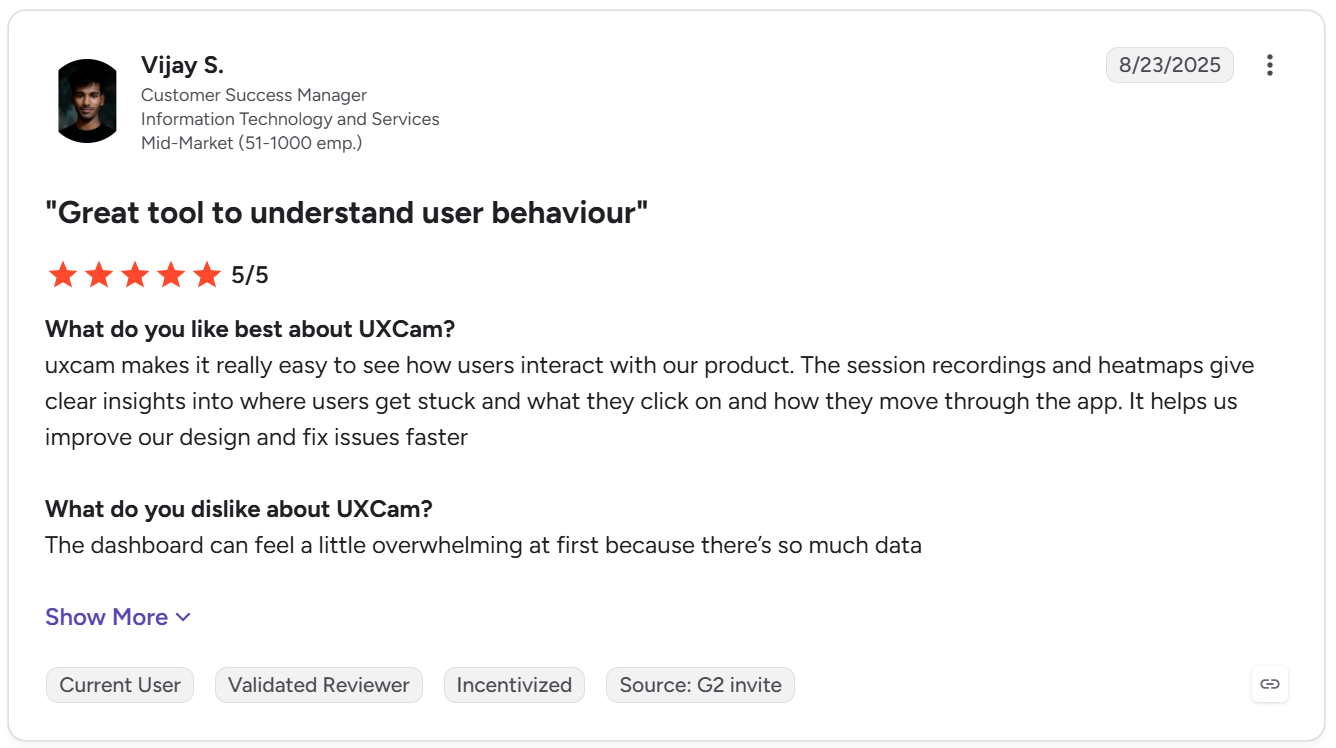
The pricing is quote-based and scales depending on monthly session volume. There’s also a 14-day free trial; use it to weigh your options. It includes full feature access, up to 100,000 sessions, and 100,000 videos.
In summary, I’d recommend UXCam if your priority is understanding mobile UX and in-app journeys. Skip it if your product is mainly a web app.
Close the loop on user behavior with Userpilot
If you want to move from identifying user drop-offs to fixing them all within a single platform, choose Userpilot.
You can spot where users drop off, watch what happened in their sessions, and reach that same segment with in-app guidance, then check whether the fix worked. Userpilot AI agent, Lia, helps you scale this workflow across your team.
Want to see how this workflow plays out with real user sessions? Book a demo now.
FAQ
What are the best user behavior analytics tools?
It depends on what you need to learn. For connecting behavior analysis to in-app action, Userpilot. For deep product analytics, Amplitude or Mixpanel. For a free starting point with heatmaps and session recordings, Microsoft Clarity.
How do you analyze user behavior?
Start with a specific question like “why did activation drop?” Then, build a funnel to locate the exact drop-off points. From there, segment the results to identify the affected users, then watch session recordings to understand why they dropped off. Finally, roll out changes and measure the outcome.
How can I track user behavior?
Start by defining the behaviors you want to understand. Then use autocapture for common actions and custom events for key moments like onboarding completion or feature adoption. Pass user and account IDs into the tool so activity ties back to the right people, and analyze it with funnels, paths, and session replays.
How do you implement a user behavior analytics tool?
In six steps:
- Choose your goal: Decide which user behavior or product outcome you want to understand.
- Install the tool: Add its tracking code or SDK to your website or app.
- Configure tracking: Set up relevant events, user segments, and privacy controls.
- Establish a baseline: Review funnels, replays, heatmaps, or other relevant reports.
- Act on the findings: Fix friction or introduce targeted guidance.
- Measure the result: Compare behavior before and after the change to see whether it worked.
About the author