Pendo vs Amplitude: How New AI Tools Change The Comparison


Executive summary
- Pendo is best suited to larger organizations that want analytics and engagement in one platform. Its strengths include automatic data capture, mature guides, Product Engagement Score (PES), and a broad AI toolkit. But teams must account for fragmented workflows, governance overhead, data latency, and relatively high, plan-dependent pricing.
- Amplitude is strongest for data- and engineering-led teams that prioritize analytical depth. It offers advanced funnels, cohorts, retention analysis, experimentation, feature flags, and warehouse integrations. But, its learning curve, technical setup requirements, and add-on pricing for Guides and Surveys can make it less accessible to non-technical teams.
- Their AI strategies are also diverging. Pendo focuses on measuring and improving AI agents inside products through Agent Analytics, Leo, MCP, and Novus. Amplitude uses AI to analyze behavior, recommend actions, and increasingly automate the build-ship-learn loop with tools like Wave.
- Both platforms are best suited to larger, more mature teams that can handle implementation, governance, and cost. For mid-market teams looking for a simpler path from insight to action, Userpilot delivers Lia, MCP, analytics, onboarding, surveys, session replay, email, and workflows in one platform for non-technical product teams.
Comparing Pendo vs Amplitude means going deep into their product analytics tools.
But with their recent pivots and new AI toolkits, they now have more things in common than before. Both platforms now offer in-app guides and surveys, as well as AI toolkits with agents and MCP connections that let you query your data, make suggestions, and even help build products.
They’re still quite different products, though. So my goal for this post is to help you evaluate both platforms fairly. I’ll explore their newer technologies, overlapping tools, pricing, and more specifically, their approach to AI.
Pendo vs Amplitude: How should you choose?
Choosing between Pendo and Amplitude used to depend on whether you needed a dedicated analytics tool with maximum depth or a single platform that combines analytics with user engagement features (Pendo), like in-app guidance, onboarding flows, and targeted messaging (Amplitude).
This is still relevant today, mostly because Amplitude remains best for product analytics, and Pendo’s in-app guidance is more mature. However, both platforms can now work well for all PLG use cases; thus, the decision criteria are a bit more nuanced.
For starters, if you work with a startup with a smaller number of users that requires basic features, then none of these products will be a fit. Both of them are meant for enterprises with larger products, complex needs, and capacity to absorb overhead costs.
If you work in a product/engineering team at an up-market SaaS company with specific needs, you might want to consider the direction of these companies. Pendo, for instance, is starting to offer license optimization for IT teams, and its goal seems to be to work with entire organizations. Amplitude, on the other hand, is looking to unify product, marketing, and engineering teams, especially with its “Wave” product, which aims to enable “self-improving” products.
To better understand how these products work, let’s look at the table below:
| Pendo | Amplitude | |
|---|---|---|
| Data latency | 🟡 Hourly batches (~75 min worst case) | 🟢 Streaming (~60s p95) |
| Guide targeting | 🟡 Up to 5 min to evaluate eligibility; no event-property targeting | 🟢 Real-time, client-side triggers (event, rage click, smart delay) |
| In-app guides & surveys | 🟢 Core product; Resource Center mature; Orchestrate adds email | 🟡 Paid add-on; richer form factors + conditional logic included |
| AI tools | 🟢 Pendo for Agents (agents toolkit + agent analytics) + Leo + MCP + Novus | 🟢 Global AI agent + AI Visibility + AI Feedback + MCP + Amplitude Wave |
| Pricing transparency | 🔴 Quote-only; many features gated (Sentiment, Orchestrate, PES, Data Sync, Guides Pro) |
🟢 Free 2M events/mo
🔴 Quote-only→ Plus/Growth/Enterprise are custom quoted
|
| Free tier | 🟡 500 MAUs, Pendo-branded NPS/roadmaps | 🟢 2M events/mo, core analytics |
| Setup time | 🔴 2-4 weeks | 🔴 2-4 weeks depending on the taxonomy |
| G2 score | 🟢 4.4/5 out of 1,810 | 🟢 4.5/5 out of 3,870 |
| Best suited for | 🟢 Large organizations looking for an all-in-one solution for product growth | 🟢 Engineering teams looking to create self-improving products |
| Key benefits |
🟢 Mature all-in-one platform for product analytics, engagement, and user feedback.
🟢 Less manual tagging and instrumentation thanks to its autocapture feature and Novus.
🟢 Tracks product engagement score (PES), which combines feature usage, adoption, stickiness, and retention.
|
🟢 Predictive analytics via AI-powered forecasting.
🟢 Strong feature flagging for rollouts and A/B testing.
🟢 Warehouse-native integrations such as Snowflake, BigQuery, and Redshift.
|
| Key downsides |
🔴 Analytics workflow fragmented across modules (Data Explorer, Guides, Listen, Replays, and Dashboards).
🔴 High governance overhead. Without strict governance processes, managing the platform becomes a full-time job.
🔴 AI toolkit can’t actively fix product issues without involving engineers (even with Novus).
|
🔴 In-app guides and surveys are sold as add-ons. Plus, they aren’t as mature as Pendo.
🔴 Requires dedicated analysts and technical support to use its most advanced features.
🔴 Agentic tools integrate with dev tools, so they can’t be owned by product.
|
When Pendo is right for you
Pendo makes sense when:
- Your team is already on the Pendo platform and wants agent analytics without a full migration.
- You have dedicated engineers available for event tagging, excellent data governance, and CSS/JS customization.
- You need analytics and in-app guidance from a single vendor and can absorb the associated pricing and governance overhead.
- You’re working with a legacy codebase and no prior instrumentation, as retroactive analytics removes the need for a large upfront tagging project.
When you should go for Amplitude
Amplitude makes sense when:
- Analytical depth is non-negotiable; cohort comparison, funnel rigor, and warehouse integrations are your primary requirements.
- You’re running serious A/B programs and need built-in experimentation with statistical significance.
- Your team’s primary workflows live in Cursor, Figma, or Notion, as Amplitude’s agentic MCP integrations route rich behavioral data directly into those tools.
What you need to know about Pendo
Today, Pendo positions itself as a “software experience management” platform for both human and agent users. What this essentially means is that Pendo consolidates all aspects of the product experience (e.g., in-app engagement, product analytics, and user feedback) while facilitating the use of agentic workflows both within Pendo and in your own app.
The reason Pendo’s positioning isn’t as clear as it could be is because it’s a very wide product. It started as a “robust” Digital Adoption Platform (DAP) for enterprises, then it expanded into other solutions for product teams (i.e., product analytics and feedback collection). Now, they’re not only expanding aggressively into AI (via MCP integration, agent analytics, etc.) but also offering use cases for IT teams (optimizing software license usage), developers (implementing Novus in the loop), and even HR (with employee onboarding tools).
In short, Pendo is looking to control all software experiences on an organizational level rather than limiting itself to product teams. That has serious implications for what it does well and whether it’s a better option compared to Amplitude.
What does Pendo do well?
Pendo’s standout capability is automatic data capture without upfront instrumentation. Install the script, and Pendo automatically begins collecting behavioral data across web apps (clicks, page views, user interactions, file downloads) without predefined events or tagging work.
For teams inheriting a legacy codebase with no prior tracking code or historical data in place, that removes a real barrier to getting started. However, be mindful that the setup will still take a couple of weeks, as you’ll need to work with Pendo’s team to complete the full integration.
Beyond that, here’s what Pendo does well:
- Analytics and in-app guidance in one platform: You can build Pendo Guides triggered by behavioral segments to launch user onboarding flows and guide them through key user journeys. For example, targeting users who completed one event but never explored a related feature. Pendo also lets you collect user feedback through NPS surveys and microsurveys without switching to a separate tool.
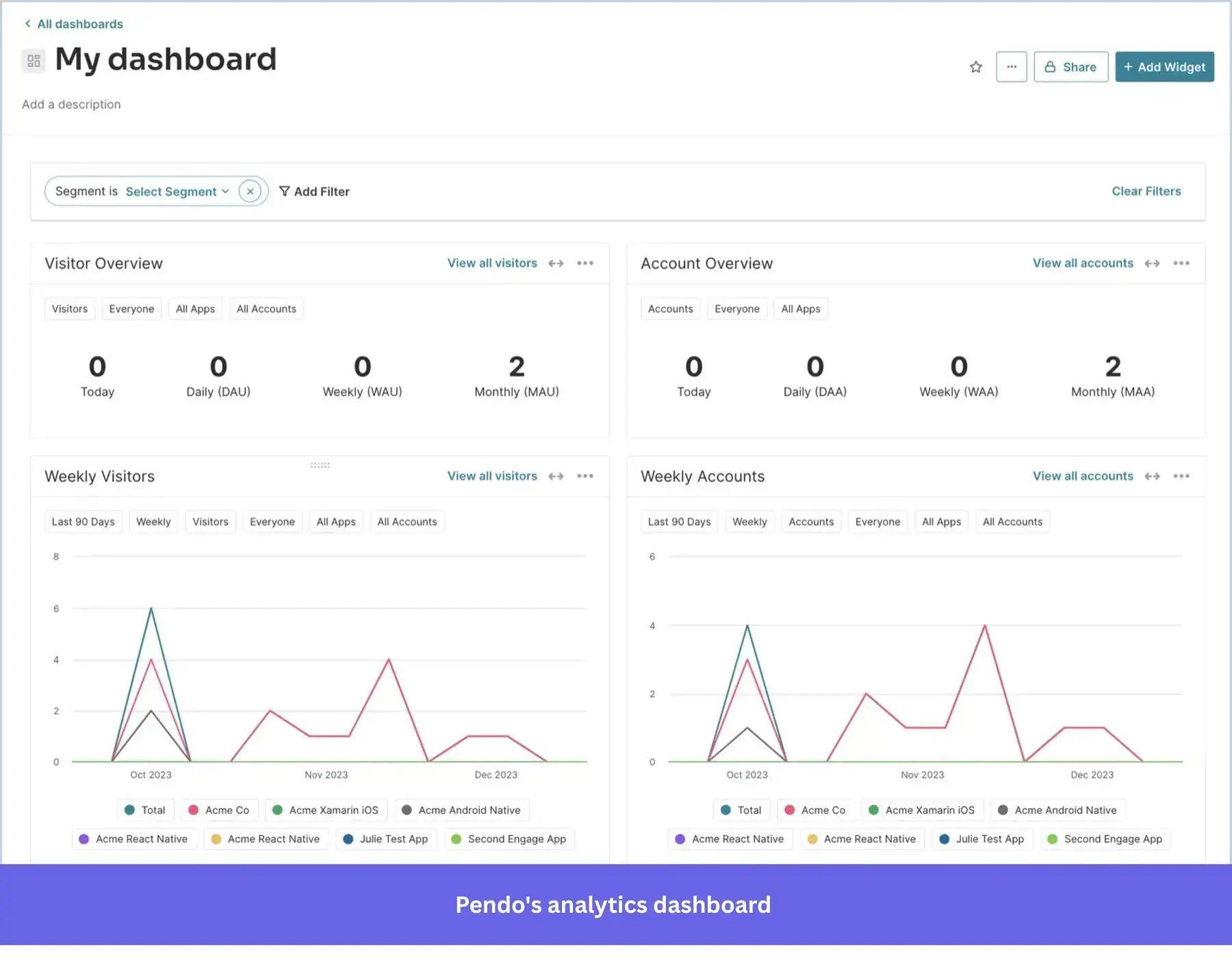
- Proprietary product engagement score (PES): Pendo’s product engagement score combines feature usage, adoption, stickiness, and retention into a single composite metric. Most competitors don’t have a direct equivalent, giving product managers a benchmark for overall product health without requiring a custom dashboard.
Pendo has also spent the past few years developing and refining products to help you use AI beyond just adding chatbots and clueless agents.
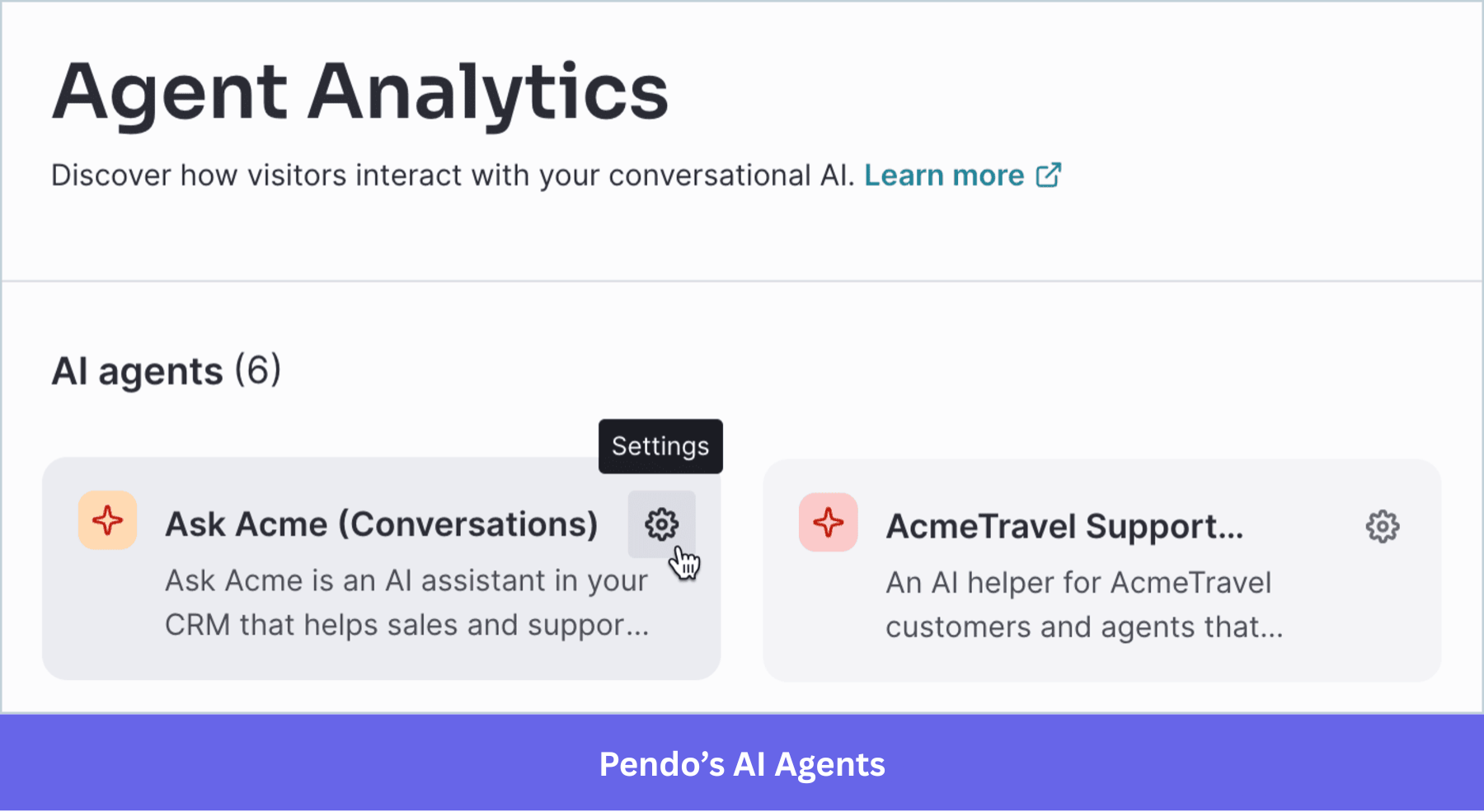
- Pendo for agents: Combines the agent toolkit (which connects your agents to your product in real time so they have enough context) with agent analytics. Pendo’s Agent Analytics tracks AI agent interactions in your product, including conversation logs, failure signals (rage prompts, unsupported requests, errors), and agent adoption trends. The goal is to help your users make the most out of your agents, reducing frustration and sloppy outputs.
- Leo + MCP integration: Leo is Pendo’s AI assistant, letting you query your product’s data (including agent analytics) to find insights and recommended actions. Additionally, Pendo also offers MCP access, allowing you to integrate Pendo data into AI tools (including Claude, ChatGPT, Cursor, and Gemini CLI) so you can query your data without navigating Pendo.
- Novus: This new release integrates directly with your codebase to scan your products, frameworks, and workflows, and can make deep changes in your app. This lets it perform tasks such as instrumenting events, feature tagging for rollouts, analyzing PRs, and even creating in-app guides based on analytics.
Where Pendo falls short
- Fragmented UI + A lack of actionable data view: You may find Pendo’s analytics workflow fragmented across modules (Data Explorer, Guides, Listen, Replays, and Dashboards), each operating somewhat independently. Exports available in one view often aren’t available in another. For example, you can export a visitor list from Funnels but not directly from Replays, even when you’re already looking at the relevant segment. That’s not to mention that sometimes the available metrics don’t offer insights that you can actually act on.
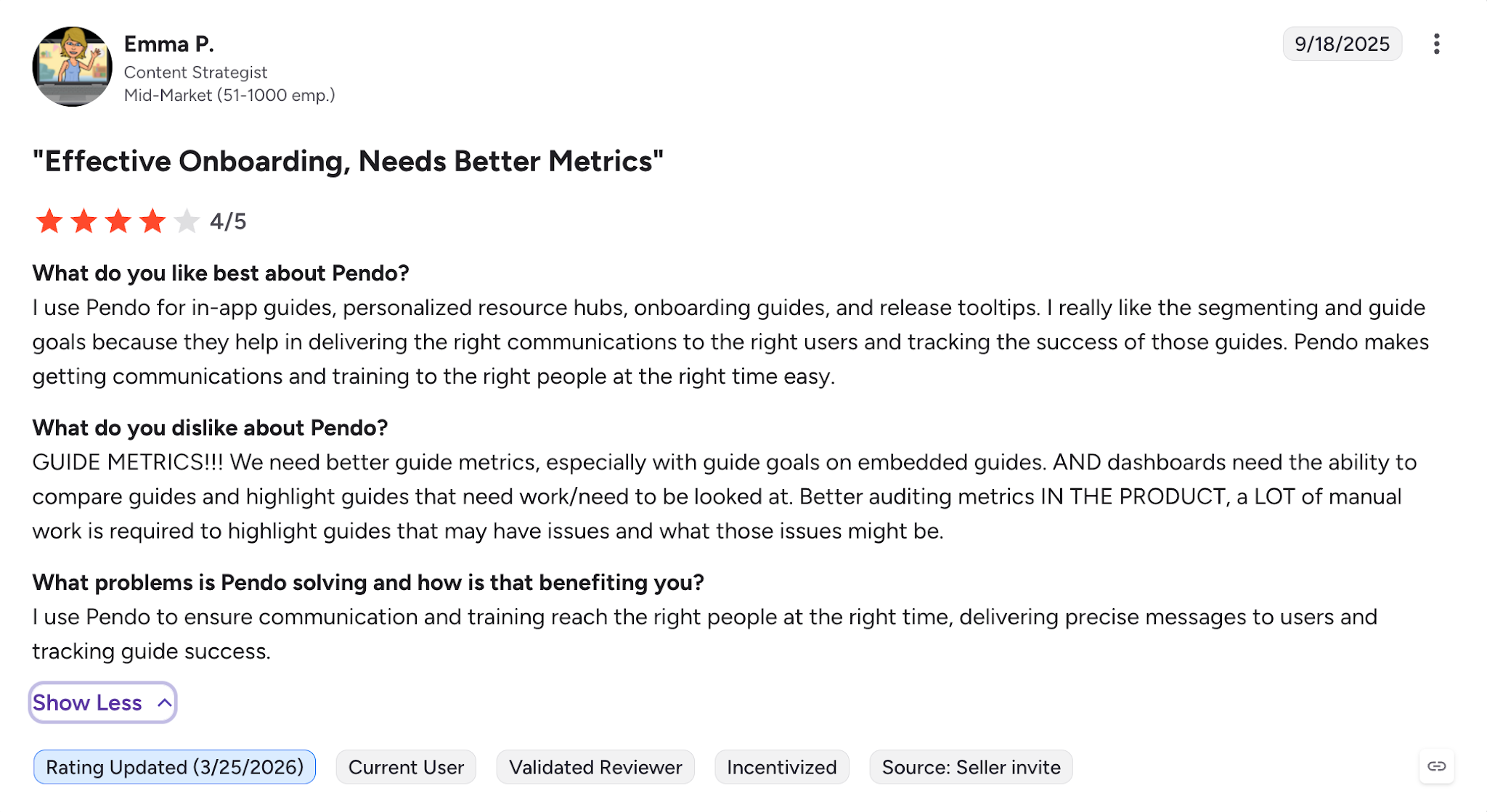
- Guide governance tax: The platform makes guide creation easy for everyone in the organization. That sounds good until every stakeholder treats tooltips as their primary problem-solving tool. Without strict governance processes in place before launch, the user experience degrades quickly, and managing guide quality becomes a full-time job.
- Custom, plan-dependent pricing: A closer look at Pendo pricing shows another serious downside. Vendr buyer data indicates typical annual spend ranges from $18,500 to $151,135 with the median being around $48,500. Several capabilities, including Session Replay, Product Discovery, Sentiment, Journey Orchestration, Predict, and Agent Analytics, are plan-dependent or available as add-ons.
- Data latency: Analytics data is updated hourly, with events typically visible in the UI within 15 minutes after each hour (for example, events from 2–3 PM appear by 3:15 PM). However, guide targeting runs on a separate fast-track: behavioral segments are used for the guide eligibility process in under 5 seconds. The latency that matters depends on what you’re doing (reporting or real-time triggering).
Although Pendo’s AI toolkit is very wide, it’s quite disjointed. For instance, Novus and Leo are completely disconnected; Leo is more of an AI assistant for PMs or UX researchers analyzing data, while Novus collaborates directly with developers during PRs and rollouts.
This means that if you’re a UX researcher using Leo to find potential sources of friction in your product, you’d still need to implement a fix yourself (via guides) or ask engineers to build a solution (since they’re the ones owning Novus). These tools can’t consolidate the entire loop in one department.
Also, Pendo Agent Analytics cannot automatically trigger experiences or journeys. It identifies friction signals, such as rage-prompting, and surfaces emergent use cases. And since Novus (the only part that can take action) will usually be owned by developers rather than PMs or designers, there’s a direct barrier in the insight-to-action loop (i.e., sending more requests to busy, almost-burnt-out engineers).
At Userpilot, for instance, instead of treating analytics, feedback, session replay, onboarding, and AI as separate workflows, we’ve been focused on shortening the distance between insight and action. If a PM discovers a friction point, uncovers a churn risk, or spots a drop in feature adoption, the next step shouldn’t be to submit a ticket to devs (like with Novus). The action layer should already be there.
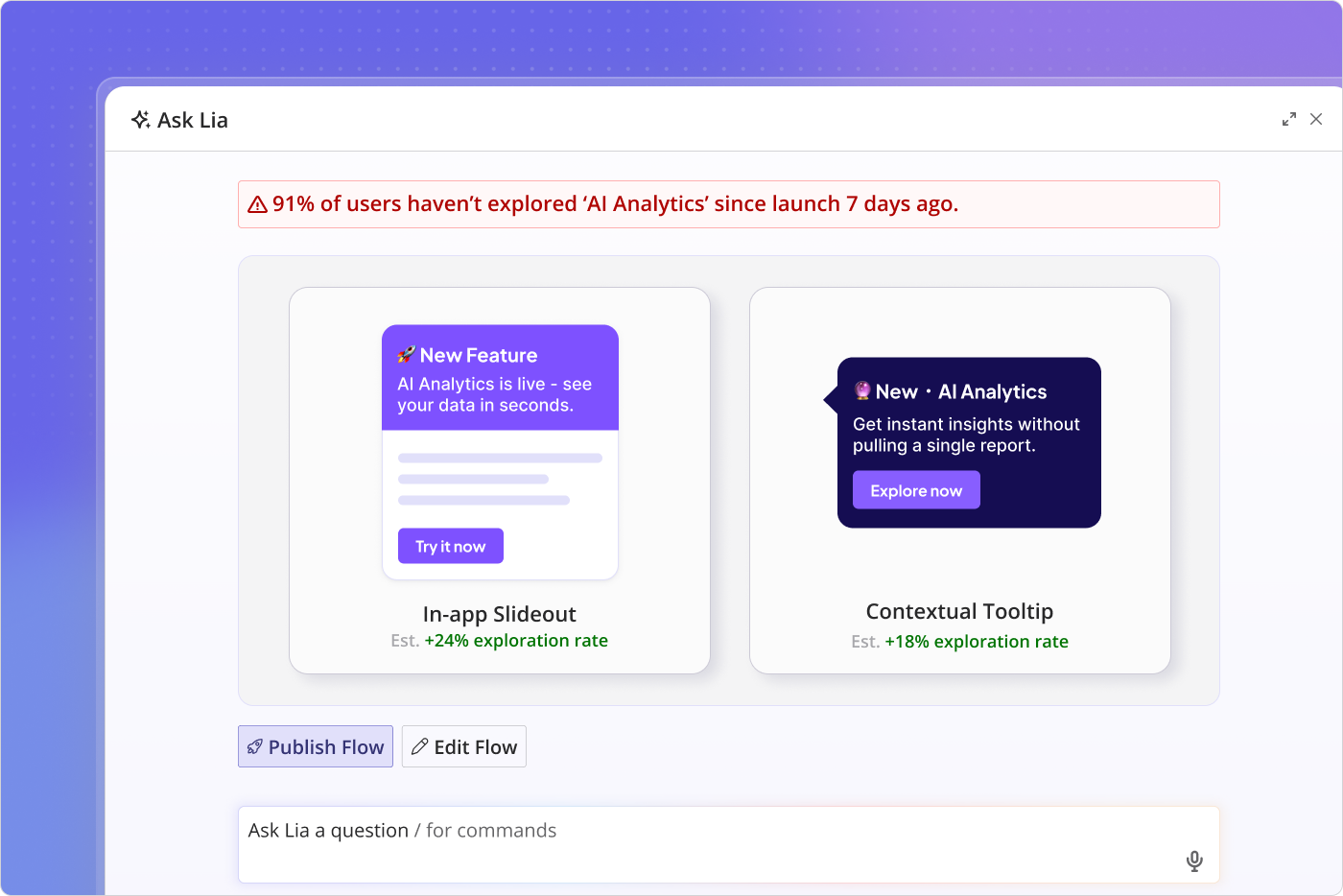
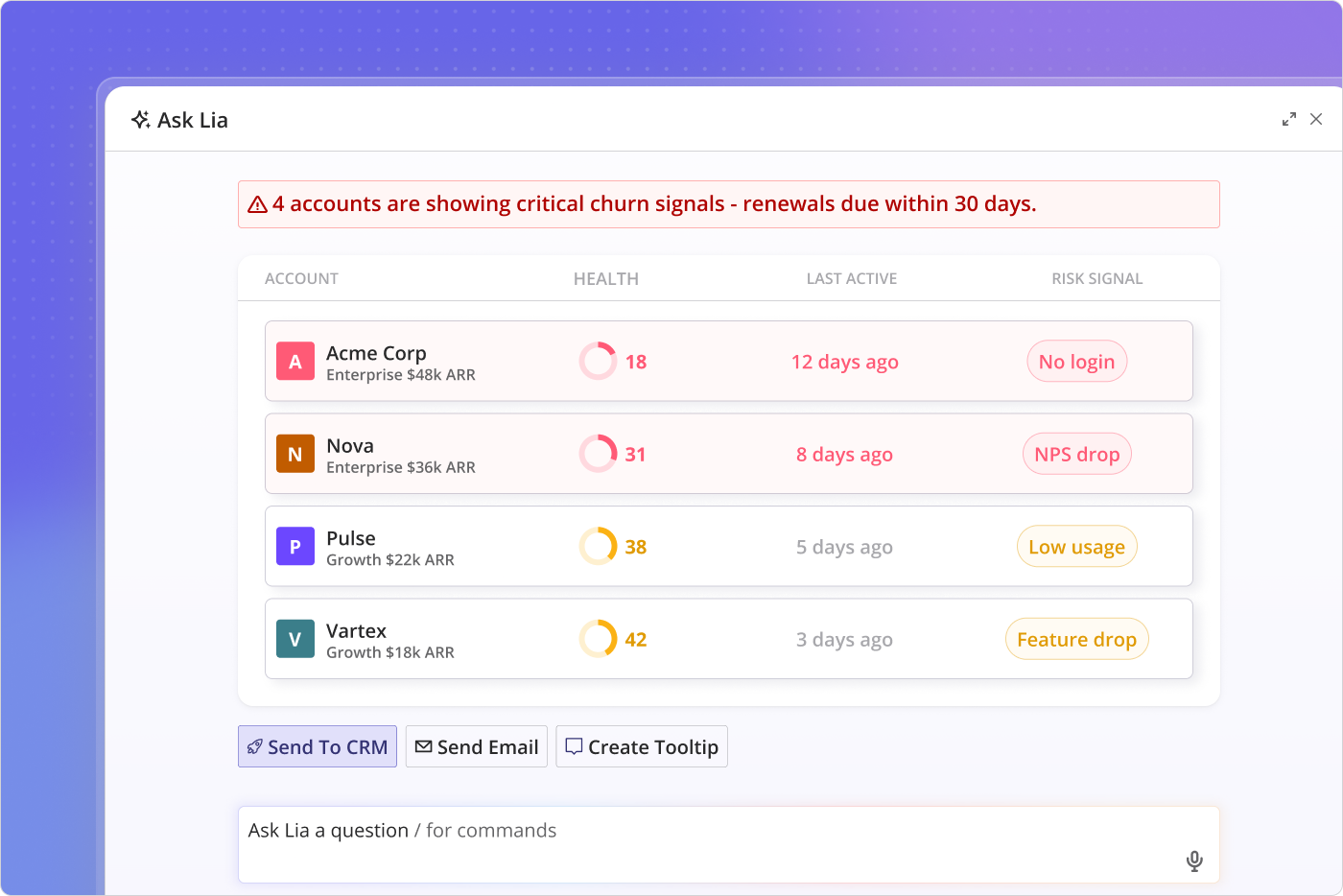
That’s the thinking behind Lia. It’s meant to allow non-technical teams address UX issues directly without overflowing engineers with requests. Instead of just surfacing insights like Leo, Lia is designed to identify risks, recommend next steps, and even build the in-app experiences needed to address them.
What you need to know about Amplitude
Fundamentally, Amplitude is a deep product analytics platform for B2B SaaS enterprises with dedicated data analysts to gain insights into product engagement.
However, Amplitude has been expanding in recent years. Besides releasing a host of AI features for agentic analytics and enabling “self-improving” products (in other words, outsourcing the entire PLG loop to AI and hitting enter on everything), the company is now looking to unify engineering and marketing teams too. The platform can now optimize landing page conversion rates, run A/B tests, and enable feature flagging for rollouts, etc.
What does Amplitude do well?
Amplitude excels as an advanced behavioral analytics platform, especially for teams that need to understand user behavior through cohort analysis, funnel tracking, experimentation, and warehouse-connected workflows. It’s built for organizations where a data analyst owns the analytics layer and needs a platform with enough depth to get a complete picture.
Here’s what Amplitude does well:
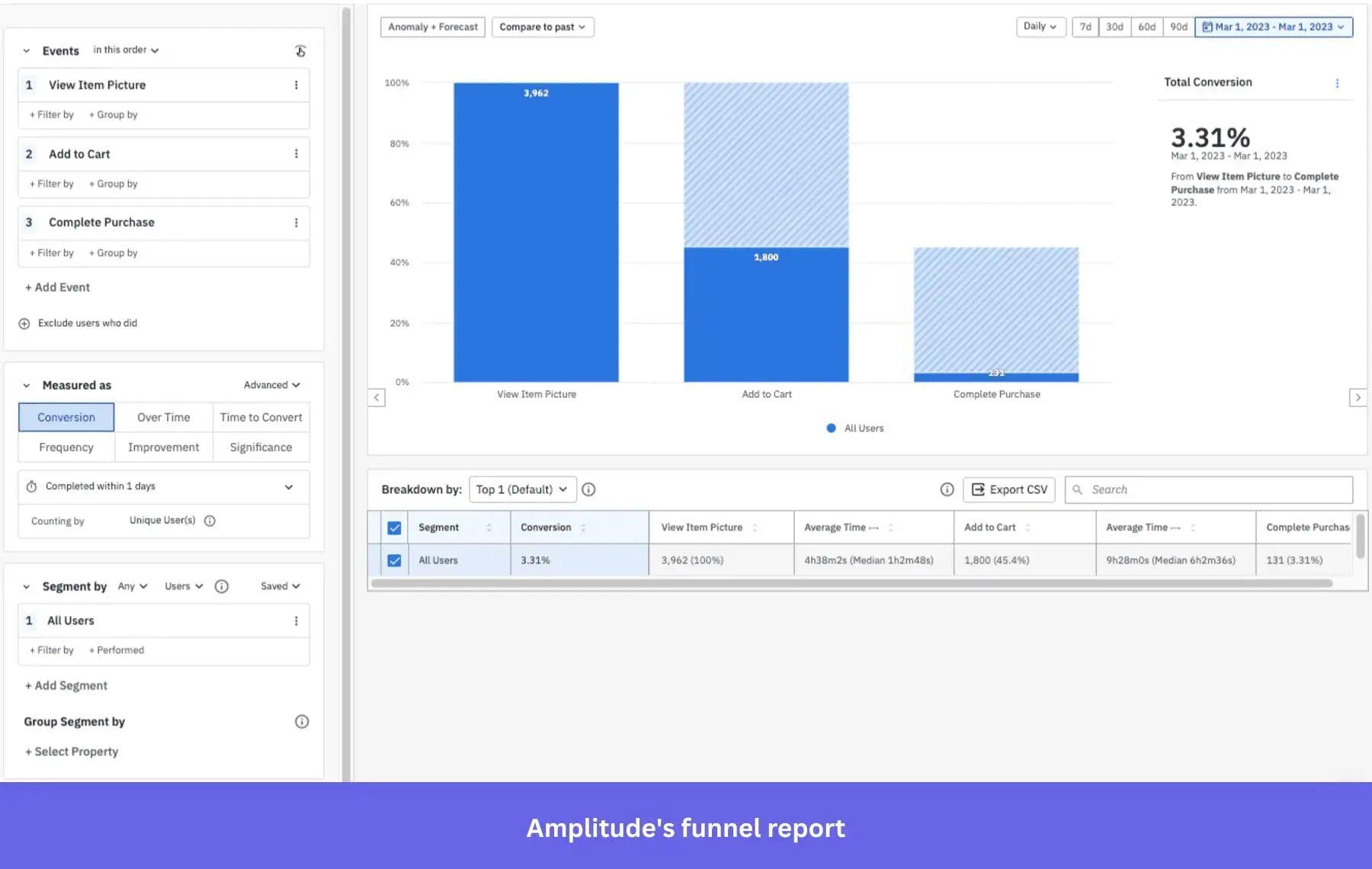
- Cohort analysis, retention curves, funnel analysis, and Pathfinder: Pathfinder (Amplitude’s journey visualization, now part of the Journeys experience) maps the incoming and outgoing paths of user events, surfacing common event paths that lead to conversion or drop-off across user journeys. Amplitude funnel analysis and cohort analysis sit at the core of its analytics toolkit, alongside retention curves, Experiment, and data warehouse workflows.
- Built-in A/B testing: Amplitude Experiment gives product managers the tools to make data-driven decisions: feature flags, statistical significance calculations, and experiment management, all without a separate tool.
- Warehouse-native integrations: Native connectors to Snowflake, BigQuery, and Redshift let teams integrate data from marketing automation systems, CRM platforms, and other tools directly alongside Amplitude’s behavioral event data, without manual export pipelines.
- Agentic AI analytics: Amplitude’s agentic suite includes a Global Agent and four specialized agents that continuously analyze product usage and recommend actions in real time. MCP integrations route behavioral intelligence into Claude, ChatGPT, Cursor, Figma, Notion, and GitHub.
- Amplitude Wave: Similar to Pendo’s Novus, this new product integrates with your codebase and data to make product suggestions, orchestrate PRs, perform experiments, and more. Amplitude describes it as a tool that enables “self-improving” products because, in addition to shipping features with vibe-coding tools, you can now let Wave analyze all your data and decide what to ship (closing the whole loop without human bottlenecks).
Where Amplitude might disappoint you:
- Guides and Surveys are commercial add-ons: Amplitude delivers a surprisingly capable set of in-app guides and surveys, complete with behavioral targeting and conditional logic. The catch is that they’re sold as a separate add-on. Teams looking for a broader onboarding and product adoption platform may still prefer Pendo’s more mature ecosystem around Resource Centers and cross-channel journeys.
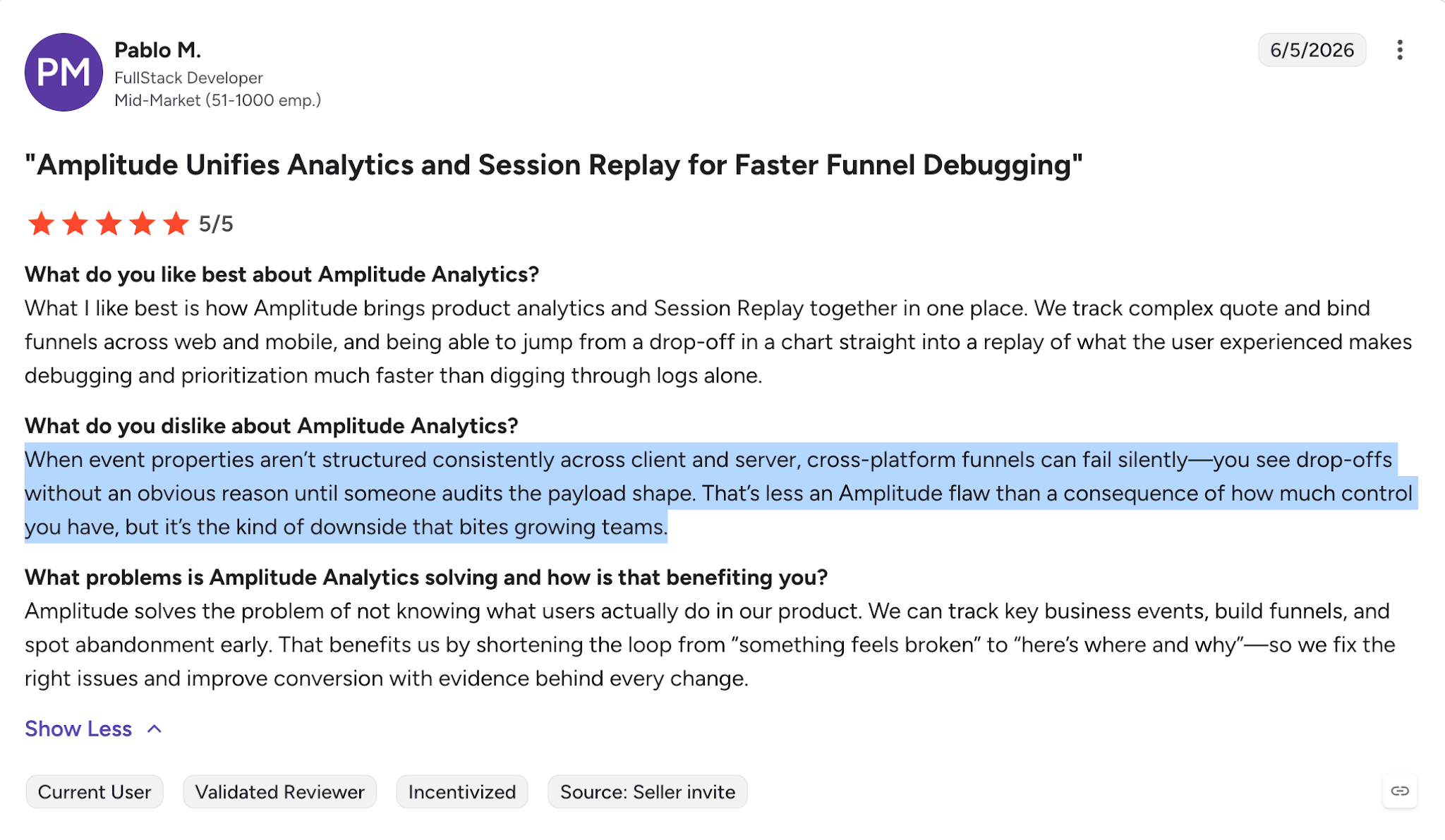
- Higher learning curve for non-technical teams: Amplitude is powerful, but that depth can make setup, taxonomy decisions, and day-to-day analysis harder without analytics or technical support. Unlike Pendo’s automatic data capture, Amplitude’s event tracking requires upfront planning to reliably track user behavior. G2 reviewers flag a steep learning curve and complex features as recurring themes, and some describe the UI as overwhelming for non-technical users working with complex reports.
- Agentic integrations surface insights in developer tools: Amplitude’s agentic suite routes behavioral intelligence into Cursor, Figma, Notion, and GitHub, making it well-suited for engineering-led teams. Building more advanced onboarding flows, lifecycle campaigns, or governed in-product experiences may still require a dedicated digital adoption platform.
Looking for an alternative to Pendo or Amplitude?
Amplitude makes the most sense when analytics depth is the main priority. Both Pendo and Amplitude can support in-product actions, but the trade-offs are cost, setup, maturity, and how directly analytics data flows into the experience builder.
If you’re a mid-market company looking for an alternative that requires less overhead and offers simpler pricing, a no-code platform like Userpilot might be a good fit. The Liv-ex team, for instance, struggled with complex data platforms and lack of PMM-friendly tools for onboarding and surveys. They used Userpilot to iterate UX redesigns based on data, collect targeted feedback (with 70% response rates), and reduce their dependency on engineers.
“If you want to understand your customers’ workflows, identify opportunities for improvements in UX, and find ways to advance your products through the use of data, go for Userpilot. And if you want to serve customer enablement materials in dynamic ways and get actionable feedback to best answer to your customers’ wants and needs? Userpilot will help you there, too.” — Fred Haselton, PM at Liv-ex
I’ve always had an issue with the lag between knowing something needed to change and changing it. Every campaign started the same way: I needed a specific user segment, asked an engineer to pull it, got back a static export a few days later, and had to push it manually across separate tools for in-app messaging, email, and session replay. By the time the campaign went live, the behavioral signal I was responding to was already stale.
That’s why I like our approach at Userpilot, where we build our AI layer to be useful, not just for the sake of having yet another AI tool.
Similar to Novus or Wave, our autonomous growth agent Lia is designed to aid you throughout the entire loop, including monitoring product signals, identifying what’s driving changes in adoption, recommending what to do next, implementing fixes (via flows, guides, and in-app surveys), and reporting on product performance. The difference is that Lia is meant to be used by non-technical PMs, designers, and UX researchers as well, with no need to submit additional requests to the devs.
The goal is to reduce the number of steps between discovering a problem and responding to it.
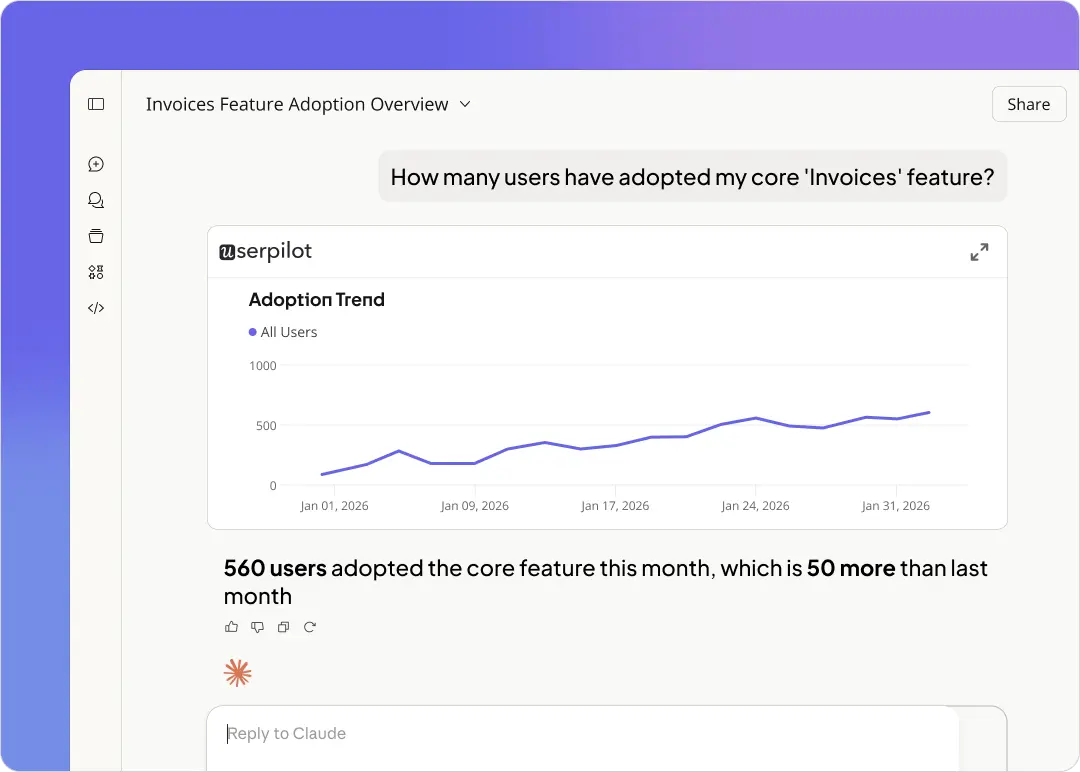
Additionally, we just released MCP integration, which makes product data available directly inside tools like Claude, ChatGPT, Cursor, and Copilot. Instead of asking a PM to pull a report, teams can query adoption trends, NPS feedback, onboarding performance metrics, session replay insights, or user behavior from the AI tools they’re already using.
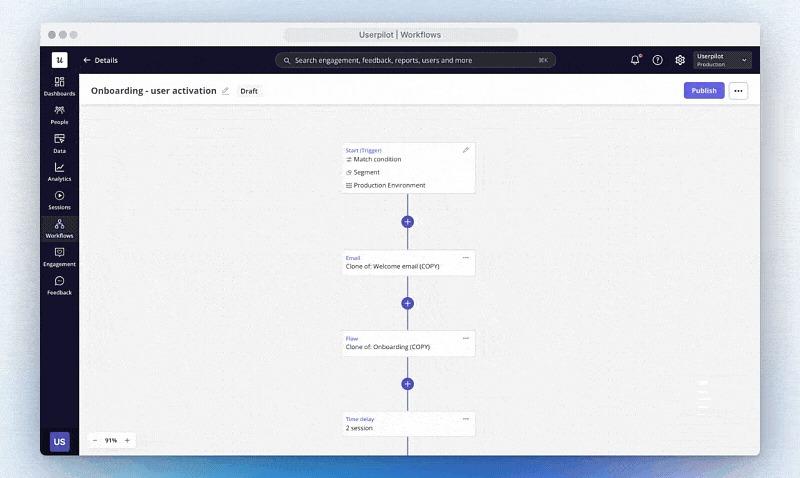
All of this sits on top of the same platform. The analytics, surveys, session replay, onboarding flows, workflows, resource center, email campaigns, and AI capabilities aren’t separate products stitched together through integrations. When Lia identifies an opportunity, it already has access to the behavioral data, segmentation, and user engagement tools needed to act on it.
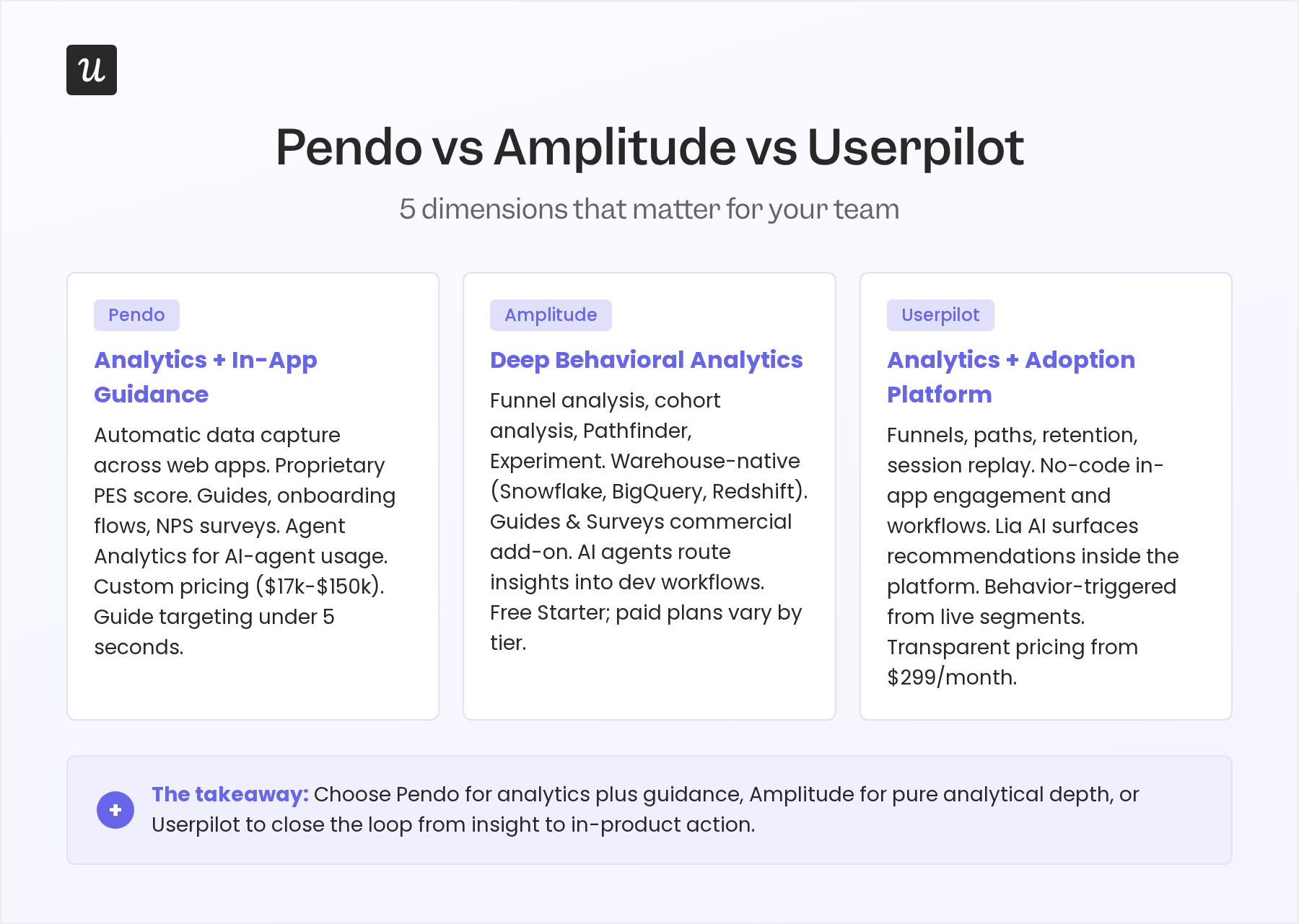
Userpilot pricing starts at $299/month with transparent tiers (and yes, before you accuse me of being biased: I work at Userpilot. But when customers keep telling us they got up and running faster while paying roughly two-thirds of their previous Pendo bill, it’s hard not to mention it).
On the other hand, Pendo’s pricing starts at $18k/year for very basic features and scales up to $150k/year when you use the full platform. Amplitude, although offering a freemium plan, will scale quickly due to its event-based pricing and multiple add-ons. The nearly $65,000 median cost gives you an idea of what to expect.
So if you want to see how it fits your product, book a demo and see how Userpilot works in practice!
Disclaimer: Userpilot strives to provide accurate information to help businesses determine the best solution for their particular needs. Due to the dynamic nature of the industry, the features offered by Userpilot and others often change over time. The statements made in this article are accurate to the best of Userpilot’s knowledge as of its publication/most recent update on September 22, 2026.
FAQ
What is the difference between Amplitude and Pendo?
Amplitude and Pendo serve different primary use cases: Amplitude is a deep analytics platform built for data and engineering teams (though expanding for marketing too), while Pendo combines analytics with in-app engagement tools (guides, onboarding flows, and tooltips) in a single platform.
Amplitude vs Pendo: Which is better for small teams?
Amplitude is the only one that’s more accessible for smaller teams because it offers a free Starter plan with a high usage limit of 2M events per month.
Pendo, however, has a very limited free plan (up to 500 MAUs) and its custom prices are mostly meant for enterprises.
Does Pendo or Amplitude have better agent analytics?
Pendo is better at answering, “How are AI agents performing inside our product?” Amplitude is better at answering, “How can AI help our team analyze product behavior and decide what to build, test, or fix next?” It comes down to whether the AI layer is being used to measure or being measured.
What are Pendo's main competitors?
Pendo’s competitors are split by category. On analytics plus in-app engagement, Userpilot and Appcues are the most direct alternatives at a lower price point; WalkMe and Whatfix compete at the enterprise end. For teams that need an analytics-only tool without built-in engagement features, Amplitude, Mixpanel, and Heap are the primary options. Teams evaluating Pendo Listen for feedback and roadmapping should also look at Productboard and Aha!
About the author