Product Marketing Strategy in 2026: The Steps Haven’t Changed, Execution Has


Product marketing strategy still operates on the same four questions it always has: who it’s for, why they choose it, what it costs, and how it launches. For a growing number of B2B teams, an AI agent drafts the audience brief before anyone books the kickoff call, working off behavioral data pulled straight from the product instead of waiting for survey responses. 67% of B2B companies now use some form of AI agent in their GTM workflow, up from 23% in 2024. The percentage of companies using AI for GTM has grown from 1/4 to 2/3 in the past two years alone.
Product marketing used to hand off from research to positioning to launch, call it a job well done, and wait for the next release cycle. The lifecycle model has replaced that handoff with the same team now staying wired into the product from the first session until the renewal date. To help you navigate the shifting PMM landscape, I’ve written this guide to walk you through both the execution and strategy sides of product marketing in 2026.

How to execute an effective product marketing strategy in 2026
While the tasks and tools have been changing at a rapid pace, the steps for building your product marketing strategy still follow the same sequence that has stood the test of time. The sections below will walk you through the seven stages of executing your product marketing strategy.

Define your target audience with behavior data, not a persona template
The target audience question hasn’t changed, but what counts as evidence has. A persona deck built from three demographic sliders and a collection of stock photos tells you nothing about why someone chose your product over the six other tabs they had open. An ICP defines the company profile you win most often based on size, industry, tech stack, and budget. On the other hand, a user persona defines the person inside that company who feels the pain points and pushes for the purchase.
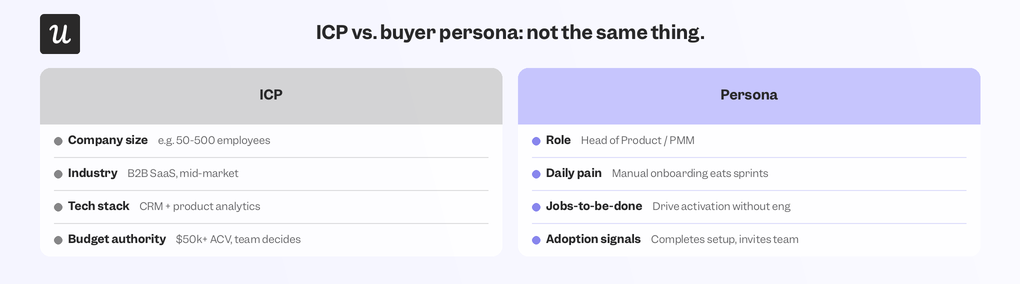
Conflating the two is how teams end up writing messaging for a buyer who never touches the product while ignoring the user who actually advocates for its renewal. AI has changed the mechanics of building ICPs and personas. Instead of waiting on a research sprint, teams can now run support tickets, sales transcripts, and product analytics through agentic models that surface patterns within minutes instead of quarters.
Deciding which patterns matter still depends on the human interpreting the results, but at least the data no longer takes weeks to manually assemble. The research documents that hold up today replace broad demographics with roles, responsibilities, and behavioral signals that actually predict renewal rates. A persona that lists age or marital status is far less actionable than one that lists login volume, activation points, and feature adoption.
Conduct market research as a habit, not a quarterly event
Market research used to consist of a slide deck built long ago and only revisited whenever competitors did something deemed noteworthy. That cadence doesn’t survive in a modern environment where competitors ship weekly updates and buyers form opinions from reading comments on a Reddit thread before your sales team gets anywhere close to them. The research itself is unchanged since you still need to know what customers think of competing products, where those products fall short, and how rivals talk about themselves. The new tempo has simply picked up the pace.
Vijai Shankar, Senior Director of AI Product Marketing at RingCentral, described why this shift towards continuous research matters:
“When market assessment became a continuous strategic input rather than a one-time exercise, it shaped not just how we went to market but what we built and for whom.”
Market research stopped being an input to messaging alone and started shaping the roadmap itself. A team that only revisits its competitors once a quarter is making four decisions a year off stale data while the competition is making data-driven decisions based on real-time insights.
Build positioning and messaging that survive an actual sales call
Positioning is the market context that makes your product the obvious choice, while messaging is how that context turns into the specific words a sales representative uses on a call (and the words customers could repeat to their colleagues afterward). The gap between the two is where most positioning documents go wrong. A positioning statement can be internally consistent yet still useless if the sales team improvises different language on every call because nobody translated the document into the exact words they need to respond with when prospects push back.

You can’t close that gap by using a better slide template. Sales enablement content has to get rewritten every time a representative reports that a specific line fell flat to create a feedback loop that allows you to continuously improve the sales script. A positioning statement that never gets revised after the first ten sales calls was never field-tested, which will limit its effectiveness at convincing prospects to take the next step.
Set a pricing strategy that signals value before anyone signs up
Pricing frames how a prospect perceives your product before they’ve even used a single feature. A high price implies confidence in the promised outcome. Conversely, a price that undercuts every competitor implies something else, regardless of whether being the “cheap option” is what you intended. The mechanics of the four pricing models for SaaS (flat, tiered, usage-based, and freemium) haven’t changed but the framing certainly has. Pricing strategy is often treated as a finance decision inside most companies when it’s actually a positioning decision with marketing implications.
The clearest fix is to pressure-test pricing against the same customer research you used for positioning, instead of relying on a theoretical spreadsheet built by the finance department. A pricing page that contradicts the value story a representative just told on a call undermines that work. Whether prospects are learning about the product on a sales call or looking at your pricing page, the value proposition needs to remain consistent across all customer journey touchpoints.
Plan a go-to-market approach built on trust, not volume
Channel selection works best when you start with a platform that your audience already trusts instead of blindly following competitors wherever they’re loudest. A channel with less reach but higher trust will convert more reliably than a crowded one where every vendor is shouting the same claims. Sales enablement in the context of a go-to-market strategy means arming your representatives with battlecards, demo scripts, and objection responses that match the positioning work from the previous steps.
The bigger shift is a gradual move away from sporadic grand announcements. Feature launches are increasingly happening in frequent drops at smaller scales that keep messaging fresh without exhausting an audience that has been conditioned to tune out those loud quarterly announcements. This is also more compatible with the increase in feature velocity that most SaaS companies have experienced since adopting AI-assisted product development workflows.
Execute a product launch that proves itself instead of announcing itself
Execution requires cross-functional coordination with internal playbooks, pre-launch alignment between departments, and a shared definition of what a successful launch actually looks like.
Lisa Sharapata, VP of Revenue Growth at Blackboard, has noticed a distinct shift in where product marketing comes from.
“The best product marketing we’re seeing right now isn’t technically coming from product marketing teams. It’s coming from customers. From communities. From people who figured something out and can’t stop talking about it. We’ve moved from explaining products to proving them.”
Lisa Sharapata, 3x CMO and AI GTM strategist
Community-driven proof, real-use content, and customers who carry the message further than marketing teams ever could now matter more than the production value of your announcement videos. A product launch checklist built with that new reality in mind spends less time on the press release and more time on making the product easy for users to advocate for. Referral and affiliate programs further incentivize the product advocacy that users may already be on the fence of doing on their own.
Measure your product marketing strategy with numbers that survive an audit
The metrics that matter are product adoption rate, time to value, monthly feature adoption rates for the first quarter, win/loss ratios, and PQL conversion rates. Page views and social reach may look good in a deck, but these vanity metrics are poor measures of whether the product actually landed. Most teams drop the ball within the first ten weeks after launch, when expectations either match reality or disappoint users. If you wait until the next quarterly review to circle back, the fix will cost far more than it would have if you caught within the first week or two.
Abrar Abutouq, a product manager here at Userpilot, ran into that exact challenge when the company’s email feature launched and adoption data showed a sharp drop-off at domain verification.
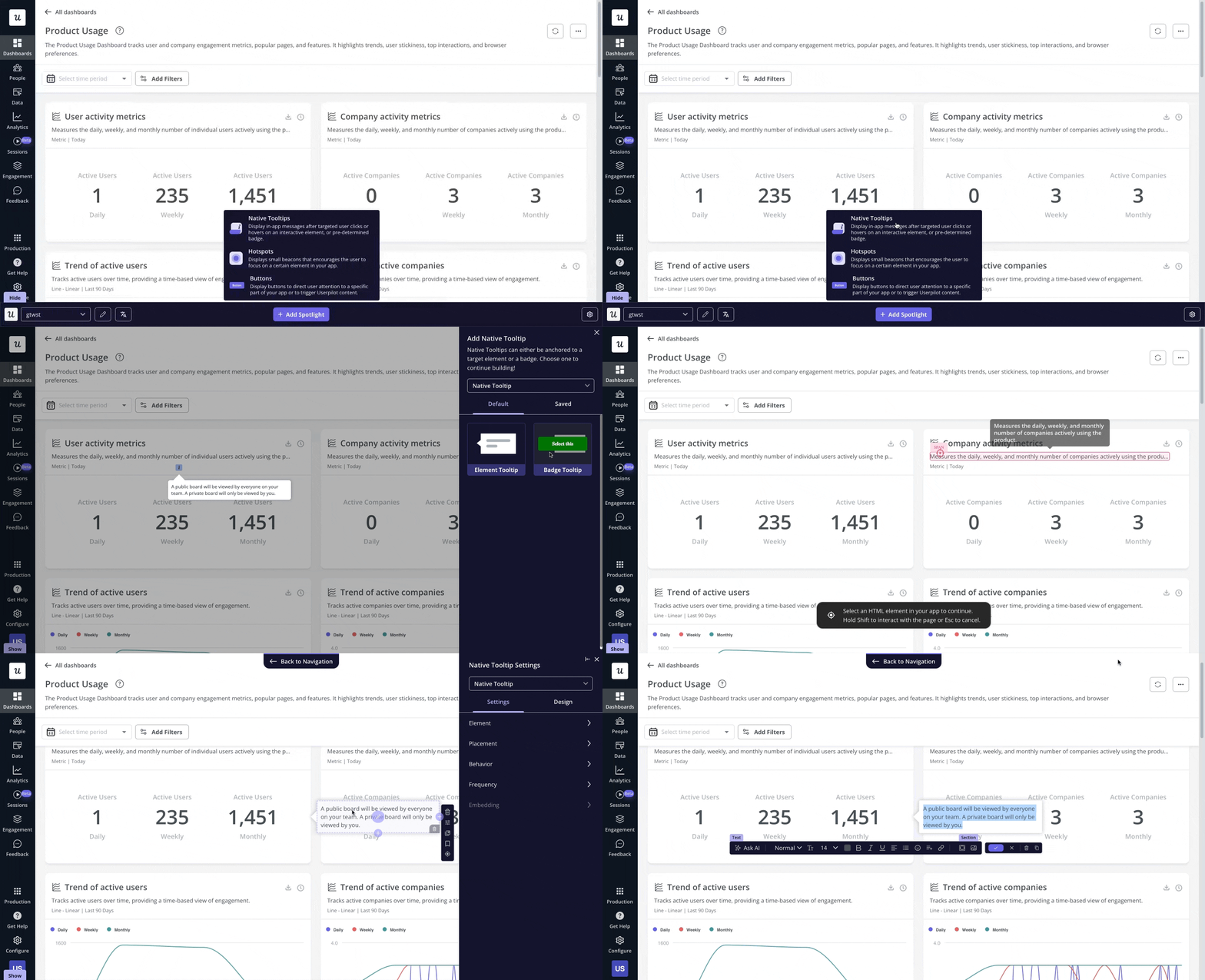
“Within a few hours, I just created a targeting tooltip and showed it to users and highlighted the correct steps for them to make it clear what to do next. That helped a lot on reducing friction and supporting users in real time without involving our dev team.”
— Abrar Abutouq, Product Manager, Userpilot
That fix took hours instead of months because someone was actively watching the metric in the first week instead of checking up on it an entire quarter later.
What’s changed about product marketing: From launches to lifecycles
Three shifts explain most of what’s changed as product marketing shifts from launches to lifecycles.
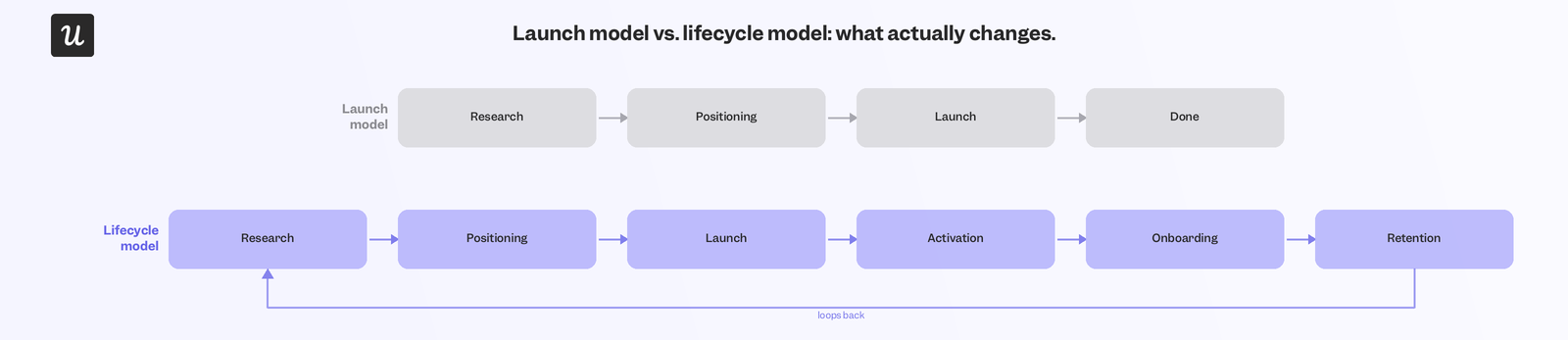
The first shift is that AI enables continuous research instead of periodic analyses. PMMs now work off real-time signals from the product rather than quarterly reports. The second shift happened when the lifecycle model replaced the launch model. Product marketing now owns (or at least co-owns) activation, onboarding, and retention rather than focusing exclusively on acquisition. This means the job doesn’t end when the campaign does.
Yazan Sehwail, our CEO at Userpilot, frames the underlying change as a shift in operator roles.
“You’re no longer operating. The AI is operating. You’re just basically evaluating and monitoring the agent workflow.”
The third shift is social proof replacing traditional brand marketing as a key driver of product adoption. Customers and creators carry more credibility than a product marketing team’s words on owned channels. None of these three shifts required reinventing the wheel or changing the steps; they just redefined what effective execution looks like. If you can apply the same principles in new ways, you’ll be better equipped to surf the wave of changes instead of drowning under the current.
How Userpilot connects product usage to product marketing strategy
All the strategies above are dependent on knowing what users actually do inside the product, not just what the messaging claims they can do. Userpilot’s user behavioral analytics groups users by what they do inside the product rather than by title alone, which is the same distinction the audience section above was built on.
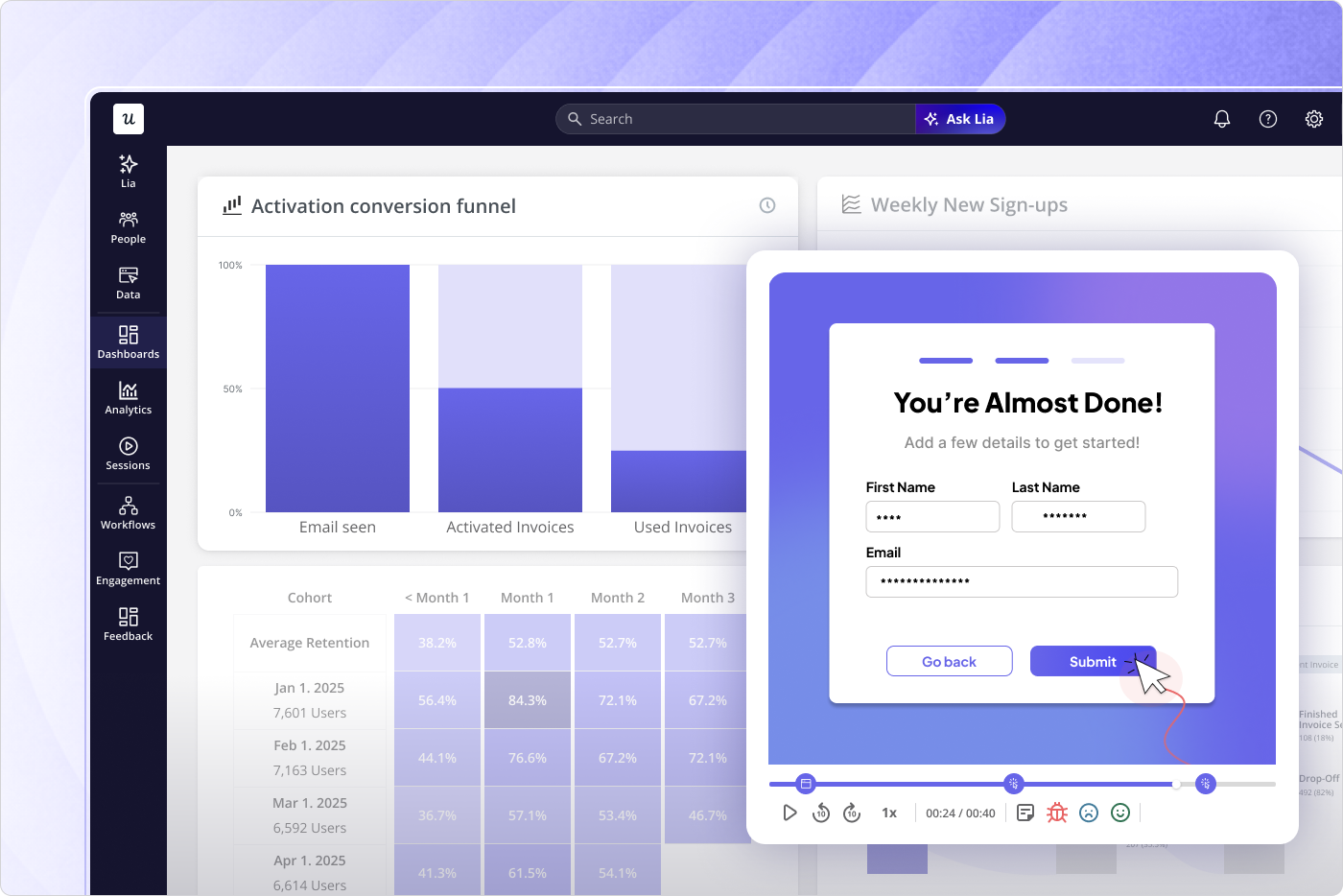
User onboarding flows tied to that segmentation become the direct adoption engine, instead of a generic product tour that every user sees regardless of their role or tasks.
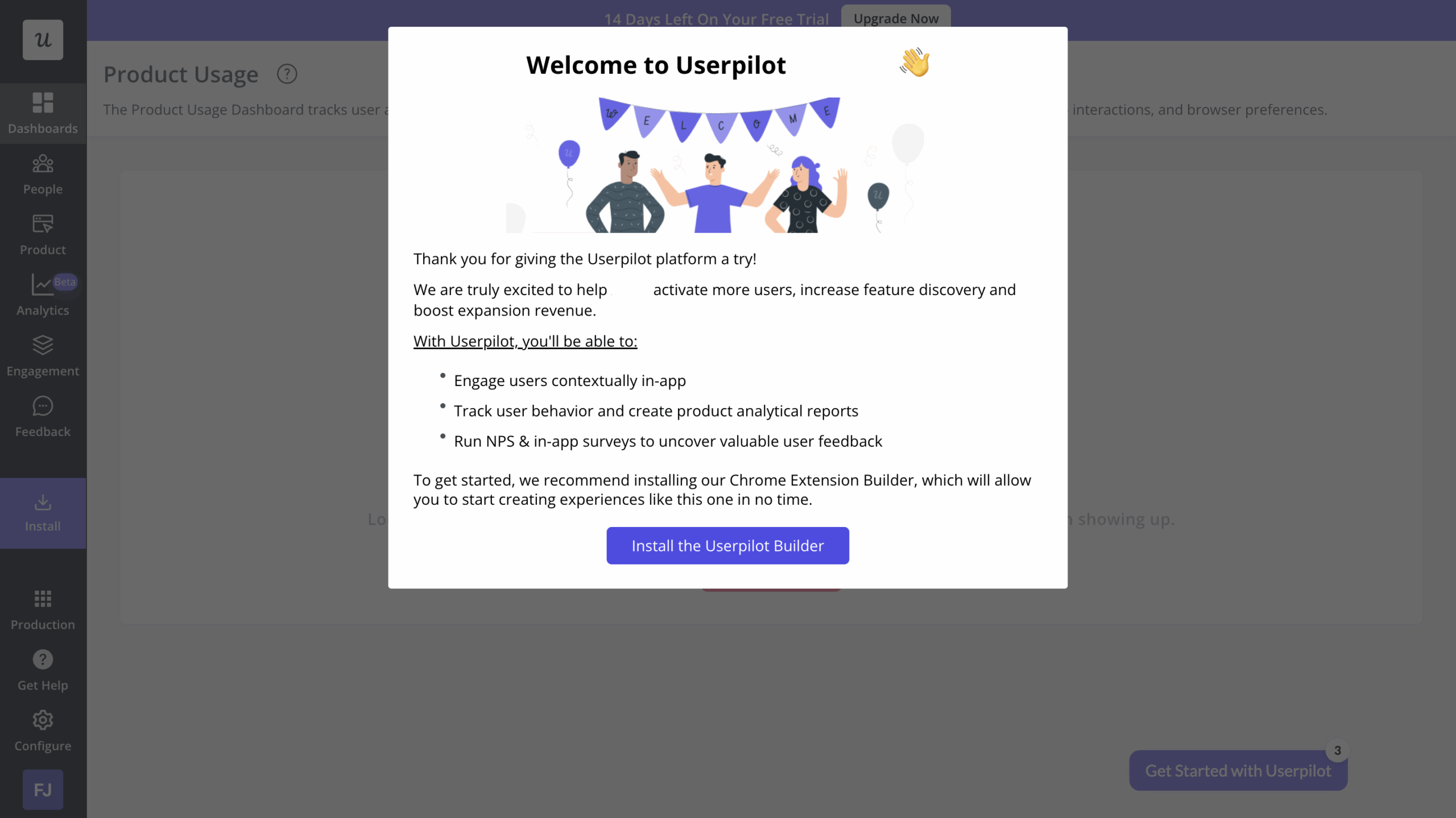
In-app tooltips are how the positioning work from earlier reaches users at the exact moment it’s most relevant. In-app messaging that meets users where they are converts far better than an intrusive banner competing with everything else on the interface.
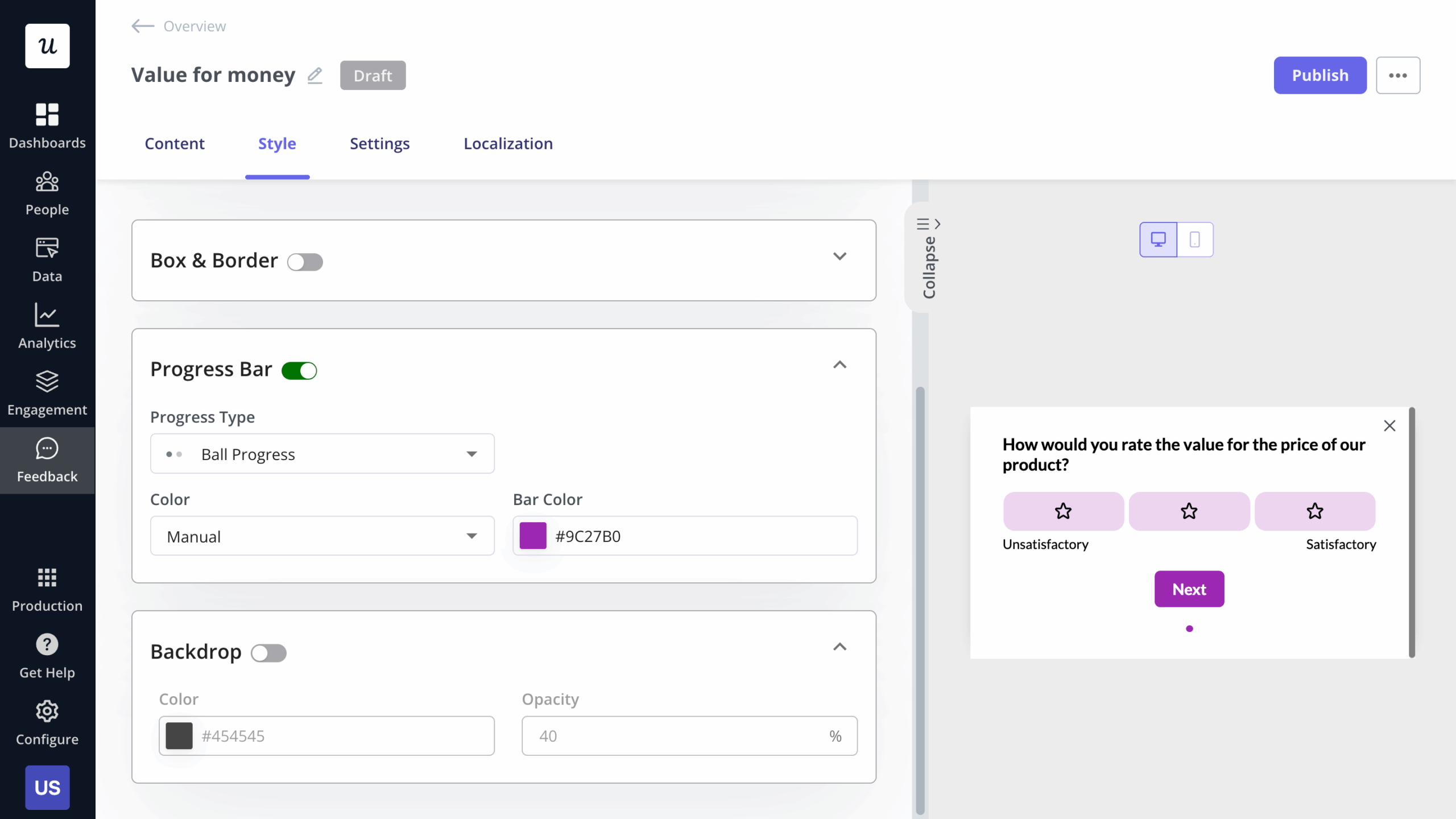
In-app surveys close the loop that your research opens by explaining why behavioral patterns are happening, instead of just whether they exist or not. Customer feedback collected at the moment of use feeds fresh data straight back into positioning decisions.
Turn product marketing strategy into a system, not a plan
The steps haven’t changed, but the expectation has moved from quarterly reviews to continuous execution. Product marketing strategy runs as an undying engine of signals feeding positioning, user behavior informing messaging, and customers advocating for the product on channels your team can’t reach. Userpilot sits at the center by tracking product usage data, segmenting users by actual behavior, and delivering the onboarding flows that help users achieve their goals while giving your team visibility into every success story or to predict churn risk.
Book a demo to see what that product marketing loop can look like within your own product!
About the author