PostHog vs Pendo: My Practical Take on Features, Pricing, and Fit


A PostHog vs Pendo comparison reveals two different approaches to product improvement.
PostHog combines behavioral analytics with developer-focused tools for debugging and experimentation. Pendo pairs user insights with no-code in-app guidance, testing, and feedback to identify and address adoption gaps.
Beyond features, consider implementation effort, access to advanced capabilities, and how pricing changes as your product grows. These factors can greatly affect each platform’s value.
In this comparison, I’ll break down these trade-offs to help you choose the right tool for your team, including when a third option might offer a better fit.
Executive summary
- Analytics alone won’t settle the decision: Both PostHog and Pendo offer funnels, paths, and retention analysis, so look at how each supports your team’s broader workflow.
- Consider how you’ll act on insights: PostHog supports experiments with feature flags to measure the impact of product changes. Pendo lets you A/B test in-app guides to see which versions drive the desired actions.
- Factor in the cost of the features you need: Compare PostHog’s usage-based charges with Pendo’s pricing, which depends on monthly active users (MAUs) and your plan. Some capabilities are paid add-ons, so check what’s included before comparing total costs.
- Userpilot is another option for improving feature adoption: It combines analytics with code-free in-app experiences. You can also send PostHog events to Userpilot via API to personalize those experiences.
PostHog vs Pendo at a glance
| Factors | PostHog | Pendo |
|---|---|---|
| In-app engagement vs experimentation | Feature flags and experiments; no native product tours | In-app guides such as tooltips and walkthroughs; guide A/B testing |
| Product analytics | Funnels, paths, retention, and custom event analysis using SQL | Funnels, paths, retention, and feature adoption reports |
| Qualitative insights | Session replay and in-app surveys for investigating behavior | Session replay, NPS surveys, and feedback management through Listen |
| AI capabilities | PostHog AI; AI-assisted analysis, dashboards, SQL queries, and session summaries | Leo, Novus, feedback analysis, guide creation, and MCP access |
| Security and governance | EU Cloud, privacy controls, and paid governance features | SOC 2 Type II, access controls, SSO, and regional hosting |
| Total cost of ownership | Usage-based billing across events, recordings, feature flags, and other products | MAU-based subscription with plan-dependent features and add-ons |
6 Factors to consider when choosing between PostHog and Pendo
Compare both platforms across six factors that affect workflows, implementation, and total cost.
1. In-app engagement vs experimentation to drive adoption
Do you need to experiment with product changes, guide users through existing features, or both?
PostHog focuses on testing improvements to show whether they help users achieve their goals. For example, if you’re building a new feature, you can use feature flags to target specific user groups. Then run an A/B test to compare the new experience with the original and see which version gets more users to complete an action.
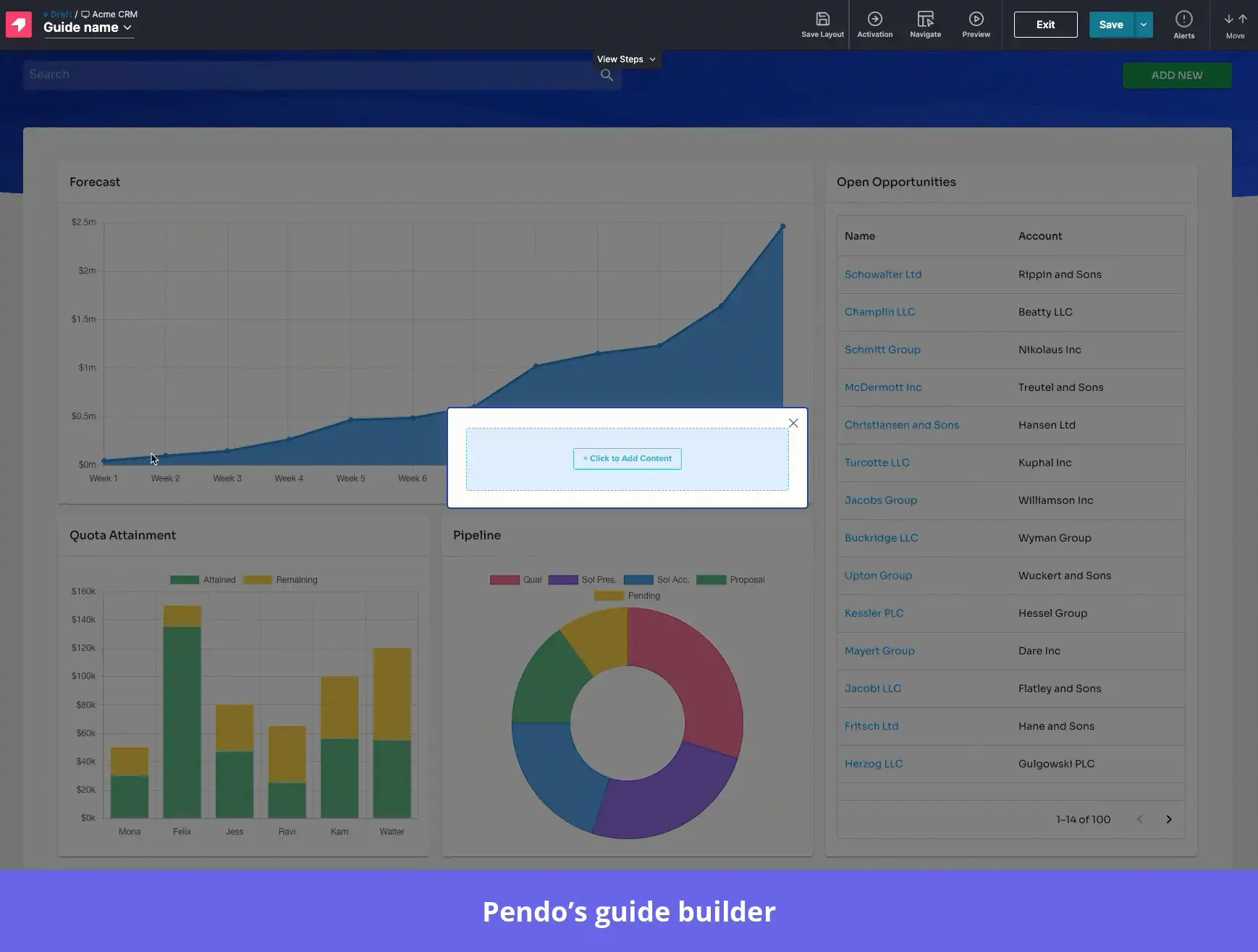
Pendo, by contrast, lets you build the in-app experiences that guide users toward key actions. Through its Visual Design Studio, you can create tooltips and walkthroughs without coding, and then apply segments to target the right people. You can also A/B test your guides to measure their impact on conversion.
This gives Pendo a slight edge if you want to turn validated changes into wider feature adoption. PostHog discontinued its native product tours on September 26, 2026. Its free AI agent skill can help recreate them, but your developers will need to build the tours using coding tools like Claude Code or Cursor.
2. Deep analytics to accelerate feature adoption
Both platforms offer versions of Funnels, Paths, and Retention reports, giving you insight into issues like where users get stuck and whether they’re discovering a new feature.
But Pendo is better for connecting in-app actions, while PostHog suits teams that frequently run custom investigations.
If your priority is to measure engagement after users see your in-app guides, check out Pendo’s analytics capabilities:
- Product Engagement Score combines feature adoption, return user stickiness, and new user growth into one metric. It lets you track overall product engagement without building separate reports for each metric.
- Set a conversion goal for each guide, such as getting users to try a feature, and see how many complete that action after viewing it.
Meanwhile, PostHog provides more flexibility for investigating why users adopt or abandon specific features. You can:
- Generate Trends and Stickiness reports to monitor feature usage over time and surface patterns and cycles worth exploring.
- Use SQL for custom analyses, which is great for examining complex data from different angles and uncovering hidden patterns.
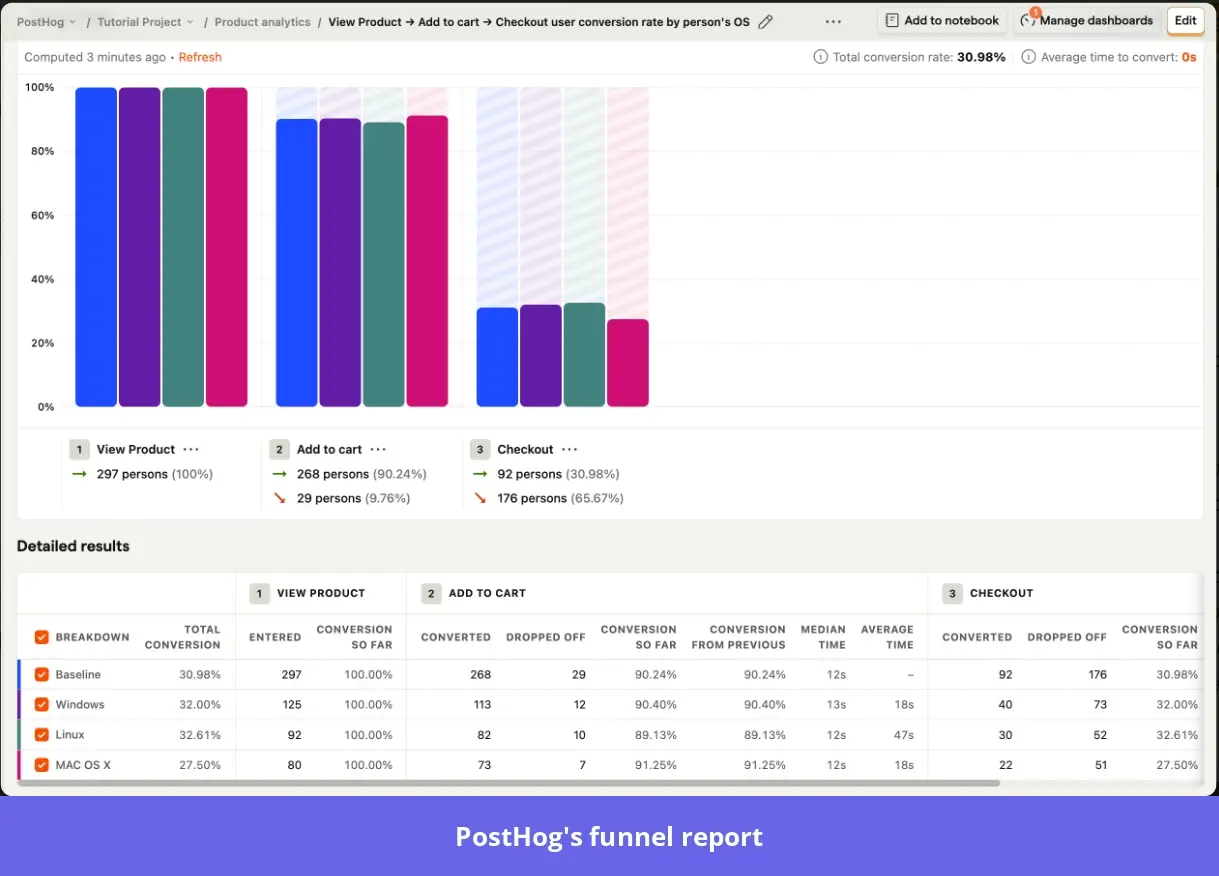
One key difference is how each collects data. Pendo lets product teams review user actions after the fact without coding. PostHog supports automatic data capture and integrates with tools like Segment and RudderStack, but key business events require proper setup.
3. Qualitative data to reveal complete user context
Do you need to investigate friction within individual sessions or turn customer feedback into product decisions? PostHog offers richer technical context for debugging, while Pendo’s Listen is better suited to organizing requests and prioritizing what to build.
PostHog helps you investigate what happened during a user’s session. Its Session Replay shows user interactions alongside console logs, network requests, and errors. You can open recordings directly from funnel drop-offs when examining specific friction points.
For teams collecting user feedback, PostHog offers in-app surveys covering NPS, product satisfaction, and custom surveys.
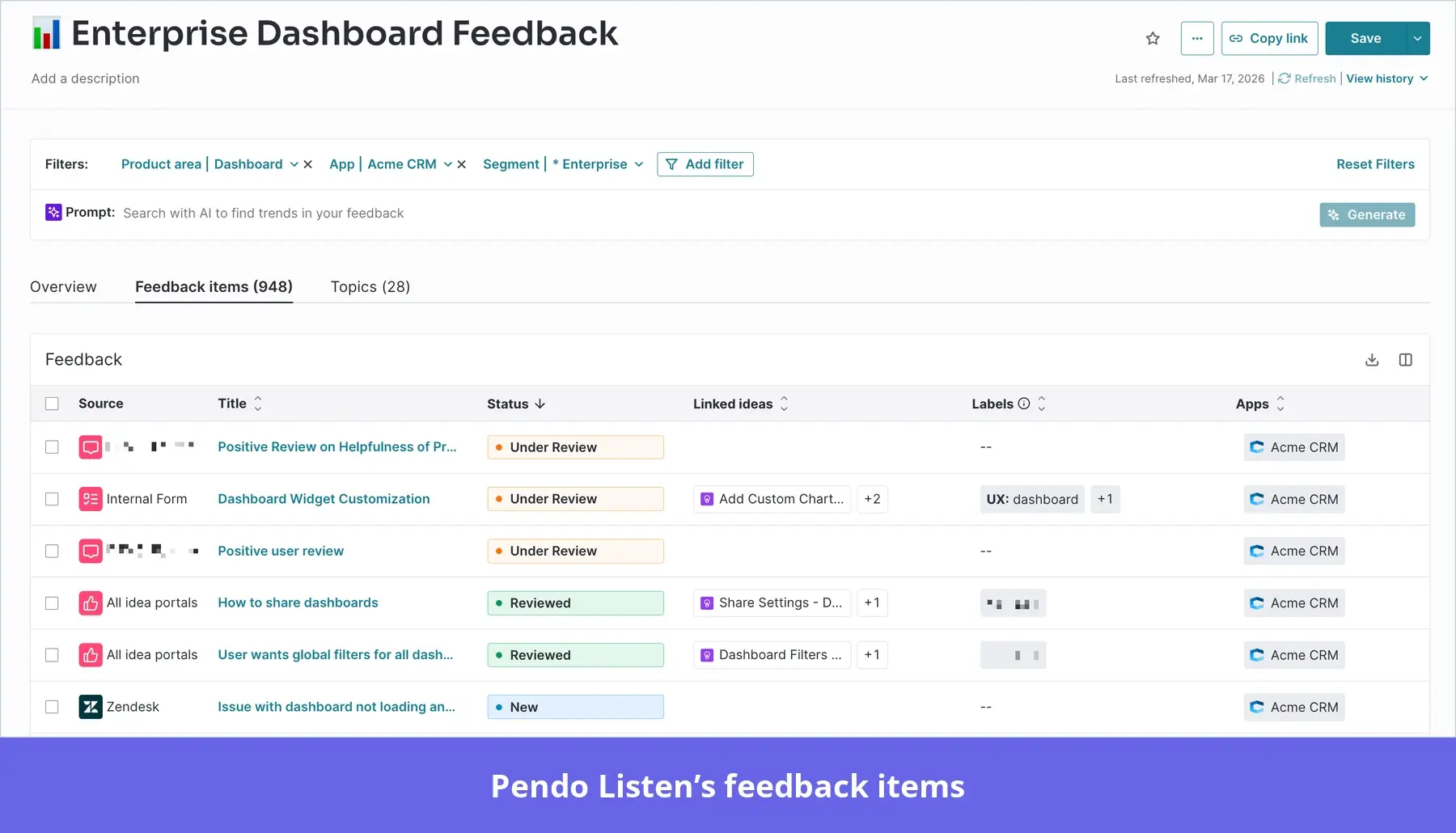
Pendo provides similar behavioral context through Session Replay. But it goes further with Listen, its dedicated product discovery and feedback management solution.
This module brings together qualitative feedback from surveys, guide polls, and external sources such as Salesforce. More interestingly, it lets you categorize user requests, link them to potential solutions, validate ideas through in-app tests, and promote selected ideas to roadmaps.
4. AI automation to scale product intelligence
Once you’ve collected behavioral data and customer feedback, the next challenge is analyzing it efficiently. AI can reduce manual work, but the tasks it handles vary by platform.
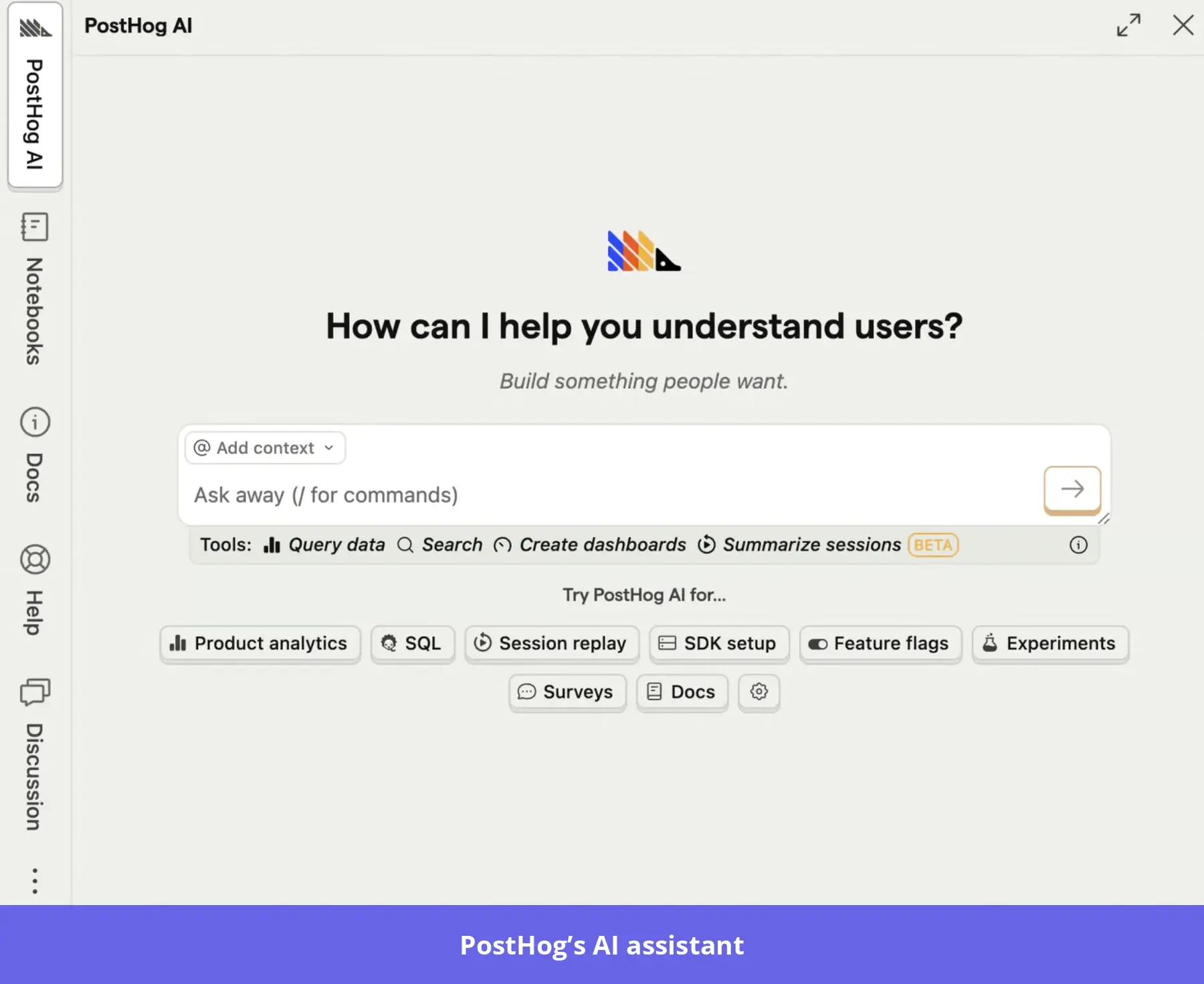
PostHog has a technical advantage here. Its AI helps you analyze product data and automate technical tasks. You can use PostHog AI to:
- Ask questions in natural language and receive detailed analytical reports.
- Generate dashboards.
- Write SQL queries.
- Summarize session recordings.
- Create surveys or feature flags without manual configuration.
On the other hand, Pendo has two main AI tools: Leo and Novus.
Leo answers plain-language questions about feature adoption, retention, or customer feedback without having to build reports manually.
Novus connects to your codebase, keeping your analytics tracking up to date and flagging issues that may affect the UX. It can even suggest code fixes through pull requests, which your engineers review before merging.
As you might expect, AI features have different availability and pricing than traditional features. PostHog provides 500 free AI credits monthly, then charges $0.01 per credit. Pendo includes Leo in its paid plans, though conversational analytics is still labeled beta as of October 2026. Novus is priced separately but is currently in beta and available for free, with no MAU limits for now.
5. Security and governance to align with privacy goals
Treat data residency, access controls, and contractual privacy requirements as non-negotiable. Whichever platform you choose must satisfy your organization’s requirements under the plan and deployment arrangement you purchase.
PostHog provides several controls for teams managing sensitive product data. Its EU Cloud runs in Frankfurt, and customers can restrict data collection and processing. The platform has a SOC 2 Type II report, but SSO, audit logs, and custom roles require paid Platform packages.
If you need a HIPAA Business Associate Agreement (BAA), PostHog offers one only on its Boost, Scale, or Enterprise packages. Self-hosting is possible but not recommended for larger volumes or HIPAA needs, and paid features are available only on PostHog Cloud.
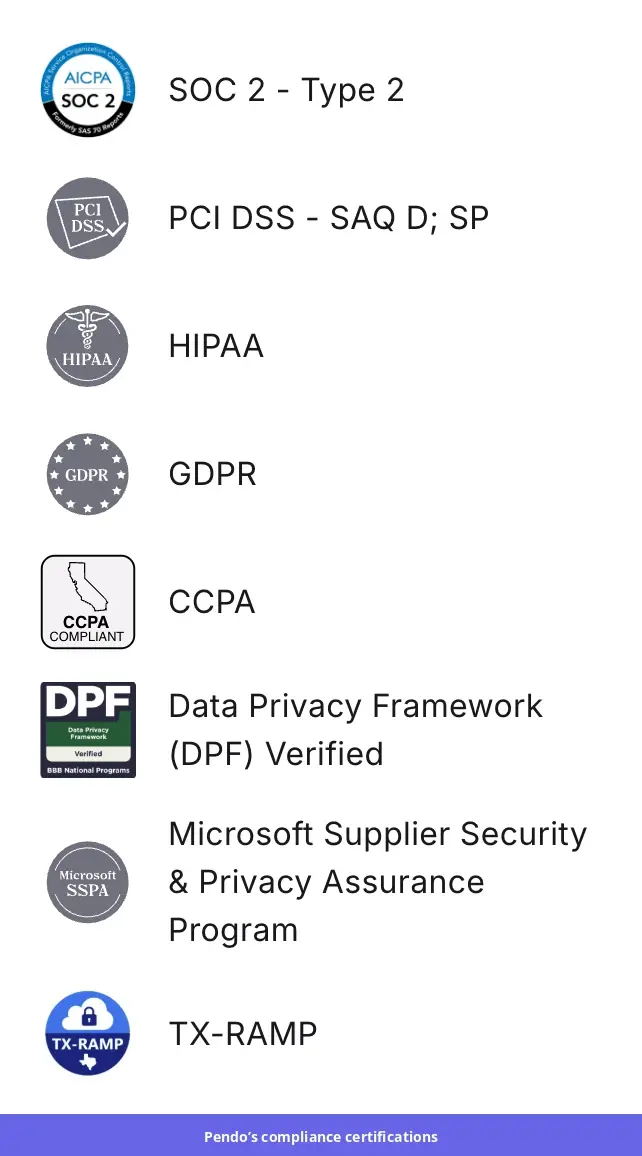
Now Pendo also undergoes SOC 2 Type II audits, covering all five Trust Services Criteria: security, availability, processing integrity, confidentiality, and privacy. It offers EU data hosting, granular user permissions, and controls to mask sensitive content before sending session recordings. It’s worth noting that Pendo’s SAML SSO is a separately paid service.
6. Flexible pricing to manage total cost of ownership
This comparison is less straightforward because PostHog and Pendo use different pricing models.
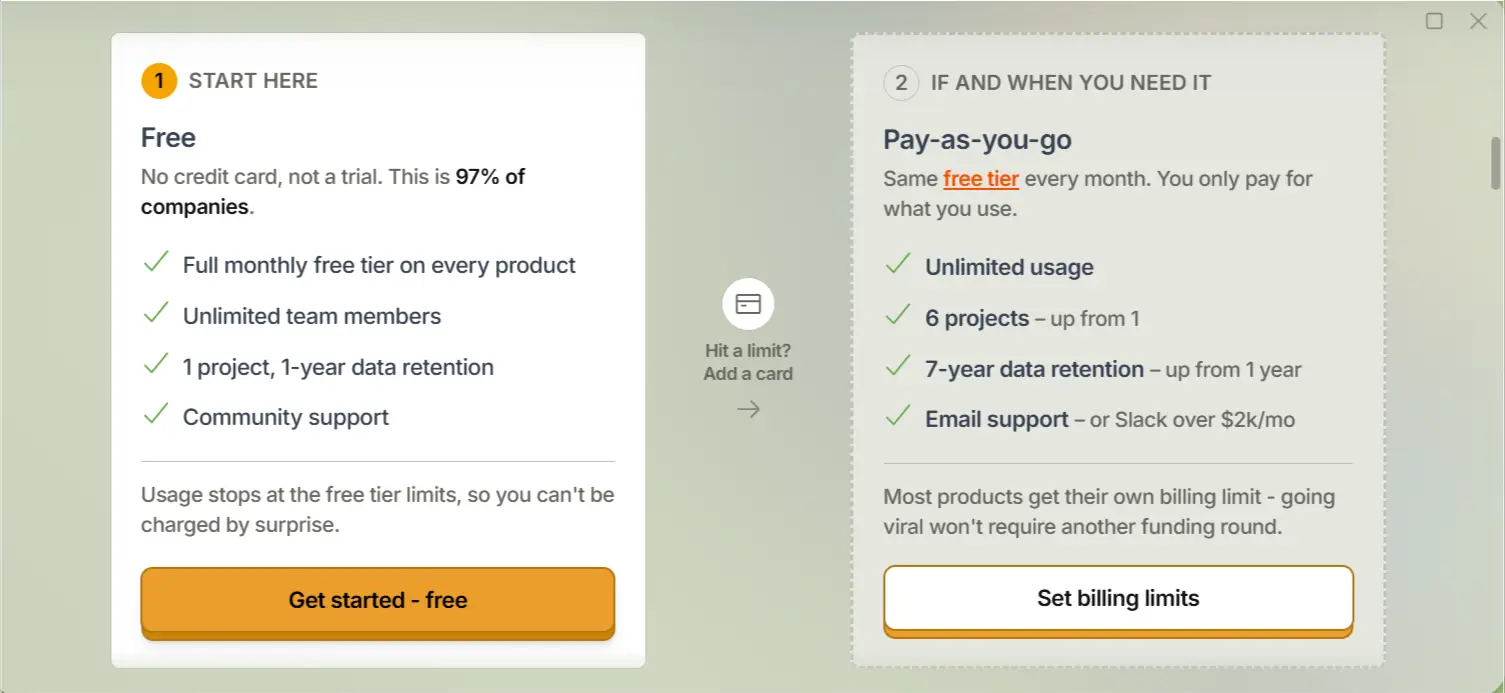
PostHog uses usage-based pricing with separate allowances for each product. With its generous free tier, you get the first 1 million analytics events, 5,000 session recordings, and 1 million feature flag requests for free each month. Beyond those limits, its pay-as-you-go model charges for additional usage.
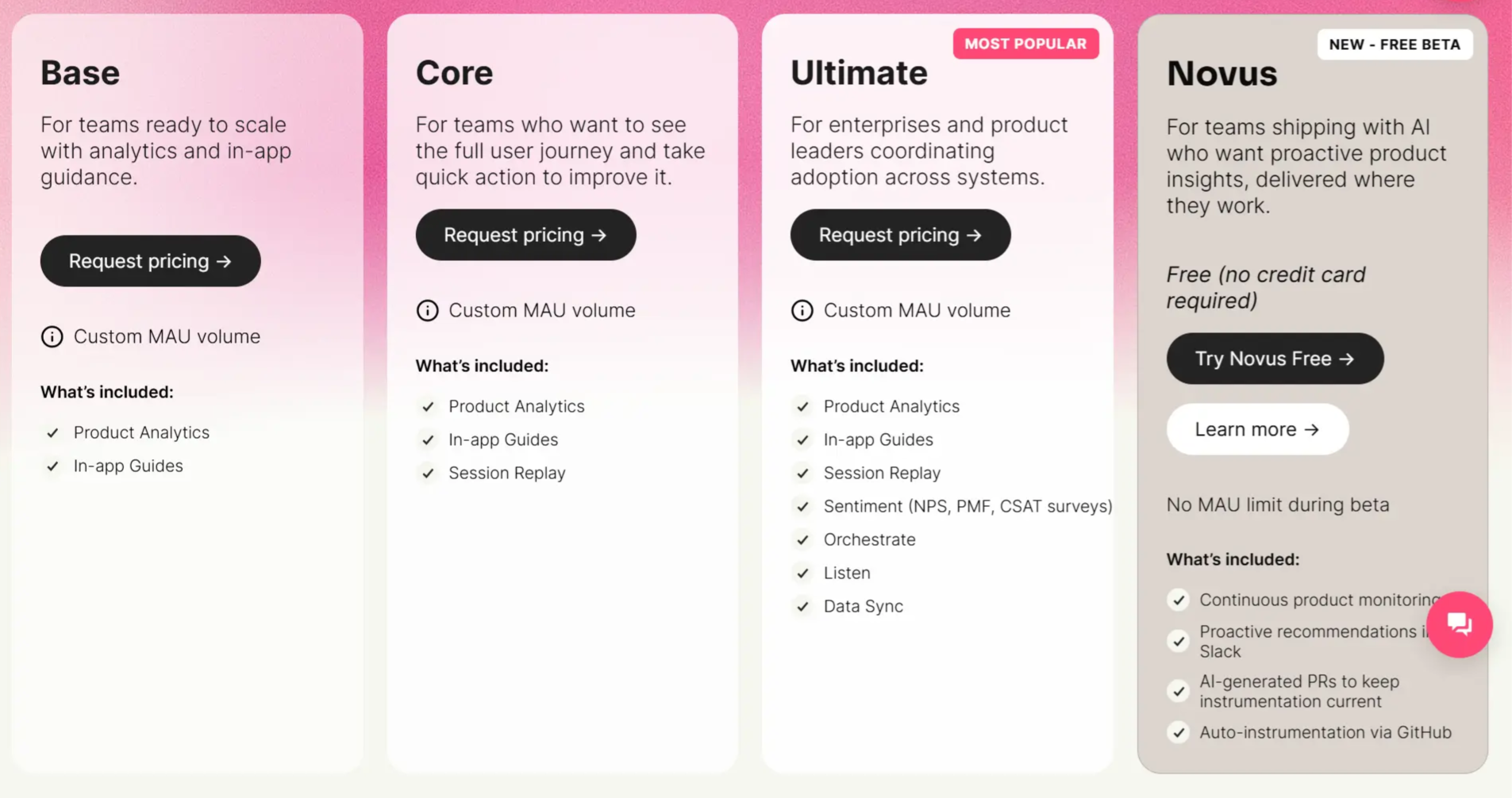
Pendo’s subscription pricing is based on MAUs instead of event volume. Its free plan supports up to 500 MAUs, while the Base, Core, and Ultimate paid plans require custom quotes.
Compare both at your expected scale, factoring in implementation, add-ons, and ongoing maintenance, to decide which offers better value.
For a real-world benchmark, Vendr reports a median contract value of $58,173/year for PostHog and $48,500/year for Pendo.
When to choose PostHog
Consider PostHog if your product and engineering teams want to own the analytics and experimentation process. Its combination of behavioral analytics, feature flags, and experimentation makes it easier to investigate adoption problems and test fixes in one platform.
Just make sure you have the engineering resources to maintain your tracking setup and manage usage-based costs as your product grows.
When to choose Pendo
Pendo works if your team needs to understand feature adoption and act on those insights through in-app guidance. Its no-code guide builder, plus targeting and goal-setting capabilities, makes it particularly useful for product and customer success teams working to improve feature discovery and adoption.
However, consider whether you’ll use enough of its analytics, guidance, and feedback capabilities to justify the subscription and ongoing maintenance.
Pendo vs PostHog vs Userpilot: A third option for scaling product adoption
What if you want to connect product analytics with in-app guidance without the complexity of developer-focused analytics software or rising costs of an extensive product experience platform?
That’s where Userpilot fits. With easier setup and transparent pricing, you can:
- Identify gaps in feature adoption: Combine analytics (including funnels, trends, and retention) with session replays to pinpoint drop-offs and friction areas. You can then send in-app surveys to hear the reason directly from users.
- See if in-app changes moved the needle: Create targeted walkthroughs and tooltips using our visual editor to help users overcome blockers. After launching them, track whether conversion or adoption improved.
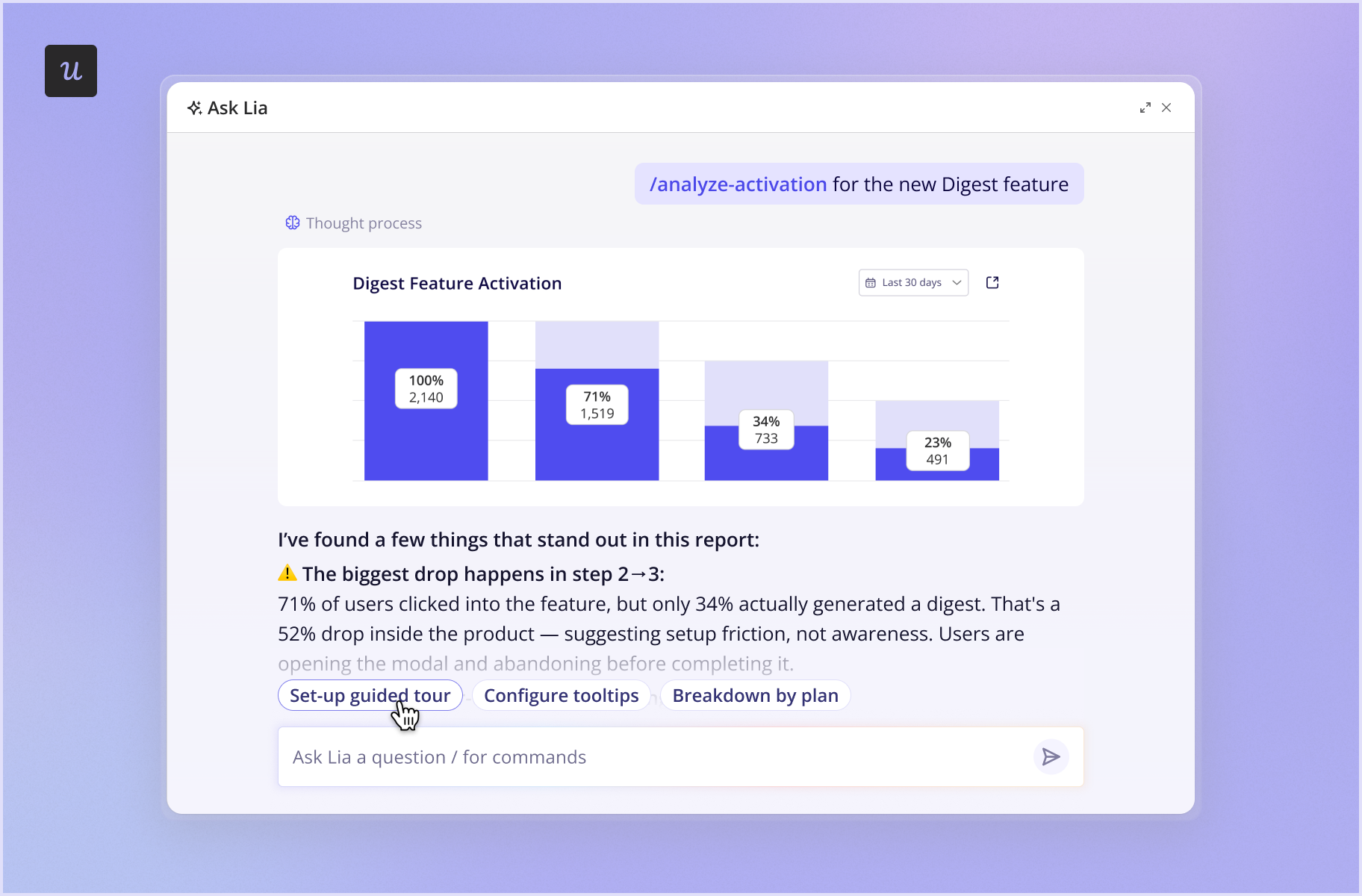
- Turn insight into action fast: Lia, Userpilot’s AI agent, analyzes user behavior and feedback and then builds the charts, recommends actions, and drafts in-app guides based on context.
Pro tip: You can also send product events to PostHog via the latter’s Userpilot Cloud or API for custom analyses and personalized experiences.
Don’t take our word for it. Check out Shelterluv’s story instead.
After struggling with Pendo’s complex implementation and growing costs, the animal shelter CRM provider switched to Userpilot. It was up and running in one to two weeks, and the team started using in-app messaging, flow analytics, segmentation, and onboarding checklists. They subsequently reported fewer support tickets and less manual work.
Matthew Brown, Director of Customer Solutions at Shelterluv, says:
In support and onboarding, Userpilot has been a time saver and has reduced the workload of a lot of the agents because we’re able to use in-app messaging to share information at scale.
Ready to see how Userpilot can help you turn product insights into adoption wins? Book a demo to discuss your needs!
Disclaimer: Userpilot strives to provide accurate information to help businesses determine the best solution for their particular needs. Due to the dynamic nature of the industry, the features offered by Userpilot and others often change over time. The statements made in this article are accurate to the best of Userpilot’s knowledge as of its publication/most recent update on November 8, 2026.
FAQ
What are the key differences between PostHog and Pendo?
PostHog, an open-source analytics platform with developer-focused origins, combines behavioral analysis, testing, and experimentation. Meanwhile, Pendo is a product growth platform that provides analytics, no-code in-app guidance, and feedback.
For pricing, PostHog charges by usage, while Pendo’s paid plans are based on monthly active users (MAUs).
Can non-technical people use PostHog?
Yes. Non-technical users can explore its dashboards and reports, and use PostHog AI to analyze complex data without writing SQL. Still, engineering-led teams are better positioned to maximize the platform, including custom event tracking and advanced workflows.
Does Pendo have a free plan?
Yes. Pendo Free supports up to 500 MAUs and includes product analytics, in-app guides, and Pendo-branded NPS surveys. However, it excludes features such as Session Replay and Listen. Exceeding the MAU limit also prevents you from creating new guides, surveys, and segments.
What is the best alternative to Pendo for product adoption?
Userpilot is a strong alternative for improving feature adoption. It combines product analytics, session replay, in-app guidance, and feedback, so you don’t stop at spotting where users struggle, but guide them to the right actions and see whether those interventions make a difference.