Amplitude Pricing in 2026: What You’ll Pay at Each Tier


Amplitude pricing is one of the more unusual topics in product analytics as the number on the pricing page tells you almost nothing useful. The Plus plan is $49 a month, but Vendr’s dataset of 237 Amplitude deals puts the median buyer at $64,724 a year.
Amplitude ships session replay, feature experimentation, guides and surveys, and a suite of AI agents alongside its core analytics, which means the price question depends heavily on which version of the platform you’re evaluating.
I’ll walk you through what each Amplitude tier includes, what doesn’t appear in the initial quote, how to negotiate if you decide to buy, and when to look elsewhere.

What is Amplitude selling in 2026?
Most people searching for its pricing have Amplitude analytics in mind. The platform now covers more than that. It ships:
- Product and web analytics: Event segmentation, conversion funnel analysis, retention analysis, cohort analysis, dynamic audience segmentation, custom events tracking, user journey visualization, and behavioral cohorts.
- Session replay and heatmaps: Visualize user sessions and interaction patterns across plans, with a cap on session replays offered on Amplitude varying by tier.
- Feature experimentation: A/B testing, multivariate testing, and feature flags via Amplitude Experiment.
- Guides and surveys: In-app messaging and survey feedback collection.
- AI agents: A suite covering dashboard monitoring, session review, experiment management, and feedback analysis.
- MCP Server: Connects Amplitude’s behavioral data to external tools, including Anthropic, OpenAI, Cursor, Figma, and Notion.
Amplitude pricing plans
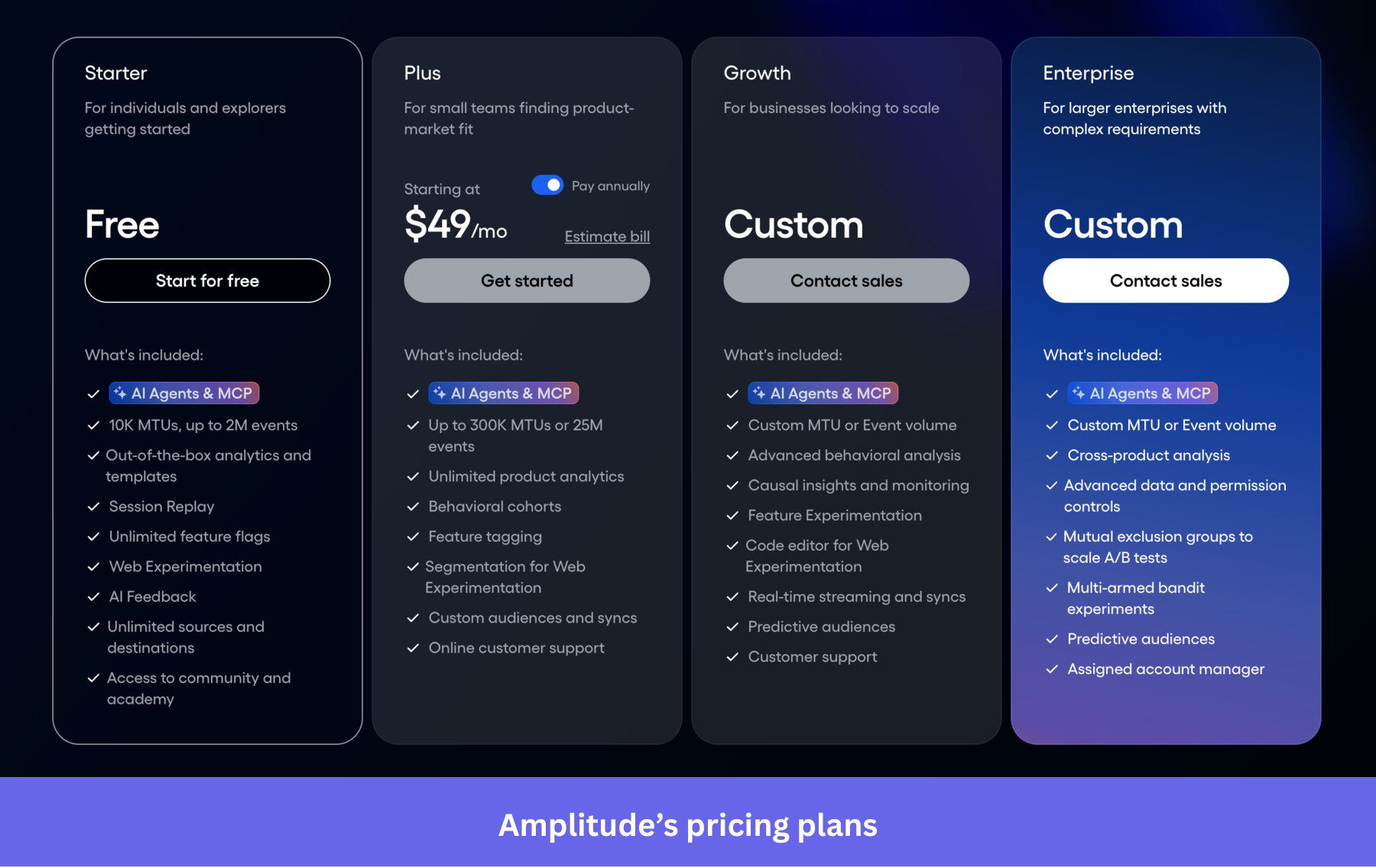
Amplitude’s pricing structure covers four tiers. In addition to what Amplitude publishes on its pricing page, I’ve added real contract data from Vendr for the tiers that require a sales call.
Starter (free)
The free Starter plan is capped at 10,000 monthly tracked users (MTUs) and 2 million events per month. It covers the essential features needed to evaluate the platform: core analytics, 1,000 session replays per month, unlimited feature flags, and one guide or survey.
Customer support and feature experimentation beyond basic web testing are not included, which makes it a reasonable proof of concept rather than a production-grade setup.
Plus ($49/month billed annually)
Plus scales to 300,000 MTUs or 25 million events per month, aimed at small teams that need more flexibility than the free Starter plan offers.
The step-up adds behavioral cohorts, the ability to segment users and build custom audiences, feature tagging, 10,000 session replays per month, and online customer support, while advanced AI features, full feature experimentation, and the agent suite remain absent.
Plus pricing scales quickly with MTU volume, which can lead to higher-than-expected costs as usage grows. Amplitude provides a plan pricing calculator on its website to help you estimate costs before committing.
Growth (custom pricing)
Growth is where the platform fully opens up for teams with advanced product analytics needs. It’s designed for mid-sized businesses that need to group users by behavior, run experiments, and gain deeper insights into their data than Plus allows. Key additions include:
- Causal insights and anomaly monitoring.
- Predictive audiences and real-time data streaming.
- AI agent access (dashboard monitoring agent and AI feedback agent).
- Unlimited behavioral cohorts and advanced behavioral analysis tools.
- Full feature and web experimentation (A/B testing, multivariate, and feature flags).
The Growth plan offers custom pricing with no transparent list price, which can make budget planning harder for cost-conscious teams. Based on Vendr’s deal data, contracts for 100,000 to 250,000 MTUs typically range from $40,000 to $80,000 per year.
Enterprise (custom pricing)
Enterprise adds another layer on top of Growth:
- Cross-product analysis.
- Dedicated account manager.
- Multi-armed bandit experiments.
- Mutual exclusion groups for A/B testing.
- Advanced data governance and access controls.
For deployments of 500,000 to 1 million or more MTUs, Vendr data show contracts typically range from $100,000 to $250,000 per year. Bundles that include Amplitude Experiment and CDP capabilities can push past that range.
Startup Scholarship
Amplitude offers one year of Growth plan features free to startups with under $10 million in funding and fewer than 20 employees. A separate program covers US-based startups with a Black co-founder, with less than $30 million in funding and fewer than 150 employees. If you qualify, apply before paying for anything.
How to negotiate a better deal
If you’re buying Growth or Enterprise, the final price is almost always negotiable. Here’s how you can do so (based on insights from Vendr):
- Start early: Engaging 60 to 90 days before your deadline gives you room to run a real evaluation.
- Bring a competing quote: A credible alternative on the table typically drives 15 to 25% better pricing. It doesn’t have to be your preferred choice, but it does have to be real.
- Multi-year terms get 15 to 30% off, but add MTU growth clauses. Without built-in flexible growth tiers, mid-term overages can cost more than the discount you secured.
- Negotiate overage rates before you sign: Buyers who lock these in upfront typically pay 20 to 40% less per MTU when they exceed their contracted tier than those who address it reactively.
- Bundle add-ons in the initial contract: Adding Amplitude Experiment or CDP features later costs 10 to 20% more than negotiating them in from the start.
- Time your close to a fiscal quarter-end: Amplitude’s quarter-ends fall in March, June, September, and December. The last two weeks of each typically produce an extra 5 to 15% in concessions.
The costs Amplitude’s pricing page doesn’t mention
The plan prices above are only part of what you’ll pay. These five categories show up in contracts regularly and don’t appear on the pricing page:
- Overage fees: When your MTU count exceeds the contracted tier, Amplitude charges at rates 20 to 50% above your contracted per-MTU pricing. A traffic spike on Plus can turn a $49/month plan into a significantly larger bill.
- Amplitude Experiment: A/B testing and feature flagging are typically sold as a separate SKU or bundled only into Enterprise plans. Standalone pricing runs $20,000 to $60,000 or more per year. Teams that assume experimentation is included in their Growth quote frequently discover it isn’t at contract review.
- CDP and data streaming: Audience management and data sync features are often priced separately from the base subscription, adding $15,000 to $50,000 or more annually for teams that need them.
- Professional services: Enterprise onboarding and custom integrations run $10,000 to $50,000 or more. Amplitude sometimes offers these as concessions in negotiations, but only when teams ask for them up front.
- Data retention: Standard plans include 12 to 24 months of data retention. Extended retention costs extra and is easier to negotiate before signing.
Is Amplitude worth it?
For data-heavy teams at Series B and beyond with dedicated analysts, I think Amplitude earns its price. The cohort retention analysis, funnel modeling, and experimentation suite are best in class when you have the technical resources to instrument the platform properly and the analyst capacity to use them in depth.
That said, Amplitude was built for data teams, not for product marketers or growth generalists working without analyst support. I’ve spent enough time in analytics tools to know that depth and navigability rarely coexist. I’d come into Heap or a general analytics dashboard knowing exactly what I wanted to ask, only to spend an hour figuring out which report to use. Amplitude has the same steep learning curve, which becomes more pronounced at higher tiers.
If you’re at a startup under $10 million in funding with fewer than 20 employees, apply for the Scholarship before committing to any paid tier. Small and medium businesses without dedicated analyst resources will find that the complexity and unpredictable cost structure work against the investment. And if you need in-app engagement alongside product analytics (onboarding flows, feature walkthroughs, surveys), Amplitude alone won’t cover it.
So, Amplitude or look elsewhere?
Amplitude makes the most sense when deep behavioral data analytics is the priority, and you have a team built to use it. For teams that don’t fit that profile, the right Amplitude alternative depends on what’s missing.
If the issue is price and complexity, Mixpanel or PostHog
Mixpanel is a popular and somewhat closest alternative to Amplitude, known for its intuitive analytics dashboards and more affordable pricing.
Mixpanel’s pricing runs on an event-based model, with a free plan covering 1 million monthly events; the Growth tier starts free for the first million events, then charges $0.00028 per event beyond that. Mixpanel suits steady-volume teams that prioritize accessibility over depth, though it doesn’t offer in-app engagement, enterprise-scale behavioral cohort analysis, or built-in experimentation.
PostHog is worth considering if you want an open-source Mixpanel alternative. It integrates product analytics with customer surveys, A/B testing, and session replay on a single platform. Plus, its free tier is more generous than Amplitude’s Starter plan. The trade-off is that Posthog requires more technical setup and ongoing maintenance than a fully managed SaaS tool.
If the issue is scope and ease of use: Userpilot
If the goal isn’t just analyzing user behavior but acting on it inside the product through onboarding flows, in-app guidance, and surveys, a product adoption platform makes more sense than a pure analytics tool. While Amplitude does have in-app engagement layers, they’re relatively new and come with a pricey tag.
That’s why Userpilot pricing is a more cost-effective choice in that case.
Pricing starts at $299 per month for the Starter plan (up to 2,000 monthly active users), with Growth and Enterprise plans custom-priced based on MAU volume. Its competitive pricing becomes clearer when you factor in what you’d otherwise spend on a separate user engagement tool alongside Amplitude, and most teams end up paying less with one platform than two.
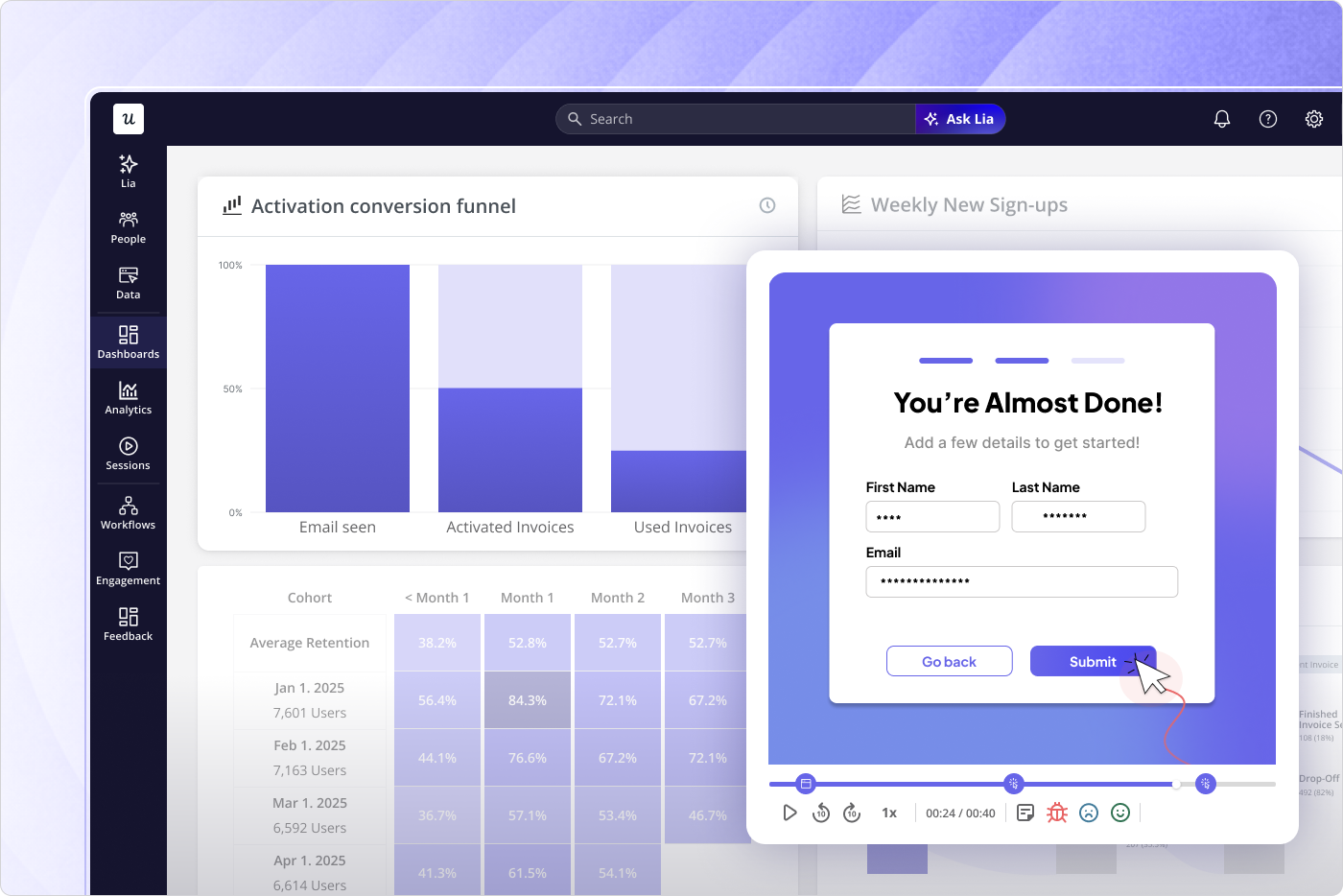
On the analytics side, Userpilot covers the same core use cases that you’d find inside Amplitude: funnel analysis, retention analysis, path analysis, cohort analysis, trend reports, and session replay with team collaboration. The depth isn’t identical to Amplitude at the enterprise level, but for teams without a dedicated data team, it covers the questions they’re actually asking.
Where it separates from pure analytics tools is the engagement layer:
- In-app onboarding flows and interactive walkthroughs.
- Behavior-triggered email campaigns.
- NPS surveys and in-app feedback.
- Checklists and resource centers.
When you find a drop-off point in a funnel, you build the in-app fix in the same tool. There’s no separate data export, reconciliation across dashboards, or lag between the insight and the action.
On the AI side, Lia, Userpilot’s AI product analytics tool, monitors key metrics, surfaces anomalies, and autonomously builds onboarding flows. Amplitude’s AI agents cover similar ground, but they’re gated at Growth and Enterprise with custom pricing. Lia is available across plans.
For teams building products with AI features, Agent Analytics tracks how AI agents interact with your product alongside human users, a measurement layer that Amplitude currently doesn’t address.
Some teams run both. Userpilot integrates directly with Amplitude, so if you need Amplitude’s analytical depth for a data team and also want structured in-app engagement, the two work together. For most mid-market SaaS teams, though, the better question is whether you need two tools or one platform that covers most of both use cases at a lower combined cost.
Book a demo, and we’ll show you exactly why Userpilot is a more suitable choice.
Userpilot strives to provide accurate information to help businesses determine the best solution
for their particular needs. Due to the dynamic nature of the industry, the features offered by
Userpilot and others often change over time. The statements made in this article are accurate
to the best of Userpilot’s knowledge as of its publication/most recent update on June 10,
2026.
About the author