Software localization has changed quickly in the last few years as AI has started taking over parts of the workflow that were once fully manual. Tools like Crowdin and Smartcat now use AI agents to support translation, QA, or publishing within a single system.

As more companies invest in scaling global products, the software localization market is also expected to grow steadily, reaching $15.6 billion by 2032.

For most teams, the challenge today is no longer whether to localize, but which tool fits their product, content, and release process without adding unnecessary complexity.

In this blog, we’ll look at the best software localization tools for building a practical localization strategy in 2026.

What to look for in an AI-ready localization tool in 2026

Choosing a localization tool today goes beyond translation features. The way these platforms are built has shifted, and so have the expectations around speed, automation, and control. These are the things that matter most in 2026:

  • An agentic AI layer that runs full workflows: Extraction, translation, QA, and publishing should run as one flow, the way Smartcat AI Agents and Crowdin Copilot now do.
  • Smart LLM routing: The tool should pick among models like ChatGPT, Claude, and Gemini for each language and content type, rather than locking you into one, as Lokalise’s Pro AI tier does.
  • Automated quality scoring: Look for MQM-based or equivalent scoring so quality is measurable, not a gut feeling, with Lokalise’s 0 to 100 MQM score a useful benchmark.
  • Human-in-the-loop review: AI handles the first draft, and human linguists review where it matters, supported by Smartcat’s marketplace of 500,000+ linguists and Lokalise’s reviewer workflows.
  • MCP or API access for agent integrations: The tool should be queryable from Claude, ChatGPT, or Cursor instead of being trapped in its own interface, which is exactly the gap Crowdin Copilot closes between LLMs and the Crowdin API.
  • Translation memory and glossary that learn over time: Each project should get cheaper and faster, not start from zero.
  • Word-based or outcome-based pricing flexibility: Per-seat-only pricing is increasingly outdated, and Lokalise’s move to processed-words billing in November 2025 shows where the category is heading.

The MCP point is the one I would weigh most heavily this year because it determines whether your localization data remains useful outside the vendor’s interface. Yazan Sehwail, Userpilot’s CEO, made the same case about product data, and it applies directly to localization assets:

If you as a marketer wanted to see, using session replay, NPS data, survey data, and product usage data, you’re able to get your answer without having to go to Userpilot, without having to pull data and upload it to someone. So this is why MCP is gonna be a game changer.

demo CTA

The best software localization tools in 2026

Here are the leading platforms, grouped loosely by the layer they serve best. I only chose the most AI-mature software on the market, ready to seamlessly fit into your workflow.

Crowdin

Best for: Teams that want an AI agent orchestrating localization across many projects at once.

Crowdin is an AI-powered localization platform, and its standout in 2026 is Crowdin Copilot. Copilot bridges large language models and the Crowdin API to run localization workflows on their own, so a manager can ask it to create tasks, generate reports, and resolve hundreds of ambiguity flags by answering a handful of questions. The platform itself supports 600+ integrations and 100+ file formats.

Crowdin frames the change bluntly in its own announcement, and the framing is a good test for any agentic tool:

Agentic AI was for translating words. Crowdin Copilot is for running your whole organization.

Crowdin Localization tool

Key features:

  • Crowdin Copilot agent with full Crowdin API access for tasks, reporting, and user management.
  • Model Context Protocol support to connect tools like GitHub, GitLab, Slack, and Linear.
  • AI Pipeline that synthesizes hundreds of ambiguous strings into a few clarifying questions.
  • Cross-project intelligence that fixes inconsistencies across many projects at once.

Pricing:

Starts at $59/month for paid plans, with Copilot powered by Claude models, a real-time cost indicator, and a $5 hard limit per request to keep AI spend predictable. A free 14-day trial is available.

Smartcat

Best for: Marketing and content teams localizing across documents, video, and learning content.

Smartcat is an AI-native platform built around expert-enabled Smartcat AI Agents. The agents create, translate, and localize content simultaneously, and they are trained by your experts to maintain your brand voice, terminology, and compliance rules across markets. Coverage spans software localization, document translation, video, and learning content.

Smartcat localization tool

Key features:

  • AI Agents that combine content creation and localization within one workflow.
  • Coverage across 280+ languages for global localization needs.
  • Access to 500,000+ linguists for human-in-the-loop review and validation.
  • Customizable agent workflows with built-in human checkpoints, no coding required.
  • Conversational assistant to launch and manage localization projects directly in-platform.

Pricing:

Smartcat offers a free tier plus paid plans from $99/month, which makes it accessible for smaller teams that still want the agent workflow.

Phrase

Best for: Enterprises that need a full translation supply chain with serious scale and governance.

Phrase is an enterprise translation management system that has grown into a broader platform, now supporting 500+ languages and processing more than 2 billion words a month. Beyond the core TMS it has added Phrase Custom AI, Phrase Orchestrator, Phrase Portal, and Phrase Analytics, which together push it toward the agentic, measurable model the rest of the category is chasing.

Phrase localization tool

Key features:

  • Orchestrates multi-step localization workflows through Phrase Orchestrator.
  • Customizes machine translation output using Phrase Custom AI.
  • Tracks quality, cost, and delivery performance via Phrase Analytics.
  • Provides a built-in CAT tool for translator review and editing workflows

Pricing:

Phrase pricing now runs Starter at $135/month, Team at $1,245/month, and Business at $4,395/month, with Enterprise custom and an LSP Freelancer plan at $27/month, per Capterra’s current listing. It sits firmly at the enterprise end of this list.

Lokalise

Best for: Product and engineering teams that want strong automation, smart AI routing, and measurable quality.

Lokalise is built for teams that need to manage localization without slowing down product development. It connects translation work directly with engineering and design workflows, so updates can move through without constant back-and-forth between teams. The platform also uses AI to decide how content should be translated and reviewed based on the type of text and language.

Lokalise localization tool

Key features:

  • Routes content across multiple LLMs based on language and content type.
  • Applies automated MQM scoring to evaluate translation quality on a 0–100 scale.
  • Uses custom AI profiles to keep translations aligned with brand terminology.
  • Connects with tools like GitHub, GitLab, and Figma for developer workflows.
  • Supports usage-based pricing through processed-word billing instead of fixed seats.

Pricing:

The current plans are Free, Explorer at $144/month, Growth at $499/month, Advanced at $999/month, and a custom Enterprise tier. Because billing is now processed-words-based, your real cost depends on translation volume rather than headcount.

Localazy

Best for: Developers and smaller teams who want automation without enterprise pricing.

Localazy is built for software teams that want a simple way to manage translations without heavy setup or enterprise complexity. It runs in the cloud and focuses on continuous localization, so updates can move through development workflows with less manual coordination. Localazy AI became more widely accessible, as it is now included in the Professional plan and above, rather than being limited to higher tiers.

Localazy localization tool

Key features:

  • Provides visual context for translations directly inside the interface.
  • Maintains consistency using translation memory and glossary tools.
  • Supports continuous localization through CLI and CI/CD integrations.
  • Enables real-time collaboration for developers and translators.

Pricing:

Pricing now runs from Free to Professional at $34/month, Autopilot at $78/month, and Business at $175/month when billed annually, with Enterprise pricing available upon request. Verify your exact tier there before buying, since the volumes scale with managed source keys.

memoQ

Best for: Language service providers and translation teams that want a mature, desktop-grade CAT environment.

memoQ is a long-established translation management system used by professional translators and localization teams. It offers both a server-based setup for organizations and a desktop application for individual translators. This makes it suitable for teams that rely heavily on structured human translation workflows. It continues to focus on core translation infrastructure, such as memory, terminology, and collaboration, rather than shifting toward fully AI-driven automation.

MemoQ localization tool

Key features:

  • Centralized project management through memoQ TMS Server for team workflows.
  • Translation memory and terminology tools to maintain consistency across projects.
  • Built-in support for machine translation within translation workflows.
  • Collaboration features for assigning and tracking translation tasks.
  • Desktop CAT environment for professional translator workflows and editing.

Pricing:

memoQ TMS now starts around $242/user/month for the Starter plan, which includes one project manager license and five linguist subscriptions, per Capterra’s listing.

Weglot

Best for: Teams that want a no-code website translation live in minutes.

Weglot is a no-code, cloud-based website translation tool that connects to platforms like WordPress, Shopify, and Webflow and manages translations from one dashboard. It uses machine translation for instant coverage with the option to order professional translations, and its pricing has stayed stable while the rest of the category churned. For a marketing site rather than a software codebase, it is the most approachable option here.

Weglot localization tool

Key features:

  • No-code integration with major CMS and e-commerce platforms.
  • Machine translation with optional professional human translation.
  • Multilingual SEO with automatic subdomains and redirects.
  • Visual editor for making in-context translation edits.
  • Central dashboard for managing pages, forms, and on-site content.

Pricing:

Weglot keeps a free plan for up to 2,000 words in one language, then Starter at 15 EUR/month, Business at 29 EUR/month, Pro at 79 EUR/month, Advanced at 299 EUR/month, and Extended at 769 EUR/month, with Enterprise custom. The plans differ mainly by word count and number of languages.

MarketFully (formerly MotionPoint)

Best for: Enterprises that want managed, human-reviewed multilingual content at the website and marketing level.

MotionPoint now operates under its parent brand MarketFully, which brings together MotionPoint, Key Content, and Social Element into a single structure. The platform has also moved beyond a purely human-translation model, combining AI-assisted multilingual content through MarketFully.AI with human review from its service teams. This setup is designed for organizations that want managed localization across websites and marketing channels, rather than a self-serve translation tool.

Key features:

  • Adaptive Content AI for translation, transcreation, and net-new multilingual content.
  • InContent AI with intelligent agents for analysis, distribution, and measurement.
  • Proxy-based and connector-based website translation models.
  • Human post-editing and SEO review through MotionPoint and Key Content.
  • End-to-end managed services covering strategy, auditing, and brand consistency.

Pricing:

MarketFully does not publish standard pricing, so expect a custom quote based on your content volume and the mix of AI and managed services you need. It sits at the enterprise, high-touch end of the market.

Localizing in-app experiences: The layer most translation tools miss

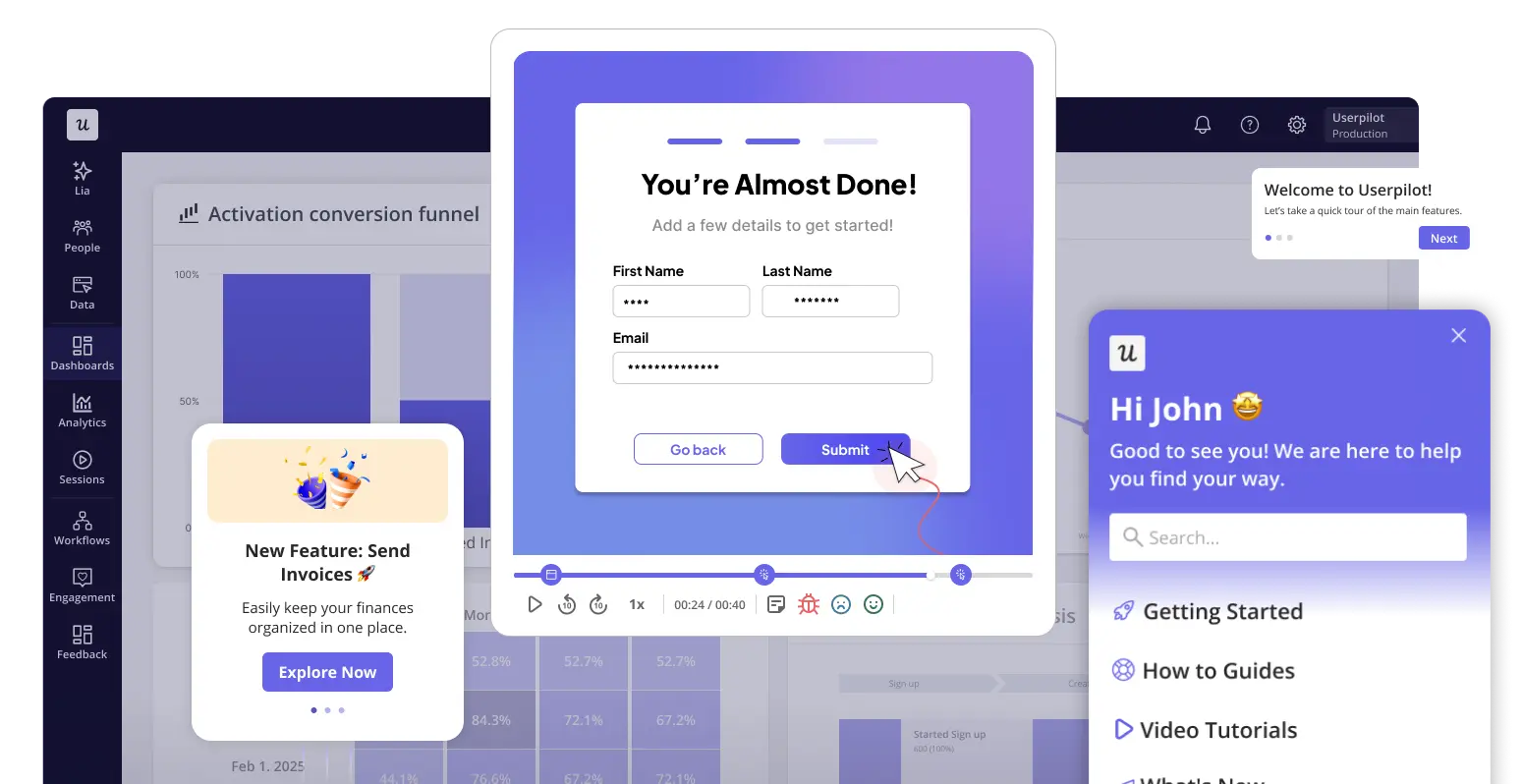
Once you have translated your product strings with a TMS like Phrase or Lokalise, your onboarding flows, tooltips, resource centers, surveys, and NPS prompts are still in one language. That in-app experience layer is a separate workflow, and most translation platforms simply do not cover it.

Userpilot covers this blind spot. It localizes the experiences your users move through, not the underlying code, so it complements a TMS rather than competing with memoQ or Phrase.

If you have read our take on product localization strategy, this is the practical execution layer that turns it into something users feel.

localization-onboarding-flows
Userpilot offers localization of the in-app user onboarding flows.

Userpilot handles in-app localization in two ways, depending on how much control you want. Its AI-powered automatic translation covers flows, checklists, the Resource Center, NPS, and surveys with a click, using a built-in translation service. For higher accuracy, you can export content as CSV or XLIFF, have your own linguists translate it, and import it back.

create-localized-in-app-experiences
Create localized in-app experiences.

Plan availability is worth checking before you build, since localization isn’t available on every tier. On Userpilot, the Growth plan supports up to 5 languages, and the Enterprise plan supports unlimited languages, while the Starter plan does not include localization at all. You can see the current tiers on the Userpilot pricing page.

Which software localization tool should you choose in 2026?

The category is moving in two clear directions at once. Pricing is shifting from per-word and per-seat models toward processed words and outcome-based billing. And tooling is shifting from standalone translators toward AI agents that own the full content lifecycle. Picking well means matching the tool to the layer you need to localize.

If your needs are at the code and string levels, look at Phrase, Lokalise, or Crowdin. Weglot, Smartcat, or MarketFully will serve you better for marketing and website needs. And when the job is the in-app experience level, where onboarding, tooltips, and surveys live, Userpilot handles the layer that the translation platforms leave behind.

Most teams localizing a SaaS product end up needing two of these layers, not one, much like the build-versus-buy calls we covered in our guide to choosing a SaaS learning management system.

If you want to localize your in-app experiences and support resources alongside your translated strings, book a Userpilot demo, and we will show you how that layer works.

demo CTA

About the author
Abrar Abutouq

Abrar Abutouq

Product Manager

Product Manager at Userpilot – Building products, product adoption, User Onboarding. I'm passionate about building products that serve user needs and solve real problems. With a strong foundation in product thinking and a willingness to constantly challenge myself, I thrive at the intersection of user experience, technology, and business impact. I’m always eager to learn, adapt, and turn ideas into meaningful solutions that create value for both users and the business.

All posts